NBPhO 2026, Теория и експеримент — Задача 9. CO₂ fire extinguisher
Nordic-Baltic Physics Olympiad 2026 · 8 т.
Practicalities for moderation.
When you are called to the moderation table to discuss your request with the graders, bring an item-by-item breakdown of the points you are claiming, following the detailed grading scheme — e.g., for P9 part (i): out of . Without this breakdown, the moderation discussion will not proceed.
Условие
— Jaan Kalda. A fire extinguisher contains liquid CO in equilibrium with its saturated vapour at room temperature . Consider two scenarios: (a) the container is held upside-down so that the liquid phase flows to the nozzle; (b) it is held upright so that the saturated vapour flows to the nozzle. The nozzle has the shape of a converging–diverging channel (see figure), and the flow through it can be modelled as reversible and adiabatic. Atmospheric pressure is ; the CO triple point is at .
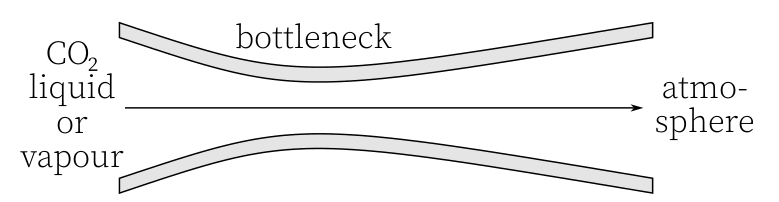
The temperature–entropy diagram of CO with isobars is provided below.
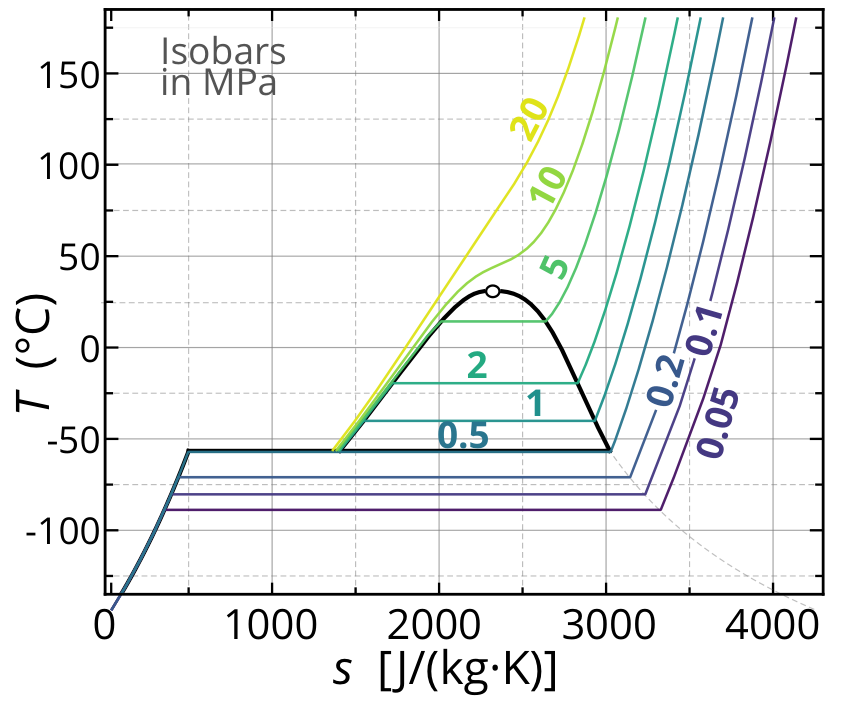
i) Identify the phase or phases present and their temperature in the stream emerging from the nozzle. [1,5 т.]
ii) Find the mass fraction of solid CO in the stream for both scenarios. [3,5 т.]
iii) Now consider an arbitrary pure substance in equilibrium with its saturated vapour at temperature , and suppose that only the vapour (not the liquid) escapes through a nozzle, undergoing reversible adiabatic expansion. Under what condition on the vaporisation latent heat (per unit mass), the isobaric specific heat of the vapour , and the temperature does a fraction of the escaping vapour condense into droplets, even for a vanishingly small pressure drop? Does condensation occur for water vapour at (, )? [3 т.]
Решение
— Solution by Jaan Kalda.
i) (1,5 т.)
At atmospheric pressure , which is below the triple-point pressure , no liquid CO can exist. The exit stream is therefore either pure vapour, pure solid, or a solid–vapour mixture. Pure solid is impossible: a rigid (incompressible) solid cannot expand or accelerate through a converging–diverging nozzle. So the exit is either pure vapour, or a solid–vapour mixture; in the latter case the temperature must be the sublimation temperature at 1 atm, ().
Tracing the isentrope from the initial state to on the - diagram (provided): for both scenarios (a) and (b), the trajectory crosses the saturation boundary into the two-phase region. Hence the stream is a solid–vapour mixture at in both cases.
Grading.
- Recognising that liquid is impossible at , so the stream is solid, vapour, or a mixture 0.5 pts
- Excluding pure solid (cannot adiabatically expand through nozzle) 0.2 pts
- If solid–vapour coexistence, identifying (), within 0.3 pts
- Tracing the isentrope on the - diagram and concluding the stream is in the two-phase region for one scenario 0.3 pts
- Two-phase for both scenarios 0.2 pts
ii) (3,5 т.)
The expansion through the nozzle is reversible and adiabatic, so it is isentropic: the entropy per unit mass is conserved between the inlet and the exit. On the – diagram, the trajectory is therefore vertical (constant ) until it crosses a phase boundary or a chosen isobar.
The exit pressure is , well below the triple-point pressure . From part (i), the exit state is in the two-phase (solid+vapour) region at ().
Lever rule. In the two-phase region at fixed , , the total entropy per unit mass for a mixture with mass fraction of solid (and vapour) is
where and are the entropies of pure solid and pure vapour at the boundaries of the two-phase region at .
Reading entropies from the – diagram. At (sublimation isobar at ), the boundaries are
The initial entropies for the two scenarios are read at () on the saturation dome:
- Scenario (a), saturated liquid at : .
- Scenario (b), saturated vapour at : .
Mass fractions. Applying the lever rule to each:
So the liquid-fed extinguisher (a) produces a stream that is dry ice (and vapour) by mass, while the vapour-fed extinguisher (b) produces a stream that is only dry ice. The liquid scenario yields about 1.6 times more solid CO per unit mass discharged — which is why fire extinguishers are designed to draw liquid.
Grading.
- Recognising that “reversible adiabatic” means isentropic (), so the endpoint is found by tracing vertically downward on the – diagram 0.6 pts
- Deriving the lever rule for mass fraction in the two-phase region: 0.7 pts
- Reading the initial entropy from the saturated-liquid line at (scenario a) 0.5 pts
- Reading the initial entropy from the saturated-vapour line at (scenario b) 0.5 pts
- Reading at the 1-bar solid boundary 0.3 pts
- Reading at the 1-bar vapour boundary 0.3 pts
- Computing for scenario (a) 0.3 pts
- Computing for scenario (b) 0.3 pts
iii) (3 т.)
Consider an infinitesimal isentropic (reversible adiabatic) expansion of the saturated vapour from . Two trajectories meet at this point: the saturation curve , and the adiabat (constant entropy). The expansion follows the adiabat. If the adiabat falls below the saturation curve in - space (i.e., the vapour cools more slowly than the saturation temperature drops with pressure), then a finite fraction of the vapour condenses into droplets. Otherwise the expansion remains in the pure-vapour region.
Saturation slope (Clausius–Clapeyron). The saturated vapour above a liquid has number density in thermal equilibrium with the liquid. By the Boltzmann distribution, the probability of a molecule occupying the vapour state (energy per molecule above the liquid) versus the liquid state is
Treating as -independent and using , the dominant temperature dependence is exponential. Per unit mass, where is the specific gas constant of the vapour. Differentiating :
Equivalently,
Adiabat slope. For the ideal-gas adiabat , with and :
Condensation condition. The vapour condenses on expansion iff the adiabat cools less than the saturation curve, i.e. :
Numerical check (water at ). , :
So water vapour does condense on isentropic expansion. This is precisely why steam from a kettle appears as a visible white plume of fine droplets, rather than as invisible pure water vapour.
iv) (? points)
Consider an infinitesimal isentropic (reversible adiabatic) expansion of the saturated vapour from . Two trajectories meet at this point: the saturation curve , and the adiabat (constant entropy). The expansion follows the adiabat. If the adiabat falls below the saturation curve in - space (i.e., the vapour cools more slowly than the saturation temperature drops with pressure), then a finite fraction of the vapour condenses into droplets. Otherwise the expansion remains in the pure-vapour region.
Saturation slope (Clausius–Clapeyron). The saturated vapour above a liquid has number density in thermal equilibrium with the liquid. By the Boltzmann distribution, the probability of a molecule occupying the vapour state (energy per molecule above the liquid) versus the liquid state is
Treating as -independent and using , the dominant temperature dependence is exponential. Per unit mass, where is the specific gas constant of the vapour. Differentiating :
Equivalently,
Adiabat slope. For the ideal-gas adiabat , with and :
Condensation condition. The vapour condenses on expansion iff the adiabat cools less than the saturation curve, i.e. :
Numerical check (water at ). , :
So water vapour does condense on isentropic expansion. This is precisely why steam from a kettle appears as a visible white plume of fine droplets, rather than as invisible pure water vapour.
Grading.
- Setting up the comparison: condensation occurs iff the adiabat lies below the saturation curve in - space 0.5 pts
- Deriving the saturation slope via Boltzmann: (those who know and use the Clausius–Clapeyron equation do not need to derive it) 0.6 pts
- Obtaining the Clausius–Clapeyron form 0.6 pts
- Adiabat slope from ideal-gas adiabatic relation 0.4 pts
- Comparing slopes to obtain the condition 0.6 pts
- Numerical check for water giving , hence condensation 0.3 pts
Оригинал в Архива: NBPhO_2026_problems.pdf · официални решения: NBPhO_2026_solutions.pdf