OPhO 2020, Теория — Задача 3. Electron Escape
2020 Online Physics Olympiad: Invitational Contest v1.4 · 28 т.
Внимание: Бележка към темата
The v1.4 question paper, native Partial Solutions and separately attributed organizer clarifications are retained. The key is incomplete: Problem 1 is only marked TBD, Problem 8 has no key for parts f–h or an explicit critical power in e, and Problem 10 has no key for Part B f–h. Problems 2 and 9 also have source gaps noted below. Printed mathematical defects and differences between repeated questions in the key and the question original are not silently repaired. Problem2(e) gives a time-dependent spin result but no explicit answer in orbital angle; key2(c) refers to an absent diagram. Problem9(a) gives its ODE and initial conditions without an explicit speed, and 9(b) does not state whether the pressure increases or decreases. Native source typography is retained, including the Planck-constant value, missing electron-charge unit, missing kappa in key3(a), mismatched labels in key4, inconsistent theta indices and ring factors in key6, the negative probability/energy signs and r_B/K_B/k variants in key7, radiation expressions and fusion-rate/proton-rate difference in key8, and image/flux signs and field factors in key10. All these are printed-source issues, not repaired answers. Question2 omits the word define while the repeated key question includes it; the repeated key question7 adds For simplicity, ignore spin. The 4-page organizer clarification contradicts question1(d)’s frictionless table and also contains both only one final submission and multiple submissions instructions. The native original and the separately attributed clarifications remain visible.
Original credits
2020 Online Physics Olympiad (OPhO): Invitational Contest v1.4
OPhO Lead Organizers and Writers: Adithya Balachandran, Eddie Chen, Ashmit Dutta, Ethan Hu, Viraj Jayam, Rishab Parthasarathy, Kushal Thaman, Max Wang, Qilin Xue
OPhO Website Developer: Ben Oommen
Advisors: Dr. Branislav Kisačanin, Kye Shi, Kevin Zhou
July 3 - 6, 2020
Указания
If you wish to request a clarification, please use this form. To see all clarifications, see this document.
- This test contains 10 long answer questions.
- The total base score for the exam is 300 points; a factor incorporating the number of teams who solved the question will be added in the marking scheme. The final scores of all the teams will be available a few days after the contest ends.
- The team leader should submit their final solution document in this here. We don’t anticipate a tie, but in the rare circumstance that there is one, the time you submit will be used to break it.
- You can write on paper, type it up online, or a mix of both. If you wish to use a pre-made LaTeX template, we made one which you can choose to use here.
- Since this is a long answer response, you will be judged on the quality of your work. To receive full points, you need to show your work, including deriving equations. As a general rule of thumb, any common equations (such as the ones in this formula sheet) can be cited without proof. Remember to state any approximations made, which system of equations were solved after every step. Explicitly showing every step of algebra is not necessary.
- You may leave all final answers in symbolic form (in terms of variables) unless otherwise specified.2
- Be sure to state all assumptions.
Sponsors
WOLFRAM · AwesomeMath (making x,y,z as easy as a,b,c) · Physics Olympiad · AoPS.com Art of Problem Solving
List of Constants
- Proton mass,
- Neutron mass,
- Electron mass,
- Avogadro’s constant,
- Universal gas constant,
- Boltzmann’s constant,
- Electron charge magnitude,
- 1 electron volt,
- Speed of light,
- Universal Gravitational constant,
- Acceleration due to gravity,
- 1 unified atomic mass unit,
- Planck’s constant,
- Permittivity of free space,
- Coulomb’s law constant,
- Permeability of free space,
- Magnetic constant,
- 1 atmospheric pressure,
- Wien’s displacement constant,
- Stefan-Boltzmann constant,
Native key title
2020 Online Physics Olympiad (OPhO): Invitational Contest Partial Solutions
The same organizer, writer, developer and advisor credits appear on this key cover.
Organizer clarification document — major notes
Separately quoted from the organizer clarification document, titled 2020 OPhO Invitational Clarifications:
MAJOR NOTES
- Hi everyone! All team members are welcome to fill out this (optional) feedback form. Everyone who submits (and consents) will be entered in a draw to receive a $25 Amazon gift card.
- Use this link to submit clarification requests. The problem writers may or may not deem it necessary to answer all clarification requests.
- Link to the overleaf template (the link has been fixed) for answer submission.
- Reminder: There is only one final submission at the end of the competition via the submission form only. Do NOT email us a copy of your submission. In case of internet connectivity issues, any team member may email us the file.
- Make sure to read over the instructions. You are expected to give symbolic answers unless explicitly otherwise stated. If the numerical values for a symbol are stated, you do not need to solve the problem for a general case.
- Uploading a .jpeg on the overleaf for a graph is allowed.
- Please check the newest version v1.4 for revisions.
- Please provide clear reasoning or derivations of any obscure results. Directly citing them would not necessarily fetch full points.
- We will be awarding a special prize for whichever team produces the most creative and/or elegant solution to certain problems. We will not be disclosing which problems until after the competition has concluded.
Note on submission of solutions:
It is highly recommended that the solutions to the invitational round be submitted in LaTeXed form. We recommend using Overleaf. It is preferred that the solutions are quite detailed; this means that while you do not need to explicitly write all your algebra, all the relevant equations must be clearly written. A brief wording on how you solve a given system of equations is also optimal. Clearly state any approximations you make. Solutions typed in .doc/.docx, and ones neatly written by hand will also be accepted. Some students have a handwriting that’s hard to read; if that’s you, please read this. You can submit solutions multiple times. Only the latest submission will count.
Условие
An infinite wire with current has a radius . The wire is made out of a material with resistivity and heat conductivity . The temperature outside the wire is a constant .
a) (4 pts) After a long time, determine the temperature at a distance from the center of the wire. Assume that the current in the wire is uniformly distributed.
b) (4 pts) Now, the outer surface of the wire is maintained at a potential of , where is positive. The wire is surrounded by an infinite cylindrical shell with radius that is grounded. Somehow, an electron is able to escape from the wire. Assume that it is at rest just as it escapes. You can neglect radiation from the electron.
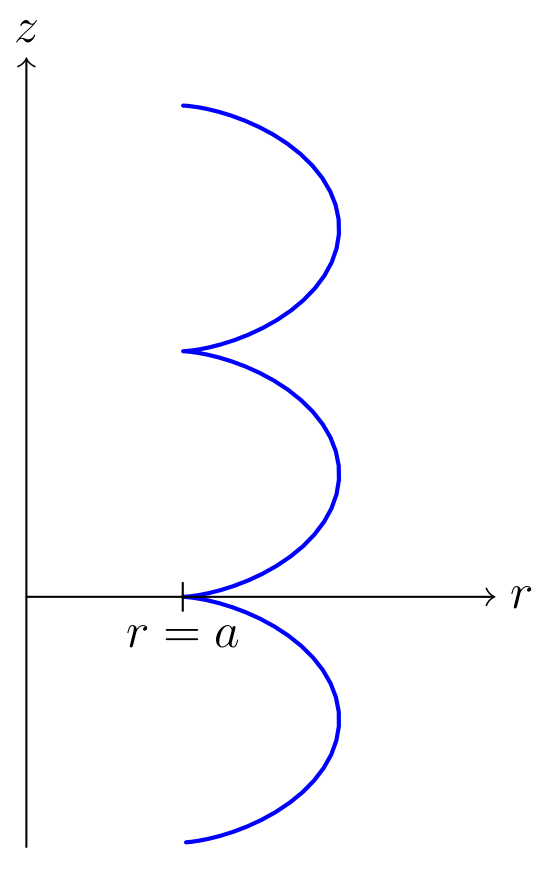
Draw a qualitative graph of the physical path that the electron takes, along with a diagram of the wire.
c) (6 pts) Find the maximum distance of the electron from the center of the wire in the subsequent motion as a function of , and also in terms of , , and . Ignore all relativistic effects in this part only.
d) (12 pts) Redo the calculation in the previous part with relativistic effects.
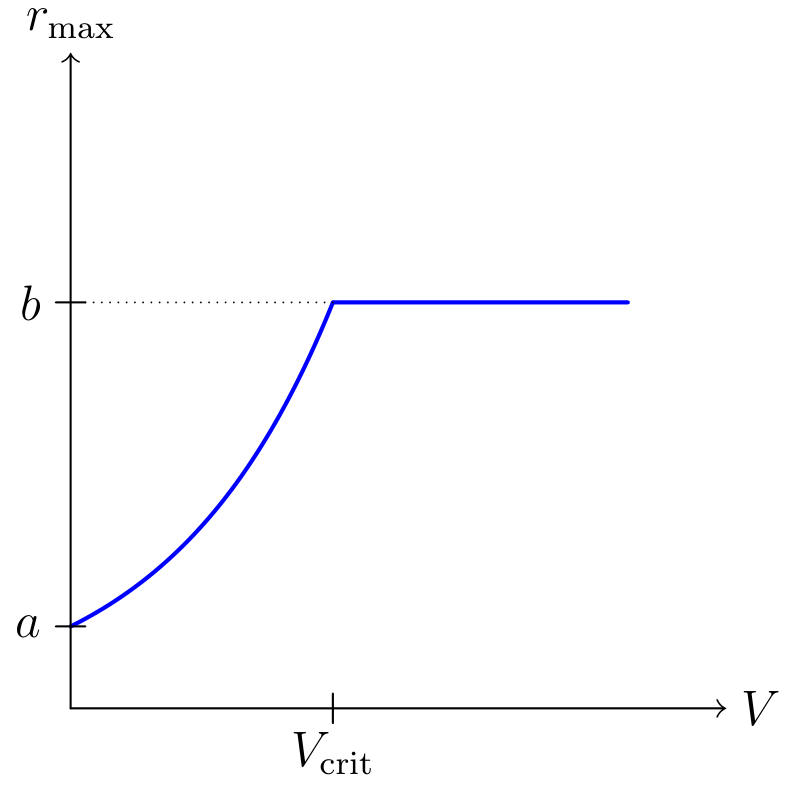
e) (2 pts) Graph the maximum radius according to part (d) as a function of .
Published organizer clarifications (separate source)
Separately quoted from the organizer clarification document:
Problem 3: Assume that the resistivity and current are small, so that the potential does not vary significantly along the surface of the wire.
- In part (b), “Now, the outer surface of the wire is maintained at a potential of V ≥ 0” is changed to “Now, the outer surface of the wire is maintained at a potential of -V, where V is positive.”
- The graph in part (e) should be created based on the formula derived in part (d)
Решение
Solution 3:
(a) As the current density is uniform, the current through a concentric circle with radius will have total current . The resistance of the portion of the wire of length up to a radius is given by
Therefore, the power emitted out of a cylindrical shell with radius and length is
By Fourier’s Law,
Therefore,
Since , so we see . Thus,
(b) The electric force is constantly outward, while the magnetic force is perpendicular to the motion in the plane determined by the axis and the radial direction. Note that the motion of the electron is always in this plane. Therefore, the electron will move outward and continuously change direction until it reaches a maximum radius. Then, it will move back towards the wire in a motion that is completely symmetric. When it reaches the wire again, the motion will repeat in a somewhat “cycloidal” motion. See the graph below.
(c) Clearly, there is only movement in the radial and directions. The magnetic field at a radius is given by , and it is tangential. From Newton’s second law in the direction,
By energy conservation, the energy of the electron at a distance from the -axis is given by
At the maximum radius, , so we get
Solving for ,
Noe that when this expression is greater than , the electron stops at a radius .
(d) Clearly, there is only movement in the radial and directions. From Newton’s second law in the direction,
Also, note by energy conservation that the energy of the electron at a distance from the -axis is
Therefore, we have,
At the maximum radius, , we have . Therefore,
We can solve for to get
However, we also have to note that . We will now find the condition on such that the electron’s maximum radius is . The critical voltage is when at . We have
By the quadratic formula,
Therefore, we have
(e) The graph is roughly exponential in until , at which point it is flat.
Organizer clarification document — other notes
Separately quoted from the organizer clarification document:
Other Notes
- Uploading images: View this link to find how to upload images on overleaf.
- You are allowed to mix LaTeX and handwritten PDFs for your answer sheet. Note that you need to write your solution to the problem alongside your final answers.
- You can use basic formulae related to topics on the IPhO syllabus without derivation but all other formulae which go beyond that must be derived.
- If you find that space is running out on your LaTeX file, try to use and see if that fixes it.
Оригинал в Архива: invitational.pdf · официални решения: invitational_sol.pdf · допълнителни данни: Clarifications.pdf