OPhO 2020, Теория — Задача 8. Radiation
2020 Online Physics Olympiad: Invitational Contest v1.4 · 40 т.
Внимание: Бележка към темата
The v1.4 question paper, native Partial Solutions and separately attributed organizer clarifications are retained. The key is incomplete: Problem 1 is only marked TBD, Problem 8 has no key for parts f–h or an explicit critical power in e, and Problem 10 has no key for Part B f–h. Problems 2 and 9 also have source gaps noted below. Printed mathematical defects and differences between repeated questions in the key and the question original are not silently repaired. Problem2(e) gives a time-dependent spin result but no explicit answer in orbital angle; key2(c) refers to an absent diagram. Problem9(a) gives its ODE and initial conditions without an explicit speed, and 9(b) does not state whether the pressure increases or decreases. Native source typography is retained, including the Planck-constant value, missing electron-charge unit, missing kappa in key3(a), mismatched labels in key4, inconsistent theta indices and ring factors in key6, the negative probability/energy signs and r_B/K_B/k variants in key7, radiation expressions and fusion-rate/proton-rate difference in key8, and image/flux signs and field factors in key10. All these are printed-source issues, not repaired answers. Question2 omits the word define while the repeated key question includes it; the repeated key question7 adds For simplicity, ignore spin. The 4-page organizer clarification contradicts question1(d)’s frictionless table and also contains both only one final submission and multiple submissions instructions. The native original and the separately attributed clarifications remain visible.
Original credits
2020 Online Physics Olympiad (OPhO): Invitational Contest v1.4
OPhO Lead Organizers and Writers: Adithya Balachandran, Eddie Chen, Ashmit Dutta, Ethan Hu, Viraj Jayam, Rishab Parthasarathy, Kushal Thaman, Max Wang, Qilin Xue
OPhO Website Developer: Ben Oommen
Advisors: Dr. Branislav Kisačanin, Kye Shi, Kevin Zhou
July 3 - 6, 2020
Указания
If you wish to request a clarification, please use this form. To see all clarifications, see this document.
- This test contains 10 long answer questions.
- The total base score for the exam is 300 points; a factor incorporating the number of teams who solved the question will be added in the marking scheme. The final scores of all the teams will be available a few days after the contest ends.
- The team leader should submit their final solution document in this here. We don’t anticipate a tie, but in the rare circumstance that there is one, the time you submit will be used to break it.
- You can write on paper, type it up online, or a mix of both. If you wish to use a pre-made LaTeX template, we made one which you can choose to use here.
- Since this is a long answer response, you will be judged on the quality of your work. To receive full points, you need to show your work, including deriving equations. As a general rule of thumb, any common equations (such as the ones in this formula sheet) can be cited without proof. Remember to state any approximations made, which system of equations were solved after every step. Explicitly showing every step of algebra is not necessary.
- You may leave all final answers in symbolic form (in terms of variables) unless otherwise specified.2
- Be sure to state all assumptions.
Sponsors
WOLFRAM · AwesomeMath (making x,y,z as easy as a,b,c) · Physics Olympiad · AoPS.com Art of Problem Solving
List of Constants
- Proton mass,
- Neutron mass,
- Electron mass,
- Avogadro’s constant,
- Universal gas constant,
- Boltzmann’s constant,
- Electron charge magnitude,
- 1 electron volt,
- Speed of light,
- Universal Gravitational constant,
- Acceleration due to gravity,
- 1 unified atomic mass unit,
- Planck’s constant,
- Permittivity of free space,
- Coulomb’s law constant,
- Permeability of free space,
- Magnetic constant,
- 1 atmospheric pressure,
- Wien’s displacement constant,
- Stefan-Boltzmann constant,
Native key title
2020 Online Physics Olympiad (OPhO): Invitational Contest Partial Solutions
The same organizer, writer, developer and advisor credits appear on this key cover.
Organizer clarification document — major notes
Separately quoted from the organizer clarification document, titled 2020 OPhO Invitational Clarifications:
MAJOR NOTES
- Hi everyone! All team members are welcome to fill out this (optional) feedback form. Everyone who submits (and consents) will be entered in a draw to receive a $25 Amazon gift card.
- Use this link to submit clarification requests. The problem writers may or may not deem it necessary to answer all clarification requests.
- Link to the overleaf template (the link has been fixed) for answer submission.
- Reminder: There is only one final submission at the end of the competition via the submission form only. Do NOT email us a copy of your submission. In case of internet connectivity issues, any team member may email us the file.
- Make sure to read over the instructions. You are expected to give symbolic answers unless explicitly otherwise stated. If the numerical values for a symbol are stated, you do not need to solve the problem for a general case.
- Uploading a .jpeg on the overleaf for a graph is allowed.
- Please check the newest version v1.4 for revisions.
- Please provide clear reasoning or derivations of any obscure results. Directly citing them would not necessarily fetch full points.
- We will be awarding a special prize for whichever team produces the most creative and/or elegant solution to certain problems. We will not be disclosing which problems until after the competition has concluded.
Note on submission of solutions:
It is highly recommended that the solutions to the invitational round be submitted in LaTeXed form. We recommend using Overleaf. It is preferred that the solutions are quite detailed; this means that while you do not need to explicitly write all your algebra, all the relevant equations must be clearly written. A brief wording on how you solve a given system of equations is also optimal. Clearly state any approximations you make. Solutions typed in .doc/.docx, and ones neatly written by hand will also be accepted. Some students have a handwriting that’s hard to read; if that’s you, please read this. You can submit solutions multiple times. Only the latest submission will count.
Условие
The Nobel Prize in Physics 2019 was awarded for providing a new understanding of the universe’s structure and history, and the first discovery of a planet orbiting a solar-type star outside our solar system.
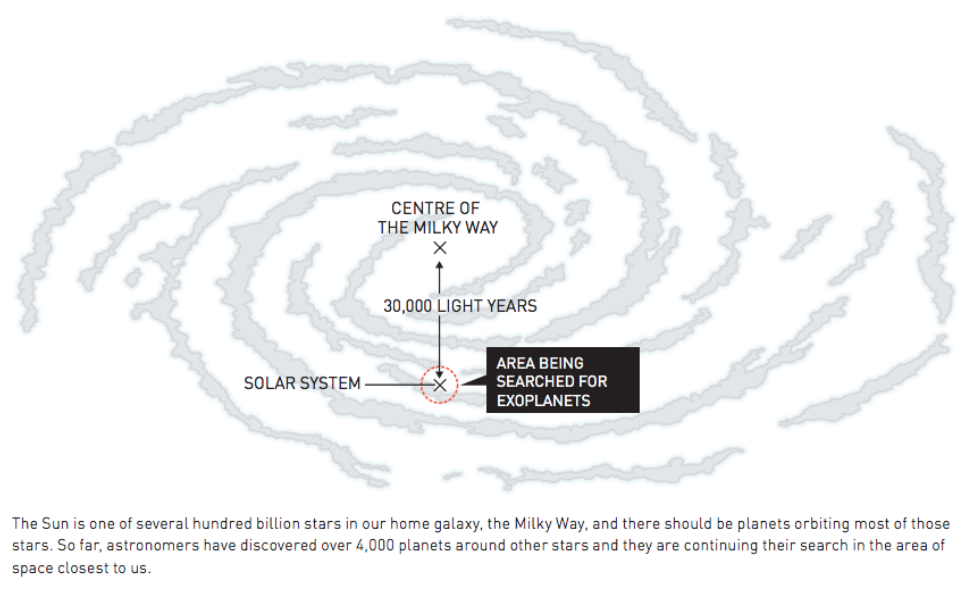
Since ancient times, humans have speculated whether there are worlds like our own, with points of views at the extremes expressed thousands of years ago. In modern times, the possibility of observing planets orbiting stars other than the Sun was proposed more than 50 years ago, and has grown into a vast and ever-expanding theory to make the evolution of the universe more clear to us than ever before. In 1995, the very first discovery of a planet outside our solar system, an exoplanet, orbiting a solar-type star was made. This discovery challenged our ideas about these strange worlds and led to a revolution in astronomy. The more than 4,000 known exoplanets are surprising in their richness of forms, as most of these planetary systems look nothing like our own, with the Sun and its planets. These discoveries have led researchers to develop new theories about the physical processes responsible for the birth of planets.
(Taken from the Nobel Prize in Physics 2019 summary, and the Laureates’ popular science and scientific views.)
In this problem, we analyse and create a model for a system of two fictitious celestial bodies: an exoplanet and a solar-type star. Unless specified otherwise, consider the two bodies to be solely in each other’s gravitational influence and rotate about their barycentre. In the three parts that follow, we will model physics of a star, of the star-planet model, and the planet respectively.
Part A
The star, with mass (twice the mass of our Sun) and radius uses nuclear fusion reactions to provide pressure against gravity and electron degeneracy pressure, so as to maintain hydrostatic equilibrium in the star. As long as the hydrostatic equilibrium is preserved, the star is said to be in “main sequence”. However, once the energy from the reactions taking place in its core start running out, the star’s outer layers swell out to form a red giant. The core of the star (having a radius ) starts to shrink, becoming hot and dense; the temperature of the core rises to over a 100 billion degrees, and the pressure from the proton-proton interactions in the core exceeds that of gravity, causing the core to recoil out from the heart of the star in an explosive shock wave. In one of the most spectacular events in the Universe, the shock propels the material away from the star in a tremendous explosion called a supernova. The material spews off into interstellar space.
Being solar-type, this star has the same proton-proton nuclear fusion chain reaction as our Sun: essentially, this is conversion of four protons (mass of a proton is ) into 1 He nucleus having mass . The star is said to have a “stable lifetime” as long as it is in its “main sequence”. The energy emitted by the star passing a sphere of radius per unit time is , constant over time and the surface of the imaginary sphere of radius . The density of the exoplanet having radius is a constant, , and it orbits around the star in a circular orbit of radius . Neglect any convection effects in the star.
a) (4 pts) Treating the solar-type star as a perfect black-body, estimate the temperature of the surface of the star, (assumed in thermal equilibrium) by integrating over all frequencies using Planck’s distribution for the energy density (defined as the energy per unit volume for a given frequency interval ):
where the constants and have their usual meanings. For this part, only, note that the energy flux from the star onto the exoplanet is . You can use as the surface temperature in the later parts.
b) (8 pts) Estimate an expression for, during the main sequence of the star:
(i) the number of protons being fused together per second;
(ii) the stable lifetime of the star, assuming mass of the star can undergo nuclear fusion. The change in the temperature or size of the star is insignificant. Assume the only fusion is between protons.
c) (8 pts) Find the temperature gradient of the star as a function of the radial distance from the center, such that if the star is in its main sequence, or in a hydrostatic equilibrium. Neglect any quantum-mechanical pressure effects such as electron degeneracy pressure, and assume that pressure from electromagnetic radiation is much larger than any other pressure. State all assumptions.
d) (1 pts) What is the temperature at , the outermost layer of the core?
e) (2 pt) From experiments, it was found that the temperature gradient of the star is actually
Here the modulus of is one, and has appropriate dimensions. For what value of ( evaluated at the surface of the star) will the star’s main sequence end, leading to the formation of a supernova?
Part B
In this part, we will analyse the radiation effects from the star onto the exoplanet. Assume only black body radiation from the star on the exoplanet. No light is absorbed in the region between the star’s and the exoplanet’s surface.
f) (5 pts) The distance between the star and the exoplanet is . For this part, assume the surface of the exoplanet has a constant and uniform reflectance . What is the force exerted by the radiation from the star on the exoplanet? For the exoplanet’s gravitational force to completely balance out the radiation force, how large must the radius of the exoplanet be? Comment on your results and their feasibility.
Part C
g) (2 pt) Find the temperature of the outermost surface of the planet, assumed constant over the whole surface from (a). Assume the planet’s surface to be a perfect black body.
h) (10 pts) Model the exoplanet to be made up of concentric shells equally spaced across the volume of the planet. Between the shells is a peculiar kind of thick type of tectonic rocks which allow no emission, reflection or absorption of energy. However, absorption or emission of radiation energy may take place. The emissivity of all the shells are the same, and are equal to , constant and uniform over a surface. Reflection, emission and absorption of any energy due to radiation from the shells, however, may take place. Assume all conduction and convection effects to also be negligible. The temperature of the exoplanet as a function of is represented by
where is the shell from the centre of the planet and is an appropriate constant as calculated from the previous part (which is unknown, meaning that you need to answer in any variables calculated before). Calculate the total thermal energy due to radiation falling on the outermost shell per unit time. The planet is maintained in a state of thermal equilibrium; this is done by an atmospheric material that allows a fraction (, which is unknown) of energy from the star falling on the exoplanet. This material only absorbs a fraction of energy it receives from the star. Do NOT assume any such effects for any of the other parts, since they are meant to be crude estimates of the actual calculation. Also compute .
Published organizer clarifications (separate source)
Separately quoted from the organizer clarification document:
Problem 8:
Part A:
- P(r) is constant with time and over the sphere of radius r.
- For part (e), P_r is evaluated at the surface of the star. (at r = )
- representing the energy density is the energy per unit volume for a given frequency interval between and .
- For part (a), you are required to solve the integral yourself. Do NOT attempt to use an integral calculator for this purpose. If you’re not familiar with how it must be solved, replace it as “I”.
Part C:
- T_0 is replaced by “T_E” in part (g). T_0 is unknown and needs to be answered using previously known variables..
- Energy absorption, reflection or emission “from the shells” may take place. The shells cannot transmit any energy, however. The special rocks do not allow any reflection or absorption of energy in between the shells and do not emit any energy on their own.
- The atmosphere does not emit any radiation of its own, and only absorbs a fraction of what it receives from the star.
- For part h, T(r) represents the temperature as a function of r, and not the temperature gradient.
Решение
Внимание: Непълно решение
The complete available printed key is retained. It ends at part e, without an explicit critical radiated power in e or answers for parts f, g and h. Part b(i) supplies a fusion-reaction rate rather than an explicit requested proton-consumption rate.
Solution 8:
(a) Using Planck’s distribution,
This integration is well known and equal to .
Returning to our problem,
The energy flux onto the exoplanet is
where . So
We get the same result by applying Stefan-Boltzmann’s radiation law for a black body, since this is how the law is derived.
(b) (i) In a single nuclear fusion reaction, four protons fuse into one helium nucleus. Let be the rate of such fusion reactions (per second), and be the rate of total energy emitted by the star at its surface. By Einstein’s law of mass energy conservation, we have
which gives
(ii) Let the stable lifetime of the star be . The total number of fusion reactions in the lifetime is then (roughly) , and we have the following expression by substituting from (i):
(c) Consider a circular strip between radial distances and from the centre of the star. For hydrostatic equilibrium to be established, the net force on this strip must be zero, or the pressure forces and gravitational forces on the layer must exactly balance. Let and be the mass and density of a sphere of radius respectively. A pressure force of on this sphere. We have from force balance:
Note that radiation pressure can be written as by Stefan Boltzmann’s law. Using this with the pressure gradient equation, we can write the temperature gradient of the star as:
(d) To find the temperature at any point on the star, we solve the gradient equation obtained in (c). Applying the boundary condition and separating variables, we have
At , we have
(e) From the problem statement, we know that the experiments suggest the following:
The main sequence of the star lasts as long as pressure from the gravitational force is greater than the net radiation pressure.
Comment (not for grading purposes):
Throughout the problem, density of the star is assumed constant and equal to .
Part (a): The integration was required to be carried out in the examination. A well known method to do this is to split the integral using by parts and express it as the limit of a sum.
Part (c): It is assumed that the pressure balancing the gravitational pressure arises from radiation. There is pressure due to the gas/fuel in the star and a few quantum mechanical effects, but they can be neglected for the sake of this problem.
Organizer clarification document — other notes
Separately quoted from the organizer clarification document:
Other Notes
- Uploading images: View this link to find how to upload images on overleaf.
- You are allowed to mix LaTeX and handwritten PDFs for your answer sheet. Note that you need to write your solution to the problem alongside your final answers.
- You can use basic formulae related to topics on the IPhO syllabus without derivation but all other formulae which go beyond that must be derived.
- If you find that space is running out on your LaTeX file, try to use and see if that fixes it.
Оригинал в Архива: invitational.pdf · официални решения: invitational_sol.pdf · допълнителни данни: Clarifications.pdf