OPhO 2020, Открит кръг — Задача 41. FBI Open Up!
2020 Online Physics Olympiad (OPhO): Open Contest v1.5 · 25 май 2020 г.
2020 Online Physics Olympiad (OPhO): Open Contest v1.5
OPhO Lead Organizers and Writers: Adithya Balachandran, Eddie Chen, Ashmit Dutta, Ethan Hu, Viraj Jayam, Rishab Parthasarathy, Kushal Thaman, Max Wang, QiLin Xue
OPhO Website Developer: Ben Oommen
Advisors: Dr. Branislav Kisačanin, Kye Shi, Kevin Zhou
Указания
If you wish to request a clarification, please use this form. To see all clarifications, see this document.
- Use in this contest. See the constants sheet on the following page for other constants.
- This test contains 55 short answer questions. Each problem will have three possible attempts.
- The weight of each question depends on our scoring system found here. Put simply, the later questions are worth more, and the overall amount of points from a certain question decreases with the number of attempts and days that you take to solve a problem as well as the number of teams who solve it. This means that your score decreases with the number of tries and days you take to solve a given problem.
- Any team member is able to submit an attempt. Choosing to split up the work or doing each problem together is up to you. Note that after you have submitted an attempt, your teammates must refresh their page before they are able to see it.
- Answers should contain at least three significant figures, unless otherwise specified. All answers within the 1% range will be accepted.
- When submitting a response using scientific notation, please use exponential form. In other words, if your answer to a problem is , please type into the submission portal.
- A standard scientific or graphing handheld calculator may be used. Technology and computer algebra systems like Wolfram Alpha or the one in the TI nSpire will not be needed. Attempts to use these tools will be classified as cheating.
- You are allowed to use Wikipedia or books in this exam. Asking for help on online forums or your teachers will be considered cheating and may result in a possible ban from future competitions.
- Top scorers from this contest will qualify to compete in the Online Physics Olympiad Invitational Contest, which is an olympiad-style exam. More information will be provided to invitational qualifiers after the end of the Open Contest.
- In general, answer in SI units (meter, second, kilogram, watt) unless otherwise specified. Please answer all questions in degrees unless otherwise specified.
- If the question asks to give your answer as a percent and your answer comes out to be “”, please input the value into the submission form.
- Do not put letters in your answer on the submission portal! If your answer is “ meters” , input only the value into the submission portal.
- Do not communicate information to anyone else apart from your team-members before the exam ends on May 29, 2020 at 11:59 PM UTC.
List of Constants
Proton mass,
Neutron mass,
Electron mass,
Avogadro’s constant,
Universal gas constant,
Boltzmann’s constant,
Electron charge magnitude,
1 electron volt,
Speed of light,
Universal Gravitational constant,
Acceleration due to gravity,
1 unified atomic mass unit,
Planck’s constant,
Permittivity of free space,
Coulomb’s law constant,
Permeability of free space,
Magnetic constant,
1 atmospheric pressure,
Wien’s displacement constant,
Stefan-Boltzmann constant,
Условие
During quarantine, the FBI has been monitoring a young physicists suspicious activities. After compiling weeks worth of evidence, the FBI finally has had enough and searches his room.
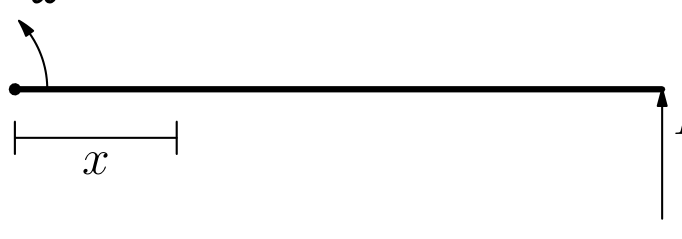
The room’s door is opened with a high angular velocity about its hinge. Over a very short period of time, its angular velocity increases to due to the force applied at the end opposite from the hinge. For simplicity, treat the door as a uniform thin rod of length and mass . The hinge (pivot) is located at one end of the rod. Ignore gravity. At what distance from the hinge of the door is the door most likely to break? Assume that the door will break at where the bending moment is largest. (Answer in metres.)
Отговори
- 0.577 m
Решение
Solution: Let be the force from the pivot and be the applied force at the end. Let be the angular acceleration. Writing the torque equation and Newton’s 2nd law for the whole door, we get:
Solving, we get and . Now, we consider the part of the door with length attached to the pivot. The rest of the door applies a torque and shear force on our system. (There is also tension force). Let . We can write the torque equation and Newton’s 2nd law for our system:
Solving, we get
and
We maximize (which is equivalent to maximizing bending moment) to get
Оригинал в Архива: open.pdf · официални решения: open_sol.pdf