OPhO 2021, Теория — Задача 1. Levitation
2021 Online Physics Olympiad: Invitational Contest — v1.1 Theoretical Exam · 25 т.
Sponsors
This competition could not be possible without the help of our sponsors, who are all doing great things in physics, math, and education.
The original sponsor marks link to Jane Street, Wolfram, AwesomeMath, Beyond the Big Bang, Physics Olympiad, and AoPS Art of Problem Solving.
Instructions for Theoretical Exam
The theoretical examination consists of 4 long answer questions and 100 points over 2 full days from August 13, 0:01 am GMT.
- The team leader should submit their final solution document in this google form. We don’t anticipate a tie, but in the rare circumstance that there is one, the time you submit will be used to break it.
- If you wish to request a clarification, please use this form. To see all clarifications, view this document.
- Each question in this examination are equally worth 25 points. Be sure to spend your time wisely.
- Participants are given a google form where they are allowed to submit up-to 1 gigabyte of data for their solutions. It is recommended that participants write their solutions in LaTeX. However, handwritten solutions (or a combination of both) are accepted too. If participants have more than one photo of a handwritten solution (jpg, png, etc), it is required to organize them in the correct order in a pdf before submitting. If you wish a premade LaTeX template, we have made one for you here.
- Since each question is a long answer response, participants will be judged on the quality of your work. To receive full points, participants need to show their work, including deriving equations. As a general rule of thumb, any common equations (such as the ones in the IPhO formula sheet) can be cited without proof.
- Remember to state any approximations made and which system of equations were solved after every step. Explicitly showing every step of algebra is not necessary. Participants may leave all final answers in symbolic form (in terms of variables) unless otherwise specified. Be sure to state all assumptions.
Problems
- T1: Levitation
- T2: Thomas Precession
- T3: Moving Media
- T4: Missing Energy
List of Constants
- Proton mass,
- Neutron mass,
- Electron mass,
- Avogadro’s constant,
- Universal gas constant,
- Boltzmann’s constant,
- Electron charge magnitude,
- 1 electron volt,
- Speed of light,
- Universal Gravitational constant,
- Acceleration due to gravity,
- 1 unified atomic mass unit,
- Planck’s constant,
- Permittivity of free space,
- Coulomb’s law constant,
- Permeability of free space,
- Stefan-Boltzmann constant,
Problem writers
T1: Levitation — Ashmit Dutta
T2: Thomas Precession — Jacob Nie
T3: Moving Media — Eddie Chen
T4: Missing Energy — Kushal Thaman
Organizer clarification document — major notes
Separately quoted from the organizer clarification document, titled 2021 OPhO Invitational Theory Clarifications:
MAJOR NOTES
- Last updated: August 14, 9:45 pm GMT
- Version 1.1 of the exam has been posted to the website.
- We will only be adding clarifications that cannot already be found in the exam. If you are not seeing your clarification answered, try looking through the exam again to see if you did not miss anything.
The original Experimental Notes points to a separate experimental clarification document; it concerns the distinct experimental paper.
Условие
Levitation is a widely researched area in physics with wide applications in real life. Commercial high speed trains use magnetic levitation to transport passengers and the very physics of aerodynamics helps planes fly in the sky. Although the many uses of levitation physics apply on macroscopic dimensions, this problem will also analyze the various applications of levitation on the microscopic scale.
Optical Tweezers
An optical tweezer (OT) is a device which uses tightly focused laser beams to trap an object in all three spacial dimensions . Consider using an OT to trap a dielectric polystyrene nanosphere with mass , radius , and relative dielectric constant . A laser beam is directed to the vertical -direction (the laser beam is similar to a monochromatic light wave propagating a sparse medium.) The laser beam has a wavelength . The time averaged intensity in the -direction due to light can be considered to follow a Gaussian distribution function:
where is the distance from the center of the beam and is known as the waist size, or the measure of the beam size at the point of its focus. Here the waist length, in general, follows where denotes the Rayleigh length.
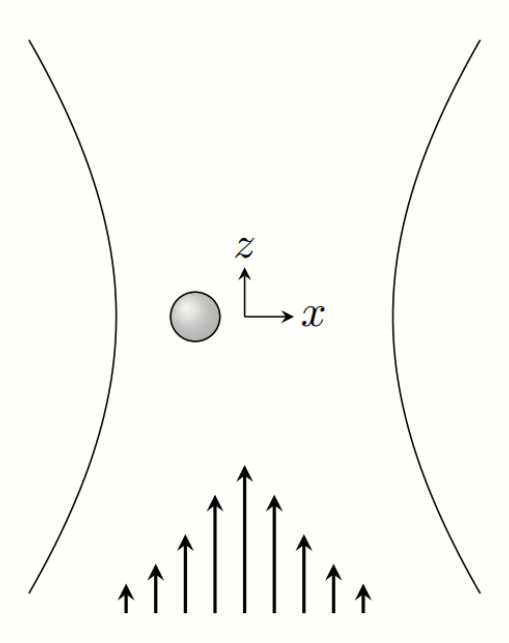
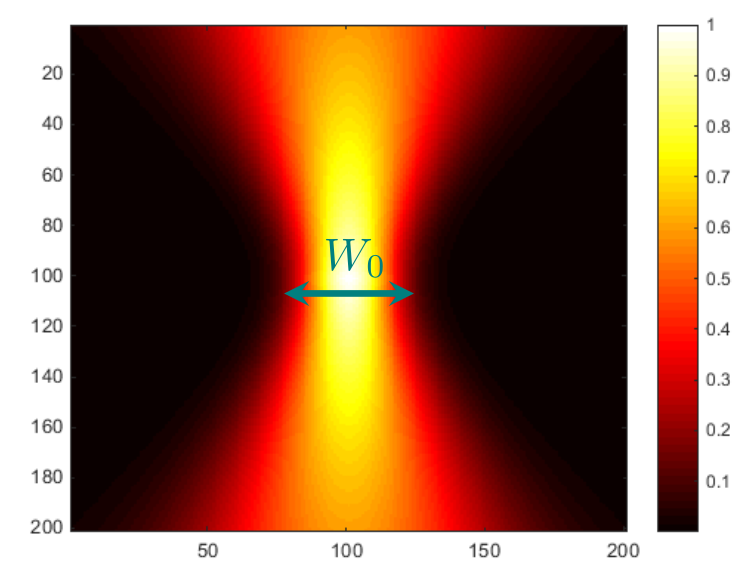
The OT traps particles via three different forces: scattering forces created by the change in momentum of light scattered or absorbed by a particle; gradient forces due to the polarization of the particle created by the strong electric fields of the laser beam; and, radiation forces produced by an accelerating charge. The total power radiated by an oscillating electric dipole with dipole moment at frequency will be , where is the speed of light.
1. (6 pts.) In the Rayleigh spectrum, the nanosphere’s size is such that . Find the oscillation frequency and equilibrium position of the nanosphere when slightly displaced a distance in the -direction. Neglect the scattering forces in this part.
In the Mie spectrum, the particle size is no longer negligible such as in part A, and follows . As a result, a non-homogenous electric field is incident upon the sphere and scattering forces are no longer neglectable. Parts B and C will investigate the nanosphere in the Mie spectrum.
1. The order of magnitude of is greater than .
2. (5 pts.) Determine the scattering force and torque on the nanosphere as a function of a distance from its origin. We can consider . Assume that of light is transmitted for simplicity. The index of refraction of the nanosphere is while the index of refraction of the medium is . You may express your answer as an integral if needed.
2. In reality, some light will be reflected due to Fresnel’s equations.
3. (2 pts.) In a simplified model, the torque acting on the nanosphere can be represented as where is a numerical constant and is the angular velocity of the nanosphere. At , the nanosphere is stationary with an angular velocity and the OT is turned on. After a time , the OT is turned off with the nanosphere left floating in the medium again. Determine the angular velocity of the nanosphere after a time passes where is the time of the entire process. It can be expressed as a piecewise function.
Acoustic Levitation
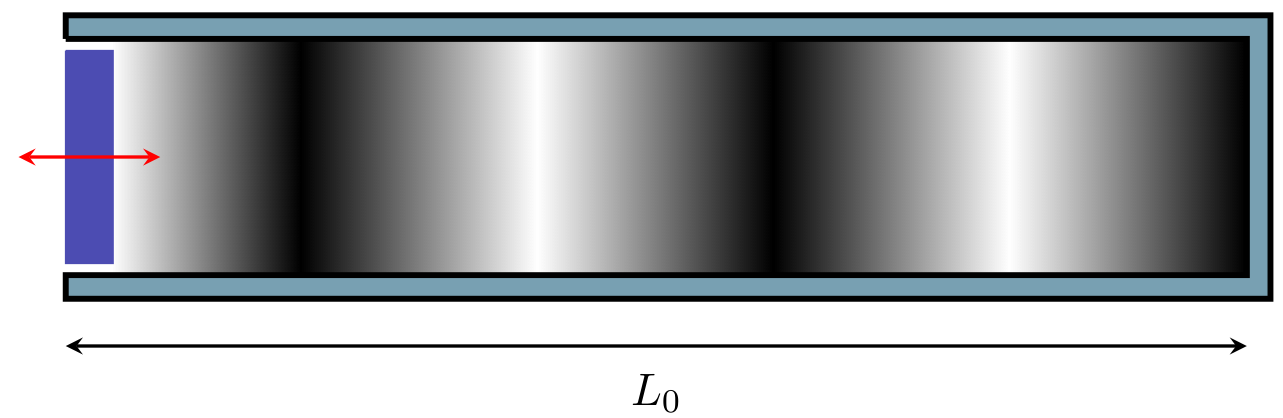
Objects can also be trapped via sound waves. Consider the simplest way to model sound waves; that is, in one dimension. A cylindrical tube of length with ambient temperature and pressure and is fixed with a piston at one end of cross-sectional area that moves periodically as where is the amplitude of the piston and is the frequency of the process. The tube contains monatomic particles of mass per unit volume. As the piston moves back and forth, the air in the tube compresses or expands (rarefies) in the tube as a sound wave. The molecules within the tube move back or forth parallel to their equilibrium position as the air travels within the piston. Neglect any viscous or turbulent friction within the pipe.
3. In some models, the piston can represent the moving cone of a loud speaker.
4. (6 pts.) What is the average power required to move the piston? Consider the limits of and where is the speed of the sound wave.
In sound waves, the density perturbations are very small, so it can be assumed that . where is the original density of the pipe. Furthermore, the wavelength of the sound waves are much larger than the mean free path of the gas molecules. The sound wave created by the oscillating piston moves at a speed and dissipates the power given by the piston.
4. You cannot use as a variable in this problem, but you can use .
5. (4 pts.) As a result of compression, the air within the sound wave has a larger temperature . Find the change in temperature . If you were unable to solve problem 4, express the average power to move the piston as .
6. (2 pts.) Consider a small cylindrical object of radius and width in the pipe where variations of pressure on the cylinder’s surface are negligible. Determine the force acting on the cylinder when the sound wave passes through it. If the pipe is placed on a vertical plane where gravity is present, qualitatively describe what location(s) the cylinder would levitate.
Published organizer clarifications (separate source, pages 1–2)
Quoted from the organizer clarification document:
Part 1:
- For problem 1, neglect scattering forces completely in all subparts. Radiation forces are not negligible.
- When finding the scattering force, the variation in is neglectable.
- For question 2, you may assume that and .
- The origin is the center of the optical tweezer.
- You may assume all photons are directed in direction.
The angular velocity of the nanosphere at is 0 in question 3.EDIT: The following was wrong. You must consider the angular velocity of the nanosphere at to be .- The torque obtained from a simplified model is not the general solution to part 2. You do not need to add contributions from part 2 to this part. If the torque is positive, it works to increase omega. Furthermore, the time described is asking during the entire process and not just after the turnoff, so you may express your answer as a piecewise function.
- Torque is about the center of the sphere.
Part 2:
- You only need to find upper and lower limits in question 4 and not general.
- The pipe does not conduct heat with its surroundings and is closed. The power that is put in the piston is dissipated by the wave. You may assume the rest of the energy from the wave is absorbed by the end of the pipe once the sound wave collides with it (reflection coefficient is 0).
- Air within the sound wave refers to the average temperature within the maximally compressed regions of the wave.
- The answer for problem 4 does not need to be expressed in terms of the speed of sound. The gas is monatomic and ideal.
- Delta rho is not a variable that you can use in this problem. However, you can use rho.
- You have to consider a cylinder in question 6.
- In question 6, there is no need to write a differential equation for when the pipe is vertical. We only ask for you to qualitatively describe where the cylinder is located and not quantitatively. The wave is moving so you can describe its general position as there will be multiple equilibrium locations and the cylinder will be oscillating.
Решение
Внимание: Непълно решение
The complete available printed key is retained. For question3, it gives the exponential spin law but no explicit turn-off branch or complete piecewise expression involving T.
1. When the exam was administered, it was said that to neglect the scattering forces in this part. In reality, the radiation forces are a type of scattering force as it takes light and re-emits it. For ambiguity, the equilibrium position was not considered in grading.
Optical Tweezers — (a)
The Rayleigh approximation tells us that . Thus, the electric field around the microsphere is homogenous; hence, the polarization of the microsphere will be as well. Furthermore, since the nanoball is displaced a small distance , the intensity distribution can be approximated by Taylor expanding . In other words:
Intensity and electric field can be related via the time averaged Poynting vector as as
where is the maximum electric field of the Gaussian beam. As the nanoball becomes polarized, it obtains a dipole moment of . It is required to find the value of of a dielectric ball. The polarized sphere can be divided into two different polarized rods of charge densities and separated a distance , replacing them by patches of charge (circles) that are superimposed. Positive charges started accumulating on the upper half of the sphere while negative charges start accumulating on the lower half of the sphere as the electric field redistributes the charges.
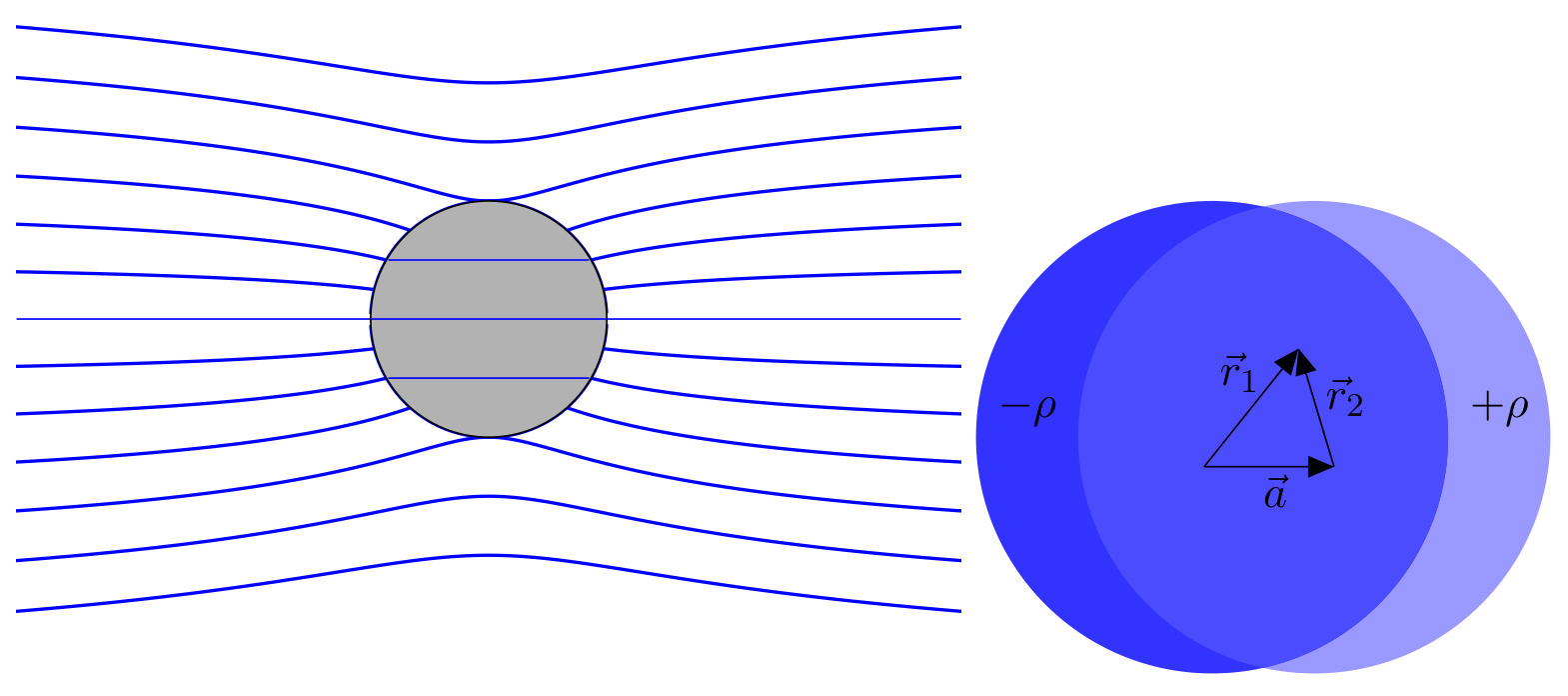
Thus, the field outside the small sphere is the sum of and the field due to an electric dipole that is at the center of the nanoball. The dipole moment expressed in terms of its polarization is
The total field at some point outside of the sphere is no longer uniform in the neighborhood of the sphere and is now the sum of the field and the field generated through the polarized matter, i.e. . Thus, the field depends on the polarization vector of the dielectric which can be expressed in terms of its electric susceptibility as
Note that the potential at all the points on the spherical boundary is simply the dipole potential or
Substituting implies . By uniqueness theorem, this must be the only solution which means that . Hence, the internal field of the sphere follows . Superposition yields
Inserting this field into the dipole momentum tells us that
The gradient force on the ball depends on the gradients of the various components of its fields. In other words, . Averaging this quantity over time then allows to write
The standard differential equation for SHO can be retrieved from this as
Here, is collectively known as the trap stiffness of the OT in the -direction. To find the force due to radiation in the -direction (as photons are directed on this axis), one can use the formula given in the problem for the power of radiation due to a rotating dipole. As , one can write that . Thus,
This must be equal to the gradient force under equilibrium, thus creating a quadratic equation on :
Substituting yields a quadratic of
6. This is well derived from the Poynting vector.
(b)
In the Mie spectrum, which implies that the intensity and electric field distribution over the sphere is no longer homogenous. Create a ray diagram:
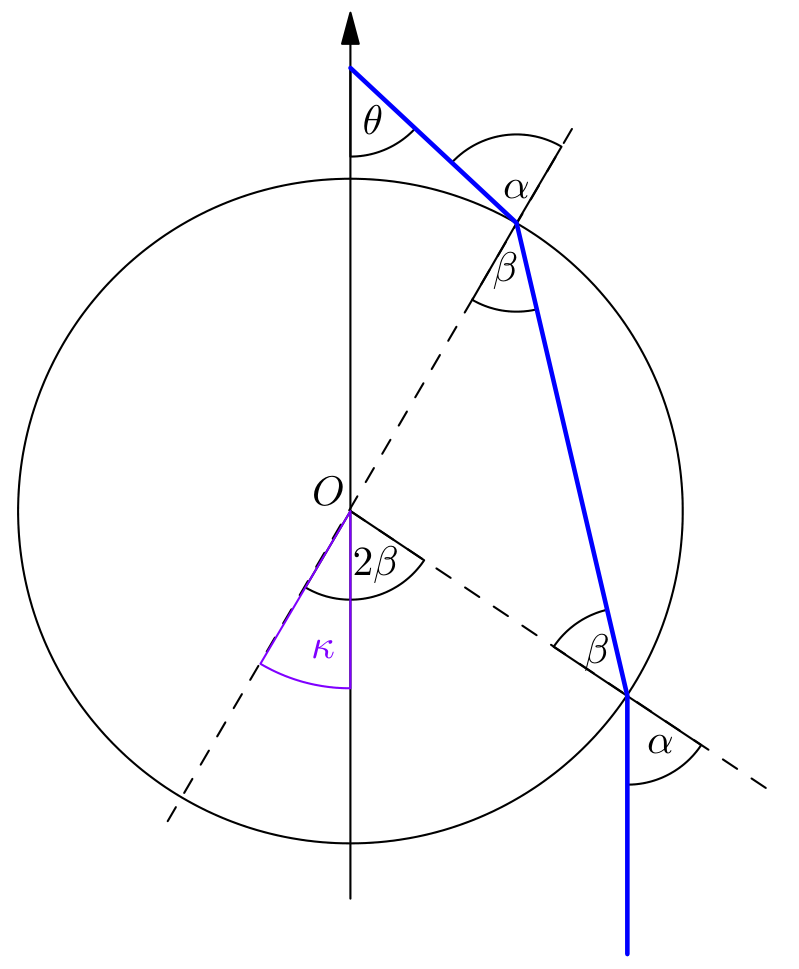
The deviation in angle can be described by the angle or
The change in momentum of photons that move towards the sphere can then be written as
We can use the law of cosines for a point away from the origin to find :
Thus, putting everything together:
Similarly, you can write the forces in the direction which will be similar to :
The net force is thus . The torque acting on the sphere can be written as a volume integral over the cross product of distance and force or:
Here will have different lengths along each direction, or .
(c)
The nanosphere has an angular momentum which implies the torque acting on it to be
We now have a simple first order differential equation whose solution is
As the nanosphere is an induced dipole, will it now lose power due to radiative losses? The answer turns out to be no, as the nanosphere rotates on an axis that is perpendicular to the direction of its dipole moment. With no dipole moment directed along the axis of rotation, no radiative power will be lost.
Grading Scheme
| A1 | It’s stated (or taken under consideration) that the entire field on the microsphere is uniform and explanation how oscillations occur is presented | 0.50 |
| A3 | Intensity and electric field are related under Poynting’s vector | 1.00 |
| A4 | Coefficient of dipole moment is calculated | 1.00 |
| A5 | Gradient force averaged over time is derived | 1.00 |
| A6 | Answer for | 0.75 |
| A7 | Radiation force is found and expressed with | 1.00 |
| A8 | Answer for equilibrium position | 0.75 |
| B1 | Correct ray diagram and proper deviation angle is derived | 2.00 |
| B2 | Finds a proper expression for infintessimal force due to momentum change | 1.00 |
| B3 | Uses law of cosines to obtain a general expression for | 0.50 |
| B4 | Integral expression for force in directions is correct | 0.75 |
| B5 | Integral expressions for torque is correct | 0.75 |
| C1 | Differential equation is created and solved | 1.0 |
| C2 | Correct answer is expressed (can be in a piecewise function) | 0.50 |
| C3 | Accounts for forces due to radiation and is able to show it does not affect rotation | 0.50 |
Acoustic Levitation — (d)
For either case, there are different processes happening which require different analysis.
When is low
By the condition , the acoustic wave produced by the piston travels much faster than the piston as . For a general traveling wave, we define:
where refers to the longitudinal displacement of the wave and is the wavenumber. Now consider a part of the gas that is in equilibrium followed by the gas in a later state.

We can approximate to be . Note that the volume of this slice of gas can be written as but the change in volume of the gas between both successive pictures can be written as . Furthermore, the ideal gas equation holds for small amplitudes which means that , and by logarithmic differentiation,
Thus, we can rewrite the volume terms as:
The change in pressure of a segment of the gas at can be characterized as
Now the force acting on the piston due to this change in pressure can be accurately described as . Power can be written as and we know that since , then . The wavenumber is written as . The total and average power acting on the piston for each quarter cycle is then,
When is very high
In the limit of , the piston will start to move much faster than the actual molecules in the air. Therefore, at some point in time, the piston will actually not have ”contact” with the molecular layer. This is because after pushing the gas molecules, there will be an empty void which will eventually be replaced at a distance . The piston will only exert a force (and hence power) upon having contact with the layer of gas. Suppose the piston moves a distance in a time . We can then find that
Assuming is small, we can use approximations such that
The entire cycle takes a time which means we must consider the interval . We can use a similar process as in the analysis for now. Except this time, to find the power used, we will find the energy per cycle and divide by . The potential energy per unit length can be written as
Thus, we must now evaluate:
Having all constants be defined under , we can now write
The average power used is thus
(e)
The internal energy of moles of the gas is given by . The power dissipated by the shockwave is then
Note that which means that where is the speed of the sound wave. Hence, the power dissipated can be written as . Thus, the change in temperature is when both power generation and dissipation is equated. Note that the process is adiabatic as the wavelength of the sound waves are much larger than the mean free path of the gas molecules implying slow motion.
(f)
The force on the cylinder will be
From part D, we know that
From this, we can see that the cylinder will levitate near the pressure nodes, or where . These will typically be compressions as they imply a stable equilibrium. As the waves are travelling, the puck will float up with the sound wave and then fall repeating the same process over again implying oscillations. For true levitate, we would require the waves to be standing.
Grading Scheme
| D1 | Correct reasoning for what happens to the piston in the limit of | 0.25 |
| D2 | Shows ideal gas equation holds and relates and | 1.00 |
| D3 | Rewrites and derives power | 1.25 |
| D4 | Correct expression for average power | 0.75 |
| D5 | Correct reasoning for what happens to the piston in the limit of | 0.50 |
| D6 | Finds characteristic time for when piston hits the ”molecular wall” | 0.50 |
| D7 | Finds potential energy per unit length per cycle | 1.25 |
| D8 | Correct expression for average power | 0.75 |
| E1 | Relates internal energy and power dissipation (alternate: uses equipartition theorem) | 3.00 |
| E2 | Correct answer for | 1.00 |
| F1 | Relates force and pressure gradient to show sinusoidal nature | 1.00 |
| F2 | Correct reasoning for how the cylinder levitates and where it does | 1.00 |
Organizer clarification document — other notes
Separately quoted from the organizer clarification document:
Other Notes
- You are allowed to refer to Wikipedia (but not any other sources). You should typically rederive proofs instead of citing them.
- Uploading images: View this link to find how to upload images on overleaf.
- You are allowed to mix LaTeX and handwritten PDFs for your answer sheet. Note that you need to write your solution to the problem alongside your final answers. If you desire a LaTeX template, we have made one for you here. Make a copy of the project to edit the document.
- You can use basic formulae related to topics on the IPhO syllabus without derivation but all other formulae which go beyond that must be derived.
- If you find that space is running out on your LaTeX file, try to use and see if that fixes it.
Оригинал в Архива: theory.pdf · официални решения: theory_sol.pdf · допълнителни данни: Clarifications.pdf