OPhO 2022, Теория — Задача 2. Euler’s Disk
2022 Online Physics Olympiad: Invitational Contest — Theoretical Examination · 18 т.
Sponsors
This competition could not be possible without the help of our sponsors, who are all doing great things in physics, math, and education.
The original sponsor marks link to Jane Street, Wolfram, AwesomeMath, Beyond the Big Bang, Physics Olympiad, and AoPS Art of Problem Solving.
Instructions for Theoretical Exam
The theoretical examination consists of 5 long answer questions and 110 points over 2 full days from July 30, 0:01 am GMT.
- The team leader should submit their final solution document in this google form. We don’t anticipate a tie, but in the rare circumstance that there is one, the time you submit will be used to break it.
- If you wish to request a clarification, please use this form. To see all clarifications, view this document.
- Participants are given a google form where they are allowed to submit up-to 1 gigabyte of data for their solutions. It is recommended that participants write their solutions in LaTeX. However, handwritten solutions (or a combination of both) are accepted too. If participants have more than one photo of a handwritten solution (jpg, png, etc), it is required to organize them in the correct order in a pdf before submitting. If you wish a premade LaTeX template, we have made one for you here.
- Since each question is a long answer response, participants will be judged on the quality of your work. To receive full points, participants need to show their work, including deriving equations. As a general rule of thumb, any common equations (such as the ones in the IPhO formula sheet) can be cited without proof.
- Remember to state any approximations made and which system of equations were solved after every step. Explicitly showing every step of algebra is not necessary. Participants may leave all final answers in symbolic form (in terms of variables) unless otherwise specified. Be sure to state all assumptions.
Problems
- T1: Maxwell’s Demon
- T2: Euler’s Disk
- T3: Rocket
- T4: Magical Box
- T5: Quantum Computing
List of Constants
- Proton mass,
- Neutron mass,
- Electron mass,
- Avogadro’s constant,
- Universal gas constant,
- Boltzmann’s constant,
- Electron charge magnitude,
- 1 electron volt,
- Speed of light,
- Universal Gravitational constant,
- Acceleration due to gravity,
- 1 unified atomic mass unit,
- Planck’s constant,
- Permittivity of free space,
- Coulomb’s law constant,
- Permeability of free space,
- Stefan-Boltzmann constant,
Problem writers
T1: Maxwell’s Demon — Zhening Li
T2: Euler’s Disk — Daniel Seungmin Lee
T3: Rocket — Adithya Balachandran
T4: Magical Box — Daniel Seungmin Lee
T5: Quantum Computing — QiLin Xue
Organizer clarification document — major notes
Separately quoted from the organizer clarification document, titled 2022 OPhO Invitational Theory Clarifications:
MAJOR NOTES
- Last updated: July 30, 12:01 am UTC
- We will only be adding clarifications that cannot already be found in the exam. If you are not seeing your clarification answered, try looking through the exam again to see if you did not miss anything.
The separate Experimental Notes link is retained in the original clarification PDF and concerns the distinct experimental paper.
Условие
A thin, uniform disk of mass and radius is initially set at an angle to the horizontal, on a frictionless surface. It is given an initial angular velocity with respect to a vertical axis passing through its center.
a. (4 pts.) Determine for the steady state case, where .
b. (2 pts) Write an expression for the total energy of the disk.
The disk is then moved onto a special surface with small bumps of height spread over it – each bump is separated by . As the disk climbs over a bump and falls back down, its impact is absorbed by the surface, causing a net energy loss in the system. The disk is set in motion with the same initial conditions as before but with
c. (6 pts.) Assuming that this is the only source of energy loss, write a differential equation for in first order to .
d. (4 pts.) Hence, write an approximate expression for as a function of time.
e. (2 pts.) Using this model, determine the time it takes for the frequency of the sound the disk makes against the surface to reach the maximum audible frequency .
Published organizer clarifications — separately quoted from the original clarification document, page 1:
- The disk “wobbles”, acquiring an angular velocity Omega_0 with respect to the z-axis - think of what that means in the given set up
- The disk rolls over a bump, rolls delta (by distance, not angle) and meets another bump
Решение
a.
Let us use the following three axes:
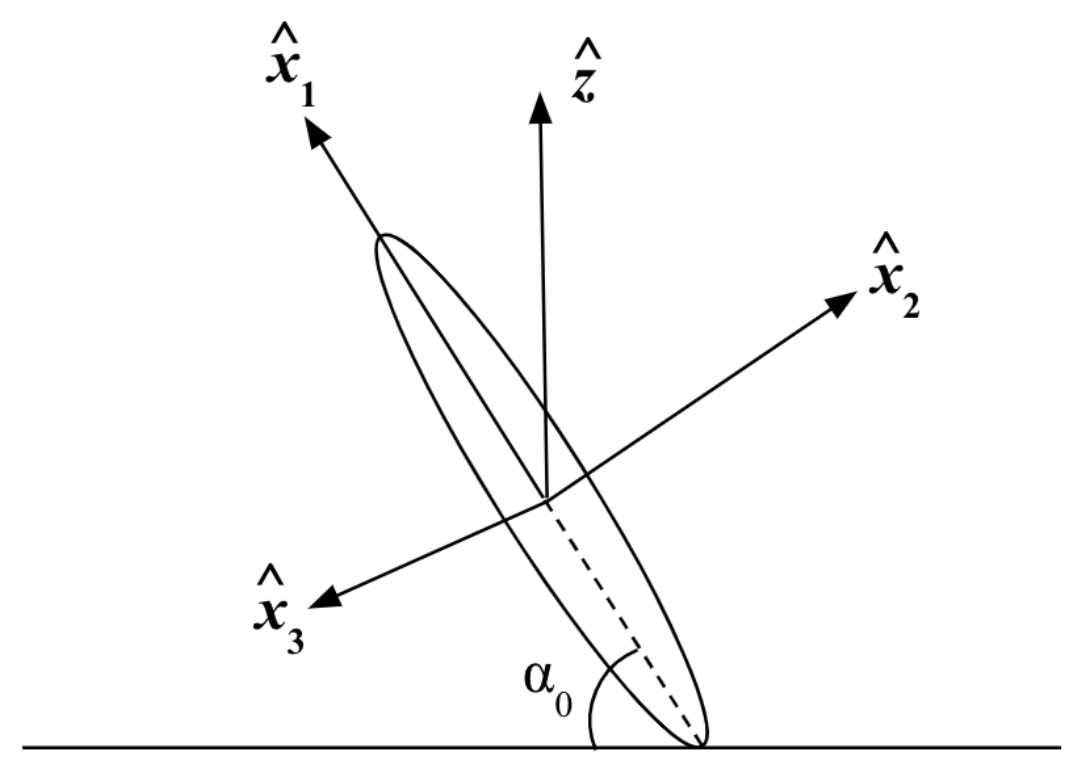
Let’s say the disk moves in a counter-clockwise direction when viewed from above. Since the disk is given an angular velocity , it must roll without slipping with angular velocity . Since it rolls without slipping:
Thus,
Therefore, the net angular velocity vector is:
Since the disk’s point of contact with the ground and the COM is at rest, we can let the axis passing through both points – – be the instantaneous axis of rotation. Note that this is validated by the net angular velocity vector lying along . By the perpendicular axes theorem, the moment of inertia around is . Thus, the angular momentum vector is:
If we calculate torque from the point of contact with the ground, the only force that contributes is weight. Thus,
This should equal:
Let’s do some quick vector analysis to find . Note that, since is the instantaneous axis of rotation, the unit vectors and spin on the plane of the disk at this given instant. Suppose spins for an infinitesimal time such that its coordinates on the plane of the disk is:
Taking the time derivative,
Plugging this into the equation above and solving for ,
b.
As derived in the previous question, the total rotational kinetic energy of the disk can be written as:
again, since is the IAR. Since the COM of the disk remains at height , we can write its total energy as:
c.
We simply have to add a term to the total energy above to take into account the disk’s falling COM. Approximating the total energy at the limit,
Now, we’ll find the power dissipated by the bumps and equate . As the disk climbs over a bump and falls back down, its gravitational potential energy will be absorbed by the surface. In other words, the disk will lose every . Hence, we get:
Therefore,
Assuming the disk spends most of its time falling down from a bump, we can approximate its COM’s acceleration to be . Fully simplifying the equation above, we get:
d.
Solving the differential equation from the previous question gives
We can simply plug in into to find the answer.
e.
The disk will produce a “click” every time it falls off a bump, hitting the surface. The frequency at any given time will therefore be:
Any attempt with this idea were given full marks.
Organizer clarification document — other notes
Separately quoted from the organizer clarification document:
Other Notes
- You are allowed to refer to Wikipedia (but not any other sources). You should typically rederive proofs instead of citing them.
- Uploading images: View this link to find how to upload images on overleaf.
- You are allowed to mix LaTeX and handwritten PDFs for your answer sheet. Note that you need to write your solution to the problem alongside your final answers. If you desire a LaTeX template, we have made one for you here. Make a copy of the project to edit the document.
- You can use basic formulae related to topics on the IPhO syllabus without derivation but all other formulae which go beyond that must be derived.
- If you find that space is running out on your LaTeX file, try to use and see if that fixes it.
Оригинал в Архива: theory.pdf · официални решения: theory_sol.pdf · допълнителни данни: Clarifications.pdf