OPhO 2025, Финален кръг · част I — Задача 2. Theory Question 2
2025 Online Physics Olympiad: Invitational Contest — Part I · 23 август 2025 г. · 10 т.
Sponsors
This competition could not be possible without the help of our sponsors, who are all doing great things in physics, math, and education.
Sponsors
This competition could not be possible without the help of our sponsors, who are all doing great things in physics, math, and education.
Указания
Part 1 of the Invitational Round consists of three theoretical free response questions over 2 full days from August 23, 12:00 AM UTC to August 24, 11:59 PM UTC. Part 2 consists of a fourth theoretical question and one experimental problem, to be completed during the second day, from August 24, 12:00 AM UTC to August 24, 11:59 PM UTC.
- The team leader should submit their final solution document in this google form. We don't anticipate a tie, but in the rare circumstance that there is one, the time you submit will be used to break it. You are allowed to submit up 10 MB of data for each problem solution. It is recommended that participants write their solutions in LaTeX. However, handwritten solutions (or a combination of both) are accepted too. If participants have more than one photo of a handwritten solution (
jpg, png, etc), it is required to organize them in the correct order in apdfbefore submitting. If you wish a premade LaTeX template, we have made one for you here. - If you wish to request a clarification, please use this form. To see all clarifications, view this document.
- Since each question is a long answer response, participants will be judged on the quality of their work. To receive full points, participants need to show their work, including deriving equations. As a general rule of thumb, any common equations (such as the ones in the IPhO formula sheet) can be cited without proof.
- Remember to state any approximations made and which system of equations were solved after every step. Explicitly showing every step of algebra is not necessary. Participants may leave all final answers in symbolic form (in terms of variables) unless otherwise specified. Be sure to state all assumptions.
- Participants are required to keep all their rough working for both parts of this round and to submit it to this form by 30 minutes after the end of the competition, i.e. the deadline is August 25, 12:30 AM UTC. Note that we will not explicitly request working from any team: all teams are required to submit their rough working.
List of Constants
- Proton mass, kg
- Neutron mass, kg
- Electron mass, kg
- Avogadro's constant,
- Universal gas constant,
- Boltzmann's constant, J/K
- Electron charge magnitude, C
- 1 electron volt, J
- Speed of light, m/s
- Universal Gravitational constant,
- Solar Mass kg
- Acceleration due to gravity,
- 1 unified atomic mass unit,
- Planck's constant,
- Permittivity of free space,
- Coulomb's law constant,
- Permeability of free space,
- Magnetic constant,
- 1 atmospheric pressure,
- Wien's displacement constant,
- Stefan-Boltzmann constant,
Условие
This problem consists of two independent parts.
A. Efficient Lighting [5.5 marks]
Let be a two-dimensional, simply connected room with perfectly reflecting walls, illuminated by omnidirectional light sources located in the room's interior. We strictly work in the geometric optics regime and neglect all reflections off of non-differentiable corners. Sources do not affect light passing through them.
(A.1) For any given configuration of distinct point sources, construct such that the parts of the room illuminated by each source are disjoint, and the total illuminated area is equal to the area of . Sketch two concrete examples of your construction that differ in more than a trivial sense. [1 т.]
(A.2) Now, for a finite number sources which are finite, disjoint and simply connected 2D regions, whose shape and placement are of your choice, construct satisfying the conditions of part (a). Sketch your construction of and indicate the chosen source shape and placement. [2 т.]
(A.3) Likewise, for any arbitrary sources which are finite, disjoint and simply connected 2D regions, describe how to generally construct satisfying the conditions of part (a). Sketch one possible example of your construction, differing in more than a trivial sense from your answer to part (b). [2,5 т.]
B. Gas Gas Gas [4.5 marks]
(B.1) Consider a viscous gas cloud of finite extent orbiting around a dominating central mass. Prove that no steady state or periodic solution exists. Do not assume any specific equation of state (i.e., relation between and ). Note: Solutions which do not demonstrate the non-existence of local minima will receive no points. Solutions which prove the result in the case of a disk will receive half points. [4,5 т.]
Решение
Efficient Lighting - Solution
Ivan's solution
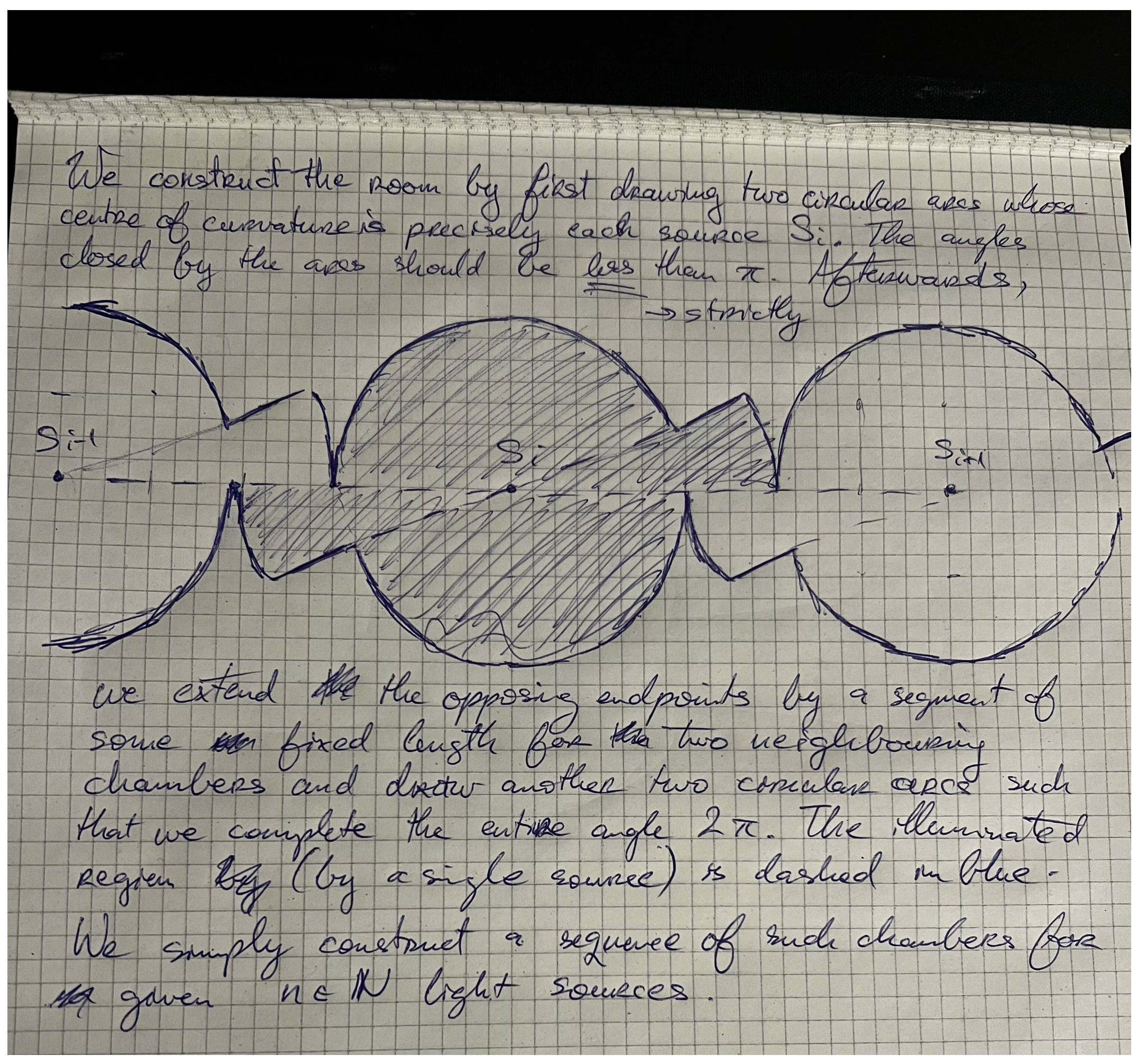
(A.1) The problem might be reduced to considering the room as a sequence of chambers, each containing one light source, such that all of the light rays emitted from the source stay confined within the corresponding chamber. One may be inspired by the fact that, considering a circle with a light source at its centre, all light rays arrive at the centre after exactly one reflection off the circular wall. The radius of the circle being irrelevant regarding reflections, one can select specific parts of the wall and prolong said parts, obtaining the room illustrated by Figure (1). Note that the light sources do not necessarily need to be collinear.
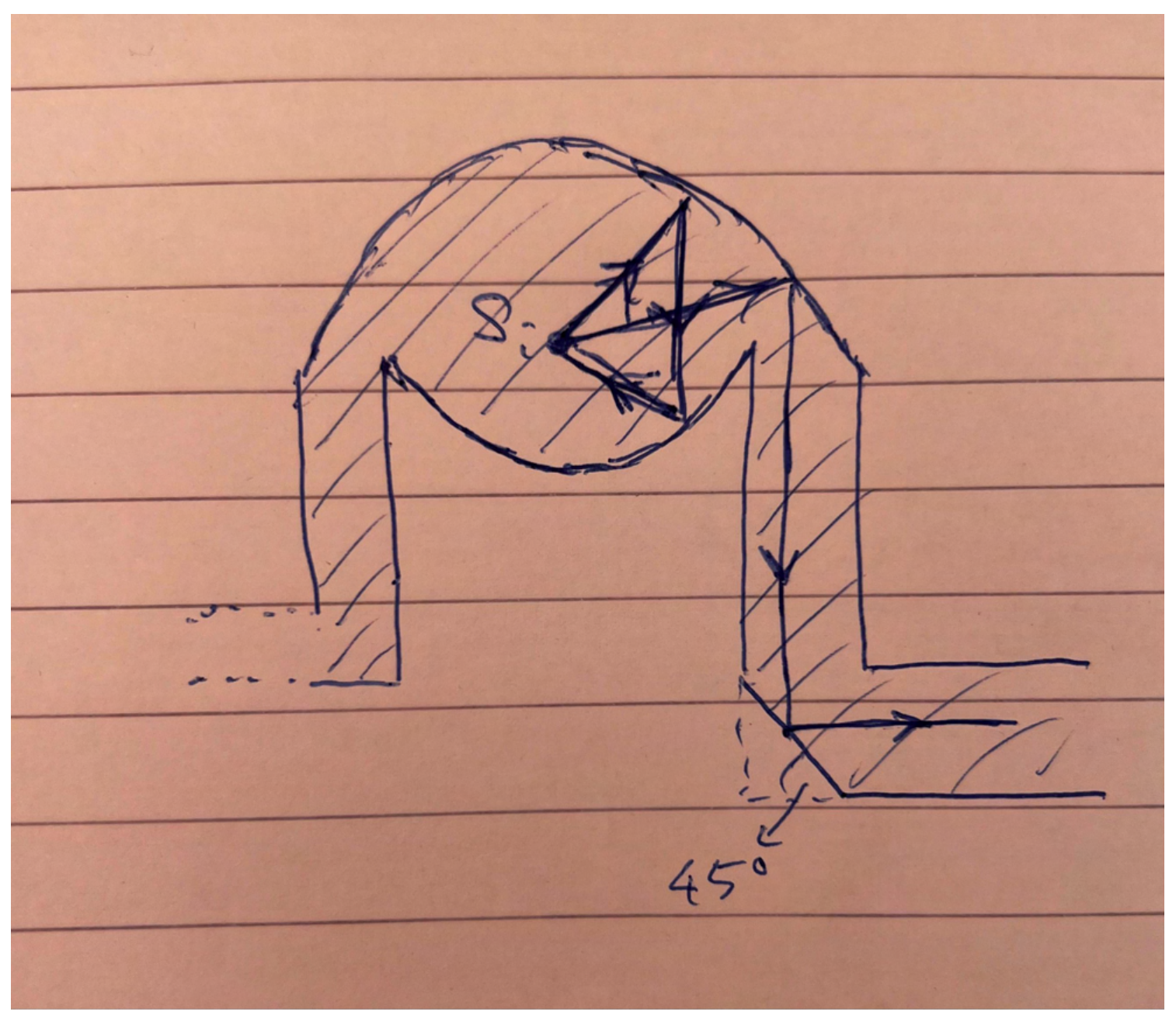
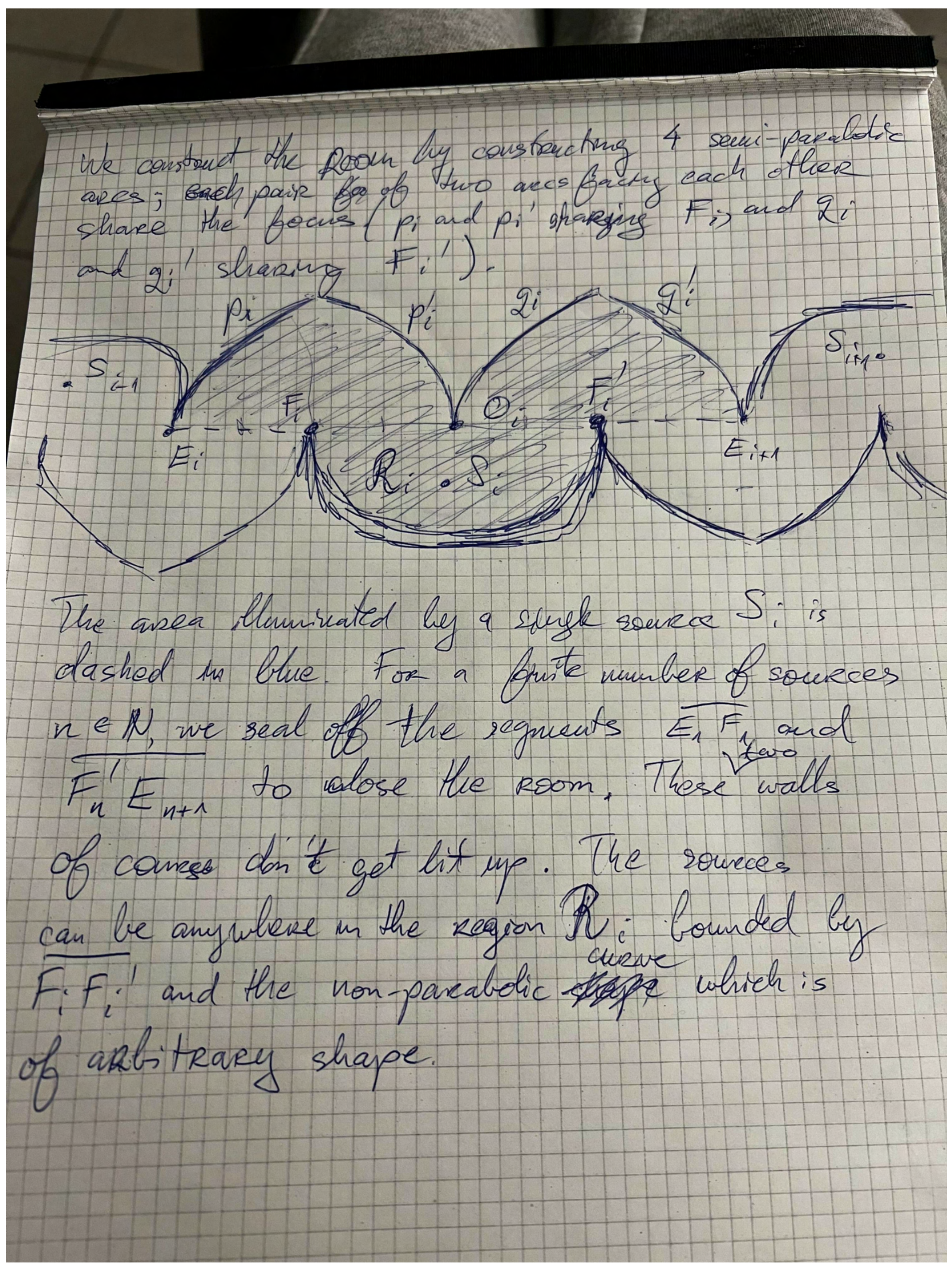
Another possible solution is to consider the reflective properties of parabolas. Construct chambers around each source made of parabolic walls such that one is wider than the other. The gaps between them allow only strictly vertical light rays to pass, enabling the construction of the entire room by prolonging these corridors in any way. Note the angle for corridors that need to bend to reach another light source.
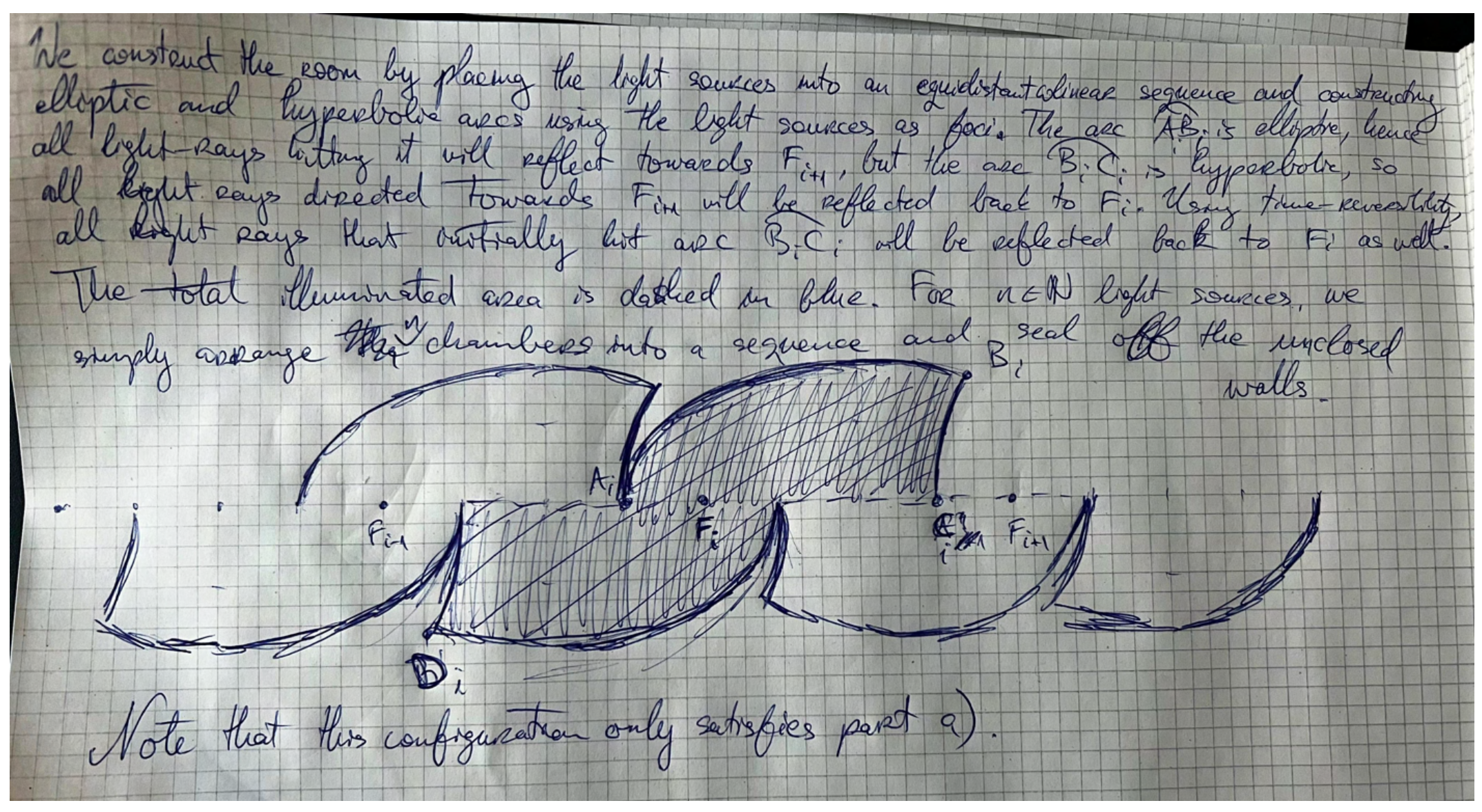
Another interesting room to consider is the following one, which uses elliptic and hyperbolic walls. However, in this case, the light sources need to be strictly collinear.
(A.2) / (A.3) Analogous to part (a), this part is concerned with controlling all light rays emitted from within some region to return to after a finite number of reflections. This is easily achieved by considering the reflective property of an arbitrary ellipse, so that one may attempt the following construction of :
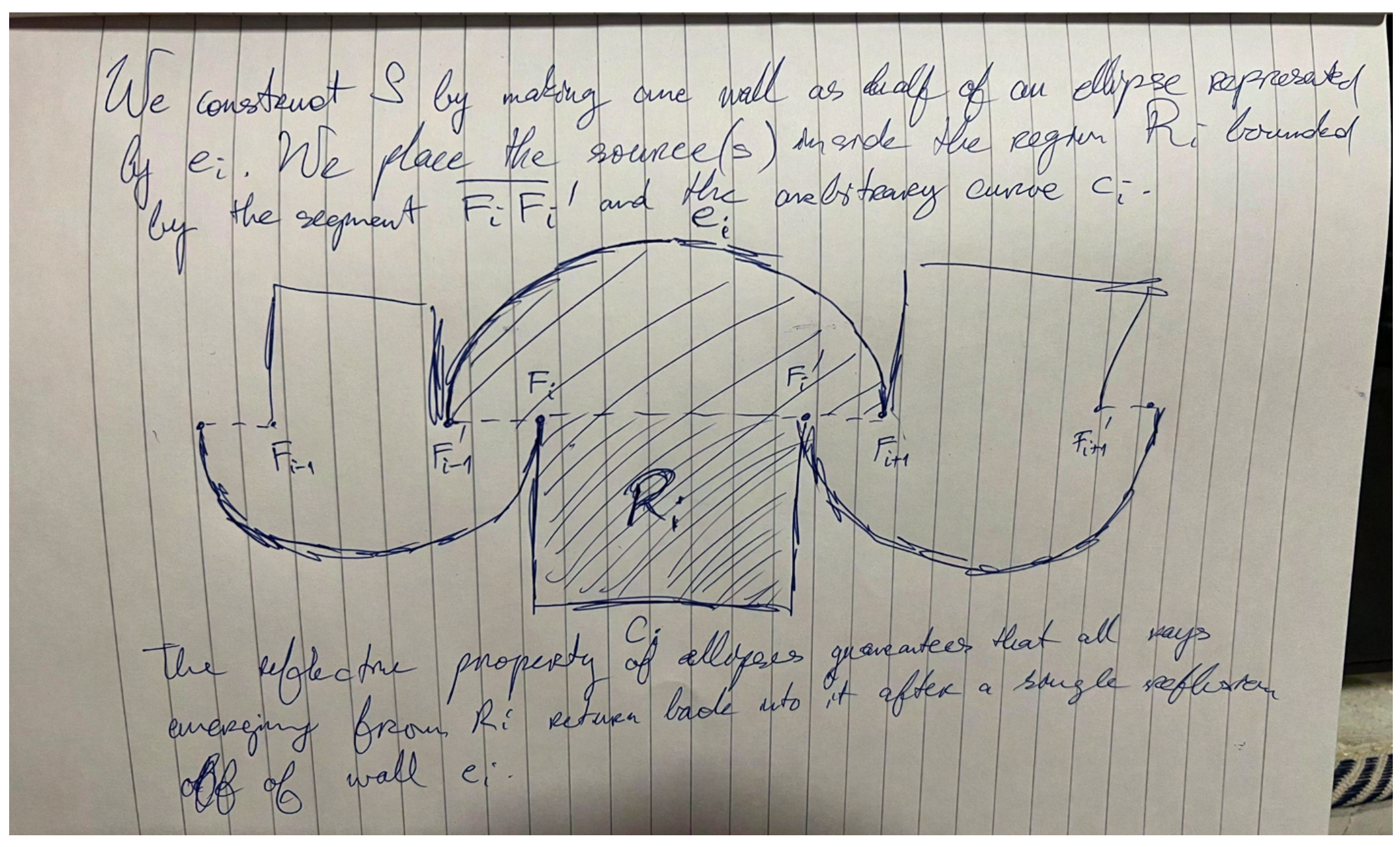
Note that the regions are of arbitrary shape, hence one can build any corridor/canal towards a specific region-like source. The same can be obtained by considering parabolas:
Hubert's solution: Formal proof for the existence of configurations for both parts follows.
(A.1) Suppose we have a finite set of point sources . We claim that it is possible to choose an ordering of such that the line segments form disjoint sets for all (i.e. they do not intersect). This can be achieved by choosing an ordering such that the x-coordinates of are arranged in an increasing order. This is achievable by the total orderedness of the reals. Should two points have the same x-coordinate we order points in order of increasing y-coordinate. Then, any two line segments have disjoint support on the x-axis and are therefore non-intersecting. For line segments which are vertical the same argument can be applied for support on the y-axis.
Given such an ordering and such a construction of line segments we make the following construction: each point is surrounded by the epsilon-ball . Then, along each line segment for , construct two sectors which has a radius of (i.e. the sector reaches just beyond the midpoint of the line segment connecting the two points) centred on and respectively. The sectors should extend an angle counterclockwise. We claim that the room consisting of the union of the epsilon-ball and all such sectors satisfies the requirements of the problem for some .
Since a circle reflects all rays from its centre back towards the centre, it is clear that each union of the epsilon-ball and all sectors centred at is fully illuminated by the source, and that all rays are parallel to any intersections of the boundaries with any source, so the only requirement is that these sets do not self intersect. In other words, if we consider that is the union of and the two sectors centred at , we want to show that there exist such that .
Firstly, we know the epsilon-balls do not intersect for some , since any finite set of points is nowhere dense. Suppose without loss of generality that the x-coordinates of and were different. (If not, the axes can be rotated infinitesimally anticlockwise.) Then we are able to choose sufficiently small such that no point in the sector pointing towards has an x-coordinate less than that of by choosing it to be less than the slope of . Assume further without loss of generality that has a different x-coordinate with (this is achievable for any configuration of three points). Then by choosing to be less than the finite difference of the x-coordinates of and we guarantee the non-intersection between the sector and the epsilon-ball around . The intersection between two sectors occurs only on the boundaries by construction. Hence the condition is satisfied.
It is also easy to show that is simply connected by observing that the curve consisting of the line segments has no return path except through the same sequence of epsilon-balls and sectors, which can necessarily be contracted to a point. This completes the proof.
(A.2) / (A.3) Similar to the previous idea, we construct the room to be bounded by the boundary of each source, with a small corridor along the straight line connecting each source. The difference is that the incident angle of the light is arbitrary, so one needs to use an ellipse or parabola to refocus the light back towards the source, as shown in the illustration above. The arguments will not be repeated as they are similar. The key point is to prove that, for any given finite disjoint sequence of simply connected sources , we can choose an ordering for and points , such that the line segments are pairwise disjoint with both and .
This can be proven by construction via a greedy algorithm. For any pair of sets we can define a minimum distance between the two sets, . We find . Then we find and construct the line segment . We then consider to be one set and reiterate the process until all sets are connected. The lines necessarily do not intersect with any set by the minimum distance property, and do not intersect with any other line as if they did, you can swap the pairs of points to obtain shorter lines, as in a minimum spanning tree. This proves the construction works for any arrangement of sources.
Gas - solution
We consider the gas cloud of density and velocity field . The total energy of this cloud is
where we have neglected the constant factor, , and is a constant relating to the mass of the central object. As viscous forces are always dissipative, we expect to minimise this functional. There are, however, several physics constraints, including the continuity equation:
as well as conservation of angular momentum, where we choose the units such that the magnitude is 1 and choose the z-axis to be along its direction (this is possible as all forces are internal):
We also note that the functional is time-varying. We want to study the steady state, so we consider the time-average over an infinite horizon, which, as the limit tends to infinity, will be dominated by the steady state:
We minimise this functional. With the two constraints, we introduce the Lagrange multipliers and for the continuity equation (which applies at every x and t) and the angular momentum conservation (which applies at every t). The full functional is therefore
Now, we vary this with respect to and , taking fixed and taking the limit later. We also assume the boundary conditions that all quantities have finite support in so boundary terms vanish (which is a physical assumption). The latter two return the constraints. Varying with respect to gives
while varying over gives
where in both cases we have implicitly taken the limit as as the steady state is unconstrained. Simplifying produces
We take the dot product of both sides of (8) with which gives
Substituting into (9) we get
which is impossible as , and must be sometimes positive for any periodic solution. Hence, by contradiction, there does not exist a steady state.
Addendum While the above solution is mathematically rigorous, we received a submission from the team ”rotting crustaceans” which in our opinion is also rigorous while being more intuitive. We attach a modified sketch of their solution below.
For the viscous fluid the viscous dissipation function is defined as , where Einstein notation is used and is the stress tensor
At any sort of energy minimum we must have zero everywhere, which implies rigid body motion. Moreover, for a given fixed density distribution with fixed total angular momentum, the minimum energy configuration is rigid body. This can be proved by considering the KE:
while the angular momentum is
where we have defined to be along the z-axis. Then we have
by Cauchy-Schwarz inequality, and therefore
completing the proof. This therefore implies that if there existed an energy minimum which is not rigid body, one could keep the density distribution the same and instead rotate the body rigidly. (This also eliminates any time-varying solutions.)
Now, for the rigid body solutions, we can show that they cannot be an energy minimum by considering the fact that, for any given particle orbiting around a central mass of mass at a distance and with angular momentum , it has energy
This is negative by the boundedness of the mass, and therefore if the mass is moved inwards (decreasing ) while conserving angular momentum, the energy will decrease. We can therefore imagine a situation where, if there were a given rigidly rotating density distribution which is a local energy minimum, one can move a parcel of mass inwards while conserving the angular momentum to further decrease the energy. We can then redistribute the angular momentum so that the motion is again rigid body - as there is a slight decrease in moment of inertia, will increase slightly and the angular momentum is transferred outwards - and so on and so forth, until all the mass is concentrated at the central mass and an infinitesimal mass is orbiting infinitely far away and/or at infinite angular velocity. This is clearly unphysical and therefore there does not exist any configuration which is an energy minimum and stable.
Оригинал в Архива: theory.pdf · официални решения: theory_sol.pdf