OWAO 2023, Практически тур — Задача 3. Eclipse in Siberia
ΩWAO 2023 ◇ Practical Round ◇ Problems
Условие
There are two videos:
eclipse1.mp4orhttps://youtu.be/nsWVPedsQNkeclipse2.mp4orhttps://youtu.be/Lw7GGm0U94g
showing conditions for the annular solar eclipse on July 25, 2120. The greatest eclipse will be observed in Siberia, geographical region in Russia. Estimate the altitude of the Sun at the point where the maximum magnitude of the eclipse will be observed (if the weather is good).
Hint: the center of lunar antumbra reaching the Earth’s surface is marked by green cross.
Отговори
4 °
Official solution: with .
Решение
Solution:
One of the videos shows Earth and lunar shadow as it seen from some point of view located in the direction to the Sun. The center of antumbra goes from point to point . Maximal magnitude of eclipse is observed at point , the closest to the Moon.
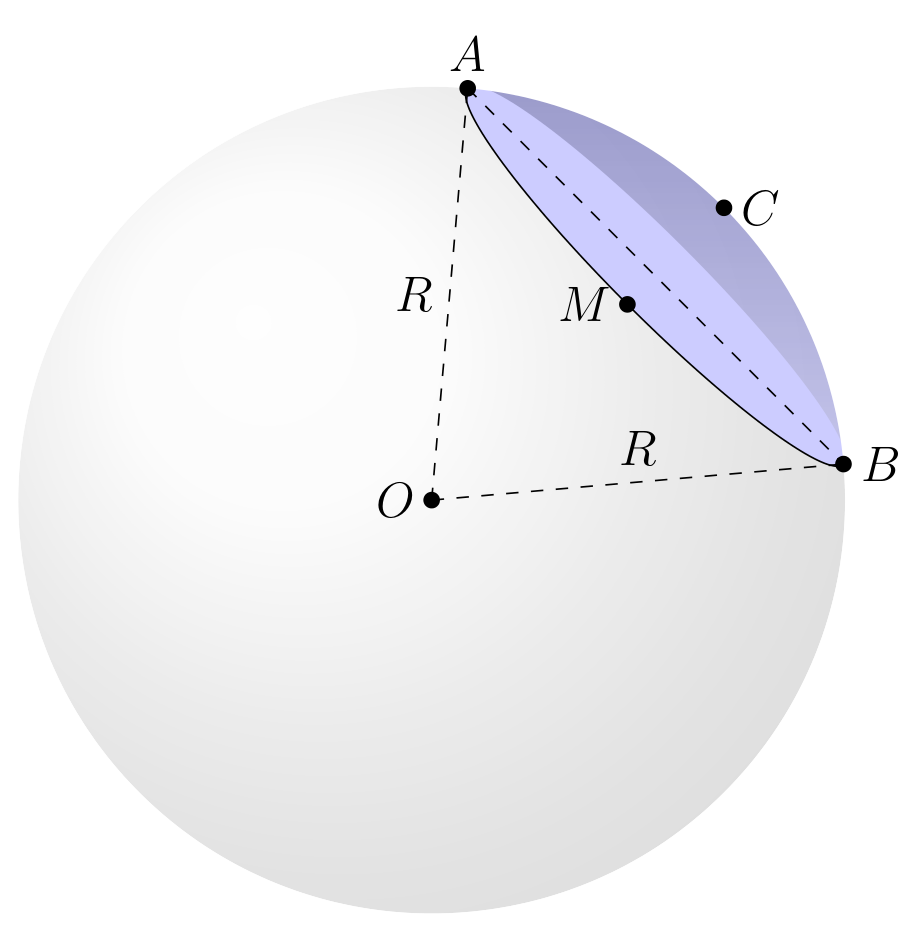
For observer in point (also in and ) the Sun is located on the horizon. The altitude of the Sun at point is equal to the angular measure of arc .
The duration of the eclipse is short, so we can assume that the shadow’s velocity is equal to the orbital velocity of the Moon moving parallel to the picture plane:
From the video, we can find that the center of the lunar shadow reaches the surface of the Earth at about 14:31 UT and leaves it at 14:47 UT. Thus, this path takes 16 minutes and the line segment
Now we can determine the arcs:
It is obvious that the arcs , and are equal due to symmetry, so
The horizontal parallax of the Sun is negligible.
Marking Scheme:
Using the author’s method:
- Duration of shadow passage — 5 pt.
- Arc length in degrees — 5 pt.
- Geometry of the problem — 5 pt.
- Altitude of the Sun: evaluation + final result — 2 pt. + 3 pt.
OR using the coordinates of the Sun:
- Accounting for local time correction — 4 pt.
- Rotation is negligible during the annular phase — 2 pt.
- Coordinates of the shadow center at the beginning/middle of the eclipse — 4 pt.
- Declination of the Sun — 2 pt.
- Time to sunset/culmination — 3 pt.
- Altitude of the Sun: evaluation + final result — 2 pt. + 3 pt.
OR using the position of the terminator (max. 15 points):
- Distance to the terminator in km and degrees — 5 pt.
- Accounting for latitude distortions on the rectangular map — 5 pt.
- Altitude of the Sun: evaluation + final result — 2 pt. + 3 pt.
This method is rough. The rectangular map projection is unknown.
Константи
| Universal | |
|---|---|
| Speed of light | |
| Planck constant | |
| Hubble constant | |
| Astronomical unit | |
| Parsec |
| Earth | |
|---|---|
| Radius | |
| Obliquity | |
| Surface gravity | |
| Orbital period | |
| Orbital eccentricity |
| Moon | |
|---|---|
| Radius | |
| Orbital period | |
| Orbital inclination |
| Sun | |
|---|---|
| Radius | |
| Absolute magnitude | (bol.) |
| Effective temperature | |
| Luminosity |
| Emission constants | |
|---|---|
| Stefan–Boltzmann | |
| Wien’s displacement |
| UBV system | Mean wavelengths |
|---|---|
| U band | |
| B band | |
| V band |
| Hydrogen spectrum | |
|---|---|
| Lyman L | Å |
| Balmer H | Å |
Оригинал в Архива: OWAO_2023_Practical_Round_Problems.pdf · официални решения: OWAO_2023_Practical_Round_Solutions.pdf