OWAO 2023, Теория — Задача 1. Ceres
ΩWAO 2023 ◇ Theoretical Round ◇ Problems
Условие
A spacecraft is in a circular orbit with radius au in the ecliptic plane. An additional speed of 5 km/s is instantly given to the spacecraft in the direction of movement, so its orbit intersects with the orbit of 1 Ceres. What will be the relative velocity of the spacecraft and Ceres when the spacecraft crosses its orbit for the first time? The distance between Ceres and the spacecraft at that time is km. Assume the orbit of Ceres to be circular with radius au. The directions of orbital motion of the objects are the same.
Отговори
6500 m/s
Official solution: m/s.
Решение
First, we determine the parameters of the orbit along which the spacecraft will move after increasing its velocity. Let us write the law of conservation of energy per unit mass of the spacecraft:
where is the current distance from the Sun and is the semi-major axis of the orbit.
Note. The mass of the Sun is not indicated in the table. Although its value is well known, it can be easily estimated using the Earth’s orbital parameters. By Kepler’s third law,
We should estimate the velocity of the spacecraft. The velocity in the initial circular orbit
The total velocity after the correction is
Therefore, taking into account (1) the semi-major axis of the elliptic orbit is
At the initial moment of time, the velocity vector was perpendicular to the heliocentric radius vector. The final velocity is also perpendicular to the radius vector, that is, after increasing the velocity, the spacecraft starts moving from the perihelion of the orbit, .
Next, we estimate the eccentricity of the orbit:
Let us determine the velocity of the spacecraft at the moment of crossing the orbit of Ceres. According to the vis-viva equation,
Next, we determine the angle between the velocity vector and the radius vector:
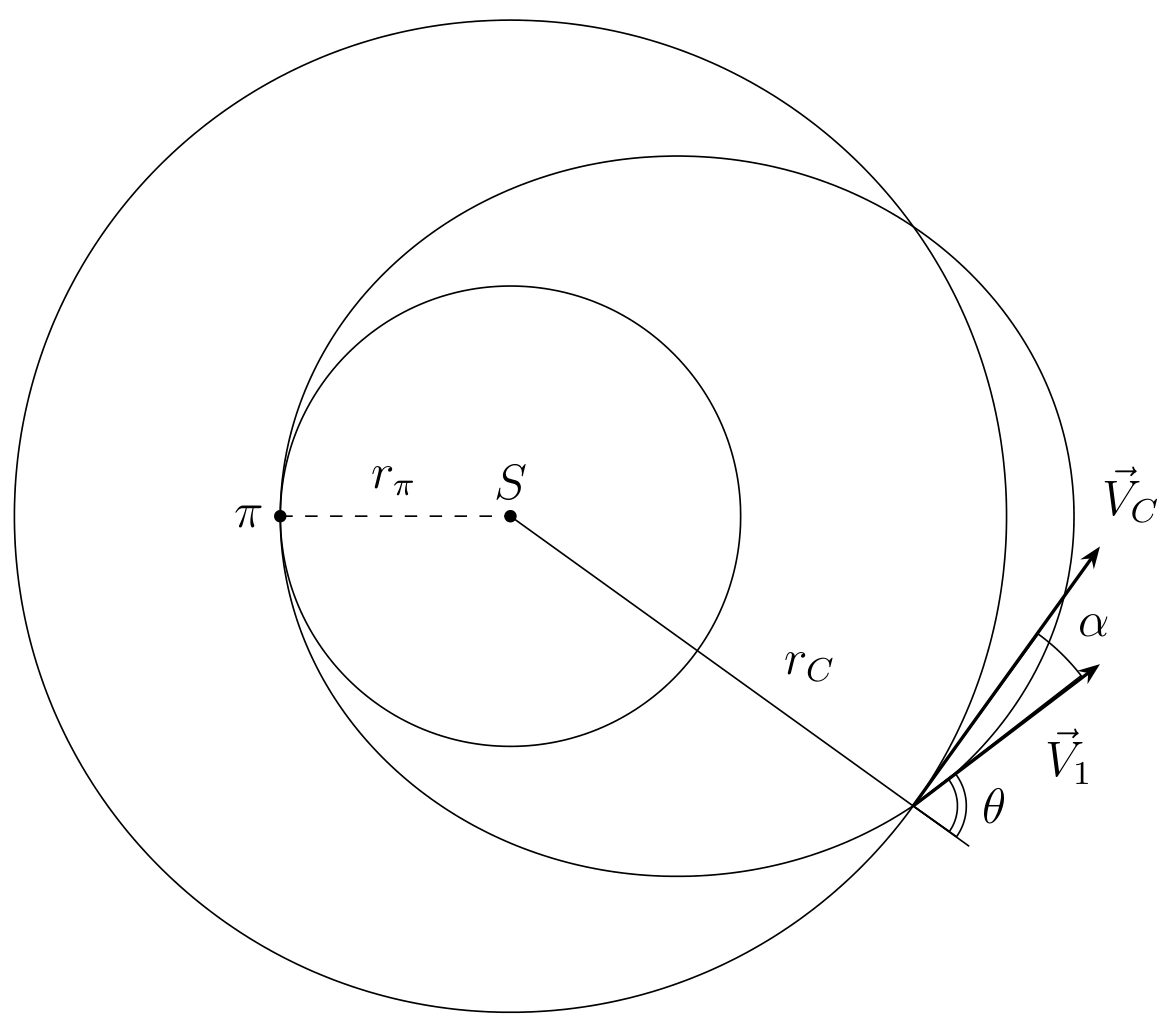
On the scale of the orbit, the distance of km is very small, so we can assume that Ceres and the spacecraft are almost at the same point of the orbit. At the same time, this distance is large enough that we can ignore the attraction of Ceres. Indeed, the radius of the Earth’s sphere of influence is km. Ceres is only 3 times farther from the Sun than the Earth, but its mass is 4 orders of magnitude less than the Earth’s.
The velocity of Ceres
is perpendicular to the radius vector. Then the angle between the velocity vectors of the spacecraft and Ceres at the approach is equal to .
Therefore, the relative velocity will be
Marking Scheme:
- Velocity of Ceres — 1 pt.
- Velocity of the spacecraft in the initial circular orbit — 1 pt.
- Velocity of the spacecraft after the correction — 1 pt.
- Semi-major axis of the elliptic orbit or proper use of energy conservation — 1 pt.
- Eccentricity or proper use of angular momentum conservation — 1 pt.
- Velocity of the spacecraft crossing the orbit of Ceres — 1 pt.
- Angle between the velocity and the radius vectors — 1 pt.
- Angle between the velocity vectors of the spacecraft and Ceres — 1 pt.
- Expression for and evaluation — 1 pt + 1 pt.
The conclusion is quite obvious, so there is no need to calculate the exact radius of the sphere of influence.
Константи
| Universal | |
|---|---|
| Speed of light | |
| Planck constant | |
| Hubble constant | |
| Astronomical unit | |
| Parsec |
| Earth | |
|---|---|
| Radius | |
| Obliquity | |
| Surface gravity | |
| Orbital period | |
| Orbital eccentricity |
| Moon | |
|---|---|
| Radius | |
| Orbital period | |
| Orbital inclination |
| Sun | |
|---|---|
| Radius | |
| Absolute magnitude | (bol.) |
| Effective temperature | |
| Luminosity |
| Emission constants | |
|---|---|
| Stefan–Boltzmann | |
| Wien’s displacement |
| UBV system | Mean wavelengths |
|---|---|
| U band | |
| B band | |
| V band |
| Hydrogen spectrum | |
|---|---|
| Lyman L | Å |
| Balmer H | Å |
Оригинал в Архива: OWAO_2023_Theoretical_Round_Problems.pdf · официални решения: OWAO_2023_Theoretical_Round_Solutions.pdf