OWAO 2023, Теория — Задача 7. One Thousand and One Nights
ΩWAO 2023 ◇ Theoretical Round ◇ Problems
Условие
On a rocky planet in a circular orbit around a star, equatorial and ecliptic coordinates are arranged in the same way as on the Earth. The local ecliptic passes through points with equatorial coordinates () and (). Calculate the fraction of the planet’s surface where polar nights can occur. Neglect the atmosphere.
Отговори
0.357
Official solution: .
Решение
First, we determine the inclination of the ecliptic to the equator as the inclination of a great circle passing through the points , .
Both the right ascension and the ecliptic longitude are counted from the local point of the vernal equinox — that is the point of intersection of the ecliptic and the celestial equator. Therefore, the inclination can be determined from a spherical triangle with vertices at the vernal equinox point ♈, a point on the ecliptic and the projection of this point on the celestial equator .
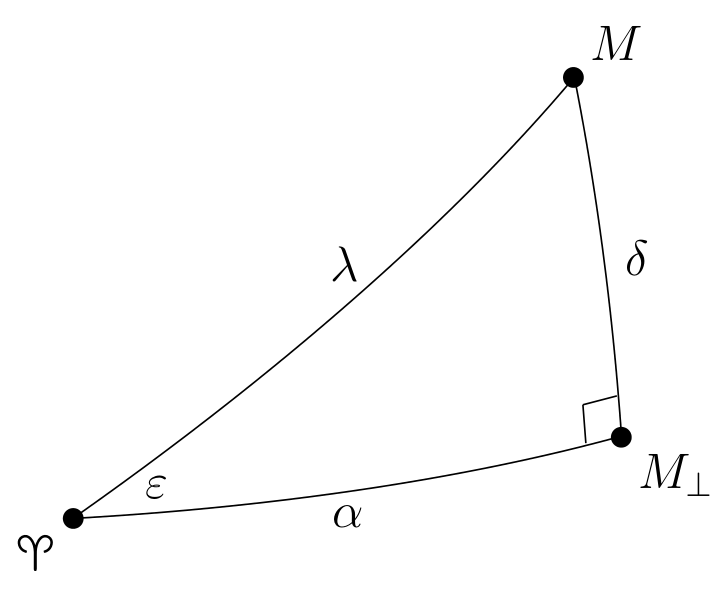
Using the five-part rule and the law of sines we obtain:
Substitution of yields
Next, we can get an estimate of the inclination from the data on any of the two points,
Another approach. We introduce a Cartesian coordinate system centered at the place of observation. The -axis is directed to the local point of the vernal equinox, the -axis is directed to the north celestial pole, the -axis complements the axes to a right-handed coordinate system. The vectors of two points are as follows:
Next, we determine the vector of the pole of the great circle (namely, the north ecliptic pole) using the vector product
where
points to the north ecliptic pole. and are the declination and the right ascension of the north ecliptic pole respectively,
Polar nights are possible only at latitudes with a modulus greater than . The corresponding points form two spherical caps around the poles. Let us determine the fraction of the planet’s surface with latitudes modulus more than :
where
is the height of the spherical cap.
Finally,
Marking Scheme:
Inclination of the ecliptic.
In case of using spherical trigonometry:
- Distance between two points on a sphere — 2 pt.
- Choosing a valid spherical triangle — 2 pt.
- Inclination — 1 pt.
It is acceptable to write the great circle equation for the ecliptic in polar coordinates without derivation.
In case of using Cartesian coordinates:
- Conversion from ecliptic coordinates to Cartesian coordinates: formula + evaluation — 1 pt + 1 pt.
- Vector multiplication — 2 pt.
- Inclination — 1 pt.
Fraction of the surface with polar nights:
- Limiting latitudes () — 2 pt.
- Area of spherical caps — 2 pt.
- Fraction — 1 pt.
Константи
| Universal | |
|---|---|
| Speed of light | |
| Planck constant | |
| Hubble constant | |
| Astronomical unit | |
| Parsec |
| Earth | |
|---|---|
| Radius | |
| Obliquity | |
| Surface gravity | |
| Orbital period | |
| Orbital eccentricity |
| Moon | |
|---|---|
| Radius | |
| Orbital period | |
| Orbital inclination |
| Sun | |
|---|---|
| Radius | |
| Absolute magnitude | (bol.) |
| Effective temperature | |
| Luminosity |
| Emission constants | |
|---|---|
| Stefan–Boltzmann | |
| Wien’s displacement |
| UBV system | Mean wavelengths |
|---|---|
| U band | |
| B band | |
| V band |
| Hydrogen spectrum | |
|---|---|
| Lyman L | Å |
| Balmer H | Å |
Оригинал в Архива: OWAO_2023_Theoretical_Round_Problems.pdf · официални решения: OWAO_2023_Theoretical_Round_Solutions.pdf