OWAO 2023, Теория — Задача 9. Get Into the Loop
ΩWAO 2023 ◇ Theoretical Round ◇ Problems
Условие
An artificial satellite moves in an orbit with eccentricity , semi-major axis , and inclination . The argument of perigee . Assume the Earth to be an ideal sphere rotating at a constant angular velocity .
a) What are the satellite’s geographic latitude and longitude depending on the true anomaly ?
b) Consider a satellite in a geosynchronous orbit () with and rad. Calculate the ground track of the satellite (projection of the trajectory onto the surface of the rotating Earth) and draw it. For convenience, use the answer sheet with table and graph grid.
Hint:
Отговори
- a)
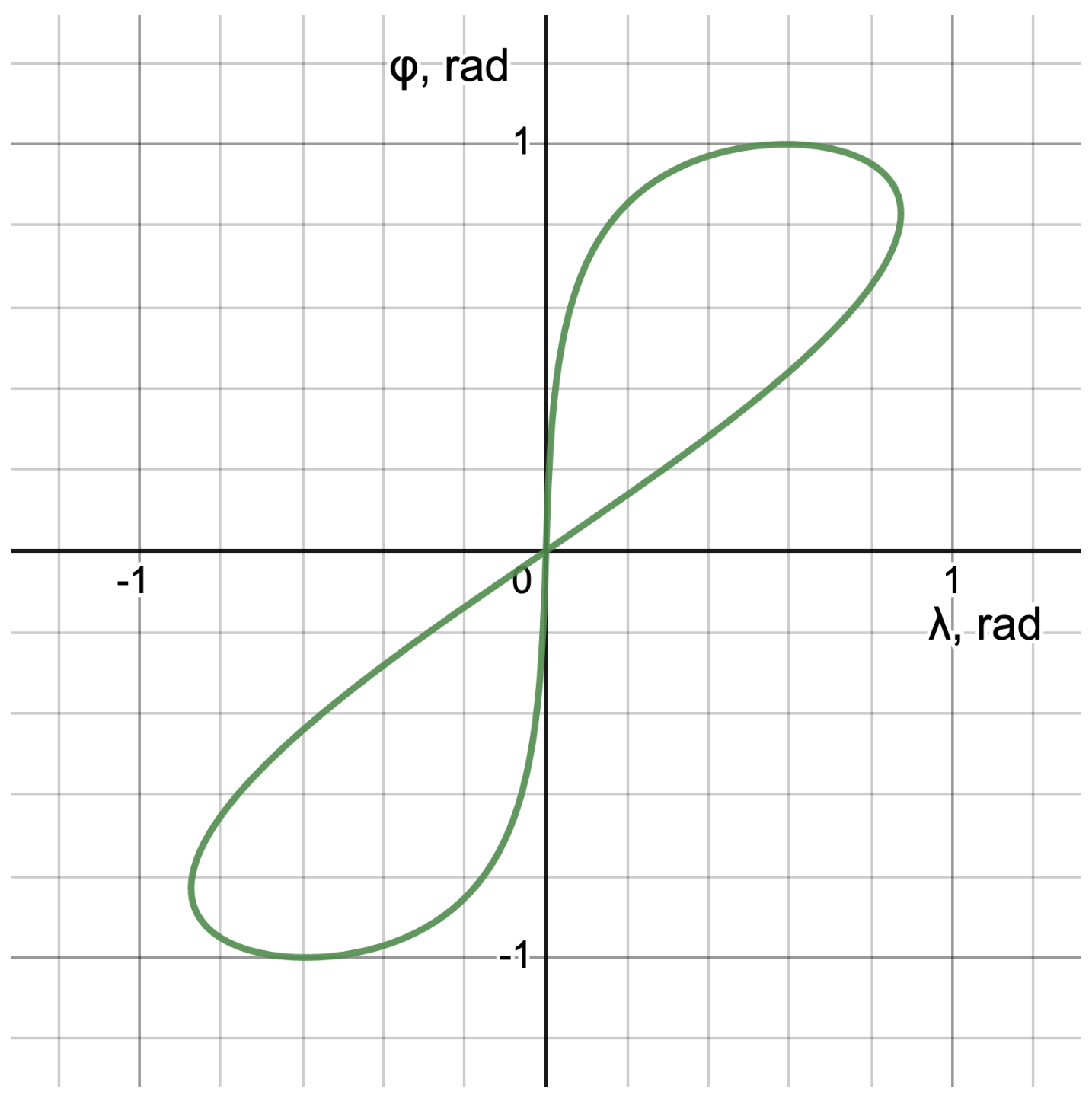
- b) The ground track is a closed figure-eight loop through the origin, symmetric under , with latitude reaching rad (plot in the official solution).
Решение
a) Let the origin point be the ascending node of the satellite’s orbit — in this problem it coincides with perigee (). For the respective spherical triangle:
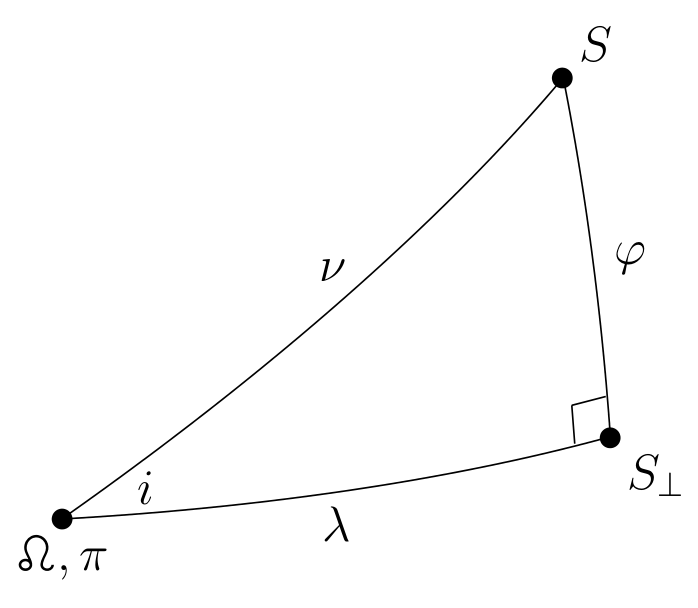
Taking into account the rotation of the Earth, we may put down the geographical coordinates of the satellite:
Due to rotational symmetry, the longitude of the satellite is determined up to a shift by an arbitrary constant value.
The angular momentum of the satellite is conserved,
At the same time, the geocentric distance of the satellite depends on its true anomaly:
Therefore,
Next, we can replace the integration variable in (3):
b) For geosynchronous orbit
so we can simplify the expression above a bit:
Thoughts on plotting. It is pretty obvious that the relative motion of the satellite is periodical and the track is closed. To plot the graph, we have to calculate and values for in range from to . In fact, the work can be simplified by noting that
so it is enough to probe the range of from 0 to , and then mirror the results.
Also, note that is ambiguous. follows the motion of the satellite, therefore arctan should be re-defined to become a continuous function for :
Here is “conventional” inverse trigonometric function ranged from to . Of course, . Such a trick does not affect the parts of the expression that came along with that remarkable integral, since appears there as an argument.
For calculations, it is convenient to substitute the values of and and regroup:
Finally, here is the plot we need:
Marking Scheme:
- Expression for latitude — 3 pt.
- Expression for longitude — 3 pt.
- Angular momentum conservation — 3 pt.
- Accounting the rotation of the Earth, like (3) — 3 pt.
- Expression for longitude taking into account rotation — 3 pt.
- Angular velocity of a geosynchronous satellite — 2 pt.
- Plot of the ground track — 3 pt.
Константи
| Universal | |
|---|---|
| Speed of light | |
| Planck constant | |
| Hubble constant | |
| Astronomical unit | |
| Parsec |
| Earth | |
|---|---|
| Radius | |
| Obliquity | |
| Surface gravity | |
| Orbital period | |
| Orbital eccentricity |
| Moon | |
|---|---|
| Radius | |
| Orbital period | |
| Orbital inclination |
| Sun | |
|---|---|
| Radius | |
| Absolute magnitude | (bol.) |
| Effective temperature | |
| Luminosity |
| Emission constants | |
|---|---|
| Stefan–Boltzmann | |
| Wien’s displacement |
| UBV system | Mean wavelengths |
|---|---|
| U band | |
| B band | |
| V band |
| Hydrogen spectrum | |
|---|---|
| Lyman L | Å |
| Balmer H | Å |
Оригинал в Архива: OWAO_2023_Theoretical_Round_Problems.pdf · официални решения: OWAO_2023_Theoretical_Round_Solutions.pdf