OWAO 2024, Практически тур — Задача 2. Support Service
2024 ⋄ Practical Round ⋄ Problems · 20 т.
Указания
The practical round is 5 hours long and accounts for 30 % of the total grade.
The maximum score for each problem is 20 points. The round total is 60 points.
Paper and electronic versions of problems are identical. The necessary files can be downloaded from the testing system.
Please present your solution as an electronic report, containing information about your work, plots and tables, intermediate and final results, and conclusions.
Please include your participant code (string like
AA-1) at the beginning of each report.Submit your report in PDF format. If necessary, also attach working files (images, source code, etc.). ZIP format archives are accepted. The maximum file upload size is 10 MB.
During the practical round, you can use:
- browser, e. g. Google Chrome/Chromium,
- text editor, e. g. Microsoft Word/LibreOffice Writer/Google Docs,
- spreadsheet editor, e. g. Microsoft Excel/LibreOffice Calc/Google Sheets.
You may also use:
- development tools, e. g. Python & Jupyter Notebook,
- graphic editors, e. g. Paint/GIMP,
- other applications for data processing, analysis, report generation, including online applications (Google Colab, Desmos, etc.).
This is an individual competition. You must not use collaborative tools and functions.
You may find and use documentation for the software and libraries used but not reference literature on astronomy, physics and mathematics.
Please remember that the jury may not understand your language. It is expected that solutions are written in plain English. Use mathematical expressions, numbers and images.
Some problems are quite difficult. Remember that partial solutions are also scored.
A list of constants is given on page 8.
Go to https://my.sirius.online/, log in with your email and password, and select the Practical round. The countdown will begin after you click the Start button.
Good luck!
Условие
An analemma (from Ancient Greek αναλημμα – “support”) is a diagram showing the position of the Sun in the sky as seen from a fixed location on the Earth at the same mean solar time, as that position varies over the course of a year. It is directly related to the so-called equation of time — the difference between mean and true solar time (that is, the difference between the right ascensions of the true and mean Sun):
This difference is due to two reasons: the tilt of the planet’s axis of rotation (obliquity) and the eccentricity of its orbit.
Assume the planet pass perihelion at the moment . If the planet moved uniformly, its position would be determined by the mean anomaly
where is the orbital period of the planet.
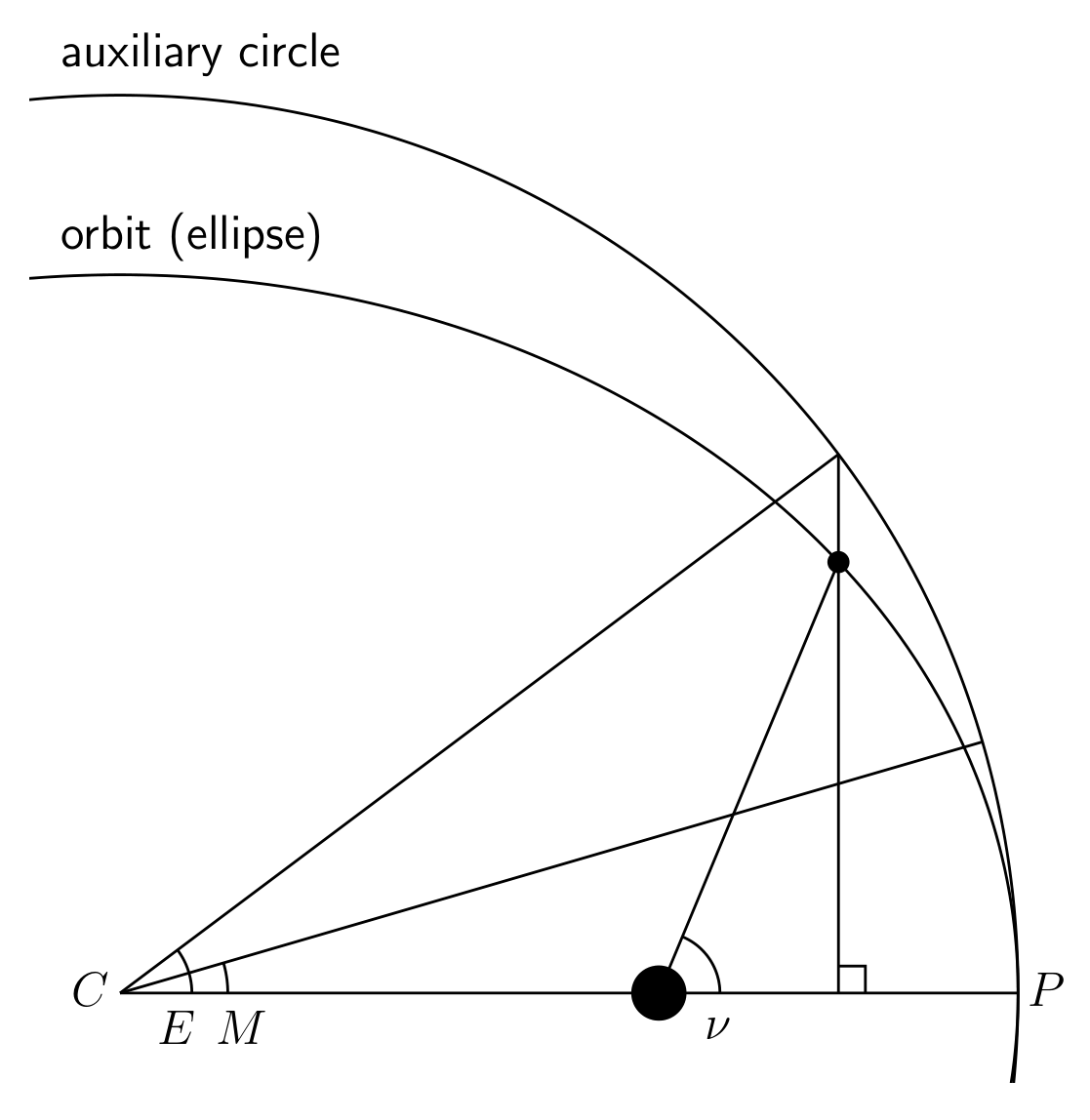
The actual position of the planet in its orbit is determined by the true anomaly . The true anomaly is geometrically related to the eccentric anomaly , which shows the position of some imaginary point on the auxiliary circle (see Figure 1).
Please note that
where is the eccentricity of the planet’s orbit. Also, the mean and eccentric anomalies (expressed in radians) are related by Kepler’s equation:
Please include your participant code at the beginning of your report.
a) Plot the difference as a function of time for the orbits of the Earth and Mars. For convenience, express in “local” minutes: 1 solar day 24 hours, 1 hour 60 minutes.
Let be the ecliptic longitude of the planet’s perihelion, measured from the vernal equinox for this planet. You can find the corresponding values in the Constants Table.
b) Express the “local” ecliptic longitude of the Sun in terms of and .
Hour angles and right ascensions are measured along the celestial equator. Since the ecliptic is inclined to the celestial equator by an angle of , both of these parameters are related to the ecliptic longitude nonlinearly. For example, for right ascension we have:
c) Plot the difference expressed in “local” minutes as a function of time for the orbits of the Earth and Mars.
The equation of time can be represented as the sum
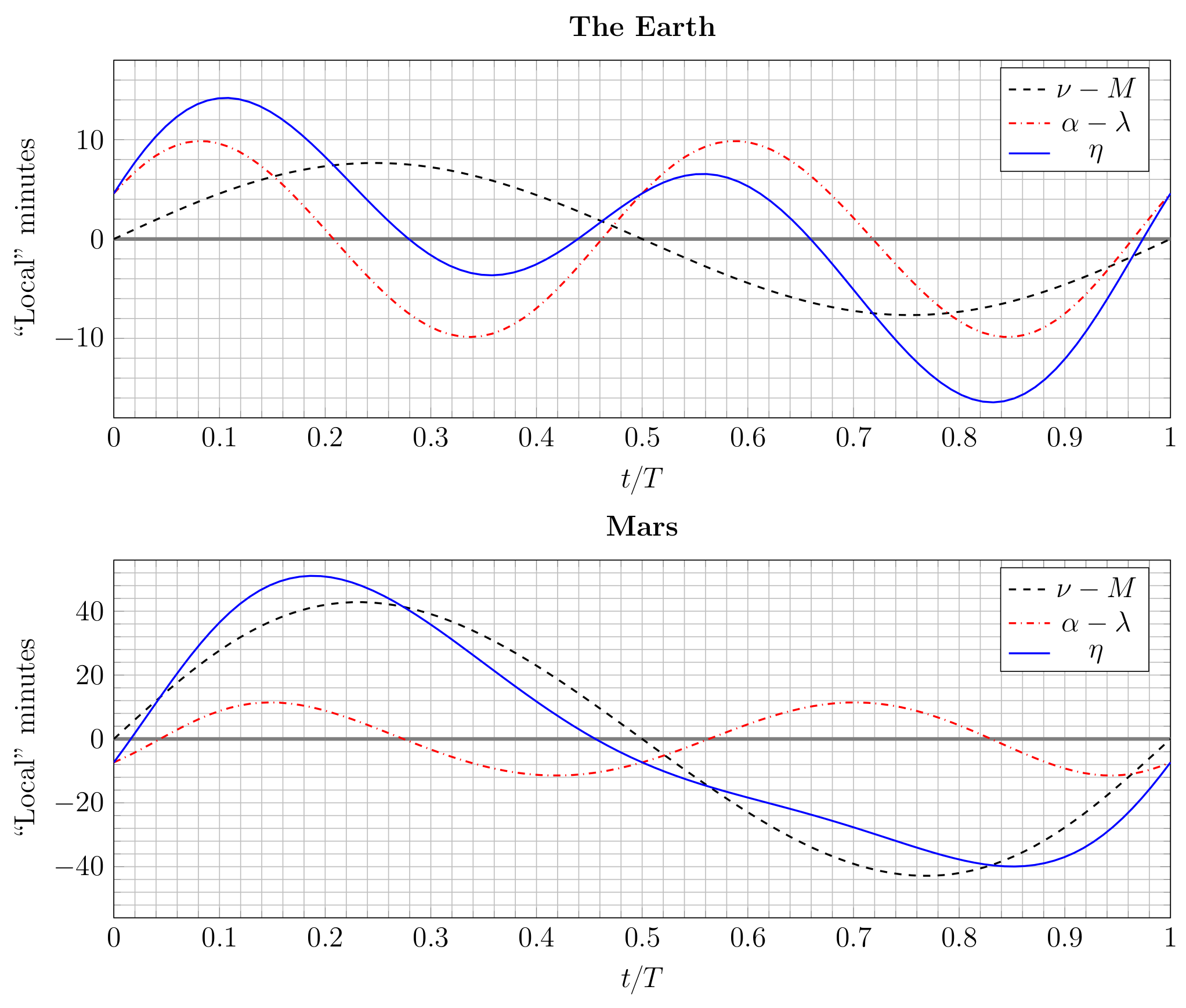
d) Plot the equation of time expressed in “local” minutes as a function of time for the orbits of the Earth and Mars.
The declination of the Sun can be expressed by the formula
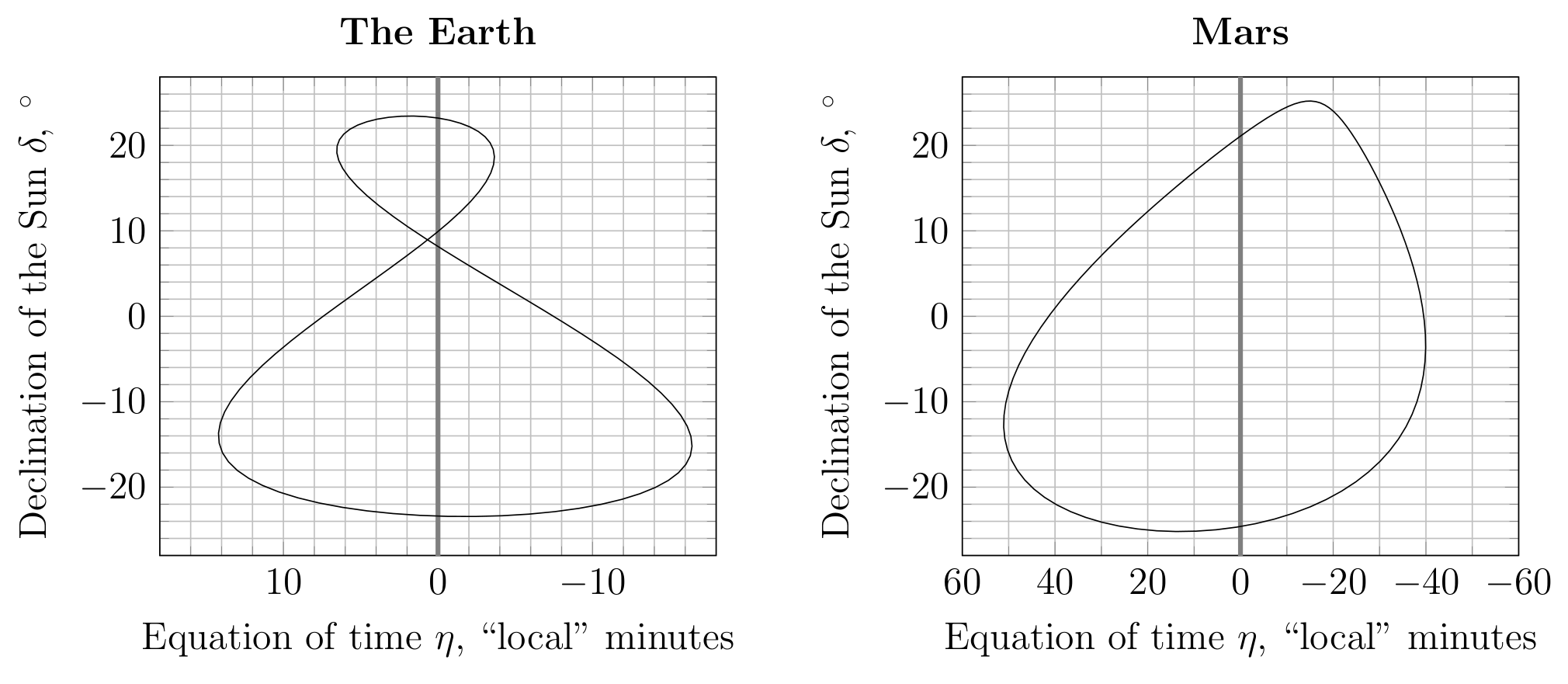
e) Plot the analemma corresponding to mean noon for an observer at mid-latitudes of the Northern Hemisphere of the Earth and Mars (north is up, west is to the right).
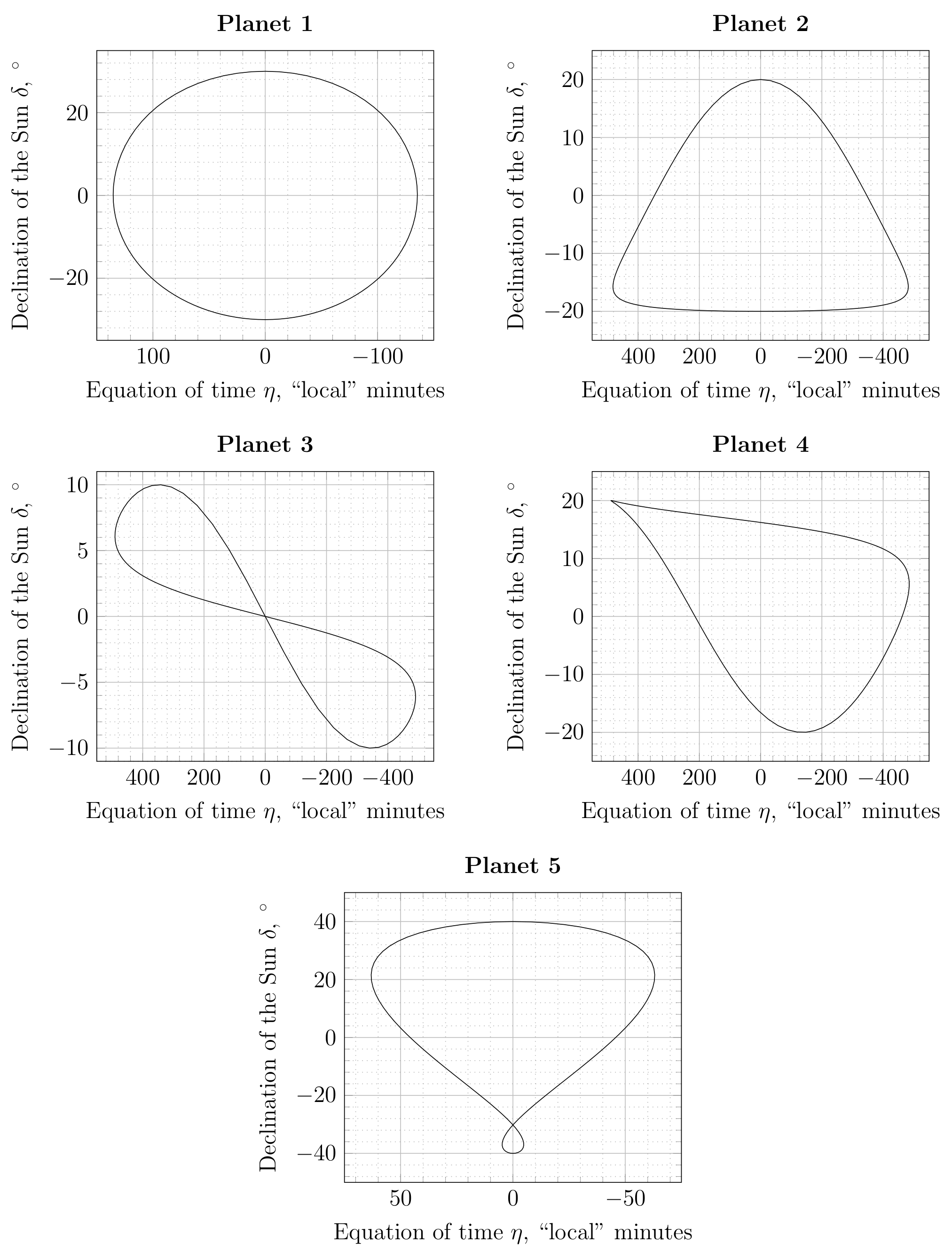
f) There are the analemmas of five imaginary planets in Figure 2. Determine the parameters , , and for each model. In case there are several possible answers, please provide any.
Отговори
b)
f) Planet 1: e = 0.3, x = 90°, ε = 30°; Planet 2: e = 0.9, x = 90°, ε = 20°; Planet 3: e = 0.9, x = 0°, ε = 10°; Planet 4: e = 0.9, x = 305°, ε = 20°; Planet 5: e = 0.1, x = 90°, ε = 40°
Possible values from the official solution; other equivalent answers are accepted.
Решение
Solution:
a) It is convenient to use the eccentric anomaly as a parameter. For to we can tabulate calculations in radians:
where if , and if .
To convert the obtained results from radians to “local” minutes we have to multiply them by factor .
b) Parameters , , and are measured along the “local” ecliptic in the same direction. Also . When the planet is at the perihelion, and , so
c) The right ascension
where integer is chosen so that when , and when . Please do not forget to convert the results to the local minutes!
d–e) We have everything we need to plot the following graph:
See Figures 5 and 6.
f) Varying parameters , , and , we can adjust the calculated analemmas to the model ones.
Note that the maximum Sun declination for each planet is . A symmetric figure means that is divisible by .
The possible values of , , and for each model planet are shown in the table below:
| Planet | 1 | 2 | 3 | 4 | 5 |
|---|---|---|---|---|---|
| 0.3 | 0.9 | 0.9 | 0.9 | 0.1 | |
| , | 90 | 90 | 0 | 305 | 90 |
| , | 30 | 20 | 10 | 20 | 40 |
Marking Scheme:
- Question (a) — 3 pt.
- Question (b) — 1 pt.
- Question (c) — 3 pt.
- Question (d) — 2 pt.
- Question (e) — 4 pt.
- Question (f)
- : method — 1 pt. + values — 0.4 pt. × 5 = 2 pt.
- : method — 1 pt. + values — 0.2 pt. × 5 = 1 pt.
- : method — 1 pt. + values — 0.2 pt. × 5 = 1 pt.
Note. In the original formulation of the problem, the notation could be understood ambiguously. Using the well-known ideas about the Earth’s orbit (the Earth passes the perihelion on January 2–5) one could easily guess how to interpret this designation correctly. However, solutions with an “inverted” ecliptic longitude of the pericenter are assessed without penalty.
Константи
Universal
| Speed of light | |
| Planck constant | |
| Boltzmann constant | |
| Gas constant | |
| Proton mass |
Astronomical
| Astronomical unit | |
| Parsec | |
| Hubble constant |
Sun
| Radius | |
| Mass | |
| Absolute magnitude | (bol.) |
| Effective temperature | |
| Luminosity |
Earth
| Radius | |
| Sidereal day | |
| Obliquity of ecliptic | |
| Surface gravity | |
| Orbital period | |
| Orbital eccentricity | |
Mars
| Radius | |
| Sidereal day | |
| Obliquity (axial tilt) | |
| Orbital semi-major axis | |
| Orbital period | |
| Orbital eccentricity | |
Оригинал в Архива: OWAO-2024-prob-P.pdf · официални решения: OWAO-2024-sol-P.pdf