OWAO 2024, Теория — Задача 2. Satellite Tracking
ΩWAO 2024 ◇ Theoretical Round ◇ Problems · 20 т.
Указания
- The theoretical round is 5 hours long and accounts for 40 % of the total grade.
- The maximum score for each problem is 20 points. The round total is 180 points.
- There are Answer Sheets to write down detailed solutions.
On each Answer Sheet, please fill in
- Student code
- Problem number
- Page number and total number of pages in the submitted work
- Start each problem on a separate Answer Sheet.
- Please write only on the printed side of the sheet. Do not write on the reverse side.
- Your work will be scanned. Please use a pen so that the writing is clearly visible on the scan. Duplicate pencil lines with a pen.
- Please remember that the jury may not understand your language. It is expected that solutions are written in plain English. Use mathematical expressions, numbers and drawings.
- If you wrote something that you do not want to be marked, just cross it out like this.
- Draft papers will not be graded.
- Some problems are quite difficult. Remember that partial solutions are also scored.
- A list of constants is given on page 4.
Good luck!
Условие
A satellite is moving in a circular orbit around the Earth with an inclination of and an orbital radius of 30 000 km. At noon, the satellite passes through the zenith at a point with coordinates .
a) At which point of the Earth will the satellite pass through the zenith after 3 hours?
b) At what astronomical altitude will it be for the observer at while passing over ?
Отговори
- a) (19° N, 39° E) or (19° S, 39° E)
- b) 47 °
Решение
a) Since the inclination is positive and does not exceed , the orbital motion of the satellite occurs in the same direction as the rotation of the Earth around its axis. We should consider two cases, since it is not known whether the satellite rises above the plane of the equator or falls below the equator.
Let us consider the case when the satellite rises above the equator. First, we will determine by Kepler’s third law how many degrees of its orbit ( km) the satellite will fly during the time h:
The satellite has completed less than a quarter of its orbit.
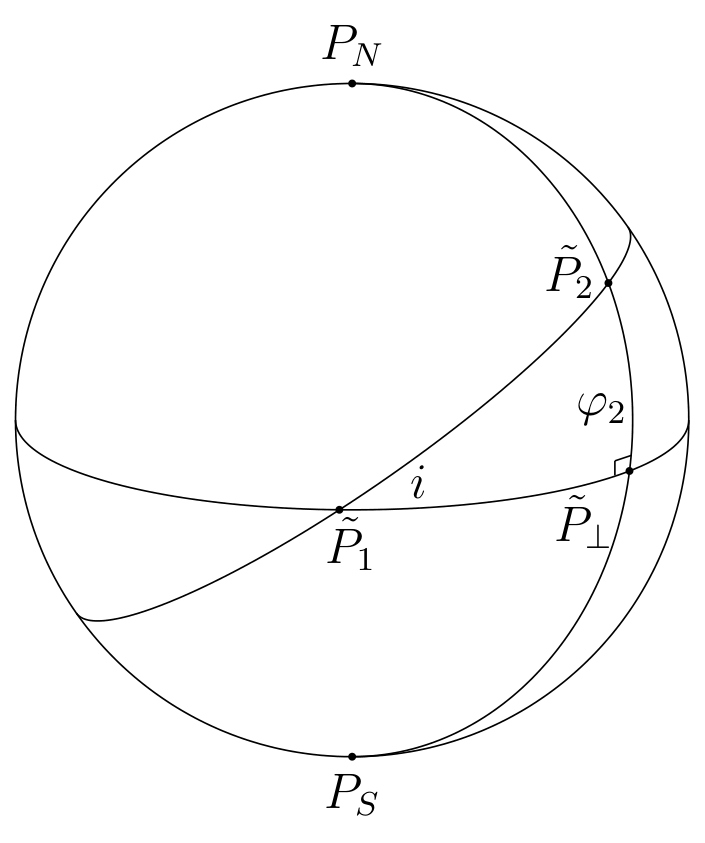
Now we assume that the Earth does not rotate — we will take this effect into account when obtaining the final longitude of the second point.
Let and be the projections of positions of the satellites and on the non-rotating Earth (see Figure 2). The goal is to find the coordinates of the point .
We draw a perpendicular from the point to the equator. Using spherical laws for one can write
The longitude is determined unambiguously
In 3 hours, the Earth will turn in the same direction as the satellite, at an angle
Then the actual longitude of the point is .
The latitude of is .
Recalling that there are two cases of satellite motion (the starting point could be an ascending or descending node of the orbit), we write down the possible coordinates of point :
b) First, we determine the angular distance between the observation points:
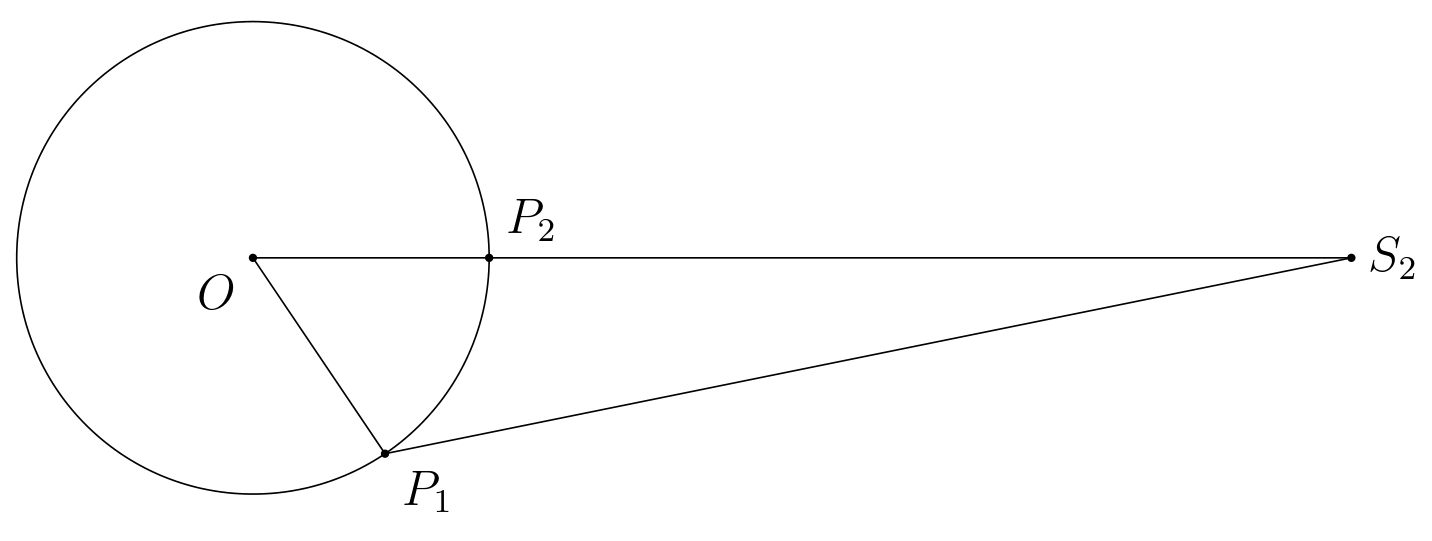
Next, we determine the distance from point to the satellite (point ) by the law of cosines (see Figure 3):
Finally, we determine the angle :
We conclude that from the point , the satellite is observed at the altitude of .
Marking Scheme:
- Question (a)
- Arc that the satellite passes in 3 hours — 2 pt.
- Geometric model, mentioning two cases — 2 pt. + 1 pt.
- Expressions for — 4 pt.
- Taking into account the rotation of the Earth — 3 pt.
- Coordinates of — 2 pt.
- Question (b) 6. Geometric model — 2 pt. 7. Angular distance between and — 1 pt. 8. Distance — 1 pt. 9. Altitude of at — 2 pt.
Константи
| Universal | |
|---|---|
| Speed of light | |
| Planck constant | |
| Boltzmann constant | |
| Gas constant | |
| Proton mass | |
| Astronomical | |
| Astronomical unit | |
| Parsec | |
| Hubble constant | |
| Earth | |
| Radius | |
| Mass | |
| Obliquity of ecliptic | |
| Surface gravity | |
| Orbital period | |
| Orbital eccentricity | |
| Hydrogen spectrum | |
| Lyman L | Å |
| Balmer H | Å |
| Jupiter | |
| Radius | |
| Mass | |
| Orbital radius | |
| Orbital period | |
| Sun | |
| Radius | |
| Mass | |
| Absolute magnitude | (bol.) |
| Effective temperature | |
| Luminosity | |
| Emission constants | |
| Stefan–Boltzmann | |
| Wien’s displacement | |
| UBV system | Mean wavelengths |
| U band | |
| B band | |
| V band |
Number of Siriuses in the Solar system
Оригинал в Архива: OWAO-2024-prob-T.pdf · официални решения: OWAO-2024-sol-T.pdf