OWAO 2025, Теория — Задача 2. Winter Ensemble
2025 ◇ Theoretical Round ◇ Problems
Внимание: Бележка към темата
All eight whole original tasks and 29 lettered parts, complete official worked solutions, alternatives and marking schemes are retained. Constants are native question page 5 and repeated key page 31, fully transcribed once as a shared reference. No paper/time/task/part total is printed, so no totals are inferred from marking criteria. Source mathematical/subscript/endpoint/equality discrepancies are preserved with attributed local notes. The separately printed cooler-star Criterion (x) remains inside original task 8; no extra problem is created.
Константи
Universal
| Gravitational constant | |
| Speed of light | |
| Planck constant | |
| Boltzmann constant | |
| Gas constant | |
| Proton mass |
Astronomical
| Astronomical unit | |
| Parsec | |
| Hubble constant |
Earth
| Radius | |
| Mass | |
| Obliquity of ecliptic | |
| Surface gravity | |
| Orbital period | |
| Orbital eccentricity |
Hydrogen spectrum
| Lyman | |
| Balmer |
Jupiter
| Radius | |
| Mass | |
| Orbital radius | |
| Orbital period |
Sun
| Radius | |
| Mass | |
| Absolute magnitude | |
| Effective temperature | |
| Luminosity | |
| Color index |
Emission constants
| Stefan-Boltzmann | |
| Wien’s displacement |
UBV… system — Mean wavelengths
| U band | |
| B band | |
| V band | |
| K band |
Условие
The Winter Triangle is an asterism formed by Sirius, Procyon, and Betelgeuse. Their equatorial coordinates are listed in the table.
| Star | Right Ascension | Declination |
|---|---|---|
| Sirius | ||
| Procyon | ||
| Betelgeuse |
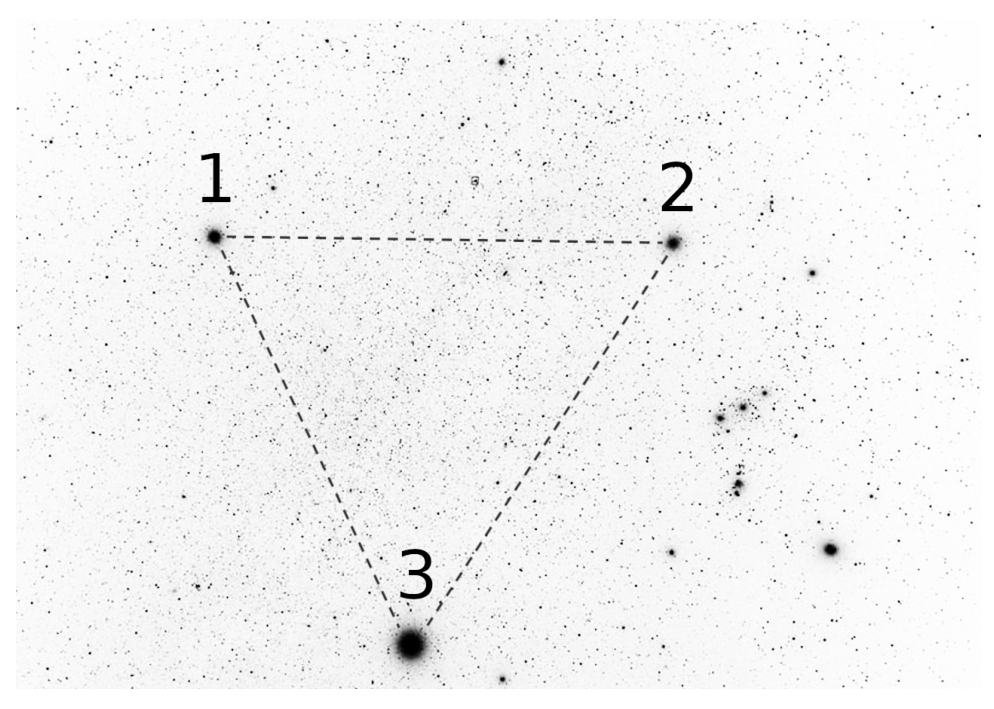
a) Write down which star is labeled by each number.
b) On what fraction of the Earth’s surface are all three stars of the Winter Triangle ALWAYS above the horizon?
c) On what fraction of the Earth’s surface can all three stars be above the horizon AT THE SAME TIME at least sometimes?
d) At what latitude can all three stars be at the same altitude AT THE SAME TIME?
Neglect atmospheric refraction.
Отговори
- a) 1: Procyon; 2: Betelgeuse; 3: Sirius.
- b) Zero.
- c) .
- d) ; northern case near the nadir, southern case near the zenith.
Решение
a) The stars in the figure can be identified in several ways. Betelgeuse (2) is located in the constellation of Orion, whose distinct asterism is clearly visible in the picture. Sirius, labeled number 3, is the brightest star in the night sky. Procyon is labeled number 1.
Celestial coordinates provide another method for orientation. The position of the Orion constellation is well-known — the celestial equator passes through Orion’s belt. The star number 3 (Sirius) has a negative declination, as it lies noticeably lower in the sky. The remaining two stars can be distinguished by their right ascension. In the diagram, Procyon (1) is to the left of Betelgeuse (2), consistent with right ascension increasing counterclockwise when viewing the celestial sphere from the north.
b) The Winter Triangle asterism includes stars both above and below the celestial equator. For a star to be circumpolar at a given location, its declination must share the sign of the location’s latitude. Since the Winter Triangle contains stars with opposing declinations, it is impossible for the entire asterism to be circumpolar simultaneously at any point on the Earth. Therefore, the fraction of the Earth’s surface from which the entire Winter Triangle is circumpolar is zero.
c) To determine the latitudes from which all stars in the asterism are visible (i.e., they all rise above the horizon), we require that each star’s upper culmination altitude is non-negative: . Let us find the range of latitudes that satisfies this condition for both the northernmost and southernmost stars in the group:
We have so far determined the range of latitudes where all stars in the asterism are theoretically visible (i.e., they each rise above the horizon at some point). However, we should verify that they can be observed simultaneously.
At the northernmost latitude, we verify whether the other two stars are above the horizon at the moment of Sirius’s upper culmination. This occurs when the local sidereal time equals Sirius’s right ascension: .
At the same moment the hour angles of Betelgeuse and Procyon are
We then calculate the stars’ altitudes at these hour angles:
At this moment, the other two stars are indeed above the horizon. As the latitude decreases from this maximum, the altitudes of all stars at culmination will initially increase. This continues until the northernmost star reaches the zenith. After this point, the culmination altitudes will begin to decrease as the stars culminate north of the zenith.
Similarly, for the southernmost latitude, we check the visibility of the other stars at the moment of Betelgeuse’s upper culmination, which corresponds to the sidereal time . The hour angles of Sirius and Procyon are:
We then calculate the stars’ altitudes at these hour angles:
At the moment of Betelgeuse’s upper culmination, the other two stars are also confirmed to be above the horizon.
Therefore, the entire range of latitudes from to is suitable for simultaneously observing the asterism. The fraction of the Earth’s surface area within this latitudinal range is given by
d) If the altitudes of all stars in the triangle are equal, the zenith must be equidistant from the vertices of the triangle on the celestial sphere. Our goal is to find the equatorial coordinates of this point, which is equidistant from the three stellar positions.
On the unit sphere, the condition for equal angular distances is equivalent to the dot products between the unit vector to the zenith and the unit vectors to each star being equal. Representing these vectors in the Cartesian equatorial coordinate system, we have:
We can solve the system by first expressing and in terms of using the first two equations. Substituting these expressions into the third equation yields an equation for .
The declination of the zenith point corresponds directly to the observer’s latitude. Therefore, the possible observation latitudes are .
Furthermore, the geometry of the configuration indicates that for an observer in the northern hemisphere the point of equal altitude will be located near the nadir. Conversely, for an observer in the southern hemisphere it will be near the zenith.
Marking Scheme:
- Question (a) Star identification 3 pt.: 1 pt for each correctly identified star
- Question (b) Always above the horizon
- Any meaningful drawing — 1 pt.
- Any sound reasoning based on the drawing or celestial coordinates. If there is no picture, full points are still given for this part if the reasoning remains sound — 2 pt.
- Correct answer (0) — 2 pt.
- Question (c) Sometimes above the horizon
- Any approximately correct culminations are written down — 2 pt.
- Proof of simultaneity by any correct method — 2 pt.
- Correct formula for the area of the spherical segment (fraction of sphere) — 1 pt.
- Correct numerical answer — 1 pt.
- Question (d) Together at the same altitude
- Idea for finding the answer (understanding that it depends only on latitude and that an equidistant point needs to be found) — 2 pt.
- Correct analytical (formula-based) implementation of the idea — 2 pt.
- Correct numerical answer for latitude — 1 pt.
- Statement about two possible answers (latitudes) — 1 pt.
Теми и трудност
Оценена трудност: 3/5.
Небесна сфера и сферична астрономия · Небесни координати · Денонощно движение и видимост · Звездни карти и съзвездия
Предпоставки: Гимназиална подготовка, Разширена олимпиадна подготовка
Оригинал в Архива: OWAO_2025_Theoretical_Problems.pdf · официални решения: OWAO_2025_Theoretical_Solutions.pdf