OWAO 2025, Теория — Задача 8. Stellar Blends
2025 ◇ Theoretical Round ◇ Problems
Внимание: Бележка към темата
All eight whole original tasks and 29 lettered parts, complete official worked solutions, alternatives and marking schemes are retained. Constants are native question page 5 and repeated key page 31, fully transcribed once as a shared reference. No paper/time/task/part total is printed, so no totals are inferred from marking criteria. Source mathematical/subscript/endpoint/equality discrepancies are preserved with attributed local notes. The separately printed cooler-star Criterion (x) remains inside original task 8; no extra problem is created.
Константи
Universal
| Gravitational constant | |
| Speed of light | |
| Planck constant | |
| Boltzmann constant | |
| Gas constant | |
| Proton mass |
Astronomical
| Astronomical unit | |
| Parsec | |
| Hubble constant |
Earth
| Radius | |
| Mass | |
| Obliquity of ecliptic | |
| Surface gravity | |
| Orbital period | |
| Orbital eccentricity |
Hydrogen spectrum
| Lyman | |
| Balmer |
Jupiter
| Radius | |
| Mass | |
| Orbital radius | |
| Orbital period |
Sun
| Radius | |
| Mass | |
| Absolute magnitude | |
| Effective temperature | |
| Luminosity | |
| Color index |
Emission constants
| Stefan-Boltzmann | |
| Wien’s displacement |
UBV… system — Mean wavelengths
| U band | |
| B band | |
| V band | |
| K band |
Условие
The figure shows the light curve of an eclipsing binary system observed in the band. The eclipses in the system are central. Both components are main-sequence stars, and one has spectral type A0V.
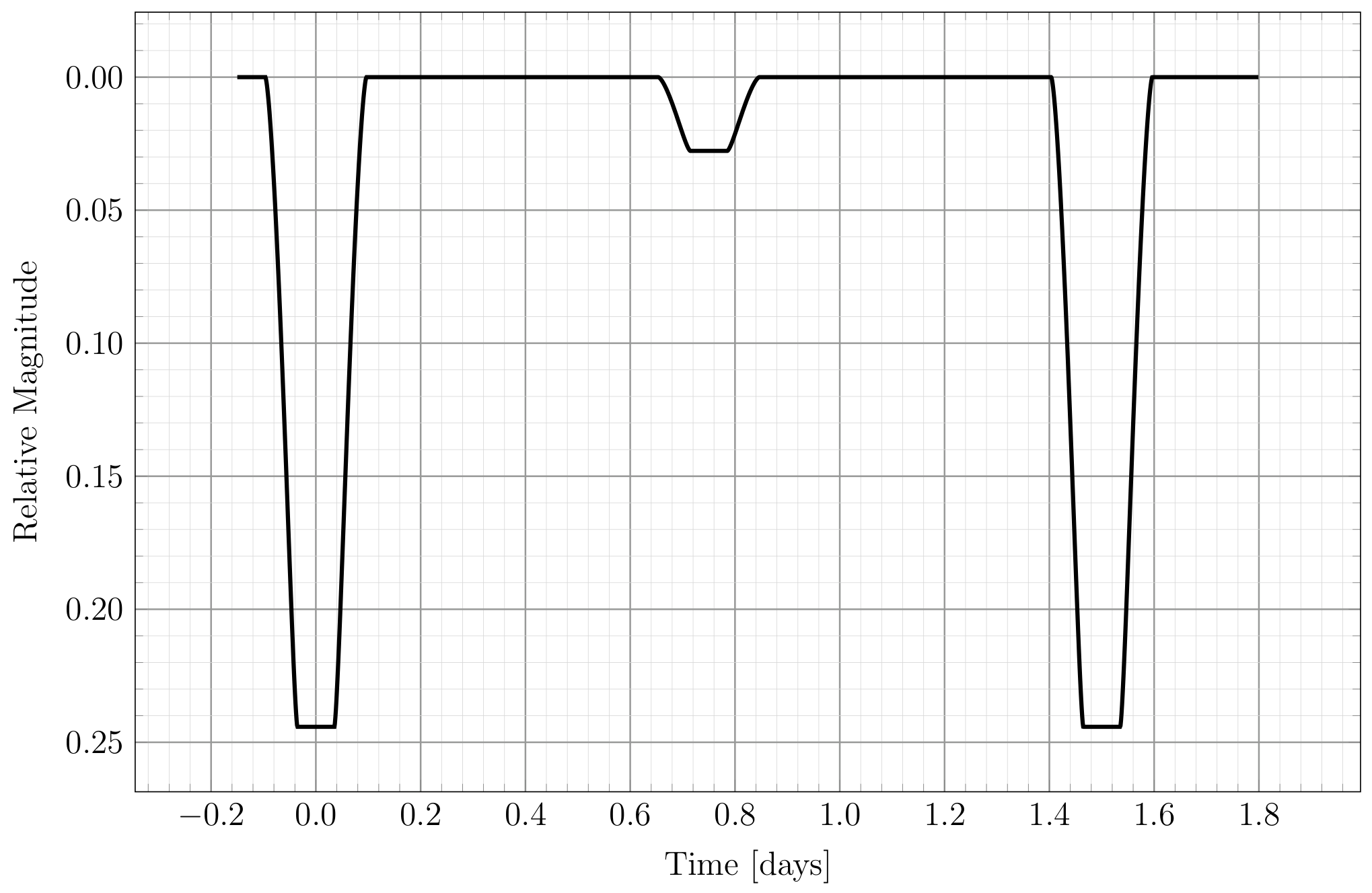
a) Determine the spectral type of the second component of the system.
b) Estimate the distance between the two components of the system.
c) What is wrong with the given light curve?
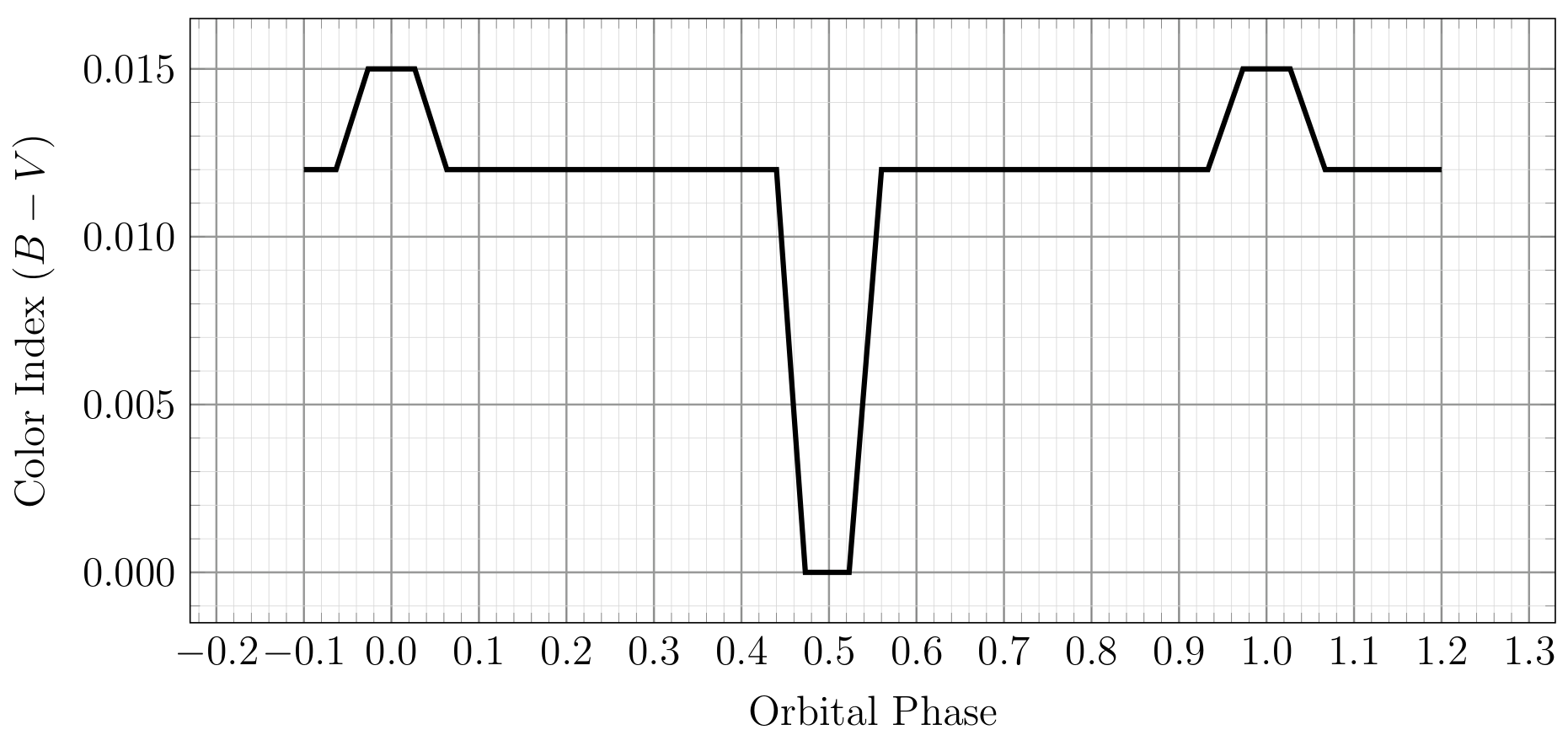
d) Sketch the curve of the system’s color index as a function of orbital phase, still assuming the validity of the given light curve.
Отговори
- a) G2V.
- b) .
- c) Stellar deformation, hot spots/reflection effects, and limb darkening make the plotted idealized light curve unrealistic.
- d) , , ; see the original key’s Figure 3.
Решение
a) The figure shows the -band light curve of a central-eclipse binary. One component is A0V with . The two eclipse depths read from the curve are
The equal spacing between successive minima, together with their equal widths, indicates that the relative orbit is circular.
A magnitude drop corresponds to a fractional flux loss
Hence
For a central eclipse in which the smaller (cooler) star passes in front, the observed flux loss at primary minimum corresponds to the -band flux from the portion of the hotter star hidden by the cooler companion, while at secondary minimum it corresponds to the entire flux of the cooler star being obscured:
with denoting the projected disc area of the cool star and the -band surface brightnesses of the hot and cool stars, respectively. Taking the ratio of the two light losses (or equivalently, of the corresponding fractional losses) gives
The secondary depth also fixes the projected area ratio:
so that the radius ratio is
Now we consider A0V as the hotter, larger component.
Since bolometric corrections are negligible for A–G type dwarfs, we may take and approximate the -band surface-brightness ratio by
With the companion’s temperature follows as , which corresponds to a Sun-like G2V star. The radius ratio derived from the light-curve minima is consistent with and .
b) Adopt main-sequence masses and . From the light curve we read the orbital period .
Hence Kepler’s third law in (au; yr; ) units gives
c) Note that .
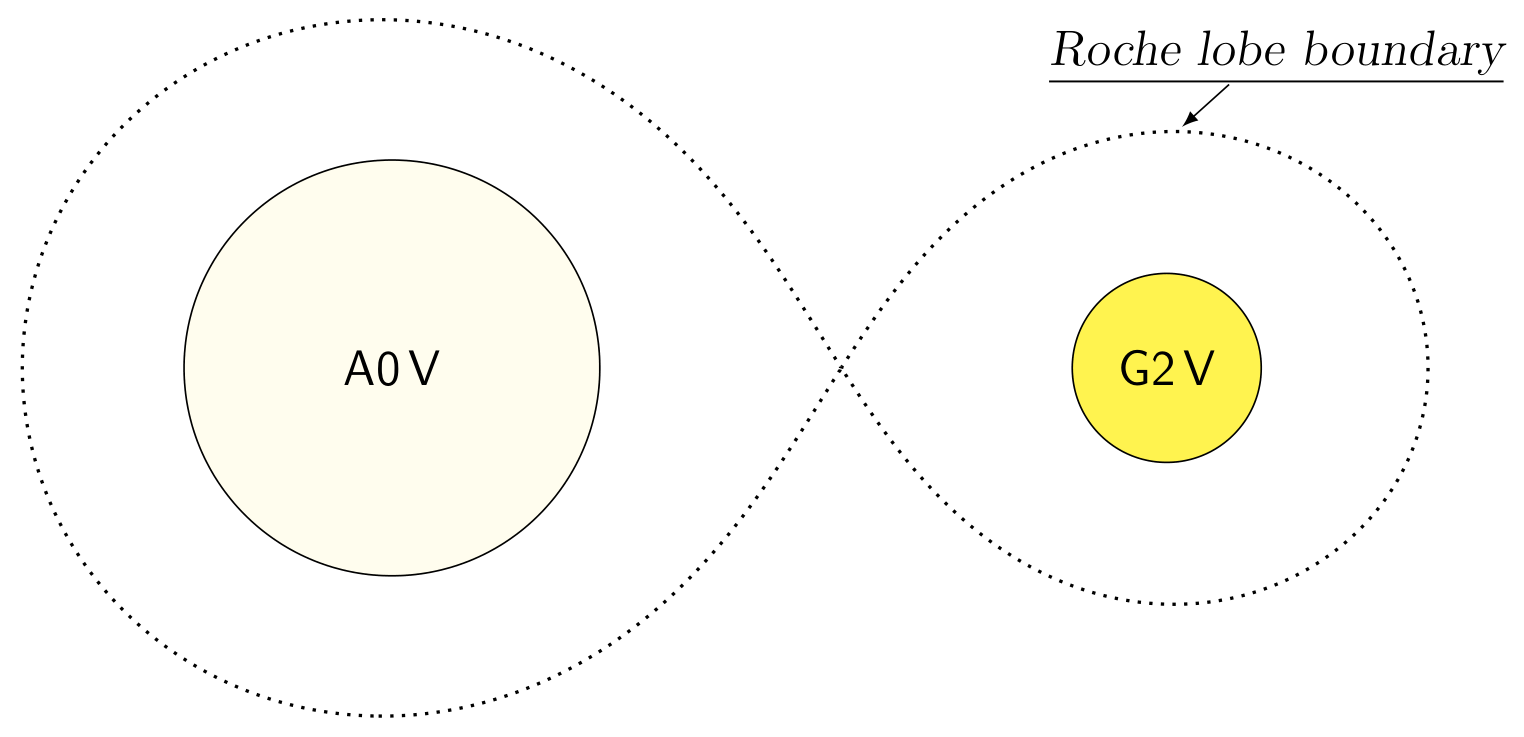
Because the stars are so close, out-of-eclipse variability should arise from both ellipsoidal distortion and reflection effects. Each star heats the hemisphere of its companion that faces it, creating hot spots and brightness variations. The plotted light curve, however, shows nearly vertical ingress and egress and flat minima, which are inconsistent with real stellar atmospheres: limb darkening smooths the contacts and rounds the minima. The figure therefore depicts an idealized, “boxy” light curve rather than a realistic one.
d) A0V stars are used as calibration “white standards”, with . For the G2V companion we adopt the solar value from the constants table, .
The out-of-eclipse color index of the system is
Here and denote the changes in the system’s magnitudes caused by the presence of the secondary component.
At primary minimum the hotter star is partially eclipsed. The system becomes slightly redder:
Brief consistency check: .
At secondary minimum only the A0 star remains visible, so .
Hence the color index curve is nearly flat, with a tiny red “bump” at primary eclipse and a small blueward excursion (back to ) at secondary eclipse (see Fig. 3).
Let A0V be the cooler star.
With , the companion’s temperature is , corresponding to a B3–B4V star. Taking , the radius ratio derived from the light curve minima gives
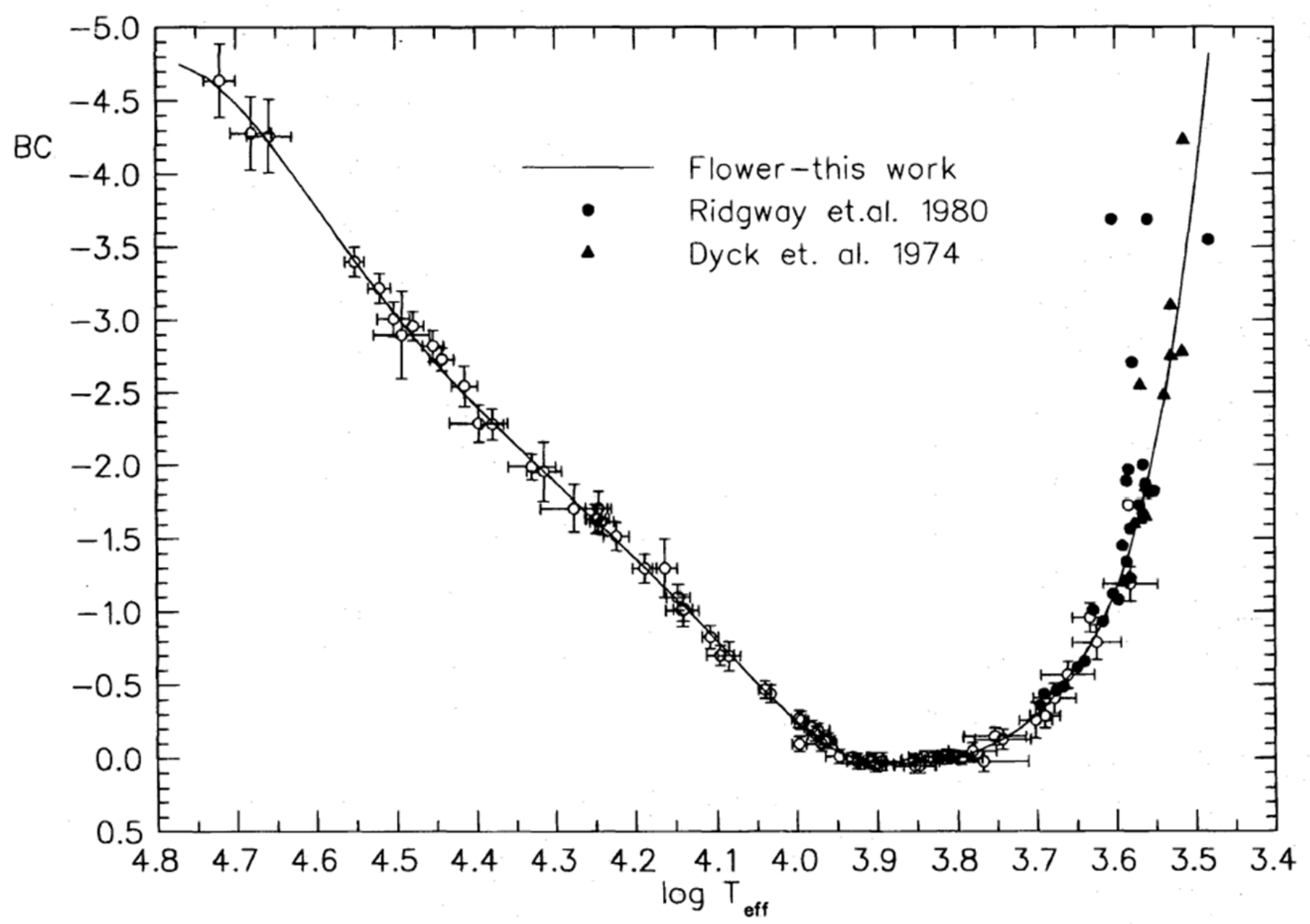
However, a typical B3–B4V star has , significantly smaller than the required value. Such stars have a significant bolometric correction, which strongly affects the temperature estimate. We adopt the bolometric correction approximation (see Fig. 4)
The self-consistency condition relates the bolometric surface brightness ratio () to the measured band ratio :
This yields a closed-form solution
This corresponds to a very hot star of spectral type O. Such stars have radii significantly larger than (from about upward). Therefore, even taking the bolometric correction into account does not allow further development of this case.
The only possible composition of the system is A0V + G2V.
Marking Scheme:
- Question (a) Spectral type of 2nd component
- Ratio of the stars’ temperatures — 3 pt.
- Spectral type — 2 pt.
- Question (b) Distance between components
- Mass-luminosity relation or a comparable method — 2 pt.
- Semi-major axis of the relative orbit (correct method + answer) — 2 pt.
- Question (c) What’s wrong
- Mention of stellar deformation — 1 pt.
- Mention of hot spots — 1 pt.
- Mention of limb darkening — 1 pt.
- Question (d) Sketch for
- Quantitative analysis of curve — 2 pt.
- Schematic drawing — 3 pt.
- Criterion (x) Consideration of the case where the A0V star is the cooler component 3 pt., includes 1 pt. for mentioning this case
Source note: Its masses use ordinary for the first component and fraktur elsewhere; this source notation is retained. The separately printed Criterion (x), including its full 3-point award and 1-point mention allowance, belongs to the original whole task and is preserved after parts (a)–(d); no extra problem or invented part (x) is introduced.
Теми и трудност
Оценена трудност: 4/5.
Звезди · Светлина и астрономически измервания · Двойни звезди · Звездни величини · Свойства на звездите
Предпоставки: Гимназиална подготовка, Разширена олимпиадна подготовка
Оригинал в Архива: OWAO_2025_Theoretical_Problems.pdf · официални решения: OWAO_2025_Theoretical_Solutions.pdf