RMPh 2012, Теория — Задача 1. MAGNETOSTATICS
Romanian Master of Physics 2012 · 10 т.
Условие
The magnetomotive force (mmf) along a curve is defined as the path integral of the projection of the magnetic induction along the curve,
Ampere's Circuital Law states that the magnetomotive force along a closed curve (loop) is proportional to the electric current crossing ANY surface whose frontier is this loop. The proportionality constant is called magnetic permeability of the vacuum ().
The positive direction of the current is associated to the path followed on the loop through the right-handed corkscrew rule.
a. An infinitely long straight conductor carries a steady current . Find the magnitude and the orientation of the magnetic induction generated by this current at a distance from the wire. Express the result in terms of , , and . [1 т.]
b. A thin uniform rod of mass and length is placed parallel to the wire, at a distance . The rod can only rotate on an axis perpendicular to the plane determined by the wire and the rod, passing through the middle of the rod. The rod carries a steady current in the opposite direction of . The rod is slanted with a small angle from its equilibrium position and let to oscillate freely. Find the period of the small oscillations of the rod in terms of , , , , , and . [1,5 т.]
c. A semi-infinite straight conductor is continued with an infinite conical conductor surface, whose axis coincides with the wire, as in the diagram alongside. The system carries a steady current . Find the magnitude and the orientation of the magnetic induction at a distance from the axis, both inside and outside the conical conductor. Express the result in terms of , , and . [1 т.]
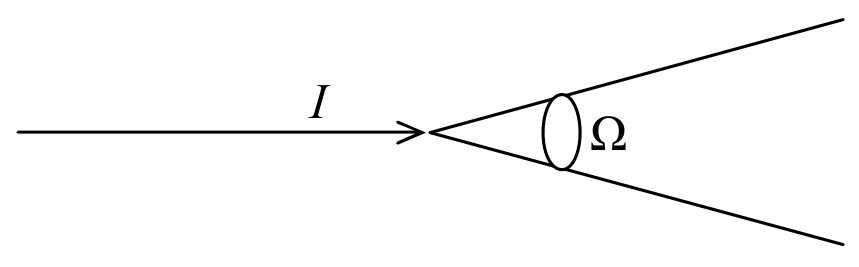
d. A semi-infinite straight conductor is connected at its end with an infinite conductor plane, placed perpendicular to the wire. The system carries a steady current . Find the magnitude and the orientation of the magnetic induction at a distance from the axis of the wire, on both sides of the plane. Express the result in terms of , , and . [0,5 т.]
e. Define the linear current density flowing on the plane from the previous point as:
where is an elementary length perpendicular to the line carrying an elementary current .
Introduce a unit vector perpendicular to the plane, in order to indicate the positive direction of the crossing from one side of the plane to the other. The vectorial product determines the positive direction for the component of parallel to the plane.
Show that when crossing the plane, the difference in magnitude of the component of parallel to the plane is proportional to the magnitude of in the crossing point, and find the proportionality constant. [1 т.]
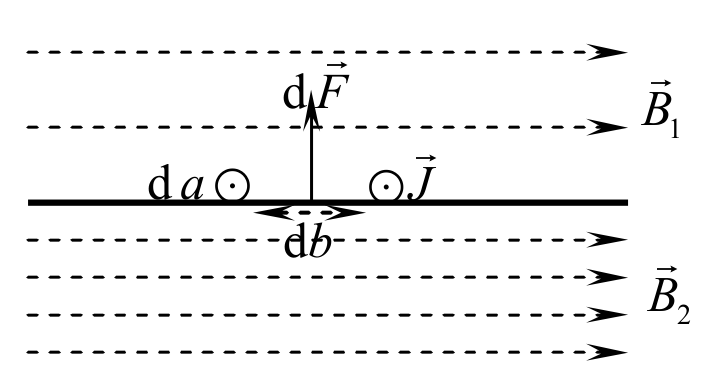
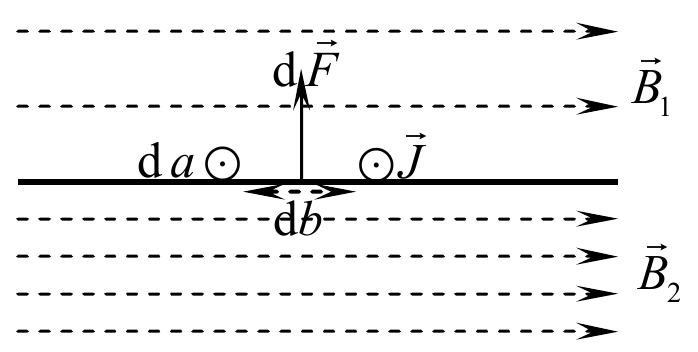
f. An infinite conductor plane is parallel to a uniform magnetic field. The magnetic induction has the same direction on both sides of the plane, but different values and . Find the pressure exerted upon the plane. Express the result in terms of , , and . [1,5 т.]
g. A conductor hollow sphere is connected at its poles with two semi-infinite straight conductors, oriented on the poles axis. The system carries a steady current . Find the magnitude and the orientation of the magnetic induction at a distance from the axis of the poles, both inside and outside the sphere. Express the result in terms of , , and . [0,5 т.]
h. A conductor hollow sphere has its poles connected by an interior straight wire. A steady current flows on the surface of the sphere from one pole to the other, and then back through the wire. Find the magnitude and the orientation of the magnetic induction at a distance from the axis of the poles, both inside and outside the sphere. Express the result in terms of , , and . [1 т.]
The Biot-Savart Law gives the expression of the magnetic induction generated in a point in space by an electric current flowing along an elementary path :
where is the position of the point relative to the elementary current.
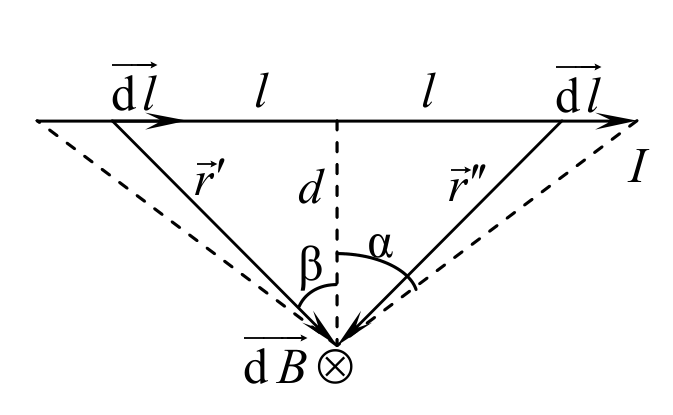
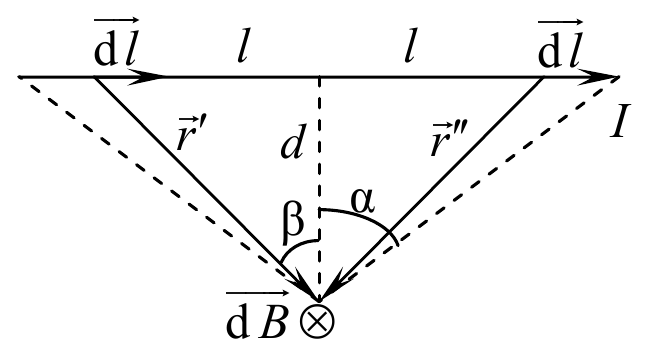
i. A straight conductor of length carries a steady current . The wire is seen from a point in its mediator plane under the angle . Express the magnitude of the magnetic induction in this point in terms of , , , and . [1 т.]
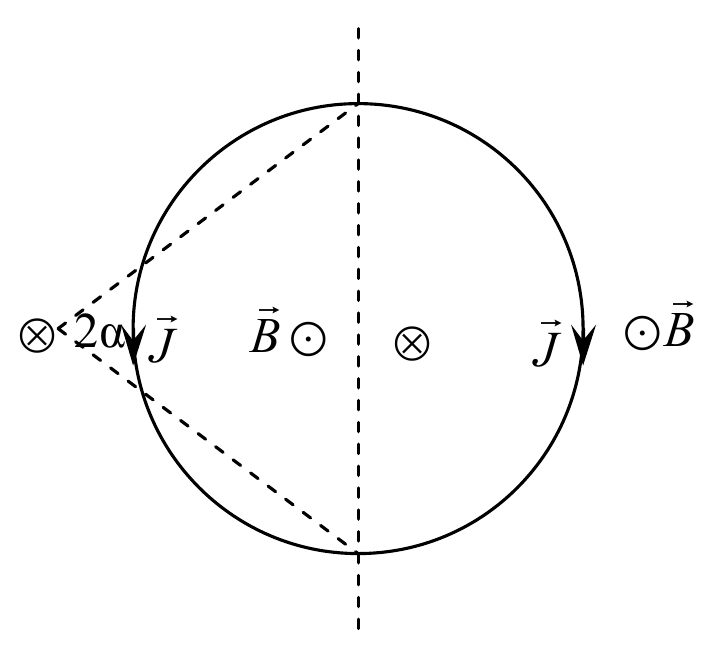
j. A steady current flows uniformly on the surface of a conductor sphere of radius , from one pole to the other. Find the magnitude of the magnetic induction in the equatorial plane of the sphere, in a point at distance from the axis of the poles, both inside and outside the sphere. Express the result in terms of , , , and . [1 т.]
Отговори
a.
Field lines are circles centred on the wire (right-handed corkscrew rule).
b.
c.
d.
e.
The proportionality constant is .
f.
g.
h.
i.
j.
Решение
PROBLEM No. 1
a. 1p
From the symmetry of the situation we take the magnetomotive force along a circular path of radius r, centered on the wire.
b. 1.5p
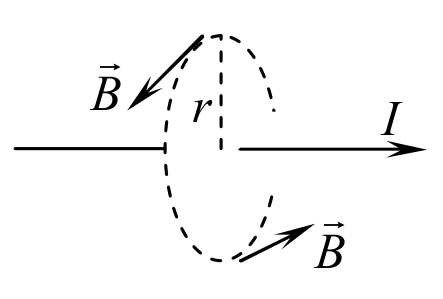
Consider two elements d of the rod placed symmetrically at distances from its center. The corresponding forces acting on them are:
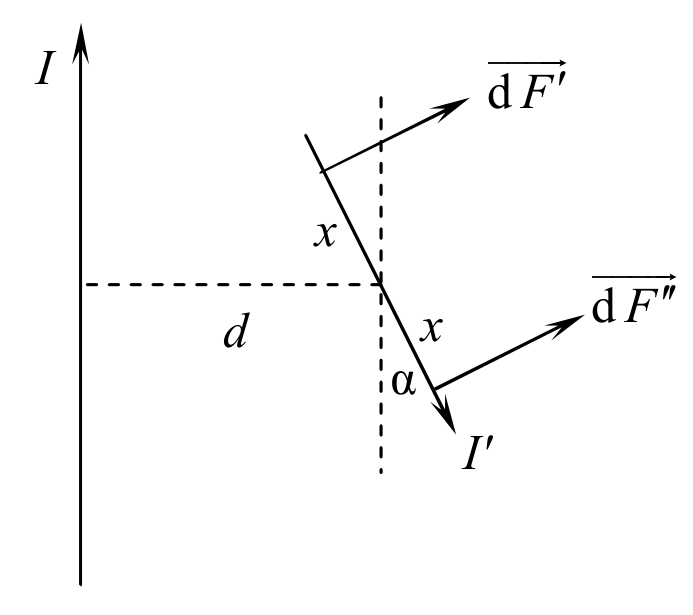
The sum of their torques is:
For very small angles, the total torque is:
c. 1p
Taking path integrals along circular field lines exactly like at the first point, we get:
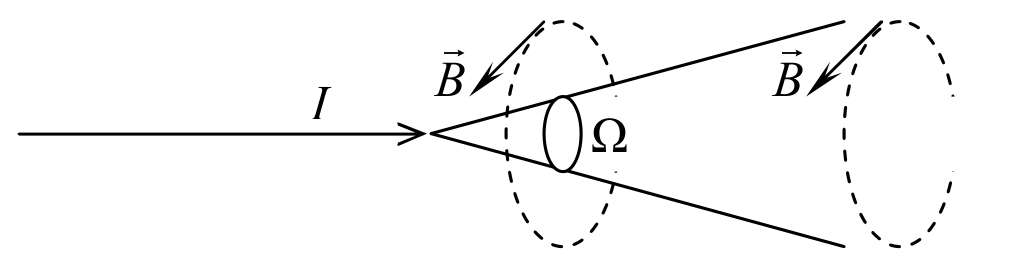
d. 0.5p
The above argument keeps holding, and the results are:
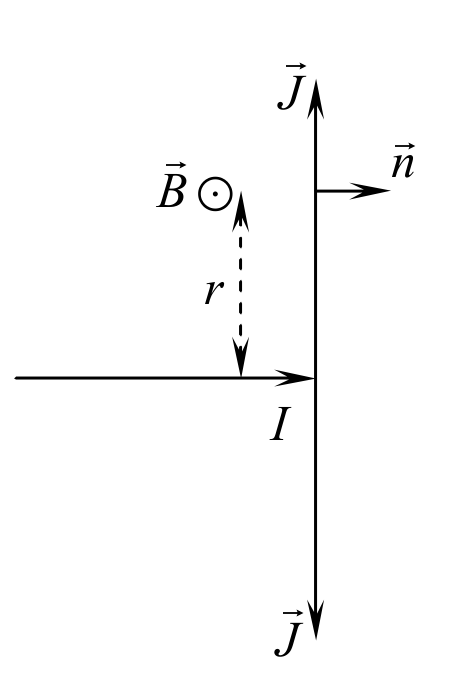
e. 1p
f. 1.5p
Consider a small region of the plane having dimensions d along and d across .
Let be the external magnetic field and the field generated by the conducting plane.
g. 0.5p
Just as before,
h. 1p
This time the path integrals go the other way around.
i. 1p
Consider two elements d of the wire, placed symmetrically at a distance from the center of the wire. Their contributions to the magnetic field in the mediator plane are equal:
j. 1p
From a point in the equatorial plane, the axis of the poles of the sphere is seen under an angle , with .
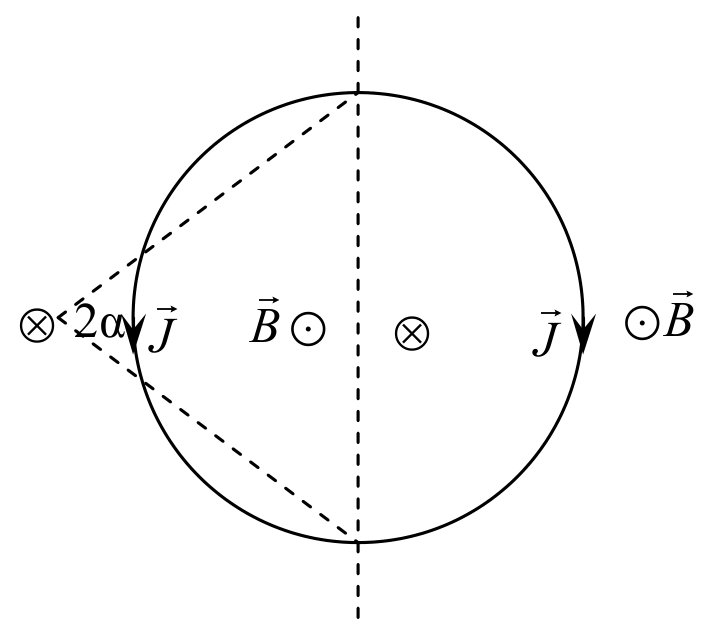
Outside, the sphere behaves similarly to an electric current flowing directly from one pole to the other through a wire connecting the poles directly:
Inside, the sphere behaves similarly to two semi-infinite straight conductors connecting the two poles of the sphere and carrying the current in the opposite direction:
Alternative archived worked-key edition
Retained alternative original. Archive attribution; this edition is preserved separately from the existing key.
a. From the symmetry of the situation we take the magnetomotive force along a circular path of radius r, centered on the wire.
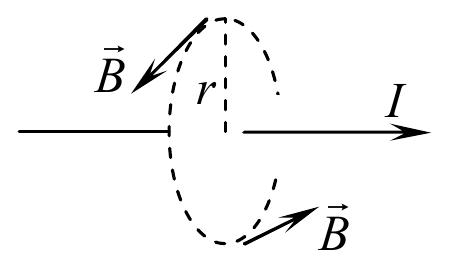
[1 т.]
b. Consider two elements dx of the rod placed symmetrically at distances x from its center. The corresponding forces acting on them are:
The sum of their torques is:
For very small angles, the total torque is:
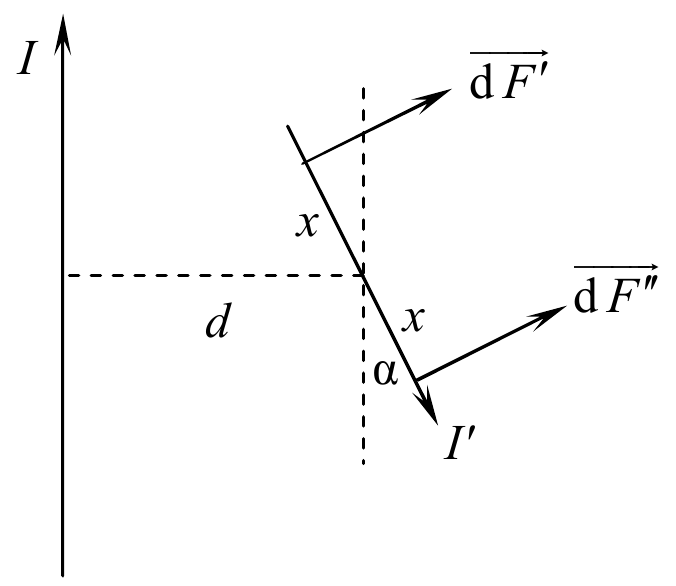
[1,5 т.]
c. Taking path integrals along circular field lines exactly like at the first point, we get:
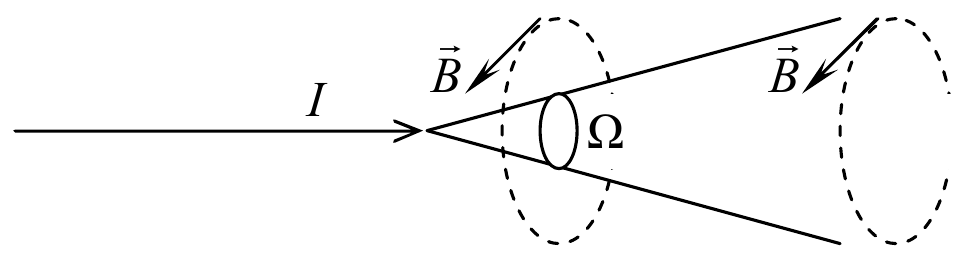
[1 т.]
d. The above argument keeps holding, and the results are:
[0,5 т.]
e.
The source uses one common sheet/current/normal illustration alongside d and e:
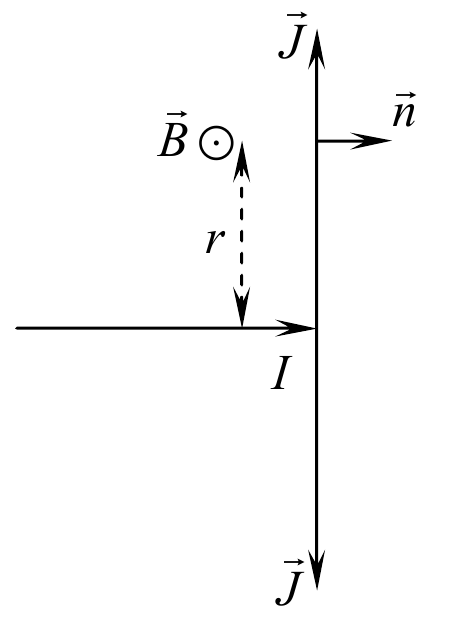
[1 т.]
f. Consider a small region of the plane having dimensions da along J and db across J.
Let B₀ be the external magnetic field and B′ the field generated by the conducting plane.
[1,5 т.]
g. Just as before,
[0,5 т.]
h. This time the path integrals go the other way around.
[1 т.]
i. Consider two elements dl of the wire, placed symmetrically at a distance l from the center of the wire. Their contributions to the magnetic field in the mediator plane are equal:
[1 т.]
j. From a point in the equatorial plane, the axis of the poles of the sphere is seen under an angle 2α, with tan α = R/r.
Outside, the sphere behaves similarly to an electric current flowing directly from one pole to the other through a wire connecting the poles directly:
Inside, the sphere behaves similarly to two semi-infinite straight conductors connecting the two poles of the sphere and carrying the current I in the opposite direction:
The inside expression is the scientific continuation on K3; the rest of that native page is blank. The illustration is on K2:
[1 т.]
Source-specific printed caveat:
The final inside-field expression for request j is on the otherwise mostly blank K3 continuation and is included above. Original response sheets Q8–10 remain connected supplements of this task, not additional whole problems.
Complete original question and connected response sheets. Response sheets are supplements of this same assignment.
Оригинал в Архива: th_1.pdf · решение от архива: th_solutions.pdf · допълнителни данни: RMPh_2012_THEO_SOL.pdf · допълнителни данни: RMPh_2012_THEO_EN.pdf