In this problem gravitational effects are to be neglected. Unless otherwise stated, substances are to be considered homogenous and isotropic at all times.
A.
Consider a very thin elastic rod, prevented from bending. The rod has length L, density ρ, and Young elasticity modulus E. The cross section of the rod is to be taken as constant. The rod is slightly stretched from both ends and then let to oscillate freely.
a. Write the kinetic energy of the rod at some moment in terms of its mass m, length L, and change rate of the tensile strain ε. [1 т.]
b. Write the potential elastic energy of the rod at some moment in terms of m, ρ, E, and ε. [0,5 т.]
c. Show that the conservation of mechanical energy for the rod leads to the characteristic differential equation for an undamped harmonic oscillation. Resorting to the analogy with a point mass m acted upon by the force σS (σ being the tensile stress and S being the cross section), specify the quantity that plays here the role of coordinate. [0,5 т.]
d. Write the expression for the period of small longitudinal oscillations of the rod in terms of L, ρ, and E. [0,5 т.]
B.
Consider an elastic sphere of radius R, made of the same material as the rod before. Let ε be the tensile strain ΔR/R. The sphere is slightly compressed uniformly and then let to oscillate freely.
e. Write the mechanical energy of the sphere at some moment in terms of m, R, ρ, E, ε and the change rate of ε. [0,5 т.]
f. Write down the expression for the period of small radial oscillations of the sphere in terms of R, ρ, and E. [0,5 т.]
C.
Consider a very thin rectangular elastic plate, prevented from bending. The plate has the linear dimensions L and l respectively. The thickness of the plate is to be taken as constant.
The effects of the tensile stresses σx and σy acting on the plate are NOT independent, in the sense that a stretching on one of the directions leads to a shrinking on the other direction. In the limits of Hooke's Law, this can be written as:
εxεy=−μEσy,=−μEσx
where the dimensionless factor μ (Poisson's ratio) is somewhere in the range of 0.3.
g. Express σx and σy in terms of εx, εy, E, and μ. [0,5 т.]
h. Write the system of differential equations for the movement of a point mass m on two orthogonal directions, using as coordinates the equivalent found at point c. [0,5 т.]
i. Find the possible values of ω for which the solutions of the above system are simple undamped harmonic oscillations (modes):
εxεy=Asinωt=Bsinωt.
Express the results in terms of L, l, ρ, E, and μ. [1,5 т.]
j. In general, the solution of the above system of equations is a superposition of the two modes found. For a square plate (L=l) and a weak Poisson ratio (μ2≪1), express the beats period in terms of μ and the period Tlong of longitudinal oscillations of a rod with the same length. [0,5 т.]
D.
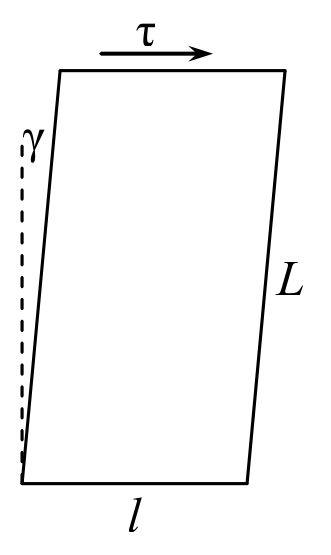
Now, instead of being squeezed, the plate is slightly slanted along one of the dimensions, by the action of a shear stress τ, as in the diagram alongside. The shear strain is defined to be tanγ≈γ, and Hooke's Law takes the form:
γ=G1τ;[τ]SI=[G]SI=N/m2,
where G is the so-called shear modulus.
k. Express G in terms of E and μ. [1,5 т.]
l. Find the period of the small slanting oscillations of the plate in terms of L, ρ, and G. Express the same period in terms of μ and the period of a rod with the same length undergoing longitudinal oscillations, Tlong. [0,5 т.]
E.
A cylinder of radius R and length L, made of the same material as before, is slightly twisted and let to oscillate freely. The torsion strain is defined as the angle θ with which the cylinder is twisted, under the stress of a torque. Hooke's Law takes now the form:
θ=C1M;[C]SI=[M]SI=Nm,
where C is the so-called elastic torsion constant.
m. Find the period of the small twisting oscillations of the cylinder in terms of L, ρ, and G. [0,5 т.]
n. Express the elastic torsion constant in terms of R, L, E, and μ. [1 т.]
ANSWER SHEET FOR PROBLEM No. 2
Contestant code: __________
The source answer sheet (booklet pages 11–13) contains the following blank fields. Its labels are preserved: it repeats Tslant at m., then labels Ttwist n. and C o., although the question ends at n.
Printed label
Answer field
a.
Ekin=
b.
Epot=
c.
Write the differential equation for ε: __________; x¨equivalent=
d.
Tlong=
e.
Emech=
f.
Tradial=
g.
σx=; σy=
h.
Write the differential equations for x¨equivalent and y¨equivalent: __________
i.
ω1;2=
j.
Tbeats=
k.
G=
l.
Tslant=
m.
Tslant=
n.
Ttwist=
o.
C=
Решение
The official key prints the marks below. In i., the final frequency formula includes an extra factor μ before the inner square root compared with the preceding line; j. continues with μ2 and Tbeats=Tlong/μ2. These source expressions are retained.
a. (1 т.)
Consider an element dx of the rod, placed at distance x from the center of the rod. Its mass is dm=mdx/L each. Let 2l be the length of the rod at some moment, and let y be the corresponding length of the region x.
Since the object is homogenous at all times,
xy=L/2l
Let v be the velocity of the two ends of the rod at some moment.
Let S be the cross section of the rod, and V its volume. The elementary work done by the tensile force σS equals the increase in elastic potential energy.
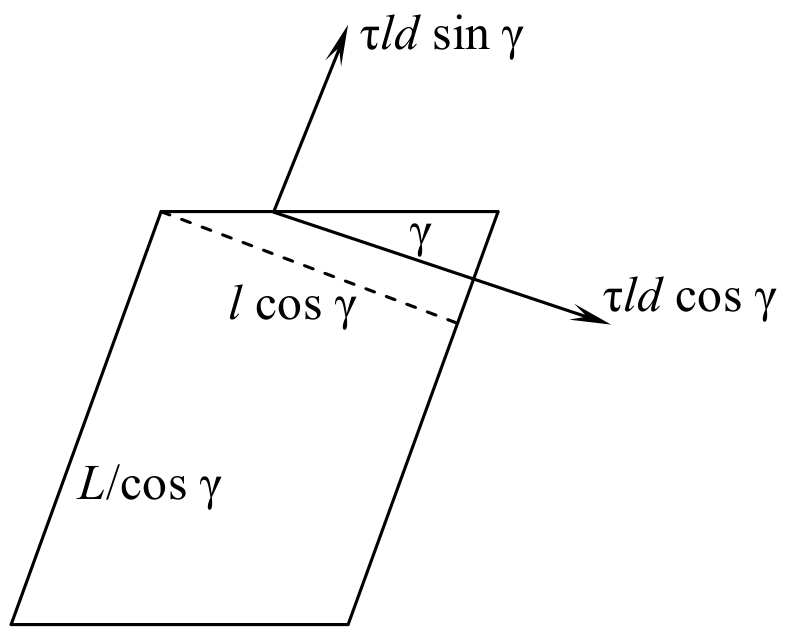
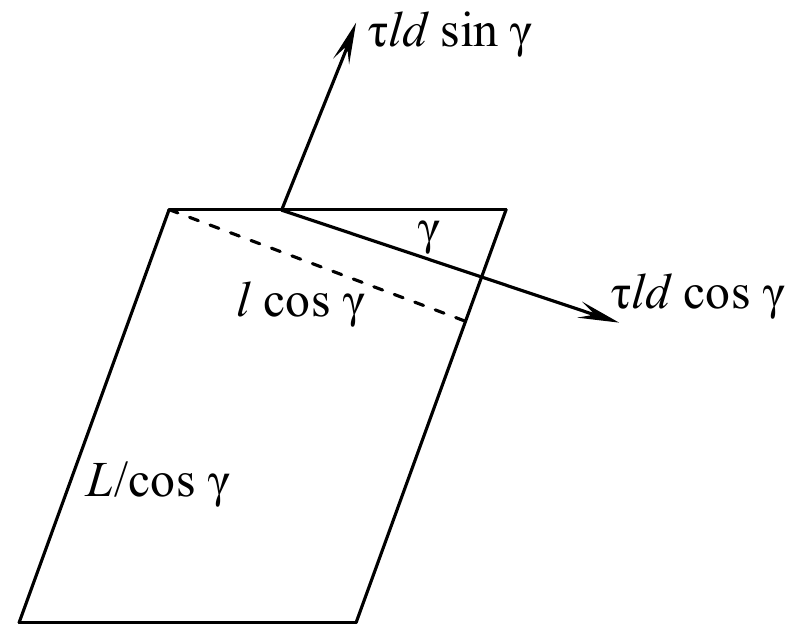
Let d be the thickness of the plate. The shear force τld can be decomposed into a stretching component along L (x-axis) and a shrinking component along l (y-axis).
a. Consider an element dx of the rod, placed at distance x from the center of the rod. Its mass is dm = m dx/L each. Let 2l be the length of the rod at some moment, and let y be the corresponding length of the region x.
Since the object is homogenous at all times,
xy=L/2l.
Let v be the velocity of the two ends of the rod at some moment.
b. Let S be the cross section of the rod, and V its volume. The elementary work done by the tensile force σS equals the increase in elastic potential energy.
Reader note: the μ immediately before the inner radical in the last expression is actually printed. It has not been cancelled or repaired here. [1,5 т.]
These μ² terms and the beats expression are retained as printed, not replaced with a different derivation. [0,5 т.]
k. Let d be the thickness of the plate. The shear force τld can be decomposed into a stretching component along L (x-axis) and a shrinking component along l (y-axis).
l. The quantities involved in the shear deformation are absolutely analogous to those describing the longitudinal deformation.
Tslant=πL3Gρ=Tlong2(1+μ).
[0,5 т.]
m. Consider very thin cylindrical layers of radius x and thickness dx. When the cylinder is twisting, each one of them is subject to a very small shear.
Ttwist=πL3Gρ.
[0,5 т.]
n. Let α be a very small angle with witch one cap of the cylinder rotates with respect to the other. Then the slanting angle of a cylindrical layer is:
The actual statement and key have fourteen requests a–n. The native response form repeats T_slant in l and m, then uses n for T_twist and o for C. Both copies and the native label shift are retained below, without inventing request o or silently renumbering the statement/key. The question prints cross-contraction relations in its explanatory context; the key prints the full combined stress relations. The key’s additional μ before the mode radical, its following μ² terms and T_beats = T_long/μ² are printed native expressions, not a mathematical correction added by this reader. Material sections A–E and their requests remain within one connected whole assignment.