Romanian Master of Physics 2012 — 3. FUNDAMENTS OF GENERAL RELATIVITY · 10 т.
Условие
Einstein declared that the idea of the Equivalence Principle (1907) was "the most fortunate thought (die glückichste Gedanken) of my life". He recalls that "I was sitting in a chair in the patent office at Bern when all of a sudden a thought occurred to me: if a person falls freely, he will not feel his own weight. I was startled. This simple thought made a deep impression on me. It impelled me toward a theory of gravitation."
So, if an observer is in free fall, he can be regarded as an inertial reference frame in which the gravitational field is abolished. Unfortunately, since different observers in space and time would be falling at different rates and/or in different directions, Einstein realized that one will have to use only local reference frames, so that inside each of them the acceleration due to gravity would be constant in both magnitude and direction.
Consequently, consider a point-like observer of negligible but nonzero mass in the vicinity of a massive object of mass M. If the massive object's gravitational field is not too strong, and in the absence of other forces, the observer will move along a gravitational field line with an acceleration equal in each point to the gravitational acceleration in that particular point. However, if mass M is sufficiently large, the notion of gravitational field loses meaning and one is forced to work instead with general relativistic concepts. What remains true, however, is that in situations with planar symmetry the elementary spacetime interval can be written as
ds2=−c2(dt′)2=−fc2(dt)2+g(dx)2+(dy)2+(dz)2,
where dt′ is the infinitesimal time interval measured by the observer's clock. In general f and g are functions of the spacetime coordinates. Thus, the observed elementary displacements dx can be regarded as being affected by some local shrinking factor, and the corresponding times dt needed to accomplish the said displacements can be considered as being affected by some local stretching factor.
So the difficulty arising in General Relativity is the fact that the known expression for ds2 (called the Minkowski metric), in which there are no variable factors whatsoever, no longer holds. In what follows, we will address the simplest possible situation and we will try to describe the events in spacetime using other sets of coordinates (or, more correctly, parameters) than the usual ones, with corresponding shrinking/stretching factors. These will lead us to other more suitable expressions for the spacetime metric ds2.
Let us consider a point-like object of rest mass m0, initially (t=t′=0s) at rest on the x-axis in a point x0=c2/a′. It now starts "falling freely" in the positive direction of the axis, so that at any time the proper acceleration experienced in an inertial reference frame momentarily co-moving with the object is constant, a′.
a. Write down the expression of the acceleration of the body in the "gravitational field" reference frame, in terms of its "falling" velocity v, a′ and c. Show that the net force acting upon the body is constant. [0,5 т.]
b. Find the expression of v in terms of t, a′ and c.
(Hint: in the integral, take v to be proportional to a trigonometric function.) [0,5 т.]
For what follows, we need to define the hyperbolic functions sinh, cosh and tanh:
Of course, there are also appropriate definitions for the inverse hyperbolic functions arcsinh, arccosh and arctanh.
c. Find the expression of the proper time t′ of the "falling" body in terms of t, a′ and c.
(Hint: in the integral, take t to be proportional to a hyperbolic function. Denote the argument of this function by τ.) [0,5 т.]
As you can see, τ is proportional to t′. In other words, τ = constant describes events that are simultaneous from the point of view of the "falling" observer. So the next step would be to try to introduce one other parameter, say ρ, so that ρ = constant describes phenomena at rest relative to the "falling" observer.
d. Using the Minkowski metric and the transformation found for the time, find the expression of the position x of the body in terms of a′, τ and c. [1 т.]
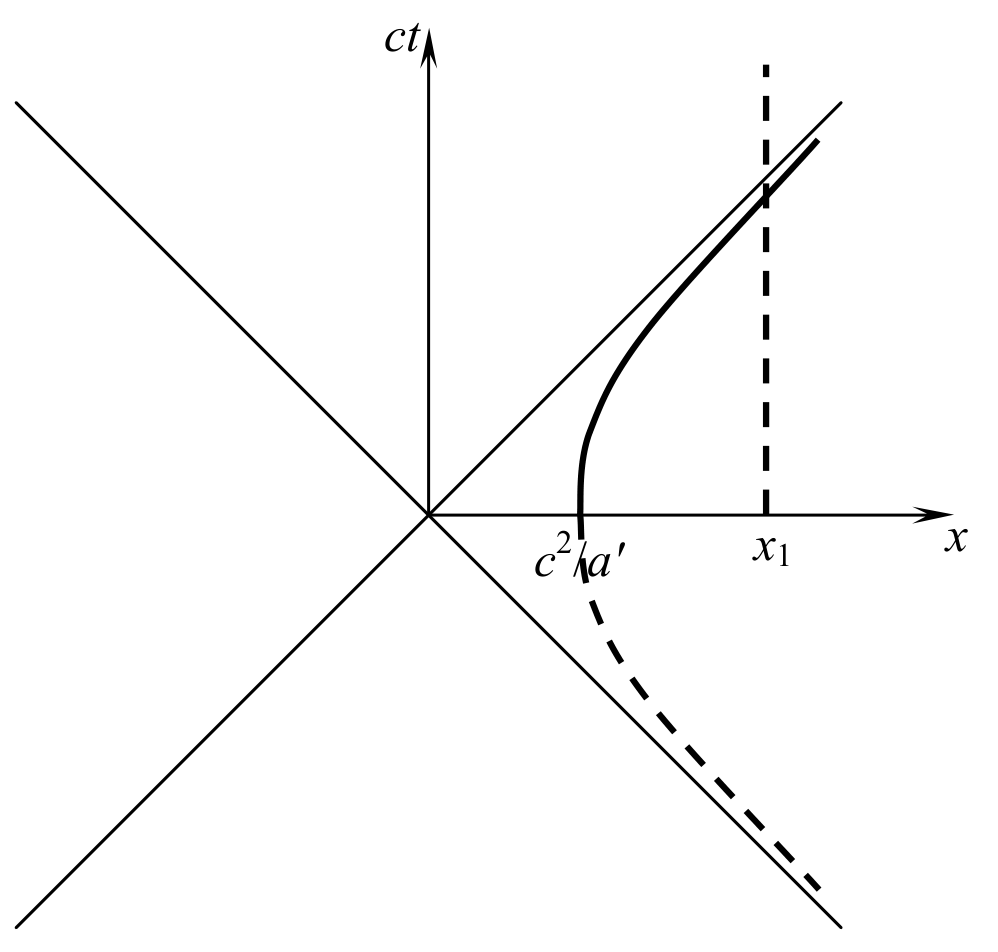
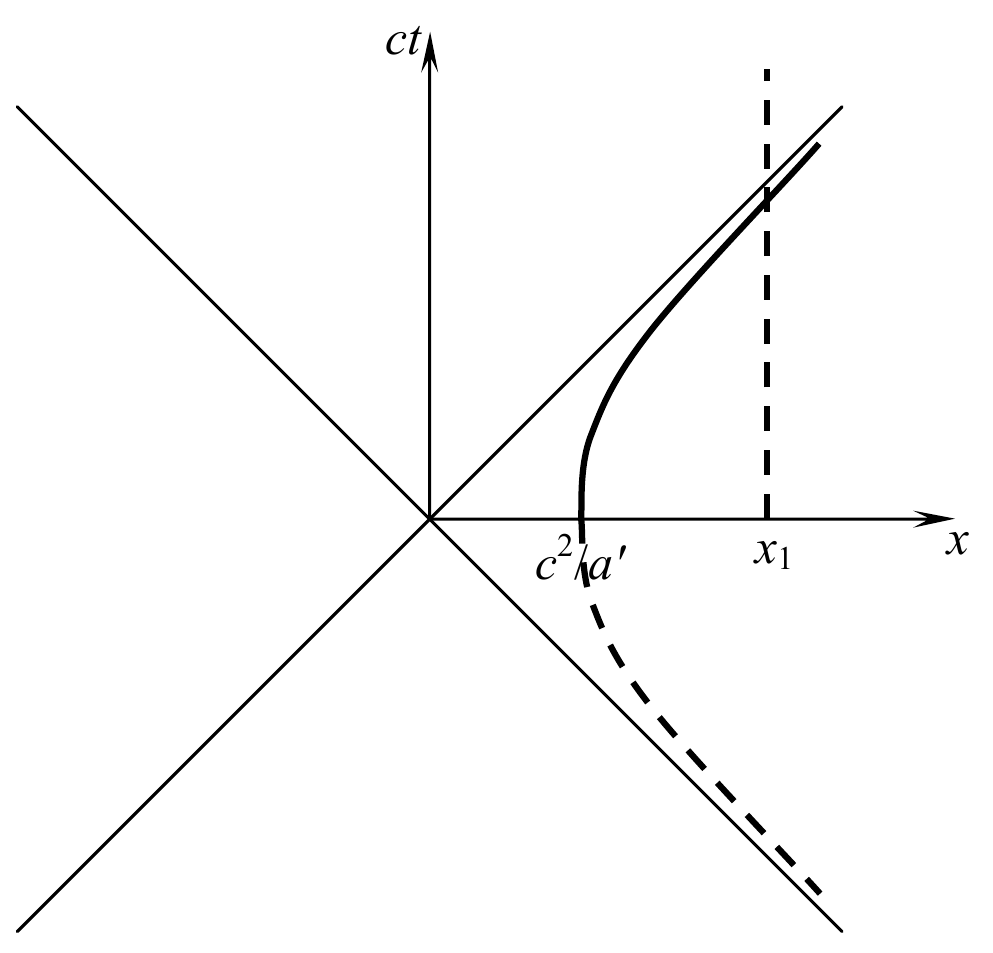
e. Write down the equation of the worldline (the trajectory) of the body in the two-dimensional spacetime ct-x (the coordinates y and z are of no particular interest here). Draw the graph of ct versus x, plotting also the past and future lightcones of a stationary observer found in the origin of the system. (The past lightcone is the region of spacetime from which signals can reach the origin; the future lightcone is the region of spacetime to which signals can be transmitted from origin.) On the same diagram draw the worldline of a stationary object having some coordinate x1>x0, which the "falling" object will pass by at some time. [1 т.]
f. In light of what we said above, it will prove to be very convenient to choose the magnitude of the constant ρ corresponding to our body at rest in a reference frame deprived of gravity, say ρ0, as being equal to the spatial constant term intervening in the equation found at the previous point. Express ρ0 in terms of a′ and c. [0,5 т.]
g. Now we will naturally extend these two new „coordinates" found for the "falling" body to an (almost) arbitrary event in spacetime. Express x and ct in terms of ρ and τ. Conversely, express ρ and τ in terms of x and ct. What is the maximal region of spacetime that can be parameterized using these coordinates? [0,5 т.]
h. Transform the Minkowski metric in terms of ρ and τ, and identify the factors f and g mentioned in the introduction to this problem. [1 т.]
OK, so let's sit back for a moment and get a better look at this new metric you found. It is called a Rindler metric, and it looks analogous to the parameterization of a plane using polar coordinates. As one would probably expect, its factors f and gare not invariant under a Lorentz transformation, but in this most simple case one can always return to the Minkowski metric in order to get a globally invariant metric. However in general it proves to be impossible to have an invariant metric.
You also saw that the Rindler metric cannot cover all spacetime. Even if we could extend it, one can easily see that an accelerating observer could never get information from all spacetime (unlike an inertial observer, whose past lightcone is bound to cover at infinity all spacetime). It is said that the events lying on the frontier of the region of spacetime from which the "falling" observer can get information make up the so-called event horizon.
Finally, since this new metric sees an accelerating body as being at rest, it yields that stationary objects in a gravitational field are now in motion relative to the reference frame deprived of gravity!
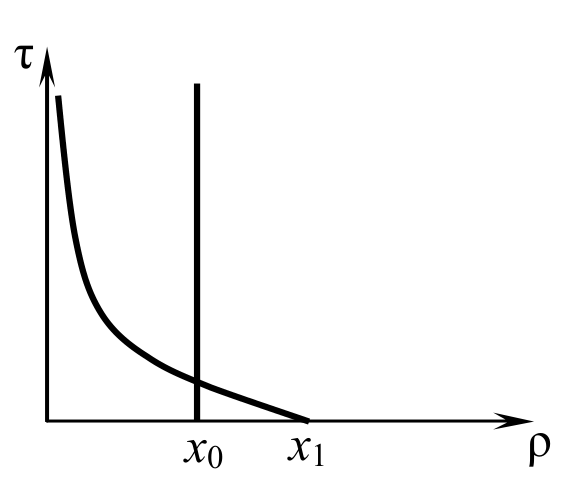
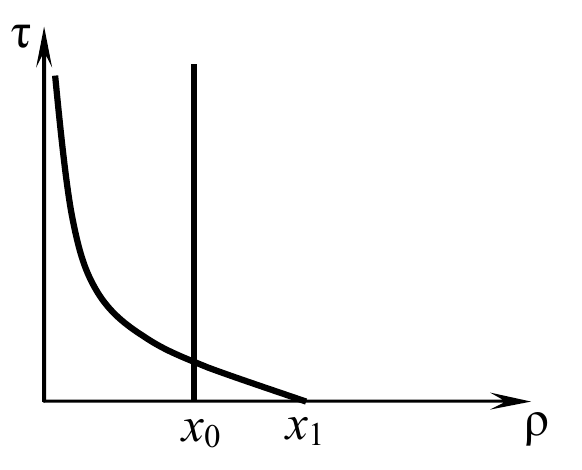
i. For the stationary object at x1 mentioned earlier, express its spacetime trajectory in coordinates ρ and τ. Draw on a τ versus ρ diagram the "worldlines" of both the objects considered, and determine the limit "distance" Δρ of the event horizon relative to the observer in "free fall". [0,5 т.]
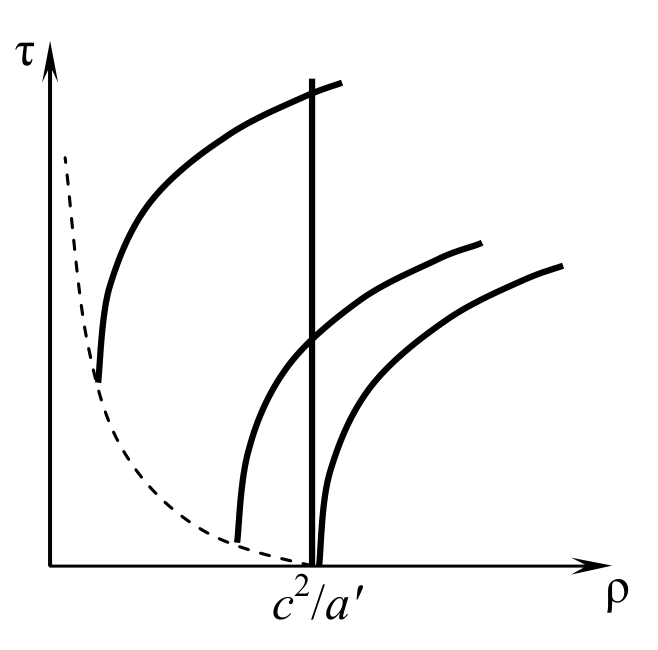
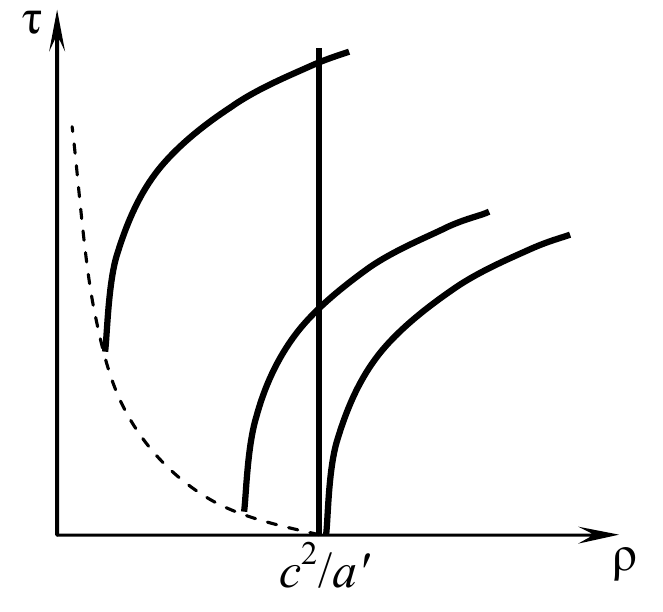
j. At the moment the observer starts to "fall", a beacon placed at x0 starts emitting very short electromagnetic pulses in the positive direction of the x-axis, separated by constant time intervals T0. How many such signals will reach the observer? Write down the expression of the worldline of the first one of them in terms of the ρ and τ coordinates. Draw on a τ versus ρ diagram the worldlines of the first three signals and of the observer. [0,5 т.]
k. Obviously the signals received will be sparser and sparser, meaning that they will have grater and greater wavelength (smaller and smaller frequency). Let ν0 be the frequency of the emitted pulses. Express the receiving time τ in terms of the emitting time t, x0 and c. Determine the frequency of the last received signal in terms of ν0, x0, T0 and c. [1,5 т.]
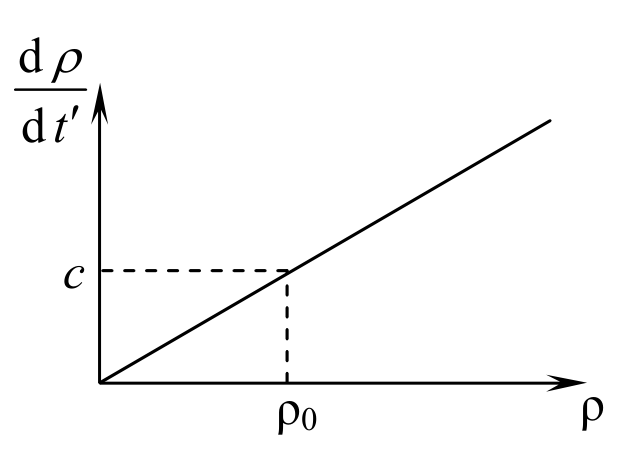
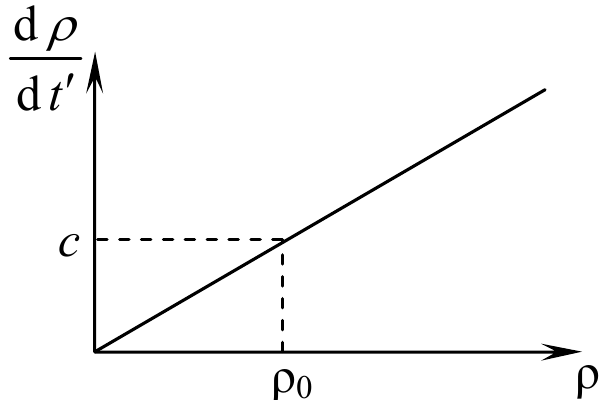
l. What is the magnitude of the coordinate change rate dρ/dt′ of the signals upon reception? Plot the graph of this "light speed along the direction of a′ in the spacetime deprived of gravity" as a function of ρ. [0,5 т.]
m. One of the most important aspects when considering dτ as being the time flowing in a local inertial frame, is that time at different locations on the x-axis will run differently not only as a function of that position, but also as a function of the time t elapsed from the moment when the inertial observer started to "fall freely". As the points of space pile up forming the event horizon, since the Rindler metric does not cover the entire spacetime, the time at those points seems to come to a halt. For instance, find the time dt elapsed at x0 as a function of x0, dτ, t and c. Considering a second point at a small distance Δx0 to the right of x0 (i.e. in the direction of the gravitational field), determine the relative slowing down of two clocks running in those points, ε=Δ(dt)/dt, in terms of x0, Δx0, t and c. [1 т.]
n. Now suppose that at t=0 the observer starts "falling" from rest on a short distance Δx0, so we can approximately interpret a′ as being the gravitational acceleration g of a very weak and almost uniform gravitational field, such the one in the vicinity of the surface of the Earth. Estimate the relative slowing down of a clock running at the surface of the Earth with respect to another identical clock running at the altitude of the ISS, h=360km. How much time would that mean for an astronaut spending one year on a mission on the ISS? (Neglect the fact that the station is moving around the Earth.) [0,5 т.]
Relative slowing down ε ≈ 4·10⁻¹¹; over one year Δt ≈ 1.26·10⁻³ s. The official solution prints „360·10³ km“ in the numerical substitution for h; the unit should be m (kept as printed).
Решение
a. 0.5p
Deriving the Lorentz transformations two-fold, we get
These equations require that x > 0 and ρ > 0, so using these new parameters one can cover only the quadrant of spacetime characterized by x > |ct|. [0,5 т.]
K11 continues this same request with the printed expression:
t=NT0⇒ν=ν0{1−x0cT0([cT0x0]+1)}.
Reader note: the printed N-plus-one/index substitution is retained exactly. No off-by-one adjustment is made and the brackets receive no invented convention. [1,5 т.]
Reader note: km after 360 · 10³ is actually printed in the key. The statement gives h = 360 km; the key's displayed numerical unit and its following values are retained separately as source content. No silent replacement by m is performed. [0,5 т.]
Source-specific printed caveat:
FUNDAMENTS is the printed title. The native K9 worldline label overlaps the curve and is preserved by the crop. The printed key combines N = [x₀/(cT₀)] + 1 with t = NT₀ for the last frequency; that indexing is kept literal. The K11 numerator visibly uses 360 · 10³ km alongside the displayed 4 · 10⁻¹¹ and 1.26 · 10⁻³ s. The statement’s altitude is 360 km. These are separately identified native caveats; no hidden correction or old-key scientific equivalence is inferred.