RMPh 2013, Експеримент — Задача 1. Porosity
Romanian Master of Physics 2013 – Experimental Problem No. 1 – Porosity (10 points) · 10 т.
Условие
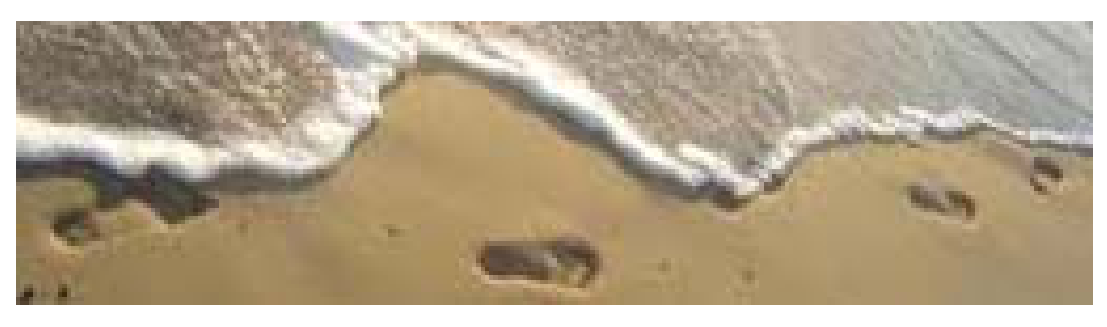
I. Footprints on beach sand (1 т.)
Write in the appropriate box in the answer sheet the letter corresponding to the answer you think is correct.
When running on a sandy beach, water saturated, immediately after a wave the area around the foot:
(a) Remains almost unchanged.
(b) Becomes wetter.
(c) Becomes drier.
Briefly justify your choice.
II. Metallic Sponges (9 т.)
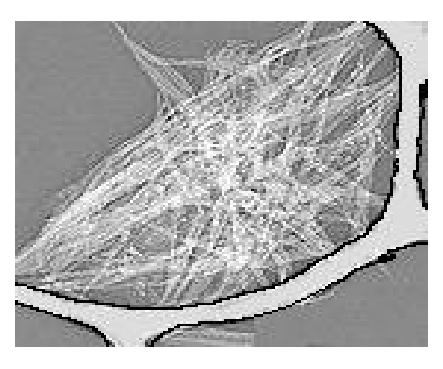
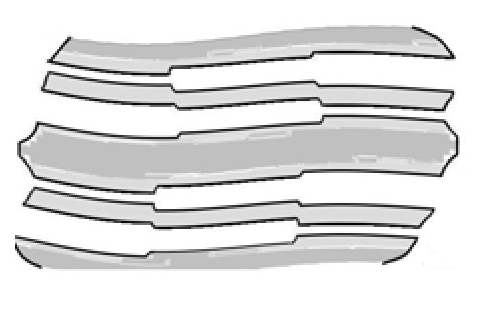
Porous metallic powders are used to produce catalysts, gas storage etc. They are assemblies of particles crossed by canals, with a sponge-like structure. In the Figure 1 is shown a portion of a spherical particle – part of the powder - crossed by pores and surrounded by other particles. The spheres forming a porous powder are crossed by networks of pores as shown in Figure 2. The sketch of pores in Figure 2 is not "at scale".
Through optical microscopy is established that the spherical particles of a metallic powder have the radius and that the larger pores observed on the surface of a spherical particle of this powder have the diameter . Pores can be modeled as a sequence of cylinders with different radii and lengths. Both ends of a pore penetrate the surface of particle so that "clogged" pores do not exist. In the following, consider that the temperature of the system remains constant.
A. In a syringe of is inserted metallic powder with the volume of . The mass of powder introduced into the syringe is . The syringe needle hole is closed and the air from the syringe is compressed. The relationship between volume of syringe (delimited by the piston) and pressure in the syringe during the compression is described by the data in Table 1.
Table 1
| Nr. crt. | Volume () | Pressure () |
|---|---|---|
| 1 | 10 | |
| 2 | 9 | |
| 3 | 8 | |
| 4 | 7 | |
| 5 | 6 |
Task No. 1
1.a. Briefly describe a method allowing determining the density of solid material which was used to produce porous metallic powder. The method will use the provided data and an appropriate graphical representation. [1 т.]
1.b. Calculate the density of solid material used to produce porous metal powder. [1 т.]
B. In the syringe - whose needle hole was closed – is inserted the volume of porous powder and a volume of liquid that does not wet porous material. At first, the liquid does not penetrate into porous powder composed of spheres - "sponge", similar in size and porosity, crossed by canals of the kind shown in Figure 2. In the absence of compression, the air occupies the places between the particles and also the channels of different diameter in the spheres. Volumes of these channels are denoted by in descending order of their diameters (denoted respectively ). During the solving the problem, use the following notations:
| Notation | Physical measure |
|---|---|
| The volume of solid material in the sphere | |
| Initial air volume between the spheres | |
| The volume of pores of largest diameter | |
| The volume of pores having the second diameter as length | |
| … | |
| The volume of spheres (solid material and channels) | |
| The total volume of porous powder | |
| The volume of liquid |
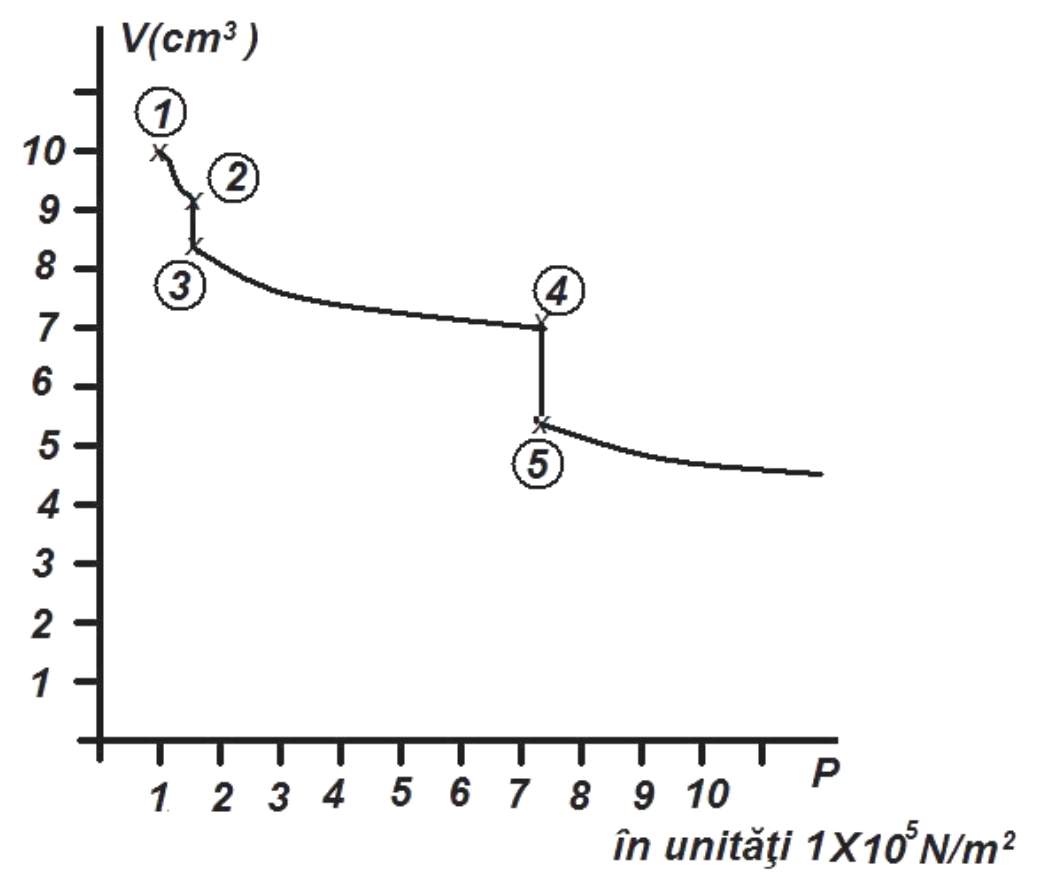
The plunge compresses slowly the liquid. As consequence the liquid starts to penetrate into porous material, removing air. Pressure dependence of the volume under the piston is illustrated in Figure 3, and numerical data on compression are written in Table 2.
Table 1
| ① | ② | ③ | ④ | ⑤ | |
|---|---|---|---|---|---|
| 10,00 | 9,16 | 8,74 | 7,07 | 5,11 |
Task No. 2
2.a. Briefly describe phenomena that occur inside the syringe during the pressing of the plunger. [1 т.]
2.b. Specify how many types of pores are in the metallic powder particles inside the syringe. Justify your answer. [0,5 т.]
2.c. Determine the volume occupied by particles of metallic powder. [1,5 т.]
2.d. Determine the total volume for each type of pores. [0,5 т.]
2.e. Determine the pore surface area in particles of metallic powder inside the syringe. [1,5 т.]
2.f. Estimate the number of particles in the volume of studied porous material. [0,5 т.]
2.g. Estimate the total length of each pore type existing in a particle. [0,5 т.]
2.h. Estimate the total number of channels in a particle of porous metallic dust into the syringe. [1 т.]
© Experimental problem proposed by: Delia DAVIDESCU, PhD; Adrian DAFINEI, PhD
Отговори
II. Metallic Sponges, 1.b. 2926 kg/m³
II. Metallic Sponges, 2.b. Two types of pores (two "thresholds" in Figure 3, for the processes 2→3 and 4→5).
II. Metallic Sponges, 2.c. 3.76 cm³
II. Metallic Sponges, 2.d. vI = 1,12 cm³; vII = 2,23 cm³
II. Metallic Sponges, 2.e. 4.91 m²
II. Metallic Sponges, 2.f. 450000
II. Metallic Sponges, 2.g. ℓI,particula ≅ 31×10³ μm; ℓII,particula = 1,7 m
The official solution divides by 4×10⁵ in (30) although N ≅ 4,5×10⁵ was found in (28).
II. Metallic Sponges, 2.h. 17310
Assuming, as the official solution does, a single-channel length of 100 μm.
Решение
I. Footprints on beach sand - Solution
When water wave washes up and back forth the sand of the beach, the sand particles near the surface of the beach are rearranged. They pack together with very little space between them - so that the water is pushed out and the surface tension of the water excludes water from flowing back in the cracks between particles. When a foot applies pressure to the sand, it opens up the cracks so that water can flow into them. As a result the sand on the surface around the pressing foot becomes dryer.
II. Metallic sponges – Solution
Task No. 1
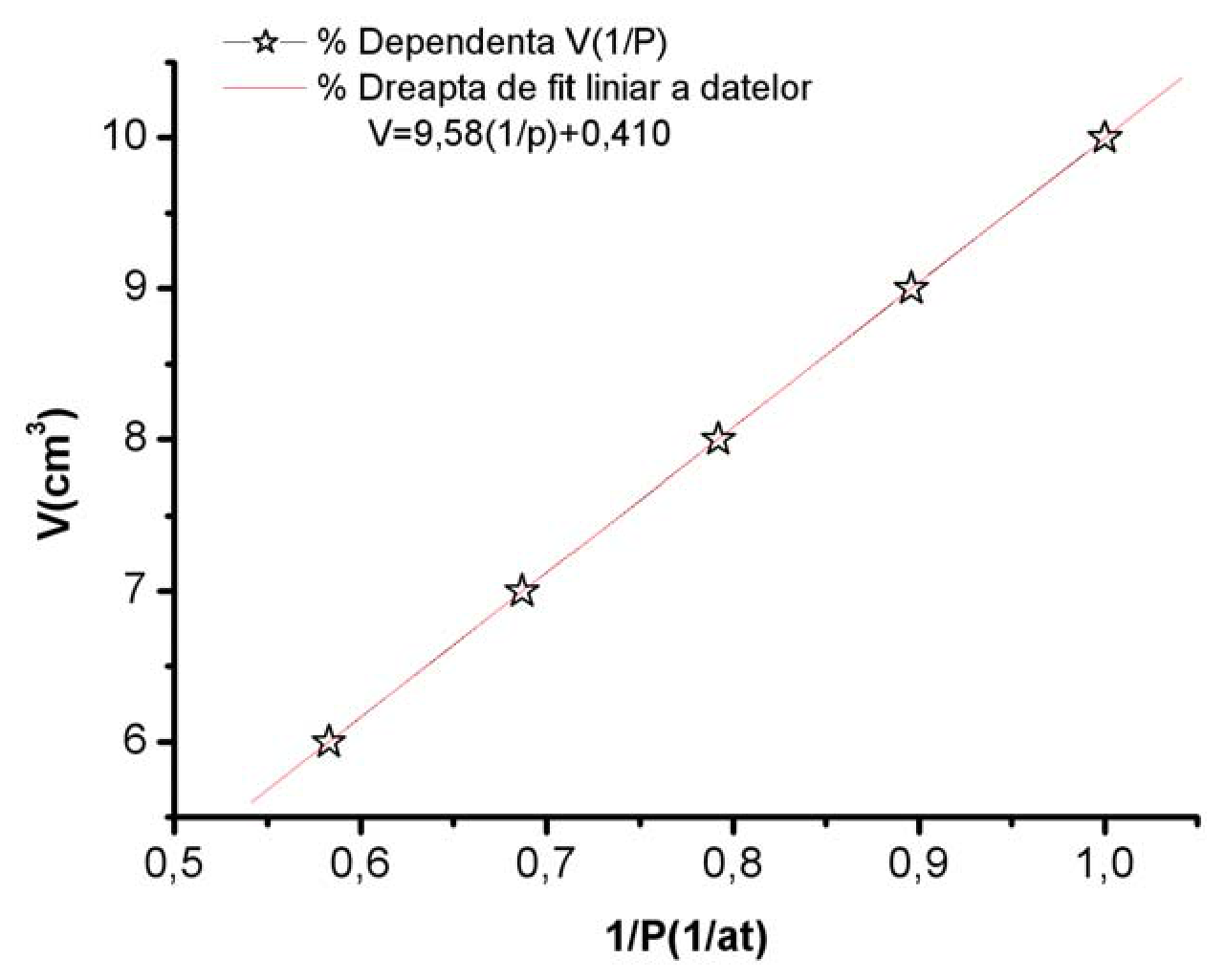
1.a. The actual volume of air in the syringe is the difference between the current volume of the syringe - (the value in the table) and the unknown volume of powder material, . The air from the syringe undergoes isothermal transformation.
or
You can add the column to the table, so that a graphical representation of the function can be described by equation (2) can be done.
| Nr. crt. | Volume () | Pressure () | 1/ Pressure () |
|---|---|---|---|
| 1 | 10 | ||
| 2 | 9 | ||
| 3 | 8 | ||
| 4 | 7 | ||
| 5 | 6 |
The graph of the dependence is a line whose interception gives the value of of the volume of material of power.
The explicit expression of dependence in the figure 4 is
Combining relations (2) and (3) one obtain the amount of support material in the porous particles
1.b. While density porous powder is
The density of solid material used to produce the powder is much higher.
The numerical value in (6) is the answer to question in task 1.b.
Task No. 1
2.a. In the process , due to the compression performed by the piston of syringe, fluid eliminates air between the particles and take his place . The removed air is compressed in the syringe.
In the process the air is eliminated from the air is removed from large radius capillaries. Once the capillary filling pressure is reached, the process is carried out without hindrance until total elimination of the air contained in this type of capillary.
In the process occurs an isothermal compression of air.
In the process occurs filling of the second type of capillary with liquid and air removal from the these capillaries.
Processes and are isobaric processes. The pores are "filled" with fluid that not wet porous material. This filling - which is done by removing the air - occurs when external pressure is sufficient to overcome the capillary pressure that prevents the entrance of liquid in capillaries..
After reaching the state ⑤, the only process that is still going on is the isothermal compression of air..
2.b. Since in the graphical representation in Figure 3 there are only two "thresholds" appropriate to the processes , and , it can be concluded that there are only two types of pores.
The specification above is a response to workload 2b.
2.c. The state ① is the initial state when the fluid has not entered yet the powder. In this state the volume delimited by the piston is composed of
In the process , due to the compression performed by the piston, the fluid eliminates air between the particles. The released air is compressed in syringe so that
Combining (7) and (8) one obtain
In the process the air is removed from the capillaries with large radiuses. When the process ends, the volume of the objects in the syringe is composed from the volume of the particles partially filled by fluid, the volume of fluid and the volume of air compressed at the current pressure
In the process occurs an isothermal compression. In the state ④ the volume of material in the syringe is
In the process the second kind of capillaries is filled with fluid.
After reaching the state ⑤ the only process that is still going on is the isothermal compression of air.
According with (9)
Since the total volume of materials in the syringe is initially composed of powder, liquid and air, the total volume of particles of powder particles, according to relation (7) is
The numerical value in (14) represents the answer to work task 2.c.
2.d. Using (10) one obtain
For the second kind of pores, corresponding to (12) results:
The numerical values in (15) and (16) represent the answer to work task 2.d.
2.e. In the graph in the figure 3, isobaric process and may indicate how the fluid "fill" the pores of the porous material. Pore filling occurs when external pressure, overcome the capillary pressure, which prevents liquid to enter in capillaries
As stated in statement, the pores with largest radius (that fill at first) have the radius . Because the first threshold pressure occurs in , coefficient of surface tension of the liquid in contact with the powder material is
Because the second threshold in pressure is / five time greater then the first, the radius of second kind of pores is five time smaller then the radius of the largest pores that is .
The surface of cross section of the largest pores is
Consequently, the length of the pores of first kind is
The surface of cross section of the small pores is
Consequently, the length of the pores of second kind is
Area of pores of first kind is
Area of pores of second kind is
The total area of pores is
Note: The ratio of pore surface area and mass of material is high
That explain why the porous powders are used to produce porous catalysts or gas storage by adsorption.
Numerical value in (25) is the answer to work task 2.e.
2.f. The volume of a particle is
The number of particles in the studied volume of porous material is
Numerical value in (28) is the answer to work task 2.f.
2.g. 1.g. The length of pores of first kind in a particle is
The length of pores of second kind in a particle is
Numerical values in (29) and (30) represent the answer to the question 2.g.
2.h. Admitting that the length of a singular channel from the first type is , the number of channel is
The number of channels (pores) of second type is
The total number of channels in a particle is
The numerical value in (33) represents the answer to work task 2.h.
© Experimental Problem Solution proposed by: Delia DAVIDESCU, PhD; Adrian DAFINEI, PhD
Оригинал в Архива: Experimental_Problem_1_Question.pdf · официални решения: Experimental_Problem_1_Solution.pdf