RMPh 2013, Теория — Задача 1. Fred & Barney's car
Romanian Master of Physics 2013 — Theoretical Problem No. 1 (10 points) · 10 т.
Условие
Fred and Barney built a car having as "wheels" two identical square prisms (figure 1). The wheels are perfectly suited to the road's shape (that is a periodical repetition of identical bumps), so that the center of mass of the car does not move vertically during the trip. The wheels never slip on the road. During the car's motion, the wheel's long edge always touches a „valley” of the road; road „heights” are reached by a line passing through the half of a rectangular face of the "wheels". The vehicle's movement starts in the tops of two road bumps. Initially, the horizontal translational velocity is .

The total weight of the vehicle excluding its „wheels” is , distributed equally on the two wheel axles. Further, assume that the only forces acting on car are gravity and normal force.
Task No. 1 - Kinetic energy of the car
1.a. Determine the expression of - the moment of inertia of wheel reported at its own axles if its mass is and the length of its square side is . [1 т.]
1.b. Determine the expression of kinetic energy of the car and the expression of the angular velocity of its wheels:
i. when the car pass on the tops of the bumps;
ii. when the car pass with each wheel through a „valley”. [2 т.]
Task No. 2 - Road's shape
In the figure 2 is shown the motion of the lower side of the square cross-section of the wheel on a bump (the curve passing through the points ).
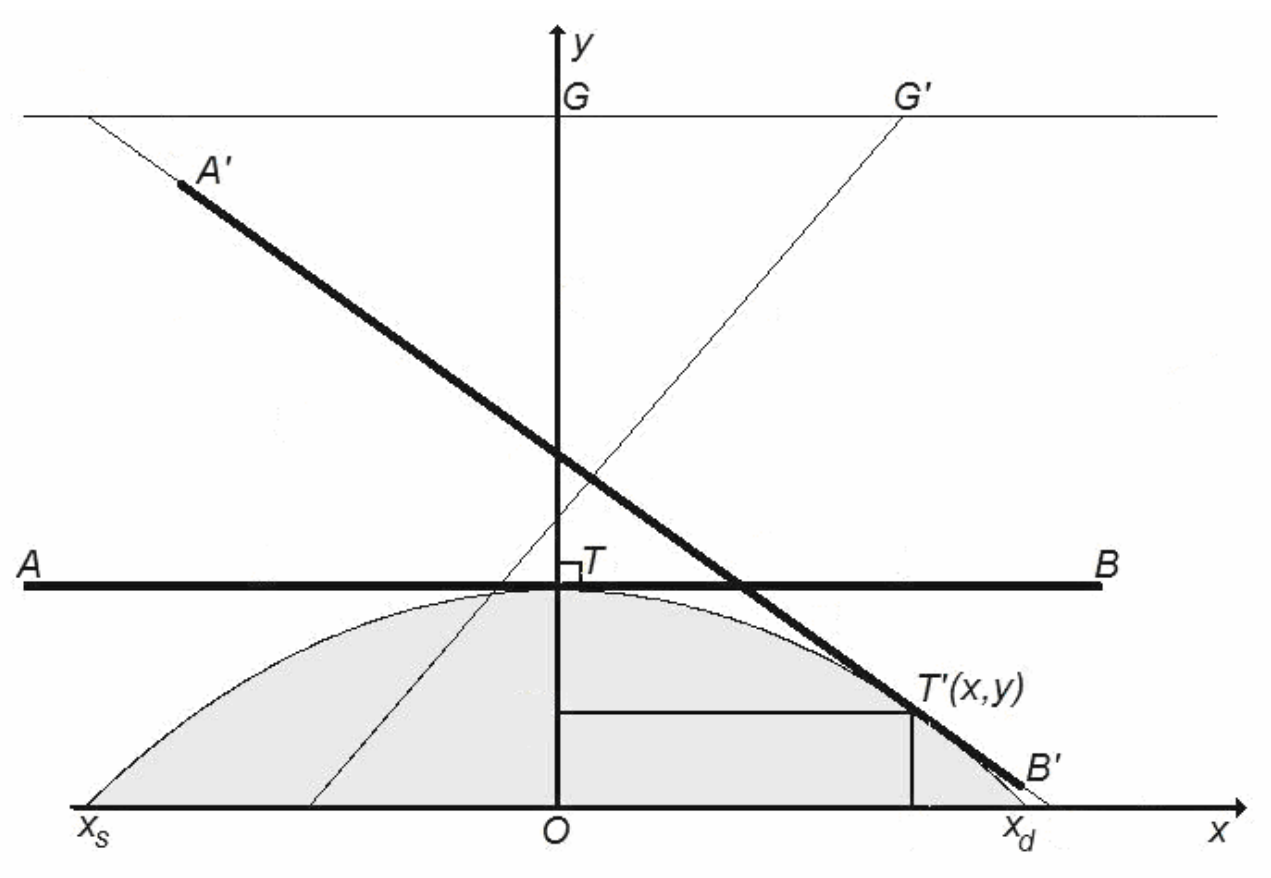
The road is a periodic repetition of such a bump.
The axis of the coordinate system passes through valleys of the relief and the axis passes through bump tip. is wheels side, is the contact point between wheel and road and is wheel axis position – in initial position. , , have the same meaning – but for a certain position. In cross-section the wheel axis is always on the same vertical line with the contact point between wheel and road.
2.a. Give an explanation for this finding. [0,5 т.]
2.b. Determine the analytical form of cross-section of the road. [2 т.]
Hint: The derivative of the function is the slope of the tangent to the graph of function in . Consider known that . We recommend to use the notation ; with property
2.c. Determine the expression of the length (on horizontal) of a bump of road. [0,5 т.]
2.d. Determine the expression of minimum distance between wheel axles Fred's car. [0,5 т.]
2.e. Decide whether a machine wheeled regular hexagonal prism conveniently chosen could run on the road whose form was determined in 2.b., without vertical displacement of the center of mass of the wheel. [0,5 т.]
Task No. 3 - Accident
Assuming that analytical expression of road’s bumps is where and are two constants.
3.a. Determine the domain of possible values of the horizontal velocity of the car, under the circumstances established in problem’s statement. [2 т.]
3.b. Determines how the amount of heat that can be released by plastic collision of Fred's car with an obstacle depends on position of obstacle on road. Immediately after the collision the car stops. [0,5 т.]
3.c. Determine the expression of heat released by collision. [0,5 т.]
© The Problem is proposed by:
Delia DAVIDESCU, PhD
Adrian DAFINEI, PhD
Решение
Внимание: Непълно решение
В архива няма официално решение на тази задача.
Оригинал в Архива: Theoretical_Problem_1_Question.pdf