RMPh 2013, Теория — Задача 2. Compton scattering
Romanian Master of Physics 2013 — Theoretical Problem No. 2 (10 points) · 10 т.
Условие
An electron storage ring contains circulating electrons with high energy produced by an accelerator and rotating in an appropriate magnetic field. X - ray photons are directed so as to collide with electrons stored in storage ring. Phenomenon that occurs is known as Inverse Compton Scattering.
A photon of wavelength is scattered by a moving, free electron. As a result the electron stops and the resulting photon of wavelength is scattered at an angle with respect to the direction of the incident photon; this photon is again scattered by a second free electron at rest. In this second scattering process a photon with wavelength of emerges at an angle with respect to the direction of the photon of wavelength .
To characterize the photons and the electrons during the processes use the following notation:
| initial photon | photon – after the first scattering | final photon | first electron before collision | first electron after collision | second electron before collision | Second electron after collision | ||
|---|---|---|---|---|---|---|---|---|
| moment | moment | 0 | 0 | |||||
| energy | energy | |||||||
| wavelength | speed | 0 | 0 |
The following constants are known:
- Planck’s constant
- rest mass of the electron
- speed of light in vacuum
Task No. 1 - First collision
1.a. Draw simple sketches marking the moments of the electron and photon before and after the first collision. Clearly specify the coordinate system used. [0,5 т.]
1.b. Express the energy and moment of the electron implied in the first collision as a function of the initial speed of the electron and its rest mass . [0,8 т.]
1.c. Express the energy and wavelength of the photon after the first collision as a function of the wavelength of the initial photon , the scattering angle and . [1,2 т.]
Task No. 2 - Second collision
2.a. Draw simple sketches marking moment of the electron and photon before and after the second collision. Clearly specify the coordinate system used. [0,5 т.]
2.b. Express the energy and wavelength of the photon after the second collision as a function of the wavelength of the photon before the collision , the scattering angle and . [1,2 т.]
2.c. Express the kinetic energy and momentum of the electron after the second collision as a function of the photon wavelengths after the collision , , and . [0,8 т.]
Task No. 3 - Quantitative description of processes
Using the values of the given physical constants and numerical values of and determine the expressions and numerical values for:
3.a. the De Broglie wavelength of the initial electron; [2 т.]
3.b. the energy and frequency of the initial photon; [1 т.]
3.c. the speed of the second electron after collision; [1 т.]
3.d. the variation of the photon wavelength after each collision process. [1 т.]
© The Problem is proposed by:
Delia DAVIDESCU, PhD
Adrian DAFINEI, PhD
Отговори
1.b.
1.c.
2.b.
2.c.
3.a. m
Official solution: ; the de Broglie wavelength of the second electron after scattering is the same.
3.b. Ei ≅ 1,58×10⁻¹⁵ J = 9,9 KeV; fi ≅ 2,4×10¹⁸ Hz
The official solution prints the unit as „KeV“ (keV).
3.c. m/s
Official solution: .
3.d. m
Official solution: .
Решение
Compton scattering - Solution
Task 1 - First collision
1.a. Figure 1 presents the situation before the first scattering of the photon.
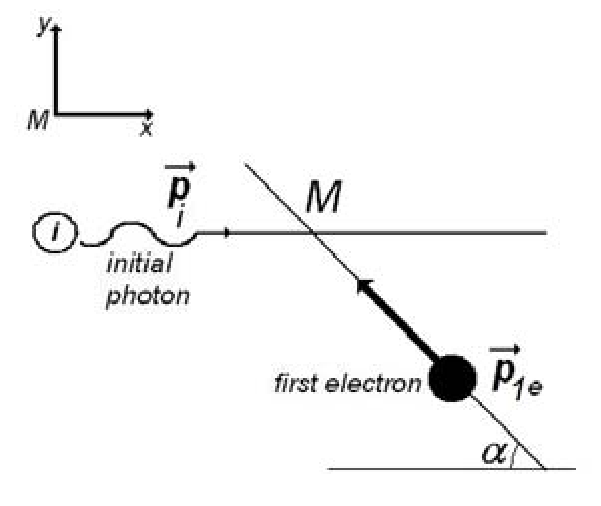
1.b. The angle between the directions of the electron and photon moments before collision is denoted by
To characterize the initial photon we will use its moment and its energy
is the frequency of the initial photon.
For the initial free electron in motion scenario, the moment and the energy are
where is the rest mass of the electron and is the mass of the moving electron. As usual . De Broglie wavelength of the first electron is
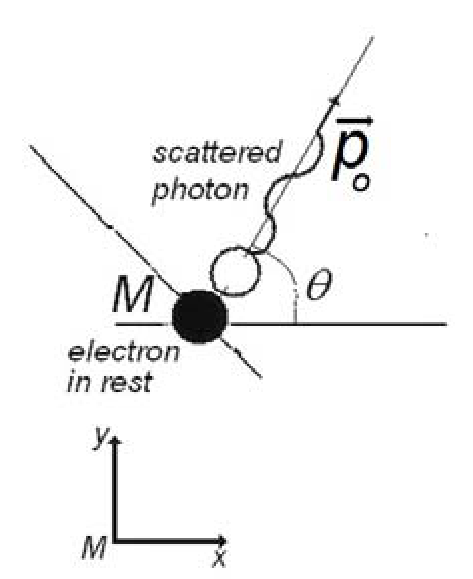
1.c. The situation after the scattering of photon is described in the figure 2.
To characterize the scattered photon we will use its moment and its energy
where
is the frequency of the scattered photon.
The magnitude of the moment of the electron (that remains at rest) after the scattering is zero; its energy is . The mass of the electron after collision is - the mass of electron at rest state. So,
To determine the moment of the first moving electron, one can write the principles of conservation of moments and energy. That is
and
Using the referential in figures 1 and 2, the conservation of the moment in collision along the direction is written as
and the conservation of moment along direction is
To eliminate , the last two equations must be written again as
and then added.
The result is
or
The conservation of energy (9) can be written again as
or
Squaring the last relation results in the following
Subtracting (14) from (17) the result is
or
Using
the relation (19) becomes
The wavelength of scattered photon is
Equation (22) show that the scattered photon wavelength is shorter than the wavelength of the initial photon. Consequently the energy of the scattered photon is greater that the energy of the initial photon.
Task 2 - Second collision
2.a. Let’s analyze now the second collision process that occurs at point . To study that, let’s consider a new referential having the axis along the direction of the photon scattered after the first collision.
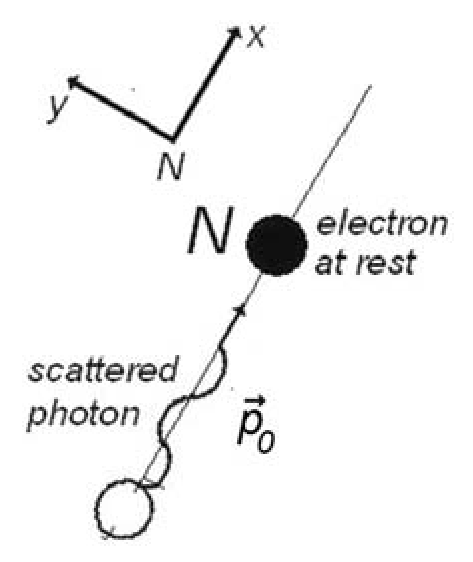
Figure 3 presents the situation before the second collision and Figure 4 presents the situation after this scattering process.
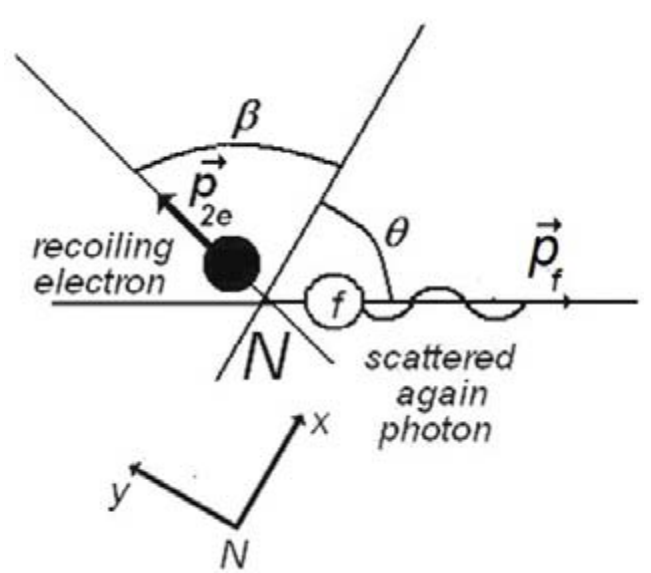
2.b. The conservation law for moments in the scattering process gives
To eliminate the unknown angle , one must square and then add equations ( 24)
That is
and
or
The conservation law for energies in the second scattering process gives
or
Subtracting (27) from (29), one obtains
that is
Concluding
Comparing (31) written as
and (22) written as
results in
2.c. Taking into account (26), the moment of the electron after the second collision is
Or, considering (33), the moment can be rewritten as
The expression of the de Broglie wavelength of the second electron after scattering is
From (28) results
that is
Task 3 - Quantitative description of processes
3.a. The relation (13) can be written as
or, considering (34) and (35)
so that the expression of the de Broglie wavelength of the first electron before scattering is
In the condition of the problem (43) becomes
Because the value of and are known as
From (33) results that
or
The numerical value of the de Broglie wavelength of the first electron before scattering is
Evidently the de Broglie wavelength for the second electron after the scattering is the same
3.b. Because the energy of the first photon before the first scattering has the following expression
Its numerical value is
The frequency of the first photon before the first scattering has the following expression
Its numerical value is
3.c. From (40) written as
results
Its numerical value is
Consequently, the speed of the second electron after the collision has the following expression
Its numerical value is
3.d. As results from (46)
The numerical value of the variation of wavelength is
© Solution proposed by
Delia DAVIDESCU, PhD
Adrian DAFINEI, PhD
ANSWER SHEET
Theoretical Problem No. 2 (10 points)
Compton scattering
| Task | Answer-sheet prompt | Points |
|---|---|---|
| 1.a. | Draw simple sketches marking the moments of the electron and photon before and after the first collision. Clearly specify the coordinate system used. | 0,50p |
| 1.b. | Express the energy and moment of the electron implied in the first collision as a function of the initial speed of the electron and its rest mass . | 0,80p |
| 1.c. | Express the energy and wavelength of the photon after the first collision as a function of the wavelength of the initial photon , the scattering angle and . | 1,20p |
| 2.a. | Draw simple sketches marking moment of the electron and photon before and after the second collision. Clearly specify the coordinate system used. | 0,50p |
| 2.b. | Express the energy and wavelength of the photon after the second collision as a function of the wavelength of the photon before the collision , the scattering angle and . | 1,20p |
| 2.c. | Express the kinetic energy and momentum of the electron after the second collision as a function of the photon wavelengths after the collision , , and . | 0,80p |
| 3.a. | Determine the expression for the de Broglie wavelength of the initial electron | 1,00p |
| Determine the numerical value for the de Broglie wavelength of the initial electron | 1,00p | |
| 3.b. | Determine the expressions for the energy and for the frequency of the initial photon | 0,50p |
| Determine the numerical values for the energy and for the frequency of the initial photon | 0,50p | |
| 3.c. | Determine the expression for the speed of the second electron after collision | 0,50p |
| Determine the numerical value for the speed of the second electron after collision | 0,50p | |
| 3.d. | Determine the expression for the variation of the photon wavelength after each collision process | 0,50p |
| Determine the numerical value for the variation of the photon wavelength after each collision process | 0,50p |
Оригинал в Архива: Theoretical_Problem_2_Question.pdf · официални решения: Theoretical_Problem_2_Solution.pdf