RMPh 2014, Експеримент — Задача 2. Electrical Black Box
Experimental Problems — chronometer and electrical black box · 10 т.
Внимание: Бележка към темата
Two independent ten-point experiments with six connected tasks and 26 printed Parts; catalogue 29differs from native source. All 26 primary question/form pages,13 matching Romanian key pages and 26additional English question/form pages were obtained and read. The two English originals repeat the same complete tasks and all 21blank form pages; PDF/font encoding and image bytes differ. Both original citations are retained without a duplicate entry. The supplied official key is preserved in Romanian; no English key was obtained. No time limit is printed. Physical apparatus and marked paper described by the question are not invented as digital companions. Printed scientific/notation/reference errors are retained and disclosed below.
Source editions and literal discrepancies
Romanian Master of Physics 2014. The primary English question/form original and the additional English question/form original contain the same two complete ten-point experiments. Both sources remain cited. The matching supplied “Barem de evaluare şi de notare” is Romanian and accepts any other correct method; it is transcribed in its original language.
Printed source discrepancies retained. Question 1.c explicitly prints . In experiment 2 the question's 1.d refers to 1.a, and 1.f refers to itself for the slope; the answer forms instead refer to 1.c and 1.e. Key 1.g for experiment 1 prints after its earlier torque equation. Its radius calculation prints followed by ; the product and printed result disagree. The regression graph's ordinate prints , while the adjacent formula and table use . The sample table's last row contains 6.97s among times near 5.9s and a printed mean 6.13s; none of these values is recalculated. Experiment 2 key 1.a prints “070p” in its total column. The original answer-sheet page 14 lacks its right outer vertical border, but the complete plotting grid is retained. The ideal-water inertia assumption in the theoretical key and the nonideal-water error explanation in 3.e are both preserved.
Условие
This experimental problem propose an analysis for an electrical black box, which has three terminals - denoted by 1,2,3. To discover the elements that compose it, is provided a measuring device comprising a voltage source variable (denoted by ), connected in series with an ammeter (denoted by ); the two terminals of the device are denoted by and . To the same terminals and is mounted a voltmeter (denoted by ). Ammeter and power supply have negligible internal resistance; internal resistance of the voltmeter can be considered as being infinite.
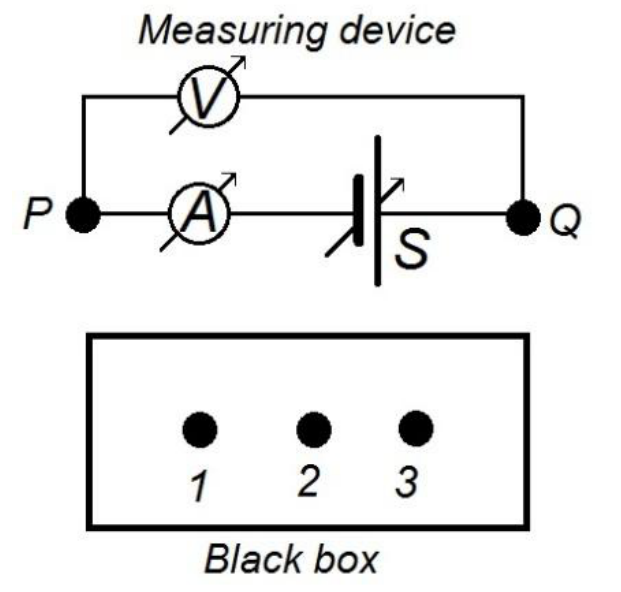
The terminals 1,2 and are placed in electrical contact. If terminals 3 and are also in electrical contact and the tension furnished by the source varies, pairs of values (indicated by the measuring instruments) are obtained. These data are given in the table 1. Current intensity is positive when the current passes through the ammeter from to .
Table 1
| (V) | −6 | −4 | −2 | 0 | 2 | 4 |
|---|---|---|---|---|---|---|
| (A) | −0.2 | 1.2 | 2.6 | 4.0 | 5.4 | 6.8 |
Then, terminals 2,3, are putted in electrical contact. If and terminals 1, are also in electrical contact, the pairs of values indicated by the measuring instruments - where the voltage supplied by the source varies - are given in table 2.
Table 2
| (V) | 0 | 2 | 4 | 6 | 8 | 10 |
|---|---|---|---|---|---|---|
| (A) | −5.2 | −4.0 | −2.8 | −1.6 | −0.4 | +0.8 |
Finally, terminals 3,1, are putted in electrical contact. If and terminals 2, are also in electrical contact, the pairs of values indicated by the measuring instruments - where the voltage supplied by the source varies - are given in table 3.
Table 3
| (V) | −6 | −4 | −2 | 0 | 2 |
|---|---|---|---|---|---|
| (A) | −0.6 | 0 | 0.6 | 1.2 | 1.8 |
Assume that all current-voltage dependencies are linear.
In this problem, calculation of errors is NOT requested.
Task 1 (3 т.)
1.a Plot current - voltage dependence for the data set in Table 1. [0,7 т.]
1.b Determine the numerical values of the intersections with coordinate axes of the graph. Determine also the slope of graph outlined in task 1.a. If applicable, write the result as a fraction. [0,3 т.]
1.c Plot current - voltage dependence for the data set in Table 2. [0,7 т.]
1.d Determine the numerical values of the intersections with coordinate axes of the graph. Determine also the slope of graph outlined in task 1.a. If applicable, write the result as a fraction. [0,3 т.]
1.e Plot current - voltage dependence for the data set in Table 3. [0,7 т.]
1.f Determine the numerical values of the intersections with coordinate axes of the graph outlined in task 1.e. Determine also the slope of graph outlined in task 1.f. If applicable, write the result as a fraction. [0,3 т.]
Task 2 (5 т.)
2.a Determine the values of the electrical resistance of the resistors and electromotive force (emf) of ideal voltage sources that form the simplest circuit (a circuit triangle, delta, ), which has the behavior described by the above data. Keep in mind that the ideal voltage source connected in series with the resistor having the lowest electrical resistance, has an emf of 10V. [4,6 т.]
2.b Draw the equivalent circuit diagram for black box. Write on diagram the values of electrical resistance and emf of the sources - as they results in the task 2.a. [0,4 т.]
Task 3 (2 т.)
3.a For the equivalent circuit that you have determined in the task no.2, plot the current-voltage dependence, when the terminals and are in electrical contact with terminals 1 and 2 respectively. Write numerical values of the intersections with the axes of coordinates of the graph plotted. [2 т.]
Answer sheet
The complete original unfilled Answer sheet occupies pages 19–26. Pages 19,20,21 contain the three blank current–tension grids and intercept/slope boxes for 1.a–1.f. The form 1.d correctly refers to 1.c and 1.f correctly refers to 1.e, whereas the question's printed references differ. Pages 22–24 retain all three native working pages for 2.a, including both “further calculations” continuations. Page 25 contains 2.b and the start of 3.a; page 26 is the final 3.a blank grid. Points are 1.a 0.70/1.b 0.30/1.c 0.70/1.d 0.30/1.e 0.70/1.f 0.30;2.a 4.60/2.b 0.40;3.a 2.00. The corresponding additional English original repeats these complete forms.




Решение
Barem de evaluare şi de notare
Se punctează oricare altă modalitate de rezolvare corectă a problemei.
Problema experimentală nr. 2 – Cutie neagră electrică
1.a
Sarcina de lucru nr. 1
Pentru trasarea caracteristicii curent-tensiune, corespunzătoare datelor din tabelul 1:
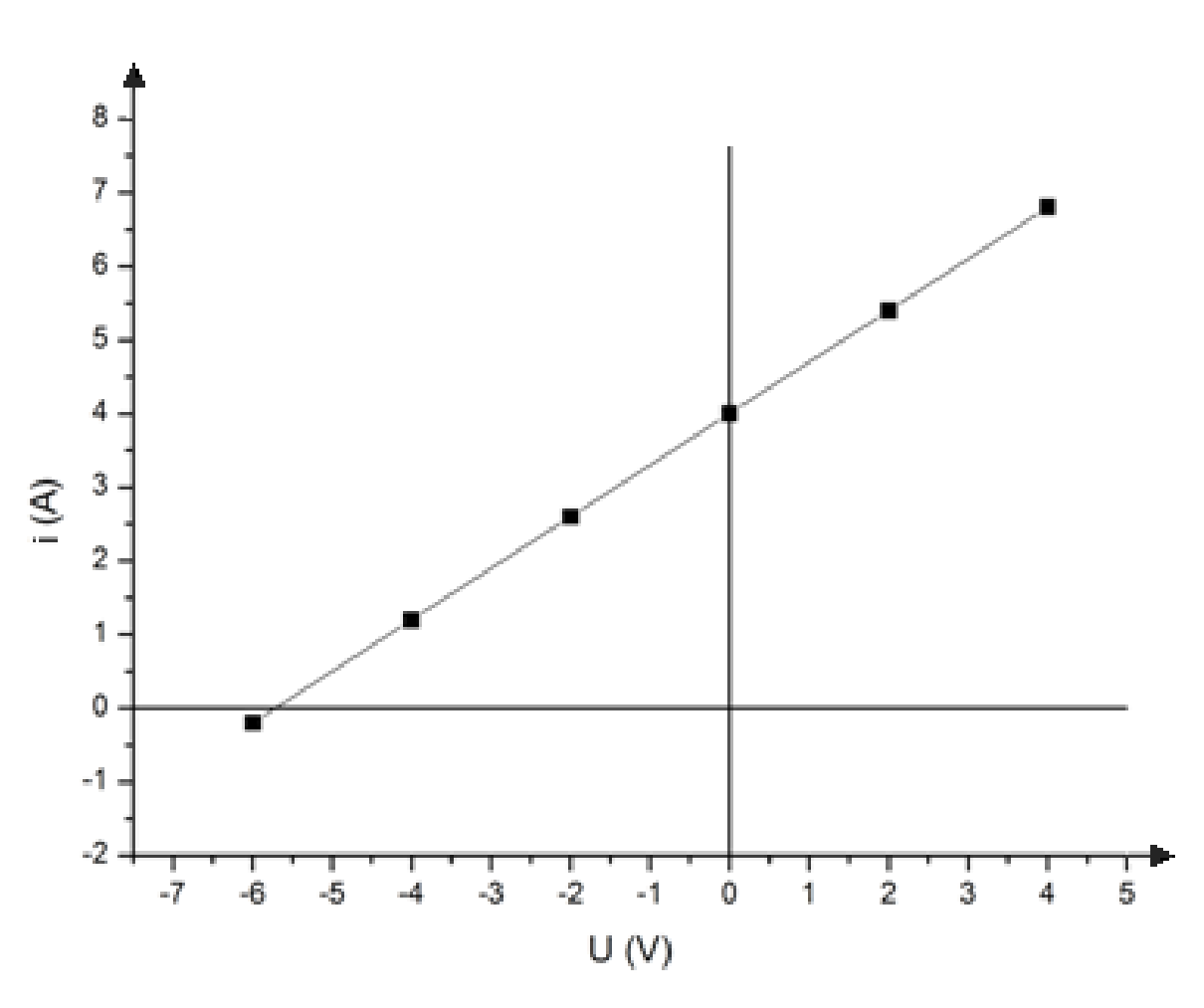
0,70p. Observaţii:
- se acordă câte 0,10p pentru indicarea mărimii şi a unităţii de măsură corespunzătoare fiecăreia dintre axele de coordonate;
- se acordă 0,50p pentru marcarea corectă pe grafic a punctelor corespunzătoare setului de date experimentale din tabelul 1.
Punctaj item: 070p (aşa cum este tipărit în coloana totală a originalului).
1.b
Pentru determinarea valorilor pentru intersecţia cu axele de coordonate a caracteristicii curent-tensiune şi pentru panta graficului, corespunzător datelor din tabelul 1:
0,30p; punctaj item: 0,30p.
1.c
Pentru trasarea caracteristicii curent-tensiune, corespunzătoare datelor din tabelul 2:
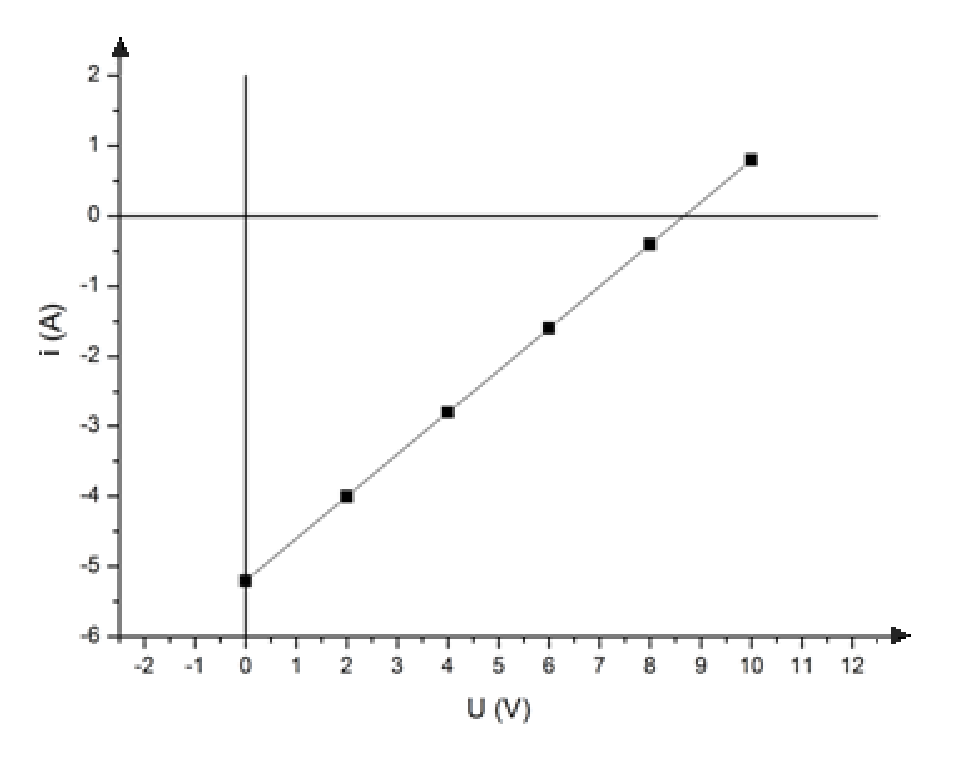
0,70p. Observaţii:
- se acordă câte 0,10p pentru indicarea mărimii şi a unităţii de măsură corespunzătoare fiecăreia dintre axele de coordonate;
- se acordă 0,50p pentru marcarea corectă pe grafic a punctelor corespunzătoare setului de date experimentale din tabelul 2.
Punctaj item: 0,70p.
1.d
Pentru determinarea valorilor pentru intersecţia cu axele de coordonate a caracteristicii curent-tensiune şi pentru panta graficului, corespunzător datelor din tabelul 2:
0,30p; punctaj item: 0,30p.
1.e
Pentru trasarea caracteristicii curent-tensiune, corespunzătoare datelor din tabelul 3:
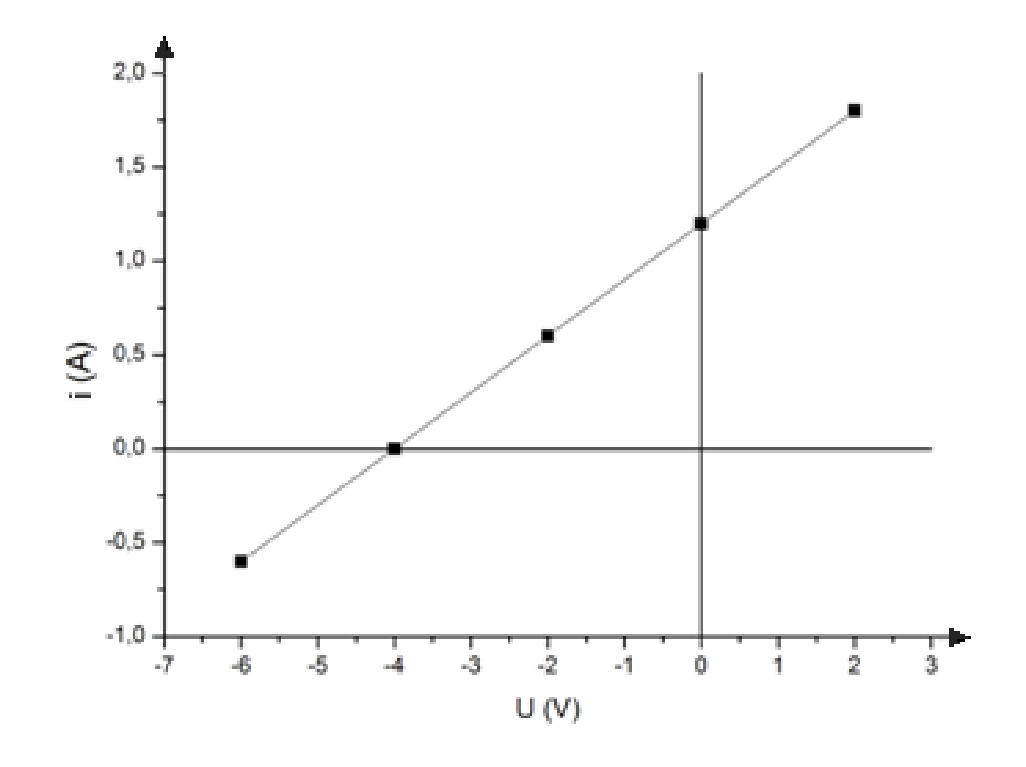
0,70p. Observaţii:
- se acordă câte 0,10p pentru indicarea mărimii şi a unităţii de măsură corespunzătoare fiecăreia dintre axele de coordonate;
- se acordă 0,50p pentru marcarea corectă pe grafic a punctelor corespunzătoare setului de date experimentale din tabelul 3.
Punctaj item: 0,70p.
1.f
Pentru determinarea valorilor pentru intersecţia cu axele de coordonate a caracteristicii curent-tensiune şi pentru panta graficului, corespunzător datelor din tabelul 3:
0,30p; punctaj item: 0,30p.
2.a
Sarcina de lucru nr. 2
Pentru schema unui circuit triunghi echivalent cu cutia neagră:
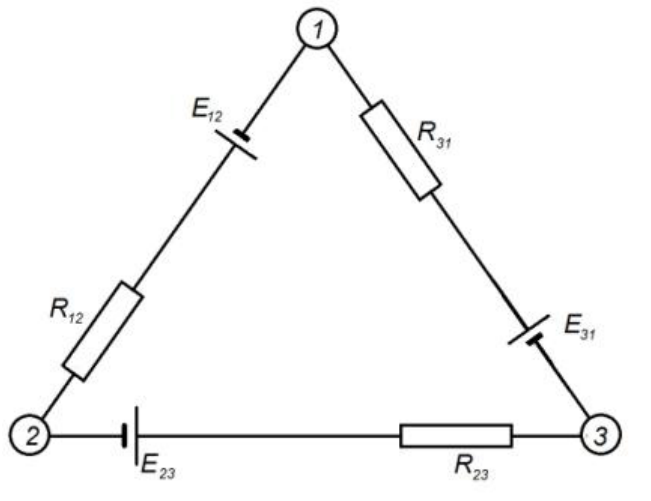
0,40p.
Schema echivalentă a circuitului, pentru primul set de măsurări, în cursul cărora sunt legate împreună bornele 1,2,P şi respectiv 3,Q:
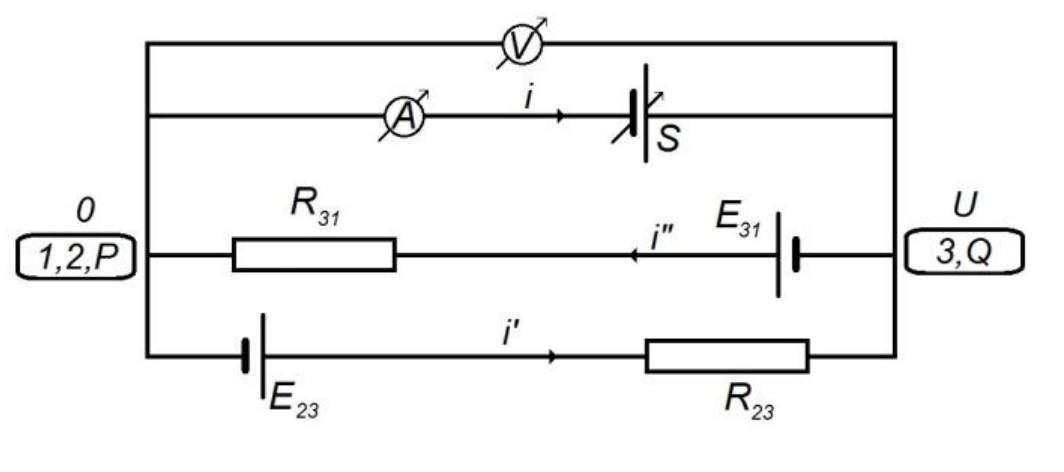
0,40p.
Expresia caracteristicii curent-tensiune a cutiei negre, pentru legarea :
Expresia pantei ; expresia intercepţiei —0,40p.
Expresiile pentru intersecţiile cu axele de coordonate:
0,40p.
Expresia caracteristicii curent-tensiune a cutiei negre, pentru legarea :
Expresia pantei ; expresia intercepţiei —0,40p.
Expresiile pentru intersecţiile cu axele de coordonate:
0,40p.
Expresia caracteristicii curent-tensiune a cutiei negre, pentru legarea :
Expresia pantei ; expresia intercepţiei —0,40p.
Expresiile pentru intersecţiile cu axele de coordonate:
0,40p.
Determinarea valorilor rezistenţelor electrice şi ale tensiunilor electromotoare ale surselor, care formează circuitul electric:
1,40p. Punctaj item: 4,60p.
2.b
Pentru desenarea schemei circuitului electric echivalent, cu indicarea valorilor elementelor constitutive:
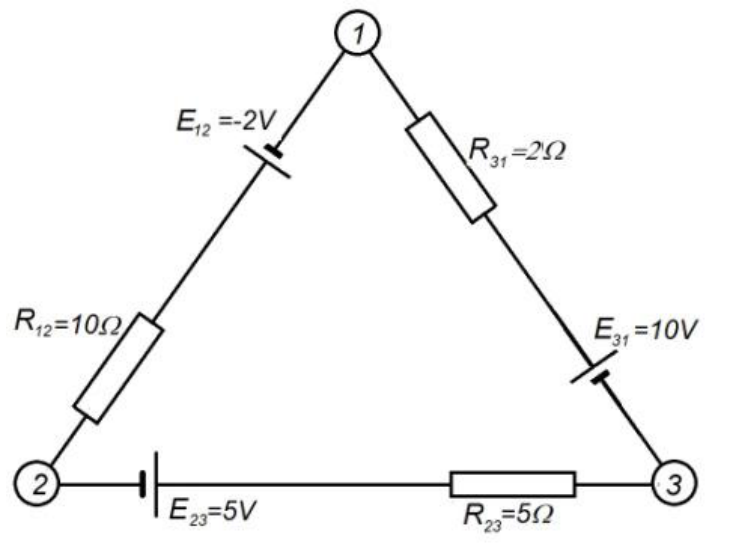
0,40p; punctaj item: 0,40p.
3.a
Sarcina de lucru nr. 3
Pentru schema echivalentă a circuitului realizat prin legarea şi :
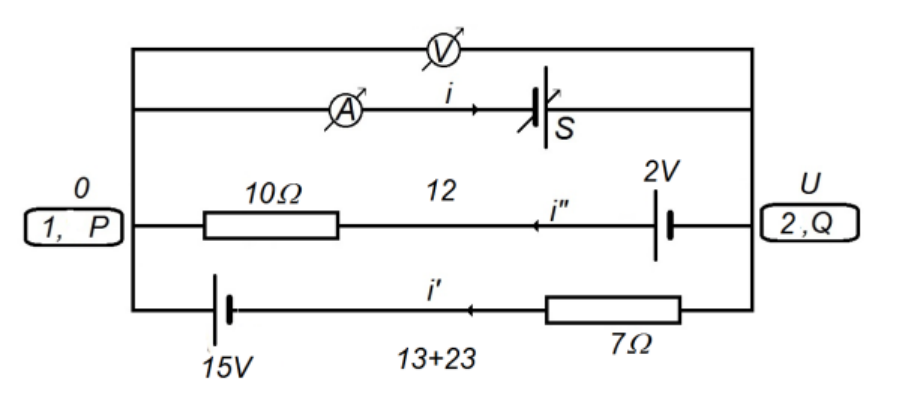
Determinarea dependenţei curent–tensiune pentru circuitul specificat:
1,00p.
Trasarea graficului pentru dependenţa curent-tensiune, în cazul în care terminalele şi se leagă respectiv la terminalele 1 şi 2:
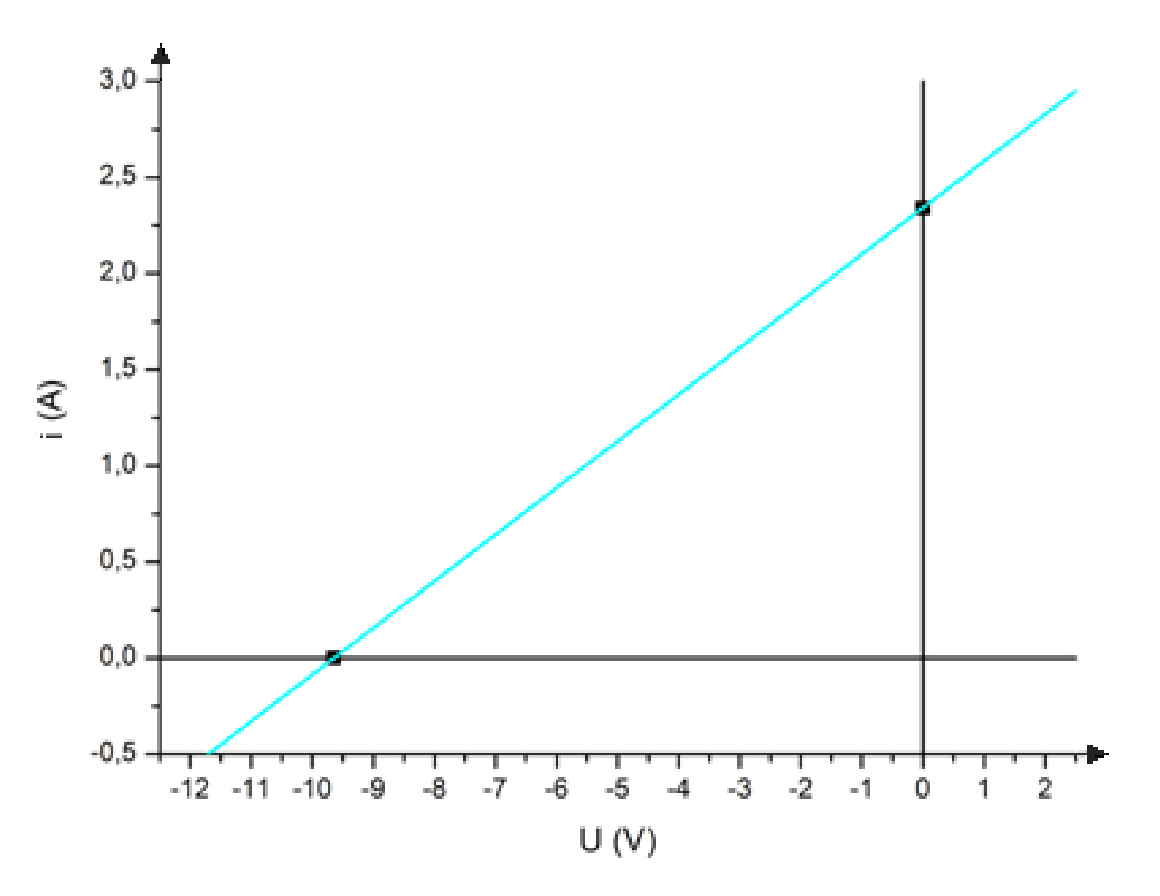
0,60p.
Valoarea intensităţii curentului electric de scurtcircuit ; valoarea tensiunii de circuit deschis —0,40p. Punctaj item: 2,00p.
Оригинал в Архива: exp_problems.pdf · официални решения: rmph_experiment_sol.pdf · допълнителни данни: rmph_experiment_sub.pdf