RMPh 2014, Теория — Задача 1. PROBLEM 1: CIRCLES ALL THE WAY
Romanian Master of Physics 2014 · 10 т.
Условие
This problem has two parts.
A. Determining the radius of curvature of a planar curve by means of Mechanics (4,5 т.)
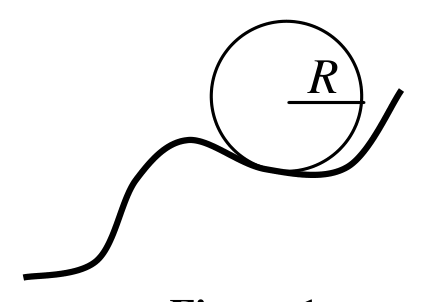
Each infinitesimal length element of a curve can be thought as belonging to a circle with a certain radius (see Figure 1). This radius is called the radius of curvature. In order to determine the radius of curvature at some point of a planar curve, one can consider that the curve is the trajectory of a point-like object, and that the given point is the very object.
Let be the equation of the curve, where and are the coordinates of the object.
a. Express the components and of the velocity of the object in terms of and its time derivatives, and and its derivatives. [1 т.]
b. Let be the component of the acceleration vector parallel to the velocity. Express vector in terms of , , the components and of the acceleration, and the unit vectors and of the O and O axes. [1 т.]
c. Express the magnitude (i.e. the absolute value) of the component of the acceleration perpendicular to the velocity, in terms of , , and . [1 т.]
d. Express the radius of curvature in terms of and its derivatives. [0,5 т.]
e. Find the radius of curvature of the parabola () at a point having coordinate . [0,5 т.]
f. Find the period of small oscillations performed by a bead on the bottom of a smooth surface of equation [m]. You may use [m/s], where is the gravitational acceleration. [0,5 т.]
B. Springs on a circle (5,5 т.)
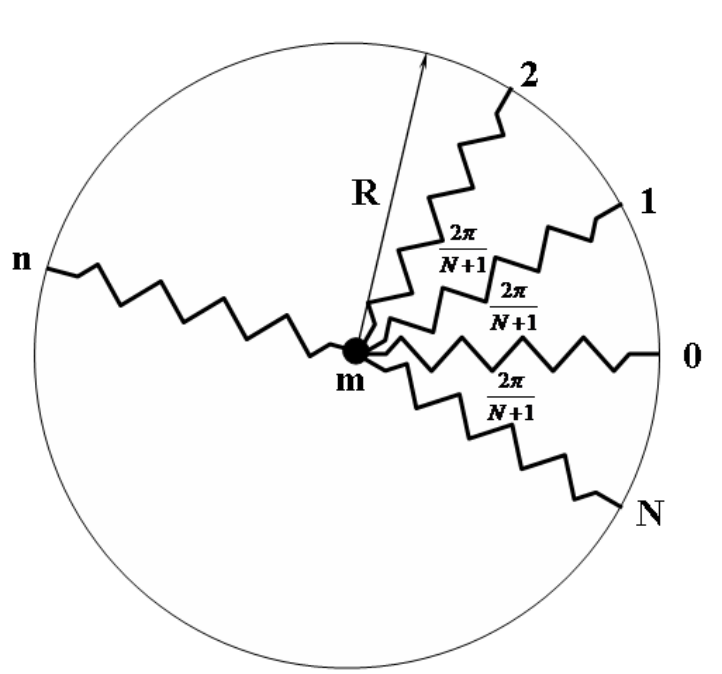
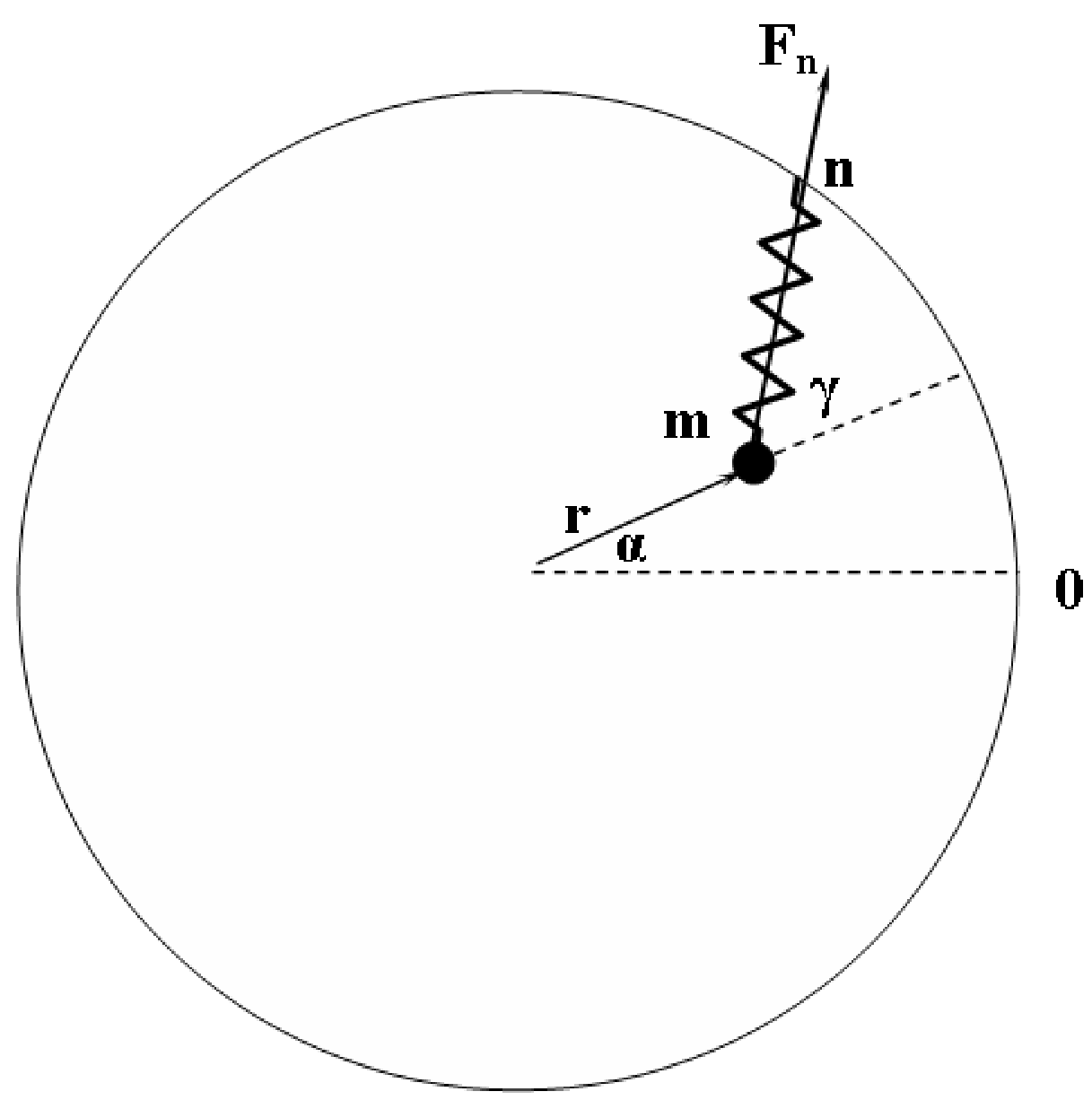
In this problem we will investigate the motion of a point-like object of mass connected to springs of stiffness . The springs are attached to a circle of radius (see Figure 2) and have negligible natural length. The points to which the springs are attached are arranged uniformly on the circle such that, when the object is at the center of the circle, the angle between two adjacent springs is equal to . We label the springs 0 through .
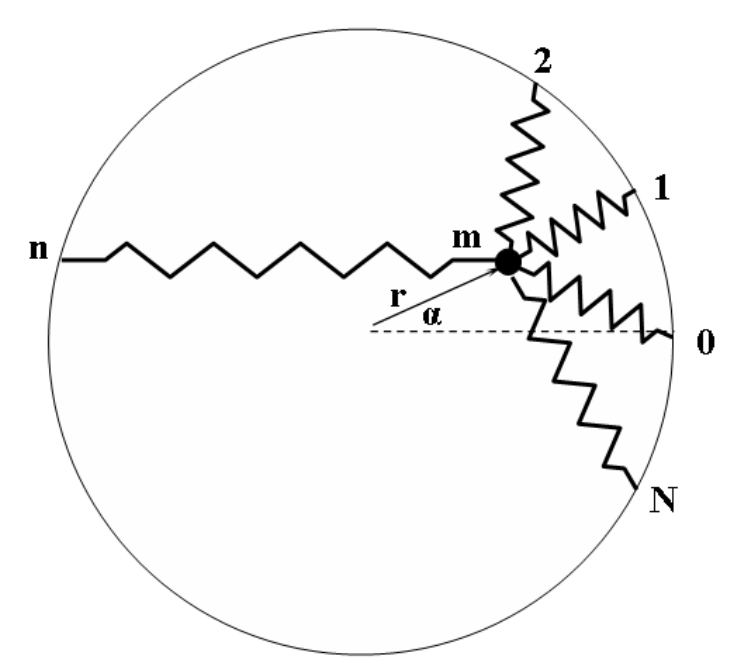
Let angle and the radial coordinate of the object be defined as in Figure 3. The object can move in the plane of the circle and we ignore the effects of gravity throughout the problem.
g. Compute the length of the -th spring for arbitrary and . [0,5 т.]
h. Write down the kinetic energy and the potential energy of the object in terms of , , and their time derivatives. (Do not evaluate the sum in the potential energy just yet.) [0,5 т.]
i. Compute the sums
and use the results to evaluate for arbitrary . [0,5 т.]
j. Show that the angular momentum is conserved. [0,5 т.]
k. Write down the implicit equation for in terms of and . [0,5 т.]
l. Perform the substitution
with an unspecified parameter, and obtain the equation “of motion” for . [0,5 т.]
Perhaps surprisingly, this equation admits oscillatory solutions .
m. Show this, and determine in terms of , , and . [0,5 т.]
and can be thought of as integration constants to be specified by the initial conditions. Since the equation of motion is second order, and we have two integration constants, it means that this is the most general function describing the distance . On the other hand, one can notice that the equation for remains unchanged on substituting with . Physically this is the same as substituting with , which means that the distance from the center of the circle to the object is the same in any two opposing directions.
n. Write down in terms of , , and . Is periodic? Is the motion periodic? Do they both have the same period? [0,5 т.]
o. Describe the motion of the object when . [0,5 т.]
p. Find out the possible value of at which the object could perform circular uniform motion. [0,5 т.]
Suppose now we remove the springs labeled 0, , , … , where divides .
q. Argue that derived in part n. continues to hold, but for a different value of . What is this new value in terms of , , and ? [0,5 т.]
Отговори
A. Determining the radius of curvature of a planar curve by means of Mechanics, e.
A. Determining the radius of curvature of a planar curve by means of Mechanics, f. 1 s
Official solution: R = 0.25 m, T = 2π√(R/g) ≈ 1 s.
B. Springs on a circle, q.
Решение
PROBLEM 1: MECHANICS
A. Determining the radius of curvature of a planar curve by means of Mechanics
a. 1.0 point
b. 1.0 point
c. 1.0 point
d. 0.5 point
e. 0.5 point
f. 0.5 point
B. Springs on a circle
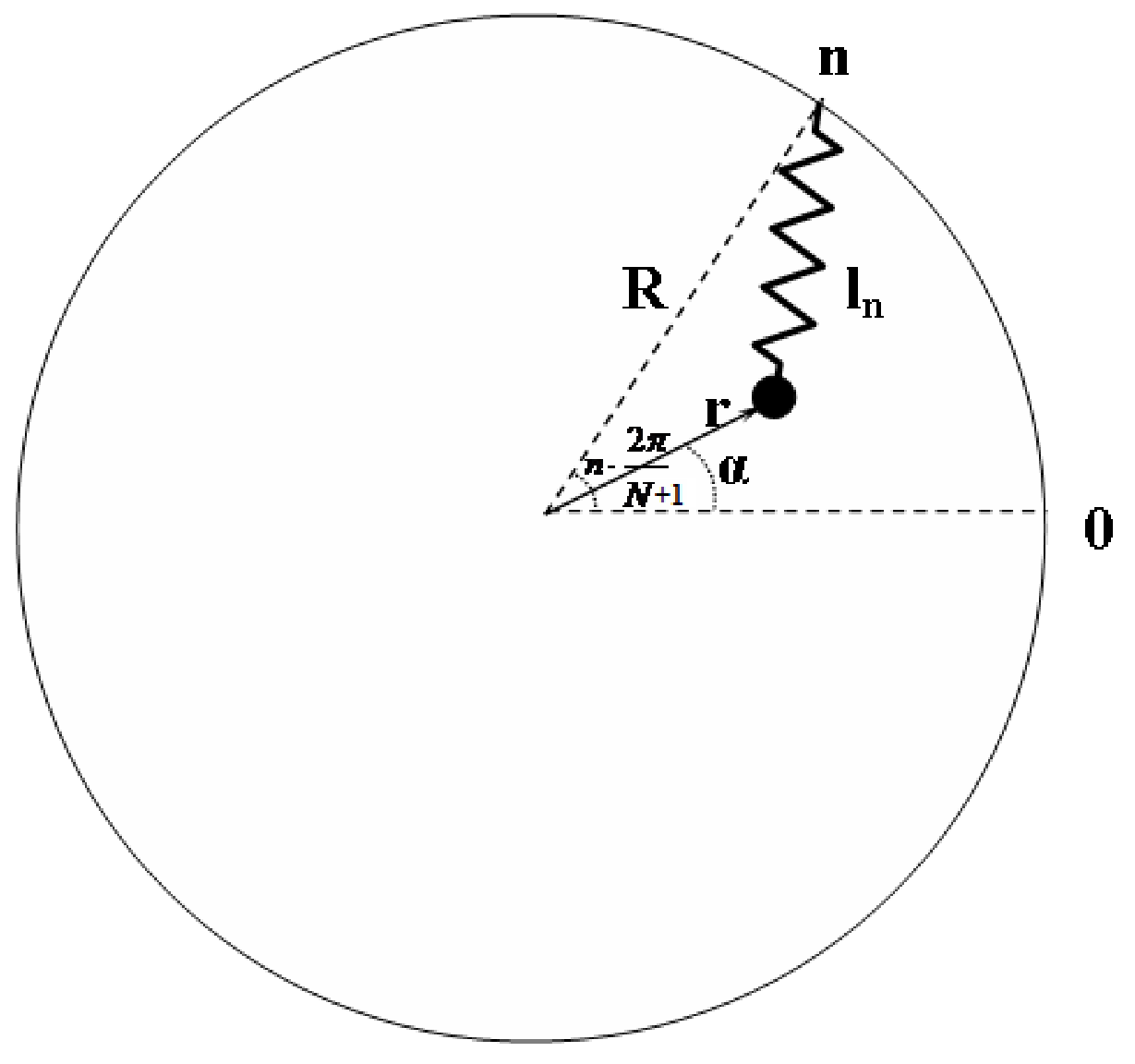
g. 0.5 point
According to the cosine rule:
h. 0.25 point + 0.25 point
i. 0.25 point + 0.25 point
One can use the sum of a geometric progression having complex terms.
So
j. 0.5 point
The force with which the -th spring is acting on the object is
According to the sine rule,
The torque of equals
The total torque equals
So the angular momentum is indeed constant.
k. 0.5 point
l. 0.5 point
m. 0.5 point
The first term of the equation cancels anyway.
n. 0.5 point
But since the values of repeat after every rotation by , it means that the period of the motion is
o. 0.5 point
According to the previous part, except for the moments when and is not defined, there will be two constant values for , corresponding to two opposing directions. So in this case the object will perform simple harmonic motion with amplitude .
p. 0.5 point
q. 0.5 point
We can think of this situation as having springs of positive constant and another springs of “negative” stiffness –k. The potential energy derived in i. holds for both ensembles (with appropriate and ) and angular momentum is still conserved. Thus all the results from part j. onwards continue to hold if we replace (N + 1) by (N + 1) + [– (N + 1)/d]. Thus
Оригинал в Архива: th_problems.pdf · официални решения: th_solutions.pdf