RMPh 2017, Теория, пролетна сесия — Задача 2. Bicycle pump
Romanian Master of Physics 2017 · 10 т.
Условие
Problem II (10 points)
A student is inflating one of his bike’s tires by using a bicycle pump which functions via a hand-operated piston. Before inflating it, the pressure inside the tire was the atmospheric pressure and the temperature was . In order to be inflated, the tire is fitted with a valve which opens when the pressure just outside the valve is equal to the pressure within the tire. Assume that the volume of the tire, does not change as the tire is inflated.
Each inflation cycle starts with the piston in the top position. Each time the piston is in its top position, the piston’s cylinder is filled with air at the atmospheric pressure and temperature . When in the top position the volume of the air in pump is , with , where is a given number. When the piston is pushed to its bottom position all of the air that was within the cylinder is pushed in the tire. The distance by which the piston moves between its top and bottom positions is given by .
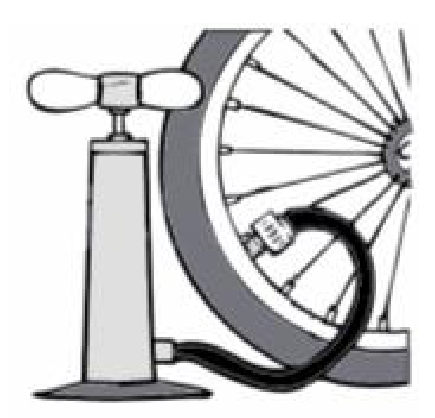
Assume that the walls of the piston’s cylinder as well as the walls of the tire itself are perfectly diathermal (allows heat but not matter to pass across it) and that their temperature as well as that of the air inside is given by the atmospheric temperature . Assume that the universal gas constant is known and is denoted by .
Task no. 1
Task number 1 asks you to analyze some of the parameters of the entire system, and to write your results in terms of the thermodynamical parameters , , , , the number , the number of pumping cycles , and the distances and .
1.a. Find the number of moles of air, that are within the tire after the student pumped air times using the pump with the hand operated piston. [0,8 т.]
1.b. Find the air pressure within the tire, after the student pumped air times. [0,4 т.]
1.c. During the th pumping cycle, the valve opens when the piston is at the distance from the top position of the piston. Determine expression of . [0,4 т.]
1.d. Find the pressure of air within the pump’s cylinder, during the th pumping cycle, as a function of the distance between the top position and the current position of the piston. [0,6 т.]
1.e. Plot the previously determined pressure, during the th pumping cycle as a function of . [0,8 т.]
Task no. 2
In task number 2 you are asked to find the work that the student needs to do in order to inflate the tire up to a given pressure. Write your results in terms of , and , the pressure and the volume .
2.a. During the th inflation cycle, the air pressure within the tire reaches the value , where . Find the expression of . [1,2 т.]
2.b. Find the work that the student needs to do between the moment when he starts pumping to the moment where the air pressure within the tire reaches . Assume that is an integer and that the friction between the piston and the cylinder walls is negligible. [1,2 т.]
Task no. 3
In task number 3 you are asked to compute the numerical values for some of the quantities which you were previously determined in task number 1 or 2.
Assume the following numerical values for the physical constants and parameters that have been previously mentioned: , , , , and .
3.a. Compute the number of air moles within the tire after 10 pumping cycles. [0,2 т.]
3.b. Compute the value of the air pressure within the tire after 10 pumping cycles. [0,2 т.]
3.c. Compute the number of cycles needed for the air pressure within the tire to reach the value . [0,2 т.]
3.d. Compute the value of the work that the student has to do during the 10th pumping cycle. [0,2 т.]
Task no. 4
For task number 4 you are asked to analyze the evolution of the air pressure in two different scenarios (I and II) which will be described below. The atmospheric pressure is once again given by , and the volume of the bicycle tire is .
I. You will consider that the inflating of the bicycle tire at pressure takes place at a temperature , on a rainy day, and that the saturated water vapor pressure is . Then, the inflated wheel is reinstalled to the bike and the bike is ride at a temperature . The saturated water vapor pressure at temperature is .
4.a. Find the air pressure within the tire under the above set of circumstances. [0,8 т.]
II. For the second scenario, assume that the student is trying to inflate the tire up to the same pressure, , at the same temperature, , however, instead of inflating the tire with air he uses nitrogen. Furthermore, assume that the bicycle tire is kept in a large room which is also filled with nitrogen at temperature and pressure . The molar mass of nitrogen is given by . On the other hand, this tire has a small defect, a very small orifice, of area .
Assume that the average speed for particles in a gas with molar mass , at a temperature is given by . Consider that for the given scenario, the number of gas particles that collide unit surface area of the wall per unit time is given by, .
4.b. Determine the number of nitrogen molecules per unit time, , which collide with the small orifice from the interior of the tire, and find the number of nitrogen molecules per unit time, , which collide with the small orifice from the exterior of the tire. [1,2 т.]
4.c. Find that time that it takes for the nitrogen pressure within the tire to decrease from the initial value to a final value . [1,8 т.]
© Problem written by:
Prof. dr. Delia DAVIDESCU
Conf. univ. dr. Adrian DAFINEI
Решение
Внимание: Непълно решение
В архива няма официално решение на тази задача.
Answer sheet
Answer sheet
Problem II (10 points)
Bicycle pump
Task No. 1
1.a. The expression of number of air moles inside the bicycle tire, after k pumping cycles — 0.80p
1.b. The expression of air pressure , after pumping cycles — 0.40p
1.c. Formula for the distance — 0.40p
1.d. Formula for the pressure as a function of the distance between the top piston position and the current position, during the th pumping cycle. — 0.60p
1.e. Sketch of the dependence of air pressure inside tire as function of distance , during the th pumping cycle. — 0.80p
Task no. 2
2.a. Formula for the number — 1.20p
2.b. Formula for the work that the student needs to do, from the moment when he starts pumping, up to the point where the pressure within the tire reaches — 1.20p
Task no. 3
3.a. The number of moles in the tire after 10 pumping cycles. — 0.20p
3.b. The value of the air pressure within the tire after 10 pumping cycles. — 0.20p
3.c. The number of pumping cycles required in order to reach a pressure within the tire. — 0.20p
3.d. The value of the work done by the student during 10 pumping cycles. — 0.20p
Task no. 4
4.a. The value of the air pressure within the tire, in the circumstances of scenario I. — 0.80p
4.b. Formula for the number of molecules per unit time , which go from the interior of the tire to the exterior. — 0.60p
Formula for the number of molecules which fall on the surface of the orifice per unit time , which go from the exterior of the tire to the interior. — 0.60p
4.c. The value of the time interval in which the nitrogen pressure from the interior of the tire decreases from the initial value to a final value . — 1.80p
Оригинал в Архива: RMPh_2017_PT2_question.pdf