RMPh 2017, Теория, 27 октомври — Задача 2. Theoretical Problem No. 2
Romanian Master of Physics 2017 — Theoretical Exam - October 27, 2017 — Theoretical Problem No. 2 · 10 т.
Условие
Theoretical Problem No. 2
Part A - Sir Geoffrey I. Taylor (2 т.)
About mid-twentieth century, the amount of energy released by the explosion of an atomic bomb was a classified information. Using dimensional analysis and images shot in 1945 during the explosion of the first atomic bomb in the air, images that became public in 1947, English physicist Geoffrey I. Taylor estimated the amount of energy released by the explosion. In 1950, Taylor published two articles in which he presented the results of this estimate.
Geoffrey I. Taylor assumed that the radius of the radioactive cloud, that appears as a result of the detonation of an atomic bomb into the air depends only on the time elapsed since the explosion, the released energy , and the air density around the radioactive cloud.
a. Using the above information and dimensional analysis, deduct the dependence of cloud radius on the energy released , the time interval and the density of ambient air. [0,5 т.]
Figure 1 shows a succession of images of the radioactive cloud from the explosion of an atomic bomb in 1953.
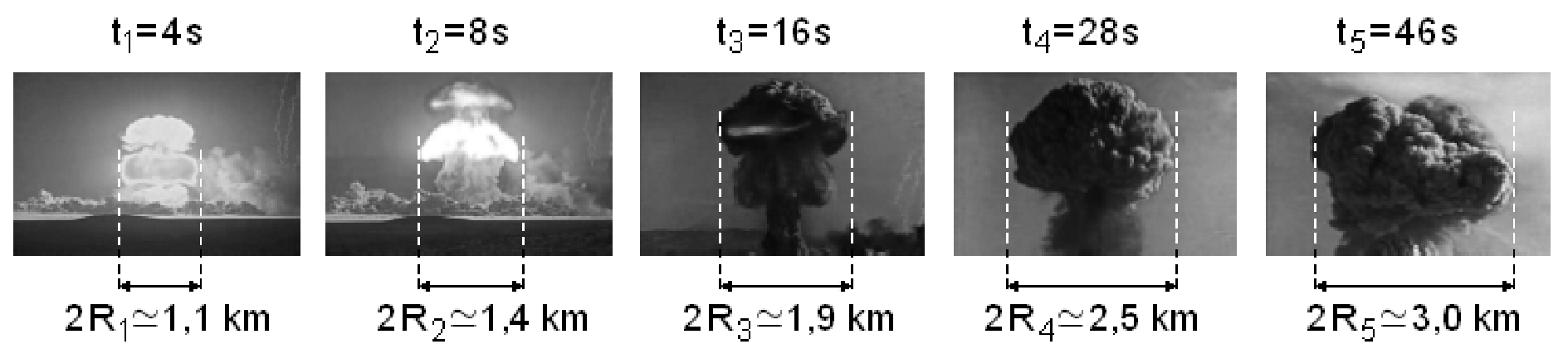
b. Estimate the amount of energy released in the explosion of an atomic bomb in 1953, using the data shown in the images in Figure 1. The air density around the radioactive cloud has the value of , and the non-dimensional coefficient is . [1,5 т.]
Part B - Estimation of the density of the watermelon in the photo — Task No. 1
The present problem proposes that only based on the picture in Figure 2 to make some estimations for the density of a melon floating in a bucket of water and to analyze the small vertical oscillations of the melon in the water bucket.
In all the estimations you will make, you will consider that the watermelon is homogeneous and can be approximated by a sphere. In the different estimations you will make, you will neglect or consider refraction and / or three-dimensional effects.
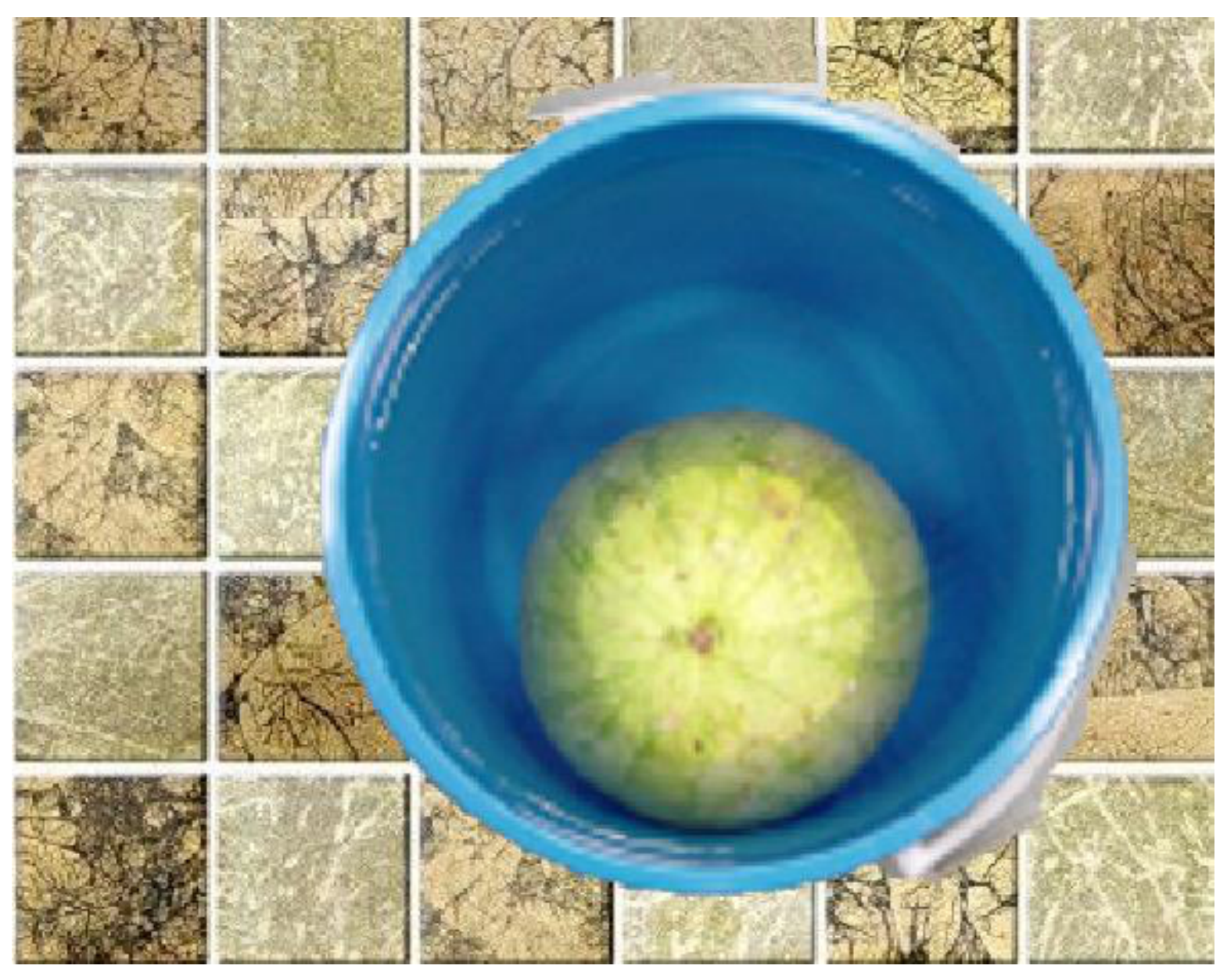
Task No. 1 proposes to analyze the factors that influence the accuracy of the density determination of watermelon and to make a first estimation of its density without considering the refraction of light on the air-water surface and the three-dimensional effects.
1a. Deduce the expression of , the volume of the watermelon portion which is immersed in water. Express the result as function of the radius of the melon and of the ratio , where represents the radius of the intersection circle of the melon with the surface of the water. [0,5 т.]
1b. Determine the expression of the density of melon as function on water density and ratio . [0,4 т.]
1c. Plot the graph of the ratio as function of . [1 т.]
1d. Using the plot drawn in task 1c briefly describe how the value of the ratio influences the accuracy of the density determination . [0,4 т.]
1e. Estimate the density of the melon from the photograph shown in Figure 2, without considering the refraction of the light to the air-water surface and the separation space between the horizontal planes containing the intersection circle of the water surface with the melon and horizontal equatorial circle of the melon. [0,4 т.]
Task No. 2
The estimation achieved in Task No. 1 can be improved by considering the spatial separation between the horizontal planes containing the intersection circle of the water surface with the melon and horizontal equatorial circle of the melon.
In this task, neglect the phenomenon of refraction of light on the surface air-water. Consider that the camera with which the photograph was taken is placed in position , at distance away from the surface of the water in the bucket, and note the "apparent" radius of the melon (Figure 3).
Assume that the camera is placed high enough relative to the surface of the water in the bucket, so it can record latitudes close to the equatorial circle of the melon. In Figure 3 the water surface is represented by the line passing through the points and . The sketch in figure 3 is not made on scale.
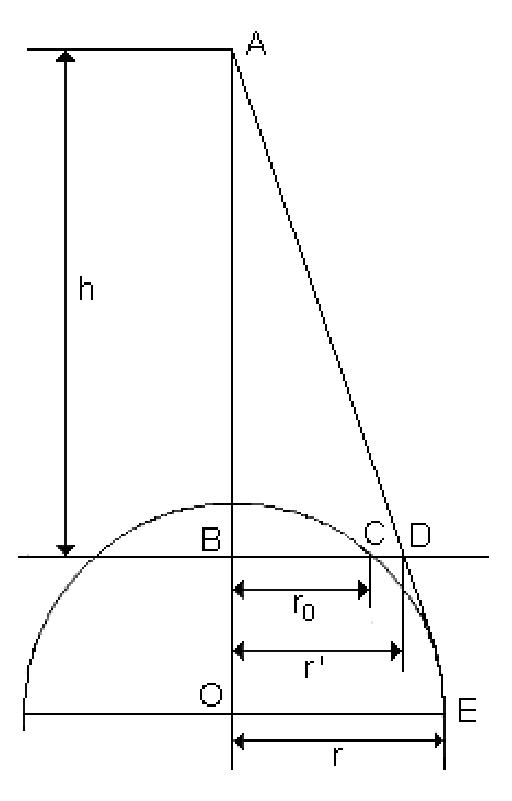
2a. Determine the expresion of the radius of the melon, in the conditions mentioned in this task. Express the result as function of , and . [0,6 т.]
2b. Estimate the density of the melon in the photograph shown in Figure 2 under the conditions specified in Task 2. Consider that the photograph was made by a young man with the height of , standing next to the bucket having the diameter . The height of the bucket is . [1,1 т.]
Task No. 3
In the Task No. 3 you are asked to consider whether the refraction of light significantly influences the result of the melon density estimation - if you take into account the spatial separation between the horizontal planes containing the intersection circle of the water surface with the melon and the melon's equatorial horizontal circle.
3a. Determine - under the conditions specified for the Task No. 3 - an expression containing the melon radius , the refraction index for water and the quantities whose significance was mentioned in the Task No. 2. [0,6 т.]
3b. Estimate the density of watermelon in the photograph shown in Figure 2, under the conditions specified in the Task No. 3. The water refraction index is . [1 т.]
3c. Specify whether the refractive phenomena considerably influence the result of the melon density estimation. Briefly motivate your answer. [0,2 т.]
Task No. 4
In the Task No. 4 is required to analyze the small vertical oscillations of the melon in the picture shown in Figure 2, using a simple modeling in which the friction forces and the moving of the water in the bucket are considered negligible.
4a. Determine the height of the spherical cap of melon located in the air - under the conditions set out in the Task No. 3 b. [0,3 т.]
4b. Determine the angular frequency expression of the small vertical oscillations of the melon around the equilibrium position shown in the picture in Figure 2. Express the result as function of , of the height of the spherical cap of the melon and the gravitational acceleration . [1 т.]
4c. Write the equation of the small vertical oscillations of the melon, if their damping is negligible. Express the result as function of elongation and pulsation . [0,2 т.]
4d. Calculate the amount of time required to perform ten small, vertical, undamped oscillations of melon under the conditions of estimation set out in the task No. 3b. Consider . [0,3 т.]
Решение
Внимание: Непълно решение
В архива няма официално решение на тази задача.
Printed source attribution
Printed source: Romanian Master of Physics 2017, Theoretical Exam October27,2017, subject proposed by Delia DAVIDESCU and Adrian DAFINEI. Archive filename/folder2018 is preserved; no solution was obtained.
Оригинал в Архива: T2.pdf