RMPh 2021, Теория — Задача 1. Steiner’s symmetry breaking highway
Romanian Master of Physics 2021 · 10 т.
Условие
Symmetries are a guiding principle in modern theoretical physics. Nevertheless, even if a problem exhibits certain symmetries, it is not always the case that all of its solutions can be found using symmetry arguments alone. This phenomenon is known as spontaneous symmetry breaking and is fundamental to understanding the nature of particles in our universe. The problem below is partly meant to exhibit this phenomenon in a much simpler setting.
Mr. Steiner is trying to get into the highway building business. The projects that he is attempting to design and build require that, given a set of cities, he builds a network of highways in such a way that travel between any two cities is possible (but the path between any two cities does not necessarily have to be the shortest one). Given this constraint, in order to diminish costs, his goal is to minimize the total length of each highway network that he has to build.
Part I (4 points). For his first batch of projects, Mr. Steiner has to design the highway network interconnecting three cities. In this part, assume that the three cities lie on a homogenous plane with no obstacles.
a) As his first project, he has to find the minimal length highway network connecting three cities which are placed at the tips of an equilateral triangle. Use symmetry arguments to find a design which minimizes the length of the highway network. If the equilateral triangle has edges of length , find the total length of this highway network. [1 т.]
b) For his next project, he has to find the minimal length highway network connecting three generic points on the plane. In order to do this, he decides to employ vector calculus.
i) Consider two points on the plane, A and O. Show that if the point O is translated by some infinitesimal vector (the norm of is much smaller than the distance between A and O), then the distance between the points A and O changes by
where (i.e. ) is the unit vector pointing in the direction from A to O.
ii) Use the result from point i) to find the minimal length highway network connecting three points that are the vertices of a triangle whose angles are all smaller than 120 degrees. Specifically, find the shapes for all the roads (straight or curved), the number of intersections and the angles at each intersection between any two edges of the network. Check if your answer from point a) agrees with your prediction.
iii) Find the minimal highway network connecting three points that are the vertices of a triangle that has one angle larger than 120 degrees. Once again, find the shapes for all the roads (straight or curved), the number of intersections, and the intersection angles between any two edges of the network. [3 т.]
Part II (3 points). For his second batch of projects, Mr. Steiner has to design the highway network interconnecting four cities, placed in the vertices of a square. Once again, in this part, assume that the four cities lie on a homogenous plane with no obstacles.
c) Just like in point a), past proposals have used symmetry arguments to find the network which minimizes the length of the highways, this time for a network connecting four cities. Describe such a configuration and determine the total length of the highway network assuming that all the edges of the square have length . Use the results from part I, to show that the symmetric configuration is the network of minimal length with a single intersection point. [0,7 т.]
d) Mr. Steiner suspects that the symmetric configuration found at point c) is NOT the one that minimizes the total length of the network. Use the results from part I to find whether there indeed are other network configurations that minimize the length. If so, find the new minimal length of the network and compare it to the distance found in point c). [1,5 т.]
e) To verify your result, make a qualitative sketch of the network's overall length as one brings the intersection points for the network found in point d) closer together or further apart along the axis that unites them.
(If the configuration found in part d) contains more than two intersection points, choose to bring only two of them closer together or further apart when drawing the plot. If you found that the configuration in part c) has the minimal length, plot the length of the network as one splits the single intersection point in this configuration into two intersection points.) [0,8 т.]
Part III (3 points). Mr. Steiner’s projects have reached a global scale as the distance between cities has increased to a scale comparable to Earth’s radius. Because of that, he has to take Earth’s curvature into account when designing the highway network. Assume that Earth is a perfect sphere with radius with a homogenous surface that has no obstacles. To connect only two cities located on Earth’s equator, he has found that the minimal path between the two also follows the equator. Using this fact, help Mr. Steiner design the following two highway networks:
f) Find the minimal highway network connecting a city at the North pole, a city at the South pole and Bucharest, a city whose latitude is 44.42 degrees North and longitude is 26.10 degrees East. To do this, find the shapes for all the roads (straight or curved), the number of intersections, the intersection angles between any two edges of the network, and the total length of the network. [1 т.]
g) Find the minimal highway network connecting a city at the North pole and two cities located on the equator, at a longitude of 30 degrees East, and 30 degrees West, respectively. To do this, find the shapes for all the roads (straight or curved), the number of intersections, and the intersection angles between any two edges of the network. [2 т.]
Hint: Given two points (1 and 2) on the sphere, whose normal vectors to the surface of the sphere are given by and then the distance between the two points is given by
where is the angle between and , given by
Use this to show that the unit vector tangent to the sphere at point 1, pointing from 1 to 2, can be expressed as
as long as the vectors and are not opposite to each other (i.e. the points are exactly on opposite sides of the sphere).
Dr. Luca ILIEȘIU
Stanford Institute for Theoretical Physics, Stanford University
Отговори
- a)
- c)
- d)
- f) The minimal path is given by the 26.1 degrees East longitude line going from the North to the South pole.
- g) One intersection point, whose edges point along great circles between this intersection point and each vertex of the triangle, and the angle between all vertices is 120 degrees.
Решение
Part I. Before we start designing the highway network for each set of cities we can make several observations that apply to all triangle configurations. Because the minimal path between two points and on the plane, is given by a straight line, the highway network should only consist of straight lines and intersections. Secondly, since every intersection includes at least 3 edges (or 2 in the degenerate case where the intersection is the same as one of the vertices of the triangle), there should never be more than one intersection if we wanted to minimize the total length of the highway network connecting three cities (which we will denote by , and ).
a) (1 point) The symmetric configurations are those that are invariant under 120 degrees rotations around the center of the equilateral triangle and under reflections around its median axes. There is only one such symmetric configuration which involves only one intersection: the intersection is in the center of the triangle and the edges of the network connect this intersection point to the vertices of the triangle. The total length of this configuration is .
b) i) (1 points) To prove the identity let’s consider the vector connecting to to be and to to be , with and . Then the norm of the vector is given by
Then, for ,
with is the unit vector pointing from to . Importantly, for b) iii), the formula above applies as long .
b) ii) (1.2 points) To minimize the minimum length path we wish to find an intersection point such that the derivative of the length with respect to the infinitesimal translation vector is zero. Using (1.2), we find that if the intersection point is translated by , then the total length of the network changes as
where , , are the normal vectors pointing from the intersection point to , or respectively. Since we want to be zero to leading order in , for any direction of the vector , then . This, in turn, implies
which implies that and, consequently the angle between and is 120 degrees. Similarly, starting from the same relation we can prove that the angle between and , and and are all 120 degrees.
There is one corner case that we should also be concerned with. The formula (1.2) is valid as long as , i.e. if the point is not the same as , , or . We need to make sure that if is the same as , , or , then it is not the network of minimal length. Let’s assume without loss of generality that . Then, translating by an infinitesimal vector yield a length change
We can note that the minimum of is given by pointing in the opposite direction as For such a vector , the length change becomes
When the angle between and is less than 120 degrees, then , and the total length of the network can be decreased by going along a vector opposite to .
Therefore, for a triangle that has all angles smaller than 120 degrees, the minimal length network has an intersection point within the interior of the triangle triangle, that has the angles between any two straight edges equal to 120 degrees. Such an intersection always exists for such triangles and is named Toricelli’s or Fermat’s point.
b) iii) (0.8 points) We will call the vertex which has the angle greater than 120 degrees . When the triangle has an angle greater than 120 degrees, than it is impossible to have . Instead the minimum is achieved by taking to be in the vertex . To see this, note that according to (1.6), the smallest variation of the length of the network is given by . Since we have that . Therefore, moving the intersection point can only increase the length of the network. Consequently, this proves that having the intersection point in yields the minimal length highway network.
Part II. For convenience, we will denote the vertices of the square as , , , and .
c) (0.7 points) The symmetric configuration is the network that is invariant when rotated by 90 degrees, or reflected around the horizontal or vertical axis of the square. This is given by a network with one intersection point placed in the center of the square connected to the vertices , , and through four straight edges. The total length of this network is given by , where is the length of the square’s edges.
Let’s prove that this configuration has a minimal length among the network with a single intersection point. Using (1.2), the variation if we translated by is given by
since at the center . Therefore, this implies that the configuration with in the center of the square is indeed a minimal length configuration amongst networks with one intersection point.
d) (1.5 points) Let’s consider other possible configurations. Once again, since each intersection has at least three edges entering it (except for the case where an intersection point agrees with a vertex which we will once again check separately), the minimal length network can have at most 2 intersection points, each with 3 edges entering it. We will call these two intersection points and . Translating or independently by any infinitesimal vectors or , respectively, should not decrease the distance. Therefore, we can use the variation formula (1.3), independently for the points and . Therefore the angles between all the edges entering and , respectively, are all equal to 120 degrees. This leads to one of the two configuration shown in figure 1, both of which have paths of equal length.
The length of this configuration is:
where the term in the first parenthesis gives the length of the the edges connecting to the closest vertex of the square and the term in the second parenthesis is the length of the edge connecting to .
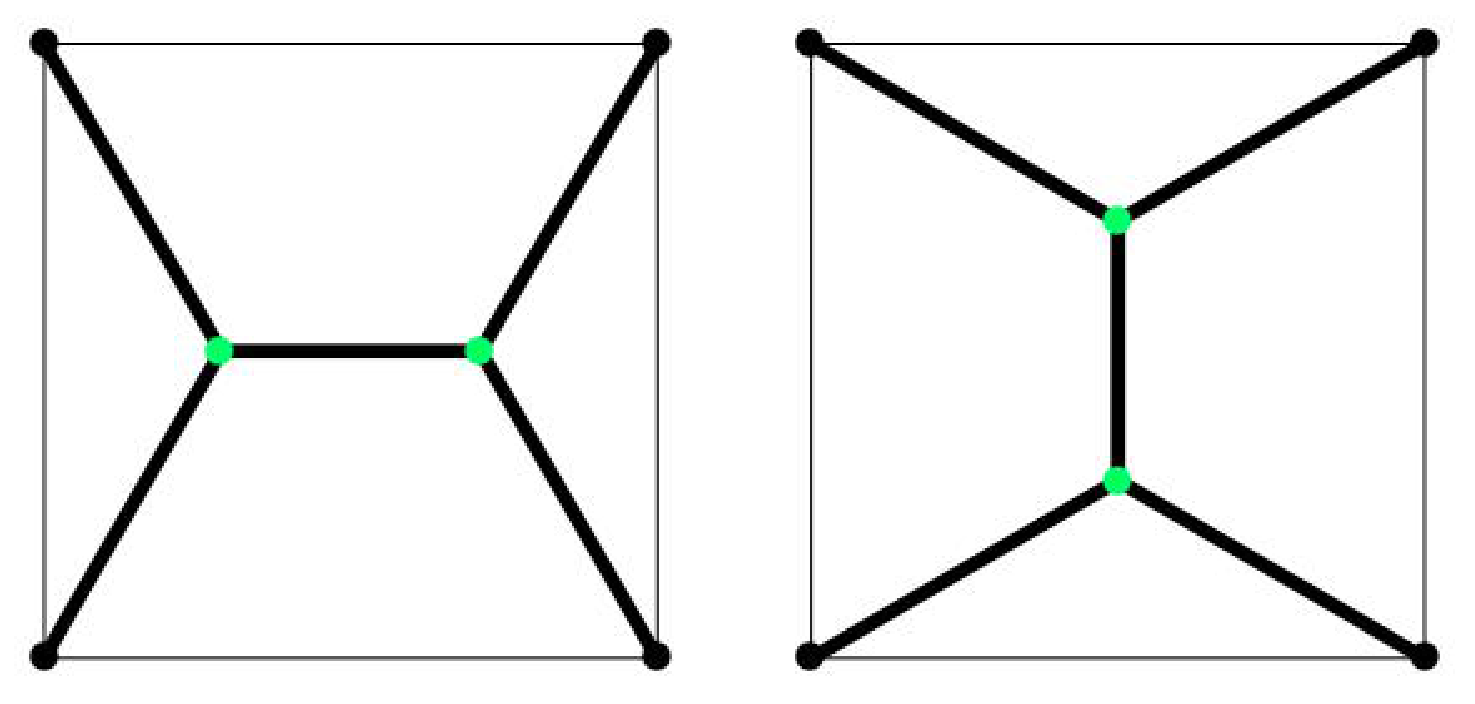
Finally, we also need to make sure that the configurations that we just discussed are indeed those with the shortest path, not only amongst those that have two intersections. First, we note that and, therefore, the two intersection configuration has a shorter length than the one intersection configuration. We also need to make sure that the degenerate configurations where the intersection points are the same as two of the vertices of the square is longer than the two intersection configuration. The former configuration has length .
Therefore, the configurations in figure 1 are those of shortest overall length. Note that each of the two configurations do not obey all the symmetries of the square: for instance, 90 degrees rotations around the center of the square maps one configuration to the other, but not to itself. This is in contrast to the example in part c) where all the symmetry transformations leave the configuration invariant. Therefore, as hinted at in the problem’s introduction, this is a basic example of spontaneous symmetry breaking in which the minimal configuration is not fully symmetric.
e) (0.8 points) As we get the intersection points and closer or further away from each other (we will denote the distance from to as ), the total length is given by,
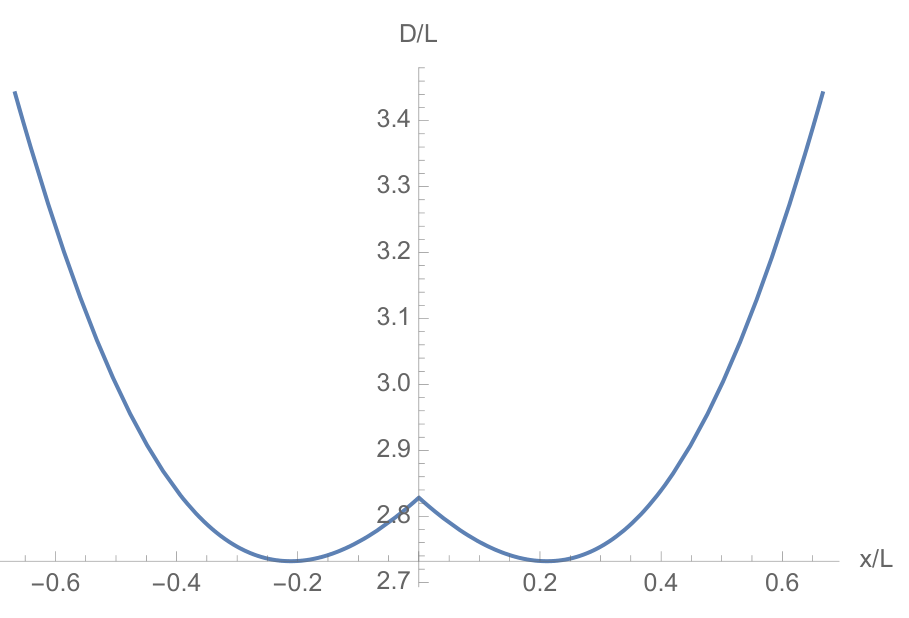
The sketch of is:
where we need to emphasize that the minimal value is achieved for the configurations shown in figure 1.
The absolute value ensures that we connect to the closest pair of vertices.
Part III. An important point to generalizing Steiner’s observation regarding the two cities placed on the Equator, is that the choice of North and South pole is arbitrary for a homogeneous sphere. Therefore, with a different choice of North and South pole, any two points and on the sphere can be placed on the same equator. This is called the “great circle” that passes through and .
f) (1.0 points) Since lines of constant longitude are all “great circles” between the North and South pole, the minimal path between the North, South pole and any third city is determined by the longitude line passing through the third city (i.e. the three points are co-linear). In the case of Bucharest, the minimal path is therefore given by the 26.1 degrees East longitude line going from the North to the South pole.
g) (2.0 points) We will present a computational and a more abstract solution to finding the minimal path connecting the three cities. Once again, before we start the derivation we need to make several general observations. Just like the situation on the plane, for 3 cities, we are only interested in the case with one intersection, which we will once again denote by . To achieve the minimal length configuration this intersection point is connected to the each of the three vertices of the triangle along the “great circles”. The task is therefore, to find the location of the intersection point .
Solution I: We will denote the normal unit vectors at the vertex points by (which we choose to be at the north pole), and , and the normal unit vector at by . Let’s translate the point by an infinitesimal vector to the point . The normal vector at is . the change in distance between and one of the vertices (let’s say ) is
Therefore, the variation of the overall distance of the network under an infinitesimal translation of is
This does not determine the angles between the edges just yet. To do that, we can express the inner product above in terms of the tangent vectors , , and pointing from to each vertex of the triangle, , or respectively. To find , we first observe that this vector is coplanar with and . Therefore, as long as and are not at opposite poles of the sphere or are identical to each other, than can be expressed as a liner combination of and . Therefore, we need to find and such that
which implies
The solutions to this system of equation yields
We obtained two solutions only one of which points from to along the shortest path. With a bit of thought one can check that this corresponds to the solution in (1.14). Using (1.14) we find that (1.11) can be expressed as
This is precisely the same formula as the one found on the plane! We will see why this is the case in an intuitive way as part of solution II. Using the same reasoning as in Part 1 we can conclude that the angle between all the edges is again precisely 120 degrees. Finally, as before, we need to check the corner cases in which coincides with one of the point , and . The angle at is 60 degrees, the angle at is 90 degrees and the angle at is also 90 degrees (note that for a triangle on a sphere the sum of the angles is not 180 degrees). Because all these angles are smaller than 120 degrees we conclude, using the same reasoning as in Part 1, that any of these configurations cannot be a minimum.
Therefore, to summarize, the minimum length configuration is achieved by a network in one intersection, whose edges point along great circles between this intersection point and each vertex of the triangle, and the angle between all vertices is 120 degrees.
Note that the vector is still a normal vector to leading order in since , since and are orthogonal.
Solution II: Let’s consider some configuration with one intersection point which is not necessarily the minimum one. Let’s choose a small sphere of radius , with , around the intersection point . Choose , and to be the intersection point between the edges and this small sphere. Since we can approximate well the region of the larger sphere contained within the small sphere by a flat plane. We can therefore use the results in part 1 to find the shortest path between the points , and . This is given by the point , Euler’s point in the triangle , and . Therefore, as long as initial angle between all the edges coming into is not 120 degrees, than there is a shorter path by moving to within the triangle. Therefore, if is indeed the intersection point of the minimal length configuration, it better be that the angle between all its edges is precisely 120 degrees; otherwise, the procedure discussed above will generate an even shorter path. Note that the argument discussed here is independent of the local curvature of the surface and our argument applies equally well on a sphere as it does on a complicated surface, with mountains and complicated valleys. Once again, the only other cases we should worry about are the corner cases in which the point is identical to one of the vertices of the triangle. Using the same reasoning as in Part I, and the vertex angles discussed in solution I, we however once again conclude that these corner cases do not lead to a shorter configuration.
However, note that in these complicated cases it might be that there are multiple configurations that have one intersection point and 120 degrees between all the edges at the intersection point. We have to compare the overall length of all such configurations and choose the minimal one.
| Part | Step | Points |
|---|---|---|
| Part I. a) | Identifying all the relevant symmetries | 0.3 points |
| Identifying the configuration | 0.4 points | |
| Computing the total distance | 0.3 points | |
| Part I. b) i) | Identifying the relevant inner products | 0.4 points |
| Obtaining in an expansion in | 0.3 points | |
| Correct answer | 0.3 points | |
| Part I. b) ii) | Identifying that the edges are straight lines | 0.2 points |
| Identifying the possible number of intersection points | 0.3 points | |
| Identifying the formula for the variation | 0.3 points | |
| Conclusion about the angles between the edges | 0.3 points | |
| Covering edge cases | 0.1 point | |
| Part I. b) iii) | Identifying the formula for the variation | 0.5 points |
| Conclusion about the configuration | 0.3 points | |
| Part II. c) | Identifying all the relevant symmetries | 0.2 points |
| Identifying the configuration | 0.2 points | |
| Computing the total distance | 0.2 points | |
| Proof that it is the min. length for 1 intersection | 0.1 points | |
| Part II. d) | Identifying the number of intersections | 0.35 points |
| Identifying the angles and configurations | 0.6 points | |
| Computing the total distance | 0.35 points | |
| Corner cases and comparison | 0.2 points | |
| Part II. e) | Qualitative plot | 0.4 points |
| With correct minim | 0.4 points | |
| Part III. f) | Identifying the type of edges | 0.5 points |
| Identifying the correct configuration | 0.5 points | |
| Part III. g) | Identifying the type of edges | 0.2 points |
| Identifying the number of intersection points | 0.6 points | |
| Proof that the configuration discussed is the min. one | 0.5 points | |
| Identifying the configuration | 0.6 points | |
| Corner cases | 0.1 point |
Table 1: Point distribution for Problem 1. Alternative solutions exist and are accepted in which case the point distribution might be slightly different since the steps of the proof might be different.
Оригинал в Архива: RMPh_2021_Q1.pdf · официални решения: RMPh_2021_S1.pdf