RMPh 2024, Теория — Задача 2. Q2: Thinking outside the conducting sphere
Romanian Master of Physics 2024 · 10 т.
Условие
Consider a conducting sphere that is grounded (i.e., has zero electric potential) that has a radius . There are two charged point-like particles, one inside the sphere at a location (), of charge , and one outside the sphere, at a location (), of charge , as in the figure below.
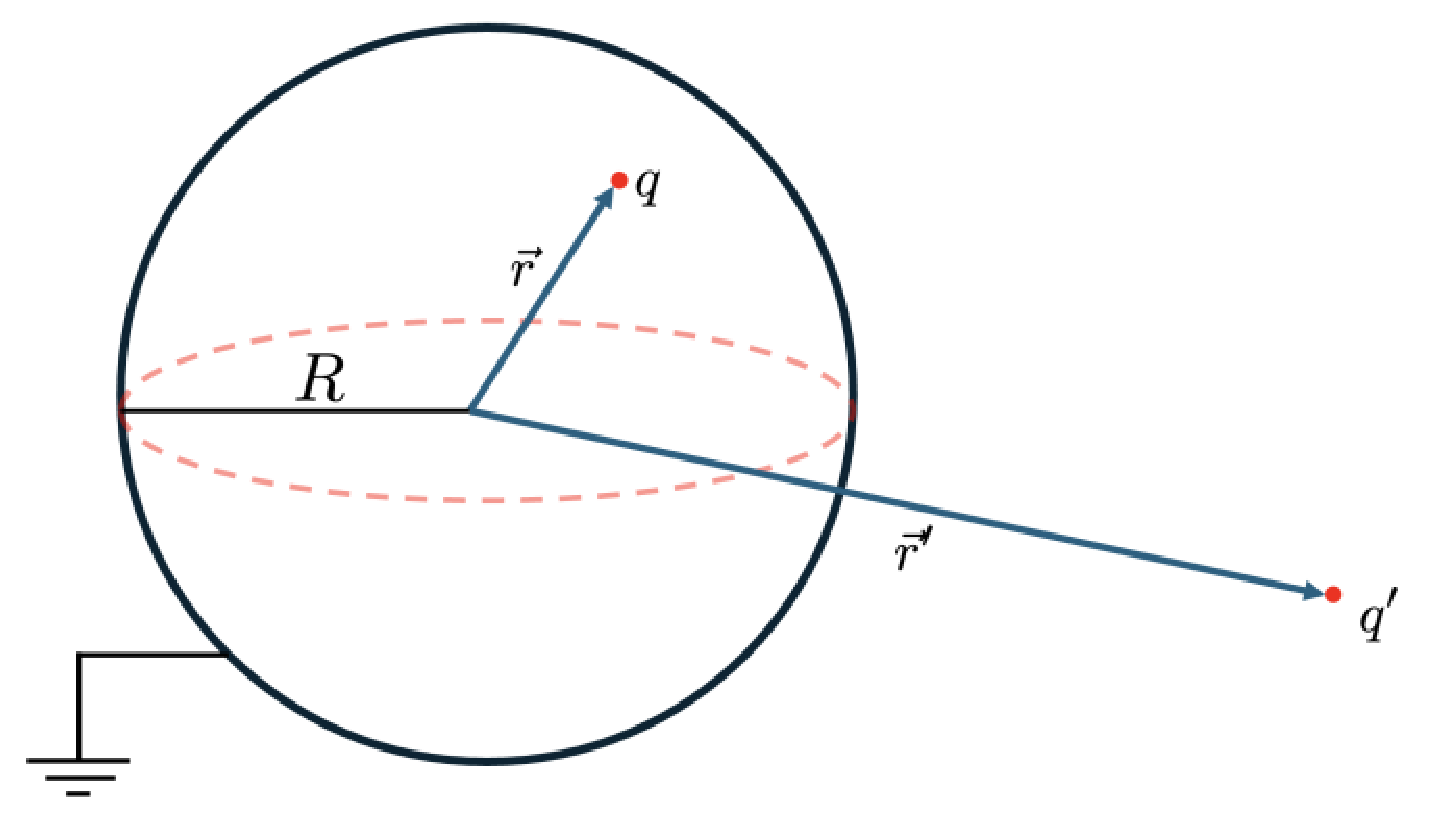
a) Find the electric force that acts on the particle of charge and on the particle of charge , respectively. [3,5 т.]
Consider a similar setup as in point a) by replacing the point-like particles with two dielectric spheres of finite radius:
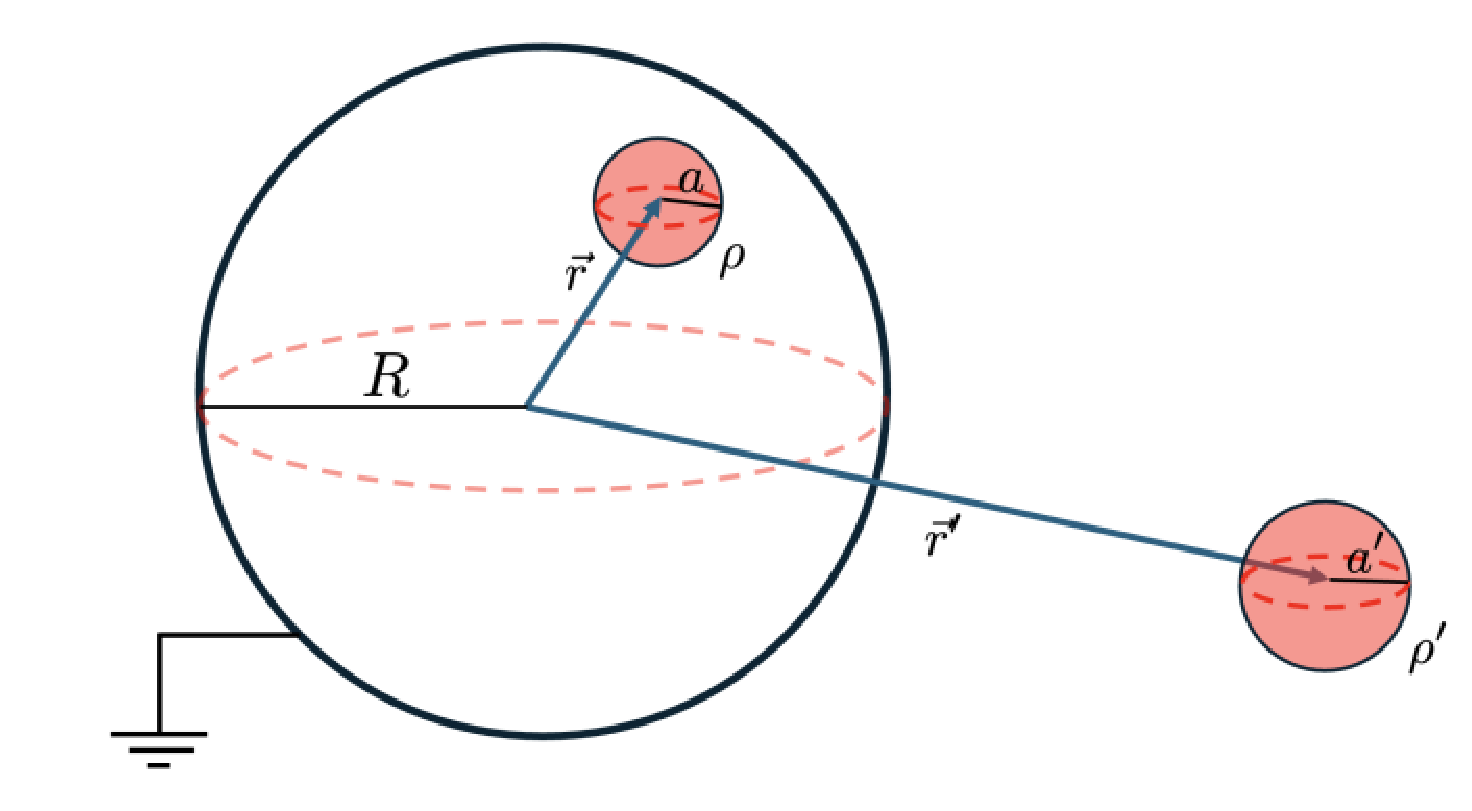
One sphere, of radius , has a homogenous charge density , is centered at and lies fully within the conducting grounded sphere (). The other sphere, of radius , with a homogenous charge density , is centered at and lies fully outside the conducting grounded sphere ().
b) Find the electric force that acts on the sphere with charge density and on the sphere with charge density , respectively. [3,5 т.]
The spheres have masses (for the sphere with charge density ) and (for the sphere with charge density ).
c) Starting at rest in the configuration in point b) (with initial locations and for the centers of the spheres), find the relationship between the velocity of each sphere and its position. Calculate their speeds when they touch the conducting sphere. Do not consider the spheres movement after they touch the conducting sphere. Furthermore, consider that the masses of the spheres are sufficiently large so that their velocities and accelerations are sufficiently small in order to neglect the induction of any magnetic fields. [3 т.]
Proposed by
Assist. Prof. Luca ILIEŞIU, PhD
Department of Physics, University of California at Berkeley, USA
Отговори
a)
b)
c)
As printed in the official solution: the outside-sphere results (2.6)–(2.7) are written with , and rather than , and .
Решение
Problem 2. Thinking outside the conducting sphere. Solution.
a) [3.5 points] Because the conducting sphere is grounded, we can treat the two-point particles as non-interacting. To compute the forces, we thus wish to compute the electric field inside and outside the conductor, and, for this, we will use the method of images. We wish to find the image charges for the inside and outside charges such that the electric potential vanishes on the surface of the sphere. This is achieved by placing the image charges between the center of the sphere and the inside/outside charges at a location with a charge for the image of the inside charge and at a location with charge for the outside charges. The potential on the inside of the sphere at a location ()is given by
Imposing that this potential vanishes on the surface of the sphere, we find (1 point)
which thus lies outside the sphere. Similarly, on the outside, at a location (), we have
Once again imposing that this vanishes on the surface of the sphere, we find (1 point)
which thus lies inside the sphere. The force on the particle inside is simply given by the attraction to the image charge outside, while the force on the particle outside is given by the attraction to the image charge inside. The former is given by (0.75 points)
while the latter is (0.75 points)
b) [3.5 points] One approach to generalize the solution above when we replace the point particles with spheres is to find the image charges for each charge element that is part of the interior of the two homogeneously charged spheres. This is, however, unnecessarily complicated. Instead, we can notice that because the contribution to the electric potential from a homogeneously charged sphere is the same as that of a charged particle placed at the center of the sphere (with a charge for the inside and a charge for the outside) the same image charges studied in part a) make the potential vanish on the surface of the conductor! Thus, outside the volumes of the homogeneously charged spheres, the electric potentials (2.1) and (2.2) found in point a) are unchanged (2.0 points). The forces acting on the inside and outside spheres are, thus, again (1.5 points)
where
c) [3 points] Because the particles (or spheres) do not interact, we can use conservation of energy separately for the charged particles (or spheres) inside or outside the conductor. Since the force is always in the direction for the particle or sphere inside (and in the direction for the particle or sphere outside) the only component of the velocity will be along the direction (or the direction). For the particle or sphere inside, conservation of energy tells us that (1.0 points)
When the inside sphere hits the surface of the conductor, we have (0.5 point)
Note that if the point particle were to hit the conductor () its velocity would be infinite and we could not neglect the effect of magnetic induction.
For the particle or sphere outside, we similarly have (1.0 point)
When the sphere touches the conductor (0.5 points), we have
The velocity would once again be infinite when the sphere would be replaced by a point particle.
Оригинал в Архива: Q2_ENG.pdf · официални решения: Q2sol.pdf