SAO 2020, Подбор за GeCAA · тест с избираем отговор — Задача 1. Section A: MCQ
Section A: MCQ
Условие
Section A: MCQ
Q1. Which of the following is the largest?
a. The radius of the Crab pulsar
b. Schwarzchild radius of Sirius
c. The geometric mean of Planck length and the observable universe
d. The diameter of the Large Hadron Collider
Q2. Mars has an albedo of 0.16. Its apparent magnitude is -2.91. Suppose now it has an albedo of 1 – what is its new apparent magnitude?
a. -0.92
b. -9.16
c. -3.34
d. -4.90
Q3. Estimate the (civil) time in which an observer in Beijing (39.9° N, 116.4° E, GMT +8) would observe the sun rising from the horizon on December 21.
(Ignore the effects of atmospheric refraction and the equation of time.)
a. 7:12 am
b. 7:25 am
c. 7:24 am
d. 7:39 am
Q4. What would the length of a sidereal day be if the Earth started rotating eastwards instead of westwards, at the same speed?
a. 23 h 52 m 8 s
b. 23 h 56 m 4 s
c. 24 h 3 m 56 s
d. 24 h 7 m 52 s
Q5. An observer in Tokyo (35.6 degrees N) spots a satellite transiting the local meridian with a zenith angle of 52 degrees. The satellite orbits along the celestial equator. Calculate its distance from the centre of the Earth, in units of Earth radii.
a. 2.79 earth radii
b. 3.16 earth radii
c. 8.34 earth radii
d. 14.70 earth radii
Q6. Consider a globular cluster of diameter 20 parsecs. It has an escape velocity of 6 km / s at the edge of the cluster. If each star has a mass of about twice that of our Sun, how many stars are there in the globular cluster? (1 pc = 3.26 ly, Mass of sun is about 2 x 10^30 kg.)
a. 20 000 stars
b. 40 000 stars
c. 80 000 stars
d. 160 000 stars
Q7. A supernova remnant in the sky has a total angular size of 5 arcminutes. We know that the remnant is 250 parsecs away from Earth. If the remnant expanded in a spherical shape with a constant expansion speed of 20 km/s, how long ago did this supernova approximately take place, as seen from the Earth?
a. 5.5 months ago
b. 8900 years ago
c. 4.02 x 10^20 years ago
d. Not enough information to tell
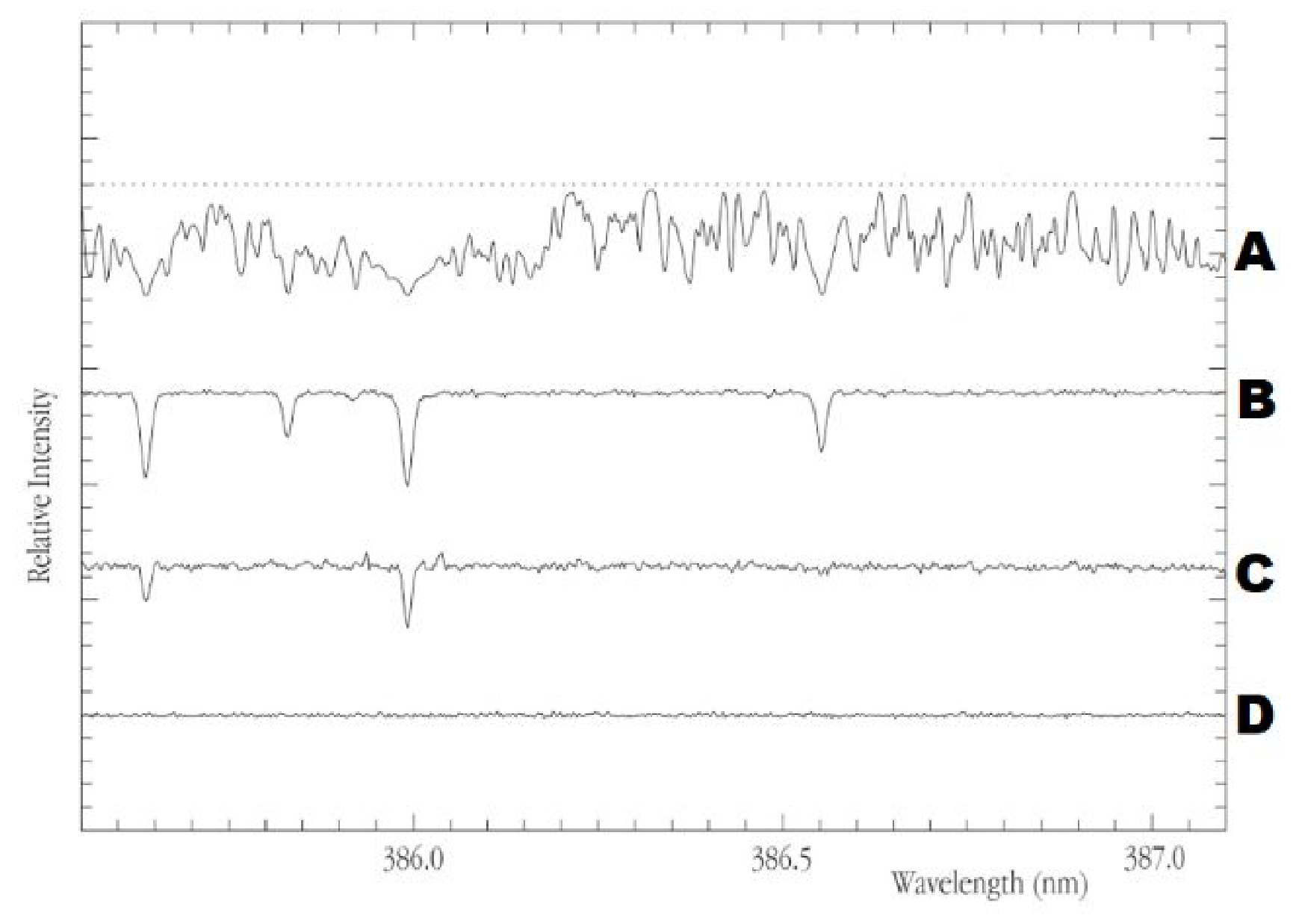
Q8. Which of these spectra best resembles (i) the sun, (ii) a Population III star?
a. D, A
b. A, C
c. A, D
d. C, A
Q9. A star has a temperature of 5800 K. A dust grain is 215 stellar radii away from the star. Assuming that the dust grain is spherical and a perfect blackbody, what is its equilibrium temperature?
a. 13 K
b. 27 K
c. 280 K
d. 396 K
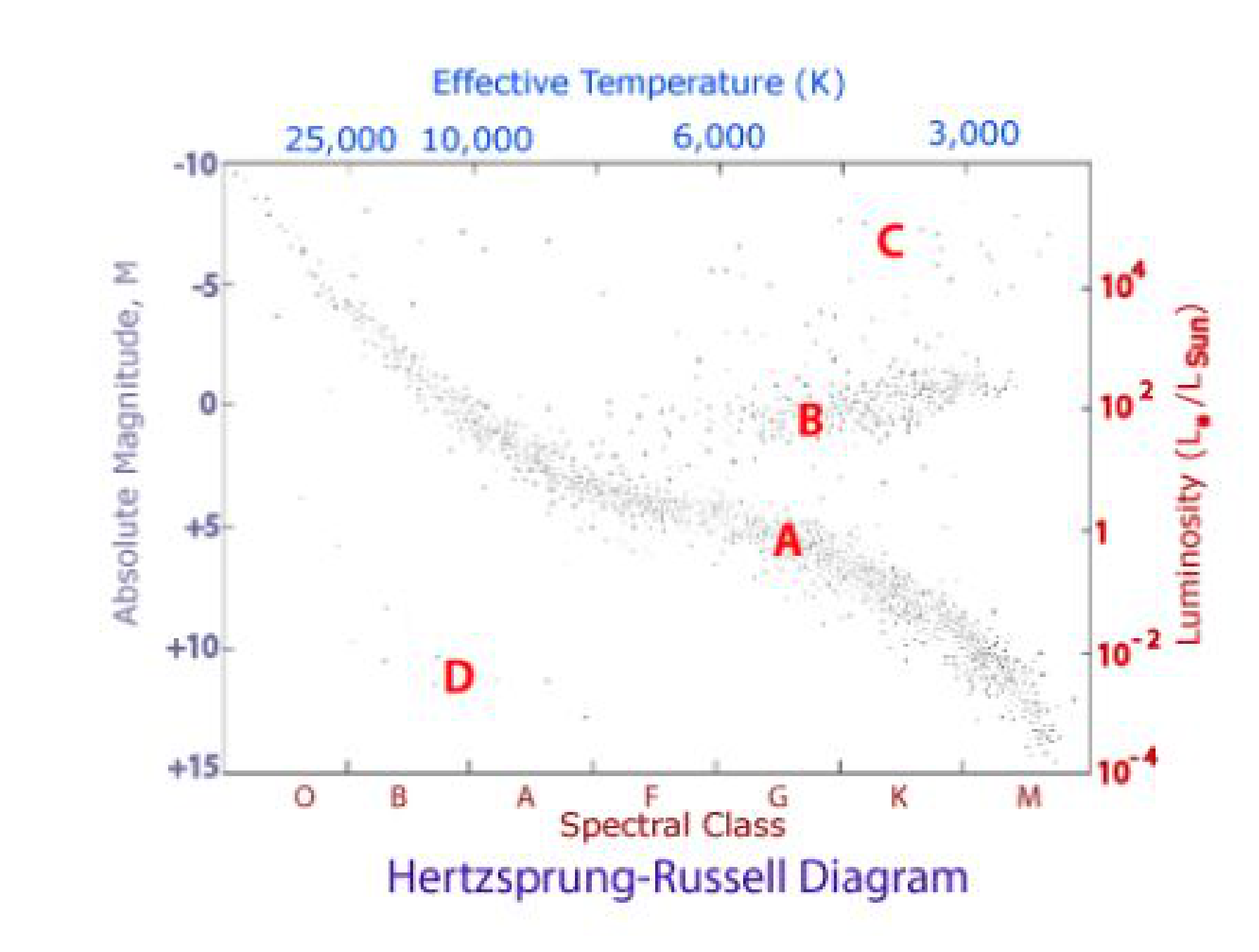
Q10. Which letter corresponds to the white dwarfs?
a. A
b. B
c. C
d. D
Q11. Which group would you likely NOT find within 50 ly of our Sun?
a. A
b. B
c. C
d. D
Q12. Neutron stars have atmospheres, just like the Earth. However, the gravity of neutron stars is far larger than the Earth. Given that the Earth has an atmosphere of about 100 km thickness, guesstimate the thickness of the atmosphere of a neutron star.
a. 200 mm
b. 2 m
c. 200 m
d. 2 km
Q13. An exoplanet transits across a distant star, causing its apparent brightness to dip by 1% over a duration of two hours. What conclusions can we draw about the planet?
a. Its radius is 1% that of the star.
b. Its orbital period is 200 hours
c. Its diameter is 1/10 of the star.
d. The planet is a gas giant.
Q14. The first elements were formed shortly after the Big Bang. During this phase of the universe, there was 1 neutron for every 7 protons. Some neutrons fuse with protons to form helium, resulting in an observed mass fraction of 25% helium and 75% hydrogen. Suppose in an alternate universe there were 1 neutron for every 5 protons. What would the mass fraction of helium in this alternate universe?
a. 25%
b. 33%
c. 40%
d. 50%
Q15. A quasar has a redshift of z = 1.4. Estimate its distance, to one significant figure. (Take the Hubble constant as 70 km s^-1 Mpc^-1)
a. 800 Mpc
b. 3000 Mpc
c. 6000 Mpc
d. 8000 Mpc
Q16. What is the smallest feature resolvable by a naked eye of diameter 5 mm? The distance to the moon from the Earth is about 3.78 x 10^8 m.
a. 26 km
b. 46 km
c. 66 km
d. 86 km
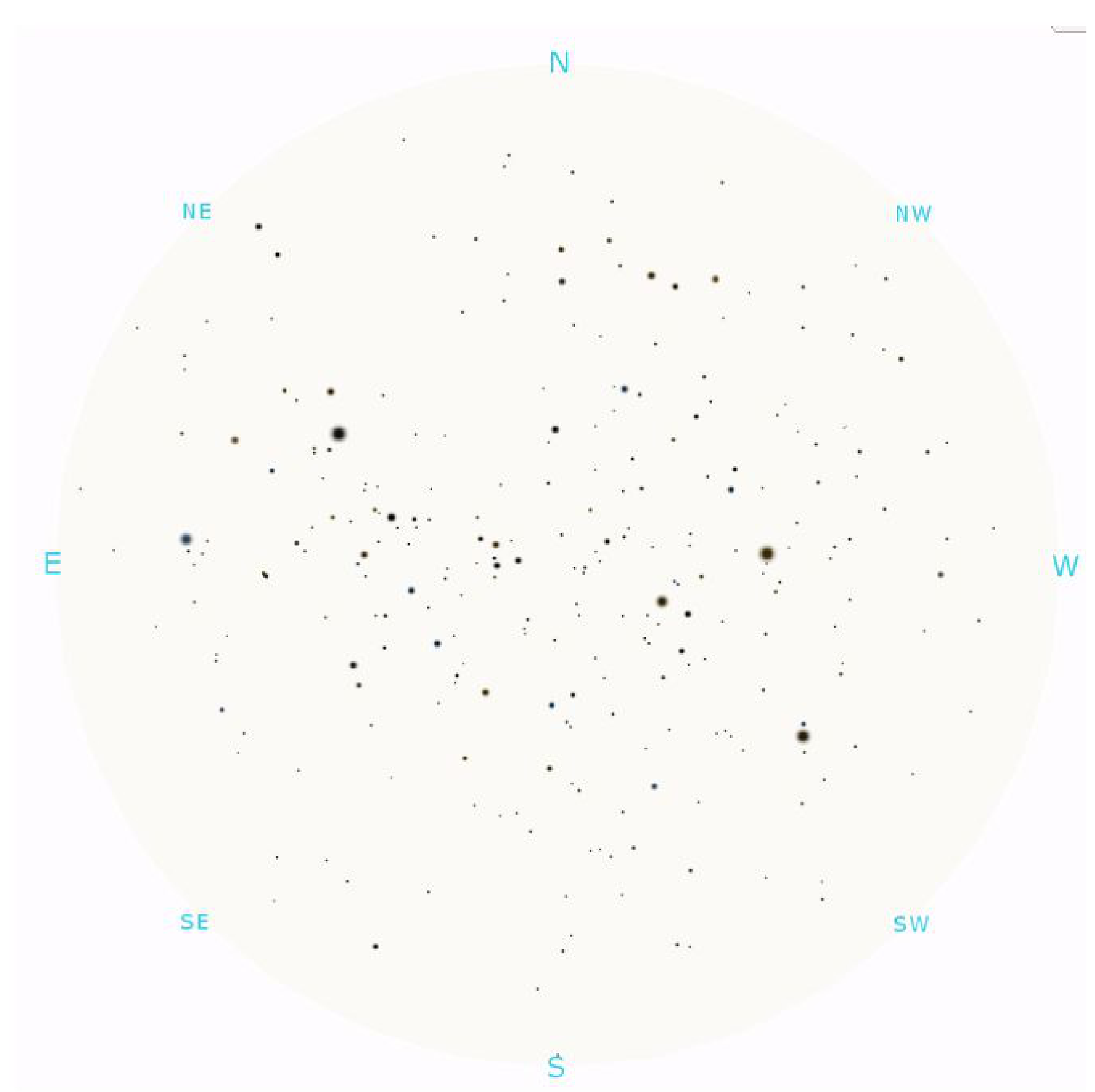
Here is a negative image of a simulated sky seen at midnight.
Q17. Which month’s sky is captured in this image?
a. March
b. June
c. September
d. December
Q18. Which location was this sky captured from?
a. Singapore (1.3521° N, 103.8198° E)
b. Honolulu, Hawaii (21.3069° N, 157.8583° W)
c. Tehran, Iran (35.6892° N, 51.3890° E)
d. Bishkek, Kyrgyzstan (42.8746° N, 74.5698° E)
e. Talinn, Estonia (59.4370° N, 24.7536° E)
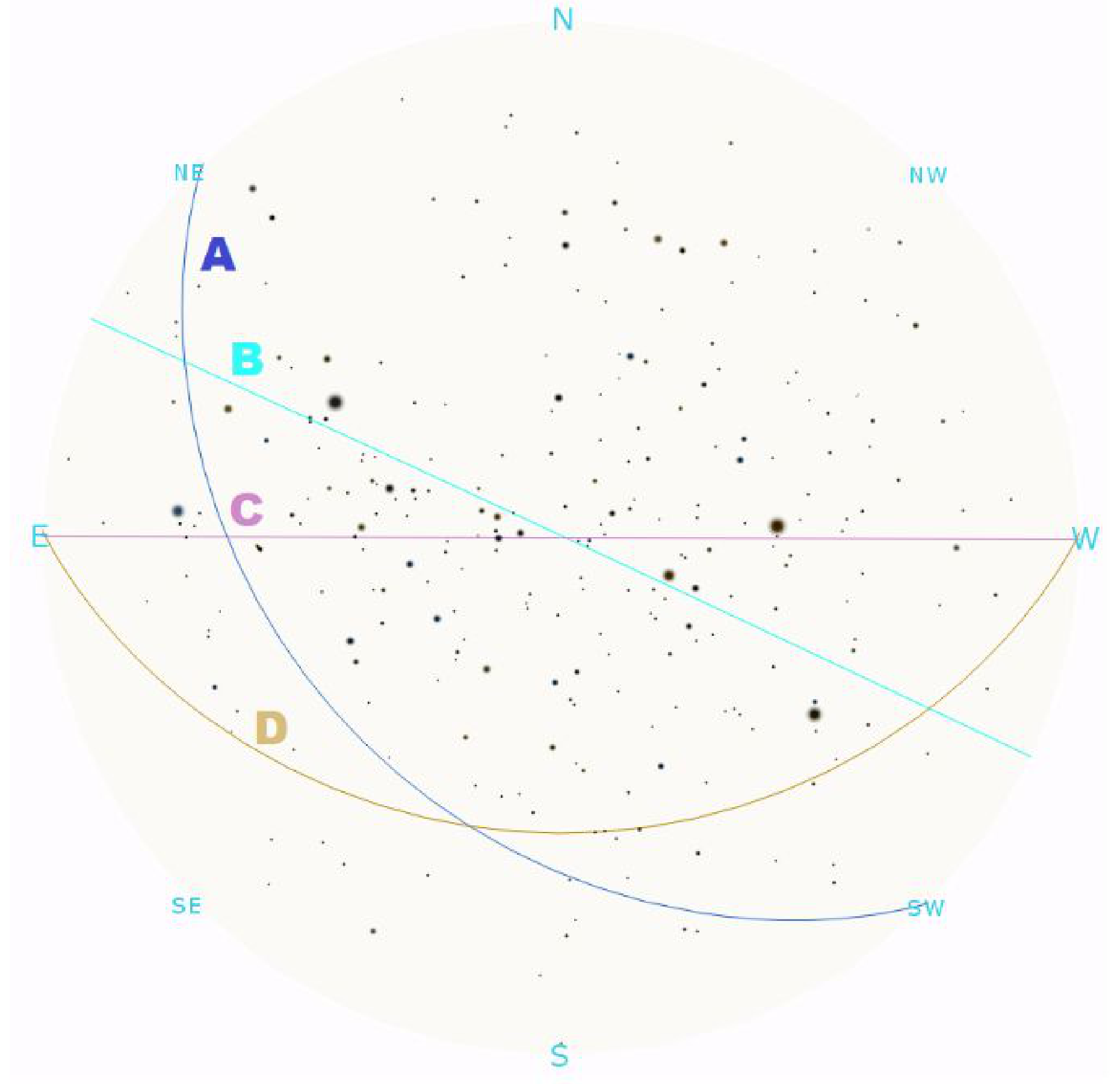
Q19 Which line shows the ecliptic?
a. A
b. B
c. C
d. D
Q20 Which line shows the celestial equator?
a. A
b. B
c. C
d. D
Отговори
- Q1. The radius of the Crab pulsar
- Q2. -4.90
- Q3. 7:39 am
- Q4. 23 h 56 m 4 s
- Q5. 2.79 earth radii
- Q6. 40 000 stars
- Q7. 8900 years ago
- Q8. A, D
- Q9. 280 K
- Q10. D
- Q11. C
- Q12. 200 mm
- Q13. Its diameter is 1/10 of the star.
- Q14. 33%
- Q15. 3000 Mpc
- Q16. 46 km
- Q17. September
- Q18. Talinn, Estonia (59.4370° N, 24.7536° E)
- Q19 A
- Q20 D
Решение
Q1 — a. The radius of the Crab pulsar
A trivia/qualitative-ish question – common starter in recent IOAA papers.
Their dimensions are 10 km, 6 km, 120 nm, and 8.5 km respectively.
Q2 — d. -4.90
Q3 — d. 7:39 am
Coordinate transformation equations for an object from equatorial to alt-azimuth reference frames are given by:
where is the altitude, is the azimuth, is the hour angle, is the declination and is the altitude of the celestial pole / latitude of the observer.
Setting in the third equation and rearranging for
On December 21, . Hence
Sunrise occurs 4 h 34 m 40 s before local solar noon, or 7:25:20 am.
Their civil time is +8 GMT, but their local time is or +7:45:24 GMT.
They are 14m 26s behind their civil time: their watch will display 7:39 am at 7:25 local time.
Q4 — b. 23 h 56 m 4 s
Trick question: Sidereal days are measured with respect to faraway stars; their length only depends on the speed of rotation of the Earth. The rotation direction hence doesn’t matter. The length of a sidereal day hence stays the same.
Q5 — a. 2.79 earth radii
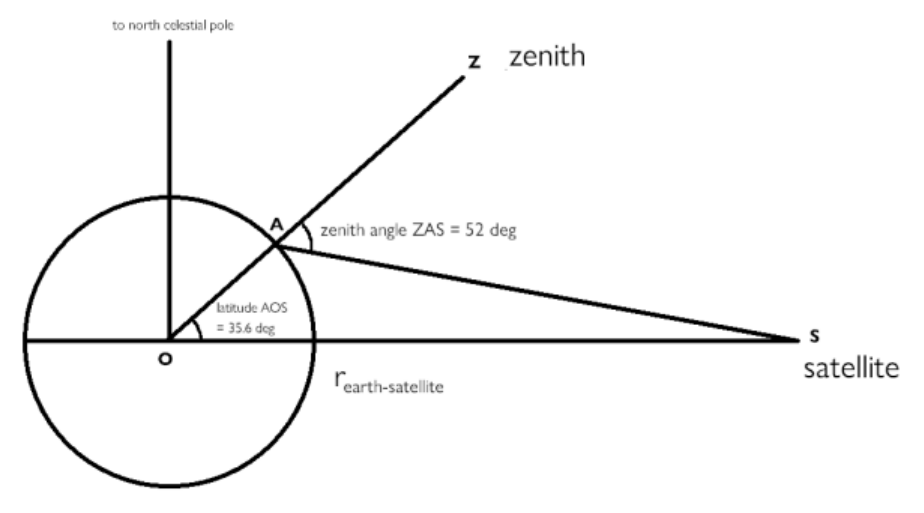
From sine rule,
Q6 — b. 40 000 stars
Q7 — b. 8900 years ago
Q8 — c. A, D
The wavelengths span the Fe + Ni absorption peaks.
Population III stars, the oldest stars in the universe, are metal poor.
Our sun, on the other hand, is rich in metals, after multiple generations of supernovae where these metals were synthesised.
Q9 — c. 280 K
At equilibrium,
Q10 — d. D
The hot exposed cores of stars. Dim as nuclear fusion has stopped.
Q11 — c. C
The nearest red supergiant to Earth is Antares, which is 550 ly away.
Q12 — a. 200 mm
Taking a quick and dirty guesstimate:
Assume
The answer of 24 cm is not that far off from the actual value of about 10 cm.
Q13 — c. Its diameter is 1/10 of the star.
Q14 — b. 33%
1n : 7p ⇔ 2n : 14p
2p fuse with 2n to form He.
Hence after fusion, the ratio of atoms would be 1 He : 12 H.
By mass, this would be
4 amu: 12 amu, or 1:3.
Repeating the above with 1n : 5p, we get a post-fusion atomic ratio of 1 He : 8 H.
By mass, this would be equivalent to
4 amu : 8 amu, or 1:2.
The answer is hence 33 %.
Q15 — b. 3000 Mpc
Invoking Hubble’s Law,
Q16 — b. 46 km
The angular resolution for a circular aperture is given by
A lunar feature with angular length equal to the angular resolution has a diameter x. The two are related by
Putting the two together,
Q17 — c. September
The winter constellations are just about rising in the East, and the prominent summer triangle is halfway to setting in the West. The season hence is autumnal in the Northern hemisphere – September.
The sky is actually taken on 26 September, the second day of the GeCAA.
Q18 — e. Talinn, Estonia (59.4370° N, 24.7536° E)
Polaris is more than halfway across the above the horizon in the North. The only possible option is Talinn, Estonia.
(Estonia is also the host country for the GeCAA).
Q19 — a. A
A passes through Gemini, Taurus and Aries, which are all fully visible on this map. It passes through Pisces, Aquarius and Capricornus as well, though some of their stars are not visible on the map due to the magnitude filter applied.
Q20 — d. D
The only great circle perpendicular to the celestial meridian is D.
Оригинал в Архива: GeCAA Selection Test MCQ Paper.pdf · официални решения: GeCAA Selection Test MCQ Solutions.pdf