USAAAO 2015, II кръг — Задача 14
National Astronomy Olympiad 2014-2015 · 25 т.
Бележка
This is the Second Round of the 2014-2015 USA Astronomy and Astrophysics Olympiad (USAAAO) competitions. You have exactly 2 hours and 30 minutes to complete the exam. There is a maximum of 67 points, and the value of each problem is indicated following each problem statement.
This test consists of 13 short answer problems and one long problem with multiple parts. Solutions should be written on blank paper, with the problem number, student’s name, and school written clearly on top of each page. Solutions to multiple short answer problems may be written on the same page, but the long problem should begin on its own page. Partial credit will be given for correct work, so make sure to clearly show all steps.
You may only use a scientific calculator as aid for this exam. A table of physical constants and other information will be provided for you. This exam document, your solutions, and all used scratch paper must be turned in at the end of the exam.
Do not discuss this examination with anyone after its completion. Your results will be emailed to you shortly. The top 5 students will be invited to represent the United States at the 9th International Olympiad on Astronomy and Astrophysics competition in Central Java, Indonesia, from July 26th to August 4th, 2015.
In the event of a tie for the top 5 places, the student with the higher score on the long problem will qualify. If the tied students have the same score on the long problem, then the short answer problems with more points will be given more weight in the grading.
I hereby affirm that all work on this exam is mine, and that I took this test under a proctor’s supervision, with no outside aids beyond the materials provided and allowed. Furthermore, I affirm to not discuss the test with others or provide any sort of aid to other examiners throughout the course of the examination period. I understand that failure to do so may result in disqualification from the exam.
Signature: ____________________________________________ Date: ____________________
Условие
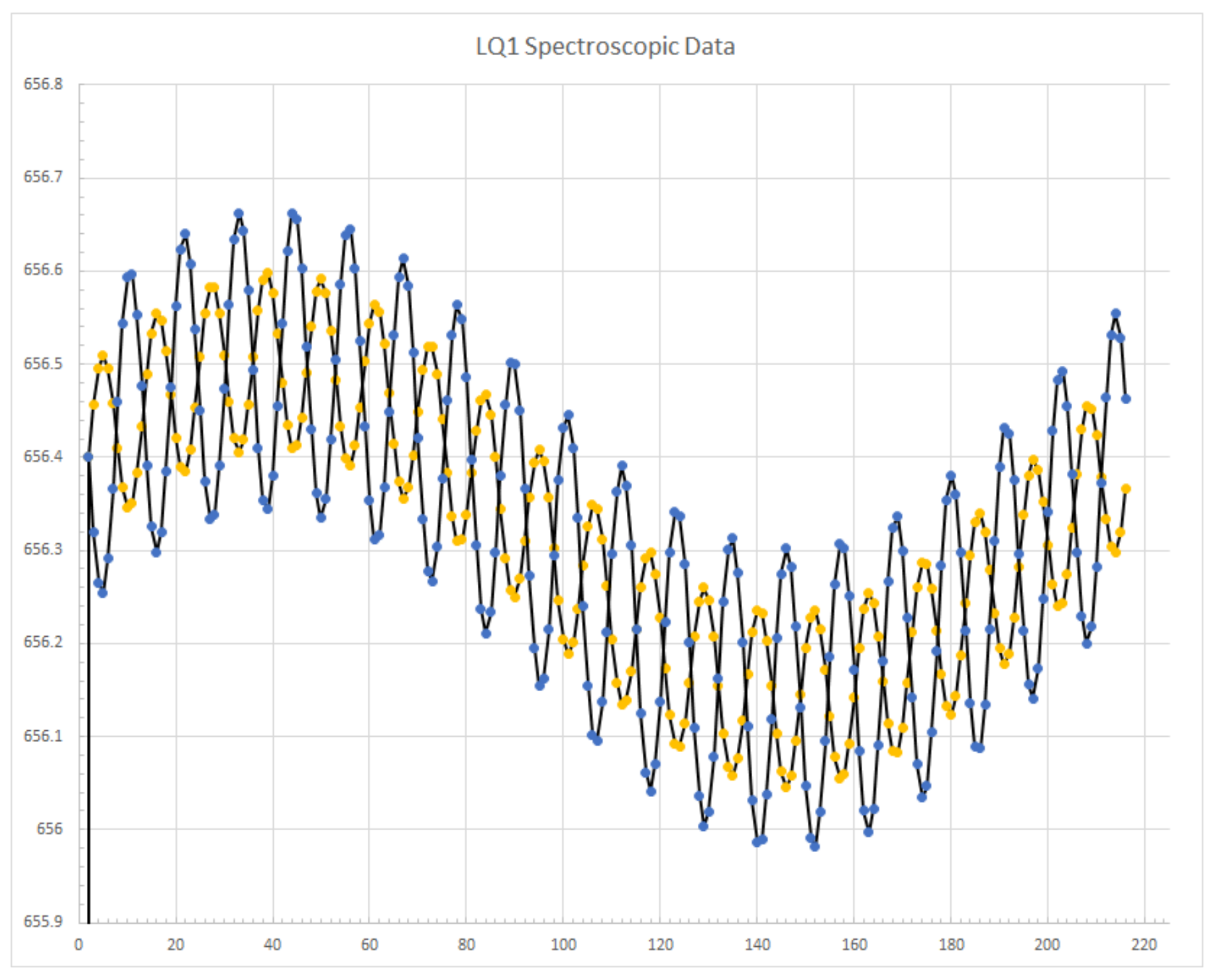
Astronomers use an 8-meter telescope to observe a star with an apparent flux of . A spectral analysis reveals a blackbody spectrum with two apparent peaks, one at 690.5 nm and the other at 461.8 nm. Sustained spectroscopic observations of the hydrogen alpha line (rest wavelength 656.3 nm) results in the following plot, in which two periodic variations have been identified and marked. Note: the x-axis is in days, and the y-axis is in nanometers.
Precision photometry of the system shows what appears to be an eclipsing binary light curve. The primary transit lasts 4 hours 46 minutes total. Maximum transit depth lasts for 4 hours 7 minutes.
(a) Calculate the ratio of the radii and the ratio of the luminosities of the two stars in the system. [4 т.]
(b) Calculate the semimajor axis and mass of each star. [5 т.]
(c) Calculate the actual luminosity and radius of each star. [3 т.]
(d) How far away is the system? The Solar flux at Earth is . [4 т.]
(e) What is the angular size of the stars’ orbit? Can the telescope distinguish the two stars? What is the minimum separation the telescope can distinguish at the distance of this system? Assume the telescope observes at a wavelength of 550 nm. [3 т.]
(f) Does the available data indicate any other objects in the system? If so, provide mass, semimajor axis, and a likely type. Justify your identification. [6 т.]
Решение
a. Drawing the transit light curve, we can see that between the first and second contacts, the relative motion of the stars is equal to twice the radius of the transiting star. Similarly, the time between second and third contacts is proportional to twice the primary star's radius. Dividing, we get
We can use Wein's Law and the provided blackbody peaks to calculate the temperature of each star. We can now use the Stefan-Boltzmann Law to find the ratio of the luminosities:
b. We use the provided chart to determine the orbital period of the binary system (approximately 5.7 days) as well as the semi-amplitude (using ). Using the period and velocity of each star, we determine the semimajor axes according to , for semimajor axes of 0.0450 and 0.0771 AU for stars 1 and 2 respectively.
Applying Kepler's Third Law for the entire system, we get a total mass of 1.90 solar masses. Since , we can determine the individual mass of each star, 1.20 solar masses for star 1 and 0.70 solar masses for star 2.
c. Using the velocity of each star, we can find the relative velocity of the two stars (just sum). This can then be used to solve the equations from part a directly, giving radii of 1.35 and 0.099 solar radii for stars 1 and 2, respectively. We can now apply the Stefan-Boltzmann Law, dividing by the solar expression, to determine the luminosity of each star (2.54 solar luminosities for star 1, 0.0027 for star 2).
d. Apparent magnitude can be found by finding the total flux of the system and using the Sun's apparent magnitude and the solar flux as a standard candle, applying . Similarly, using the luminosity of the system with the Sun's absolute magnitude as a standard candle can provide an absolute magnitude for the system. Now that we have an apparent and absolute magnitude, we apply the distance modulus to get pc.
e. Applying the small angle formula, we get a maximum angular separation of 0.021". The best possible resolution of the telescope is given by ", so the stars are distinguishable. The smallest visible size can be found by applying the small angle formula with the limiting resolution, and is 0.10 AU.
f. Examining the given plot, there appears to be a longer period variation with a period of approximately 214 days. Based on the change in wavelength, the variation has an amplitude of approximately 83.2 km/s. Using this velocity and the period of oscillation, we can determine the semimajor axis of the binary stars' orbit (1.62 AU)
We now apply the fact that and Kepler's third law for the binary-unknown system, solving for and . We find that the unknown object has a mass of 16.2 solar masses and a semimajor axis of 0.19 AU. Given the high mass and lack of a visible counterpart, the object is likely a stellar mass black hole.
Оригинал в Архива: 2015-nao-exam.pdf · официални решения: 2015-nao-solutions.pdf