USAAAO 2018, II кръг — Задача 12
2018 National Astronomy Olympiad (NAO) · 15 т.
Instructions (Please Read Carefully)
(Start the exam after reading the instructions carefully and affirming that the contestant understood the instructions given.)
The top 5 eligible scorers on the NAO will be invited to represent USA at the next IOAA. In order to qualify for the national team, you must be a high school student with US citizenship or permanent residency.
This exam consists of 2 parts: Short Questions (5 points each) and Long Questions (15 points each). The maximum score is 100 points.
The test must be completed within 2.5 hours (150 minutes). The proctor should mark the start and end time of the exam on the front page.
Please solve each problem on a blank piece of paper and mark the number of the problem at the top of the page. The contestants full name in capital letters should appear at the top of each solution page. If the contestant uses scratch papers, those should be labeled with the contestants name as well and marked as ”scratch paper” at the top of the page. Scratch paper will not be graded. Partial credit will be available given that correct and legible work was displayed in the solution. This exam document, solution, and all the scratch paper used should be turned in to the proctor at the end of the exam.
This is a written exam. Contestants can only use a scientific calculator for this exam. A table of physical constants will be provided. Discussing the problems with other people is strictly prohibited in any way until the end of the examination period on April 6th. Receiving any external help during the exam is strictly prohibited. This means that the only allowed items are: a scientific calculator, the provided table of constants, a pencil (or pen), an eraser, blank sheets of papers, and the exam. No books, notes, laptops, mobile phones, or any other devices are allowed while taking the exam.
After reading the instructions, please make sure to sign at the bottom of this page, affirming that:
- All work on this exam is mine.
- I took this exam under a proctors supervision.
- I did not receive any external aids besides the materials provided.
- I am not allowed to discuss the test with others throughout the period of this examination.
- Failure to follow these rules will lead to disqualification from the exam.
Условие
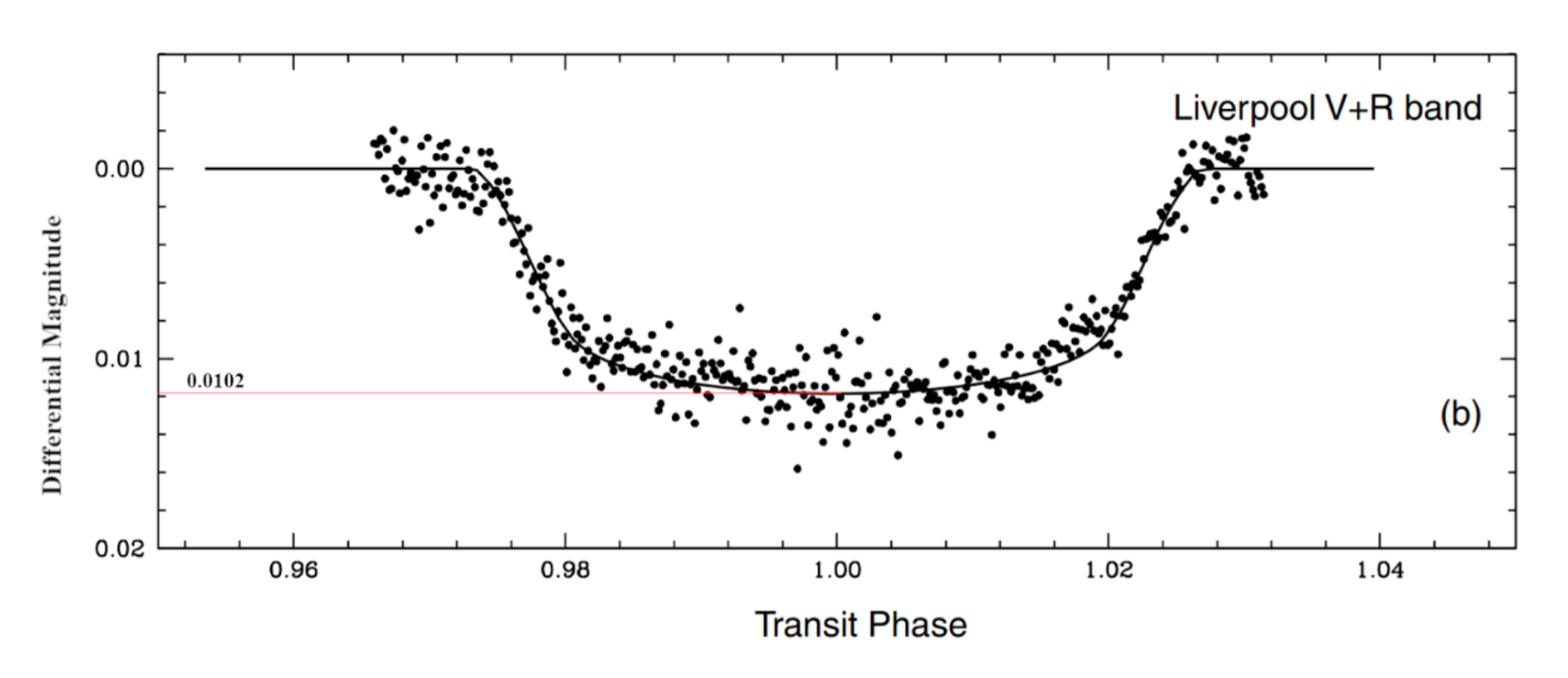
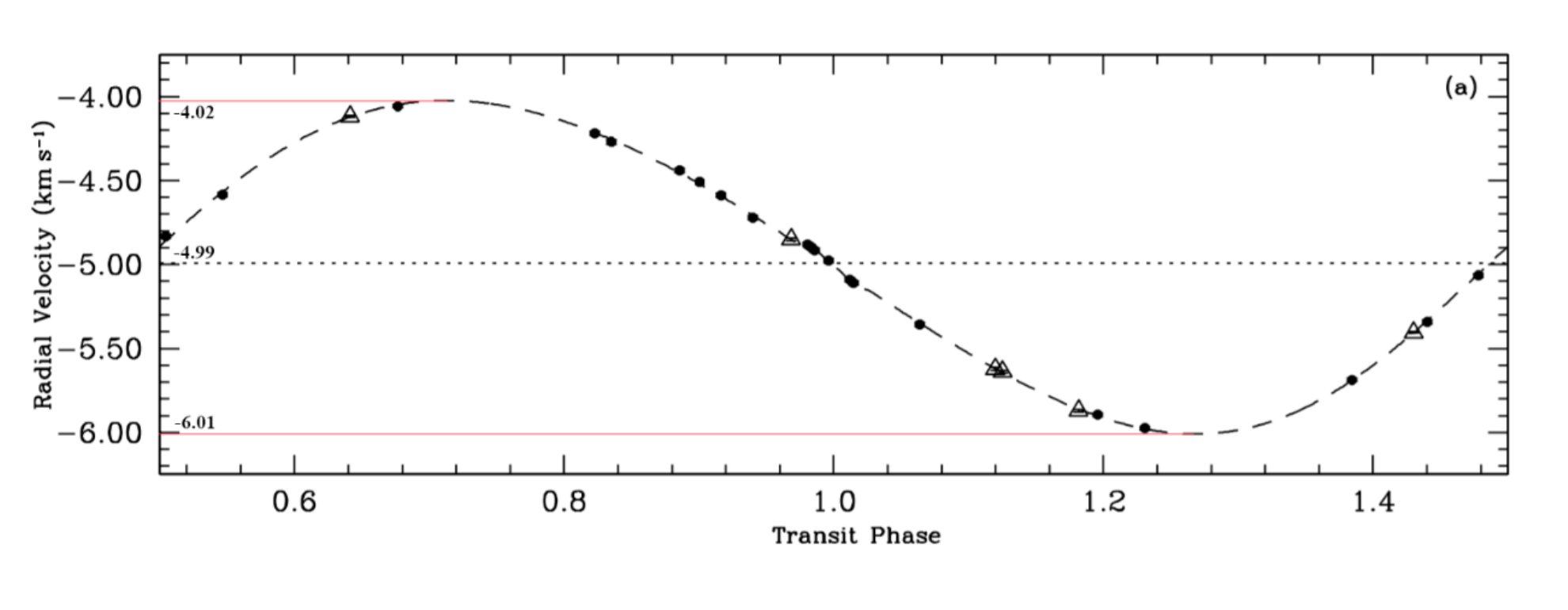
In 2008, while observing WASP-14, a main sequence star of mass 1.211 and radius 1.306 , an exoplanet called WASP-14b was discovered via the transit method. Photometry as well as radial velocity data are shown in the figures. Transits occur once every 2.243753 days. The radial velocity of the center of mass of WASP-14 and its planet is -4.99 km/s. Fitting of the radial velocity curve indicates that the argument of periastron of the orbit of WASP-14b is 254.9.
(a) Determine the length of the semi-major axis of the orbit of WASP-14b. [5 т.]
(b) Determine the density of WASP-14b. [5 т.]
(c) Determine the eccentricity of the orbit of WASP-14b. [5 т.]
Отговори
(a) m
= 0.0357 AU
(b) 4843.7 kg/m³
(c) 0.0964
Решение
(a) Answer: .
From Kepler’s third law:
Assuming that the mass of the planet is negligible to the mass of the host star, and that the semimajor axis of the host star is negligible compared to the semimajor axis of the planet gives
Solving for , we get
(b) Answer: .
To find the mass, we assume the orbit is circular. Since the planet is transiting, its inclination must be approximately . Therefore, the velocity of the host star’s movement is the amplitude of the radial velocity curve.
The velocity of the planet can be calculated from the semimajor axis from part (a):
Finally, the two velocities and are related by the conservation of momentum: . Solving for gives
Note that given the eccentricity from part (c), we can find a more accurate mass of the planet; however, assuming circular orbits gives a close approximation.
To find the radius, we compare the magnitude difference during transit. A difference in magnitude relates to flux by
The normalized drop in flux during transit (i.e. relative to the normal flux) is therefore
The normalized drop in flux relates to the radii of the host star and planet by
The radius of the planet can then be found: .
Density is simply
(c) Answer: .
Because the planet is transiting, we know that the inclination must be . Let be the argument of periastron, which is the angle between the periapsis and the plane of the sky. Let be the true anomaly, which is the angle between the planet and the periapsis. Therefore, is the angle between the planet and the plane of the sky.
Let be the position of the planet along the axis perpendicular to the plane of the sky (i.e. toward and away from the observer). Let be the distance from the planet to the host star. . The radial velocity of the star is simply the time-derivative of , which is .
The orbit equation gives the distance from the host star to the planet as a function of true anomaly:
Taking the time-derivative of gives:
can then be substituted into the expression for radial velocity:
From Kepler’s second law:
This can then be substituted into the expression for radial velocity:
The term determines the radial velocity over time, since all other variables are constants. Radial velocity is maximized when and is minimized when . Let .
Subtracting the two equations gives , or . Adding the two equations gives . So,
Оригинал в Архива: usaaao-nao-2018.pdf · официални решения: usaaao_second_round_2018.pdf