USAAAO 2019, II кръг — Задача 10
2019 National Astronomy Olympiad (NAO) · 25 т.
Instructions (Please Read Carefully)
(Start the exam after reading the instructions carefully and affirming that the contestant understood the instructions given.)
The top 5 eligible scorers on the NAO will be invited to represent USA at the next IOAA. In order to qualify for the national team, you must be a high school student with US citizenship or permanent residency.
This exam consists of 3 parts: Short Questions (7 points each), Medium Questions (15 points each) and Long Questions (25 points each). The maximum score is 153 points.
The test must be completed within 2.5 hours (150 minutes). The proctor should mark the start and end time of the exam on the front page.
Please solve each problem on a blank piece of paper and mark the number of the problem at the top of the page. The contestant’s full name in capital letters should appear at the top of each solution page. If the contestant uses scratch papers, those should be labeled with the contestant’s name as well and marked as ”scratch paper” at the top of the page. Scratch paper will not be graded. Partial credit will be available given that correct and legible work was displayed in the solution. This exam document, solution, and all the scratch paper used should be turned in to the proctor at the end of the exam.
This is a written exam. Contestants can only use a scientific calculator for this exam. A table of physical constants will be provided. Discussing the problems with other people is strictly prohibited in any way until the end of the examination period on March 8th. Receiving any external help during the exam is strictly prohibited. This means that the only allowed items are: a scientific calculator, the provided table of constants, a pencil (or pen), an eraser, blank sheets of papers, and the exam. No books, notes, laptops, mobile phones, or any other devices are allowed while taking the exam.
After reading the instructions, please make sure to sign at the bottom of this page, affirming that:
- All work on this exam is mine.
- I took this exam under a proctor’s supervision.
- I did not receive any external aids besides the materials provided.
- I am not allowed to discuss the test with others throughout the period of this examination.
- Failure to follow these rules will lead to disqualification from the exam.
To be completed by the proctor:
Full name (First, Last): ______
Position (e.g. Physics Teacher at High School x): ______
Email address: ______
Student began exam at (hh:mm): ______
Student submitted the exam at (hh:mm): ______
Signature: ______ Date (mm/dd/yy): ______
To be completed by the student:
Last name: ______
First name: ______ Middle name: ______
Date of birth (mm/dd/yy): ______ Email address: ______
Signature: ______ Date (mm/dd/yy): ______
Table of Physical Constants
| Constant | Symbol | Value |
|---|---|---|
| Electron rest mass | kg | |
| Proton rest mass | kg | |
| Electronic charge | C | |
| Speed of light in free space | m s | |
| Permeability of free space | H m | |
| Permittivity of free space | F m | |
| Planck’s constant | J s | |
| Reduced Planck’s constant | J s | |
| 197.33 MeV fm | ||
| Boltzmann’s constant | J K | |
| Gas constant | J kg K | |
| Molar gas constant | 8.315 J mol K | |
| Avogadro’s number | mol | |
| Standard molar volume | m mol | |
| Unified atomic mass unit (C scale) | MeV kg | |
| Mass of hydrogen atom | kg | |
| Bohr magneton | A m or J T | |
| Nuclear magneton | A m or J T | |
| Proton magnetic moment | ||
| Neutron magnetic moment | ||
| Bohr radius | m | |
| Fine structure constant | ||
| Compton wavelength of electron | m | |
| Rydberg’s constant | m | |
| 13.606 eV | ||
| Stefan-Boltzmann constant | W m K | |
| Radiation density constant | J m K | |
| Gravitational constant | N m kg |
Rest masses of some leptons and hadrons in MeV/:
0.5110, 105.66, 1777, 134.98, 139.57, 493.7, 497.7, 547, 1865, 1869, p 938.3, n 939.6, 1115.7, 1189, 1193, 1197, 1315, 1321, 1672, , .
| Quark | Charge | Mass (GeV/) | |||||
|---|---|---|---|---|---|---|---|
| u | 0 | 0 | 0 | 0 | |||
| d | 0 | 0 | 0 | 0 | |||
| c | 0 | 0 | +1 | 0 | 0 | ||
| s | 0 | −1 | 0 | 0 | 0 | ||
| t | 0 | 0 | 0 | 0 | +1 | 174.3 | |
| b | 0 | 0 | 0 | −1 | 0 | 4.2 |
Astrophysical Data — Other data and conversion factors — Trigonometrical identities — Prefixes
Astrophysical Data
| Quantity | Symbol | Value |
|---|---|---|
| Astronomical unit | AU | m |
| Parsec | pc | m |
| Luminosity of Sun | W | |
| Mass of Sun | kg | |
| Radius of Sun | m | |
| Mass of Earth | kg | |
| Radius of Earth | m |
Other data and conversion factors
| Quantity | Symbol | Value |
|---|---|---|
| 1 ångstrom | Å | m |
| 1 fermi | fm | m |
| 1 barn | b | m |
| 1 pascal | Pa | 1 N m |
| 1 standard atmosphere | Pa | |
| Standard acceleration due to gravity | 9.807 m s | |
| 1 electron volt | eV | J |
| eV/ | m | |
| eV/ | K | |
| Wavelength of 1 eV photon | m |
Trigonometrical identities
In a triangle ABC,
and .
Prefixes
| Symbol | Prefix | Factor |
|---|---|---|
| T | tera | |
| G | giga | |
| M | mega | |
| k | kilo | |
| c | centi | |
| m | milli | |
| micro | ||
| n | nano | |
| p | pico | |
| f | femto |
Archive constants sheet
The archive retains this general constants sheet alongside the USAAAO collection. The visible sheet does not identify a year or an issuing body. Its values differ from some constants explicitly used in the 2019 solutions; the archive does not establish that this was the exact sheet given to the 2019 contestants.
Условие
In this problem, we will try to understand the relationship between magnetic moments and angular momenta, first for charged particles and how this can be extended to planetary objects.
(a) Consider a charge and mass moving in circular orbit of radius with constant speed . Write down the angular momentum of the charge and magnetic moment of the effective current loop. Recall that the magnetic moment of a current loop with current and radius is given as where A is the area of the loop. [5 т.]
(b) Use the above results to find a relationship between the magnetic moment and angular momentum in terms of intrinsic properties of the particle (charge,mass). [3 т.]
(c) The relationship from part (b) can be expressed as . is usually referred to as the classical gyromagnetic ratio of a particle. Evaluate the classical gyromagnetic ratio for an electron and for a neutron in SI units. [2 т.]
(d) For extended objects such as planets, the magnetic dipole moment is not directly accessible whereas the surface magnetic field can be measured. Assuming a magnetic dipole of magnetic moment located at the center of a sphere of radius , write down the expression for the surface magnetic field and the surface magnetic moment defined as . You may use the value of the angular dependence at the magnetic equator for the following parts. [7 т.]
(e) Assuming a gyromagnetic relationship exists between magnetic moment and angular momentum of an extended object, write down the relationship between the surface magnetic moment and angular momentum as . You will observe that depends only on fundamental constants and intrinsic properties of the extended object. [3 т.]
(f) The surface magnetic moments for Mercury and Sun are T and T respectively. Assuming the bodies are perfect spheres, evaluate the constant for Mercury and the Sun. Comment on values obtained and if they fit into the model developed in parts (c) and (d). [3 т.]
(g) The surface magnetic moments and angular momenta of various solar system bodies are plotted in the figure 3. Justify that the data implies and calculate the constant . What is the expected value of from the model developed in parts (c) and (d)? [5 т.]
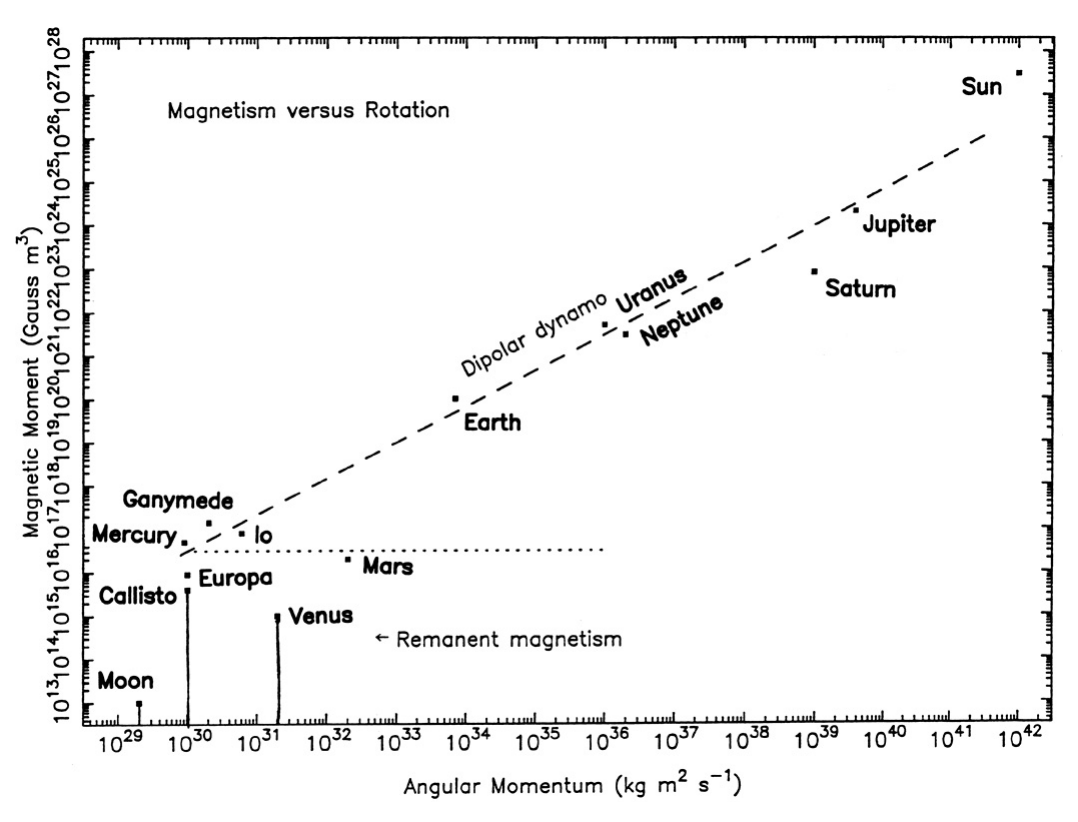
(h) Certain bodies such as Venus, Mars and the Moon are remarkably separated from the trend observed for other bodies. What can you say about magnetism in these bodies when compared to the others? [2 т.]
Отговори
- (a)
- (b)
- (c) C/kg; for a neutron.
- (e)
- (f) Mercury: T s²/(kg m); Sun: T s²/(kg m).
- (g) 0.8
Решение
Solution:
(a) and
(b)
(c) C/kg and for a neutron, since the charge is zero.
(d) Use the magnetic field of a dipole as . The dependence is crucial here which follows for any dipole type distribution; partial credit if that is shown.
(e) Neglecting the angular dependence,
(f) For Mercury, angular momentum kg /s, so T /(kg m). For Sun,angular momentum kg /s, so T /(kg m). These two values are approximately close to within an order of magnitude. We therefore expect that the mechanisms for magnetic dipole generation are similar in Mercury and the Sun.
(g) Observe that the plot is on log-log scale. A linear relationship on this plot implies a power-law form. From the slope of linear trend-line on the graph, . Full credit for realizing ; if is written, partial credit.
(h) Venus, Mars and Moon do not have a active dynamo and hence the magnetism present with them is of a different nature from the other bodies. These bodies had a magnetic dynamo in the past which has since died down. The magnetism is only remnant from this past dynamo.
Оригинал в Архива: nao_2019.pdf · официални решения: nao_2019_solution.pdf · допълнителни данни: physical-constants.pdf