USAAAO 2019, II кръг — Задача 5
2019 National Astronomy Olympiad (NAO) · 15 т.
Instructions (Please Read Carefully)
(Start the exam after reading the instructions carefully and affirming that the contestant understood the instructions given.)
The top 5 eligible scorers on the NAO will be invited to represent USA at the next IOAA. In order to qualify for the national team, you must be a high school student with US citizenship or permanent residency.
This exam consists of 3 parts: Short Questions (7 points each), Medium Questions (15 points each) and Long Questions (25 points each). The maximum score is 153 points.
The test must be completed within 2.5 hours (150 minutes). The proctor should mark the start and end time of the exam on the front page.
Please solve each problem on a blank piece of paper and mark the number of the problem at the top of the page. The contestant’s full name in capital letters should appear at the top of each solution page. If the contestant uses scratch papers, those should be labeled with the contestant’s name as well and marked as ”scratch paper” at the top of the page. Scratch paper will not be graded. Partial credit will be available given that correct and legible work was displayed in the solution. This exam document, solution, and all the scratch paper used should be turned in to the proctor at the end of the exam.
This is a written exam. Contestants can only use a scientific calculator for this exam. A table of physical constants will be provided. Discussing the problems with other people is strictly prohibited in any way until the end of the examination period on March 8th. Receiving any external help during the exam is strictly prohibited. This means that the only allowed items are: a scientific calculator, the provided table of constants, a pencil (or pen), an eraser, blank sheets of papers, and the exam. No books, notes, laptops, mobile phones, or any other devices are allowed while taking the exam.
After reading the instructions, please make sure to sign at the bottom of this page, affirming that:
- All work on this exam is mine.
- I took this exam under a proctor’s supervision.
- I did not receive any external aids besides the materials provided.
- I am not allowed to discuss the test with others throughout the period of this examination.
- Failure to follow these rules will lead to disqualification from the exam.
To be completed by the proctor:
Full name (First, Last): ______
Position (e.g. Physics Teacher at High School x): ______
Email address: ______
Student began exam at (hh:mm): ______
Student submitted the exam at (hh:mm): ______
Signature: ______ Date (mm/dd/yy): ______
To be completed by the student:
Last name: ______
First name: ______ Middle name: ______
Date of birth (mm/dd/yy): ______ Email address: ______
Signature: ______ Date (mm/dd/yy): ______
Table of Physical Constants
| Constant | Symbol | Value |
|---|---|---|
| Electron rest mass | kg | |
| Proton rest mass | kg | |
| Electronic charge | C | |
| Speed of light in free space | m s | |
| Permeability of free space | H m | |
| Permittivity of free space | F m | |
| Planck’s constant | J s | |
| Reduced Planck’s constant | J s | |
| 197.33 MeV fm | ||
| Boltzmann’s constant | J K | |
| Gas constant | J kg K | |
| Molar gas constant | 8.315 J mol K | |
| Avogadro’s number | mol | |
| Standard molar volume | m mol | |
| Unified atomic mass unit (C scale) | MeV kg | |
| Mass of hydrogen atom | kg | |
| Bohr magneton | A m or J T | |
| Nuclear magneton | A m or J T | |
| Proton magnetic moment | ||
| Neutron magnetic moment | ||
| Bohr radius | m | |
| Fine structure constant | ||
| Compton wavelength of electron | m | |
| Rydberg’s constant | m | |
| 13.606 eV | ||
| Stefan-Boltzmann constant | W m K | |
| Radiation density constant | J m K | |
| Gravitational constant | N m kg |
Rest masses of some leptons and hadrons in MeV/:
0.5110, 105.66, 1777, 134.98, 139.57, 493.7, 497.7, 547, 1865, 1869, p 938.3, n 939.6, 1115.7, 1189, 1193, 1197, 1315, 1321, 1672, , .
| Quark | Charge | Mass (GeV/) | |||||
|---|---|---|---|---|---|---|---|
| u | 0 | 0 | 0 | 0 | |||
| d | 0 | 0 | 0 | 0 | |||
| c | 0 | 0 | +1 | 0 | 0 | ||
| s | 0 | −1 | 0 | 0 | 0 | ||
| t | 0 | 0 | 0 | 0 | +1 | 174.3 | |
| b | 0 | 0 | 0 | −1 | 0 | 4.2 |
Astrophysical Data — Other data and conversion factors — Trigonometrical identities — Prefixes
Astrophysical Data
| Quantity | Symbol | Value |
|---|---|---|
| Astronomical unit | AU | m |
| Parsec | pc | m |
| Luminosity of Sun | W | |
| Mass of Sun | kg | |
| Radius of Sun | m | |
| Mass of Earth | kg | |
| Radius of Earth | m |
Other data and conversion factors
| Quantity | Symbol | Value |
|---|---|---|
| 1 ångstrom | Å | m |
| 1 fermi | fm | m |
| 1 barn | b | m |
| 1 pascal | Pa | 1 N m |
| 1 standard atmosphere | Pa | |
| Standard acceleration due to gravity | 9.807 m s | |
| 1 electron volt | eV | J |
| eV/ | m | |
| eV/ | K | |
| Wavelength of 1 eV photon | m |
Trigonometrical identities
In a triangle ABC,
and .
Prefixes
| Symbol | Prefix | Factor |
|---|---|---|
| T | tera | |
| G | giga | |
| M | mega | |
| k | kilo | |
| c | centi | |
| m | milli | |
| micro | ||
| n | nano | |
| p | pico | |
| f | femto |
Archive constants sheet
The archive retains this general constants sheet alongside the USAAAO collection. The visible sheet does not identify a year or an issuing body. Its values differ from some constants explicitly used in the 2019 solutions; the archive does not establish that this was the exact sheet given to the 2019 contestants.
Условие
An alien spaceship from the planet Kepler 62f is in search of a rocky planet for a remote base. They’re attracted to Earth because of a fortunate coincidence: its axis of rotation points directly at their home planet. That means they can have uninterrupted communication with home by planting fixed transmitters on The North Pole. But first, they need to find out if Earth’s axis will always point in the same direction or if it undergoes precession. They can’t know without years of observation, so they hope that we, its now-extinct intelligence, have left behind the answer.
While orbiting Earth, they see a few remarkable structures, including the Hoover Dam in Nevada. Zooming in on the dam, a colorful plaza with peculiar markings on its floor catches their attention. Descending on the plaza, they realize the markings are a map of the sky when the dam was built, left to indicate the date to posterity. Figure 1 is an overhead architectural map of this plaza. The center-point depicts the north ecliptic pole, and the large circle represents the path of the Earth’s axis throughout its counter-clockwise procession. As they interpret the map, they’re dismayed to realize that their star has not been and will not be Earth’s north star for very long.
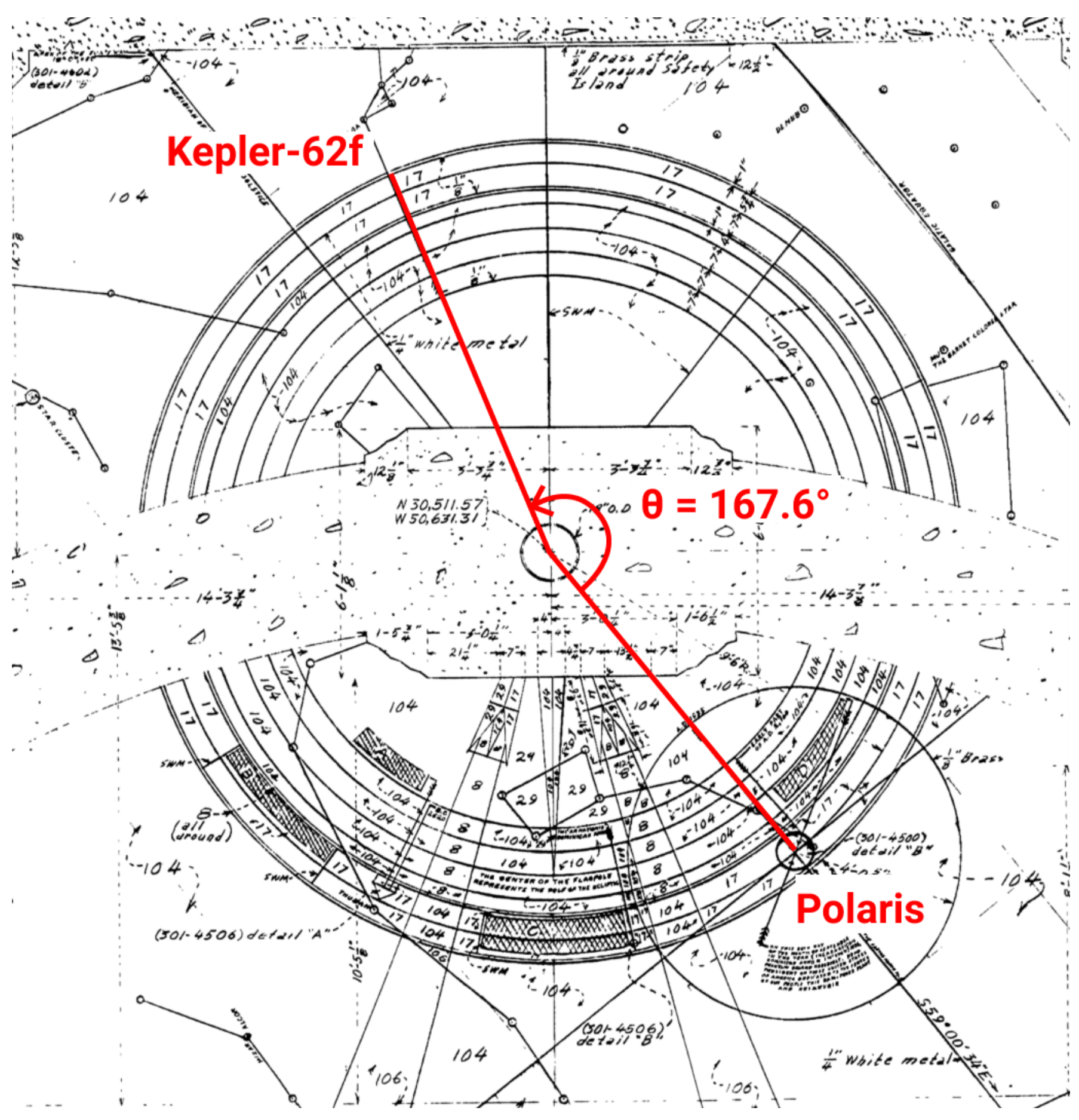
For the purpose of this question, assume that the Earth’s axial tilt is a constant and its axis precesses at a constant rate.
a) Using the values on the map, and knowing that the aliens used carbon-aging to determine that the dam is 12,000 years old, find all possible values for the period of Earth’s axial precession.
b) Using the most optimistic answer (longest period) from part (a), calculate how many arcseconds the Earth’s axis precesses each day. Use the period you calculate here in the next two sections.
c) If they hadn’t been lucky enough to come across the star map and decided to build a radio interferometer to observe the movement of the celestial pole over the course of 30 days instead, how many kilometers would the baseline of their telescope array have to be, assuming it operated at a 20cm wavelength?
d) As a last resort, to keep Earth’s axis fixed, the aliens decide to counter the forces that cause the Earth’s precession by building giant nuclear thrusters on the Earth’s surface. Assume Earth’s precession is caused by external forces alone and calculate the average force (in kN) that a strategically positioned thruster would have to exert to counter them.
Отговори
- a) years or years or years etc.
- b) 0.05 arcsec/day
- c) 25 km
- d) kN
Решение
Solution:
(a) We know that where and or or ... which gives: or or etc.
(b) The axis is in the direction of the angular momentum vector, which traverses a path on a small circle of the celestial sphere, traveling a total of radians in each period. So the axis moves per day.
(c) so
(d) so
Оригинал в Архива: nao_2019.pdf · официални решения: nao_2019_solution.pdf · допълнителни данни: physical-constants.pdf