USAAAO 2020, II кръг — Задача 8
2020 National Astronomy Competition · 15 т.
Instructions (Please Read Carefully)
The top 5 eligible scorers on the NAC will be invited to represent USA at the next IOAA. The next 5 eligible scorers will be invited to join the USA guest team at the next IOAA. In order to qualify for the national team, you must be a high school student with US citizenship or permanent residency.
This exam consists of 3 parts: Short Questions, Medium Questions and Long Questions.
The test must be completed within 2.5 hours (150 minutes).
Please solve each problem on a blank piece of paper and mark the number of the problem at the top of the page. The contestant’s full name in capital letters should appear at the top of each solution page. If the contestant uses scratch papers, those should be labeled with the contestant’s name as well and marked as “scratch paper” at the top of the page. Scratch paper will not be graded. Partial credit will be available given that correct and legible work was displayed in the solution.
This is a written exam. Contestants can only use a scientific calculator for this exam. A table of physical constants will be provided. Discussing the problems with other people is strictly prohibited in any way until the end of the examination period on April 5th. Receiving any external help during the exam is strictly prohibited. This means that the only allowed items are: a scientific calculator, the provided table of constants, a pencil (or pen), an eraser, blank sheets of papers, and the exam. No books or notes are allowed during the exam.
Условие
An astro-photographer has taken the photo of the moon close to a new moon day shown below right before the sunset on December 21 (Winter Solstice) in a wide open area.
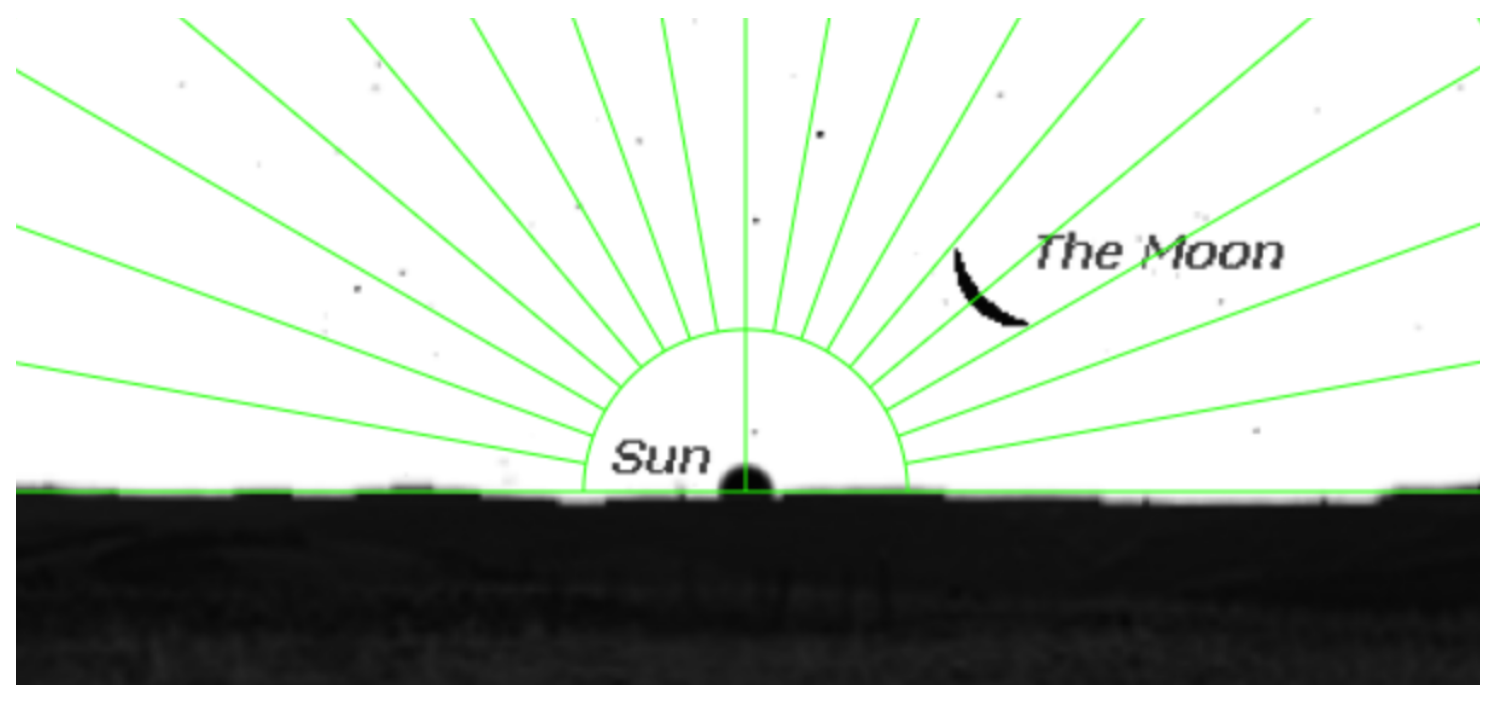
(a) In which hemisphere (Northern or Southern) is the photographer located?
(b) Find the latitude of the photographer. Ignore the orbital inclination of the Moon and the ellipticity of the Earth’s orbit. Hint: The green equiangular lines are added to the image to help you out in measuring any relevant angle.
(c) Calculate the sidereal time when the photo was taken.
Отговори
- (a) Southern
- (b) φ = 44.6° S
- (c) 1h 42m
Решение
Solution:
(a) By looking at the position of the moon with respect to the sun, we know that the photo has been taken from the Southern hemisphere.
(b) First off, we measure the angle between the horizon and ecliptic. It is .
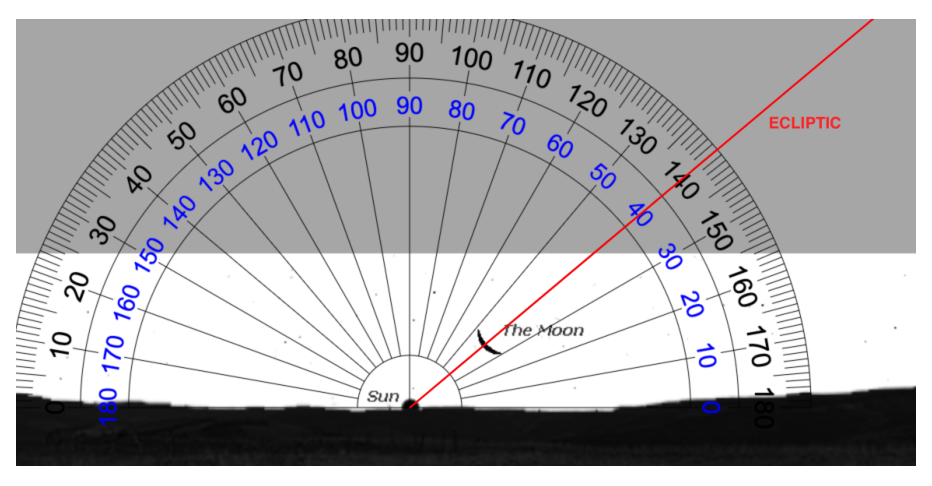
Drawing the celestial spheres, let be the celestial south pole, be the zenith, and be the South ecliptic pole. ; ; ; ; ; and . So, Sun is the pole of a great circle crossing both and points, . Using the spherical law of cosines, . Since the astrophotographer is in the Southern hemisphere, .
(c) Sidereal time=+. Using the spherical law of cosines, . (Winter Solstice).
Оригинал в Архива: usaaao_second_exam_2020__apr4.pdf · официални решения: usaaao_second_exam_2020__apr4sol.pdf