USAAAO 2022, I кръг — Задача 14
USAAAO 2022 - First Round · 5 февруари 2022 г.
Условие
Figure 6 shows a 6-hr root-mean-square (rms) Combined Differential Photometric Precision (CDPP) curve for 150,000 stars observed by the Kepler space telescope. CDPP is a measure of the white noise contained in a light curve, so for a target with 6-hour CDPP of 100 parts per million (ppm), a 6-hour transit with depth 100 ppm would be considered a 1- detection.
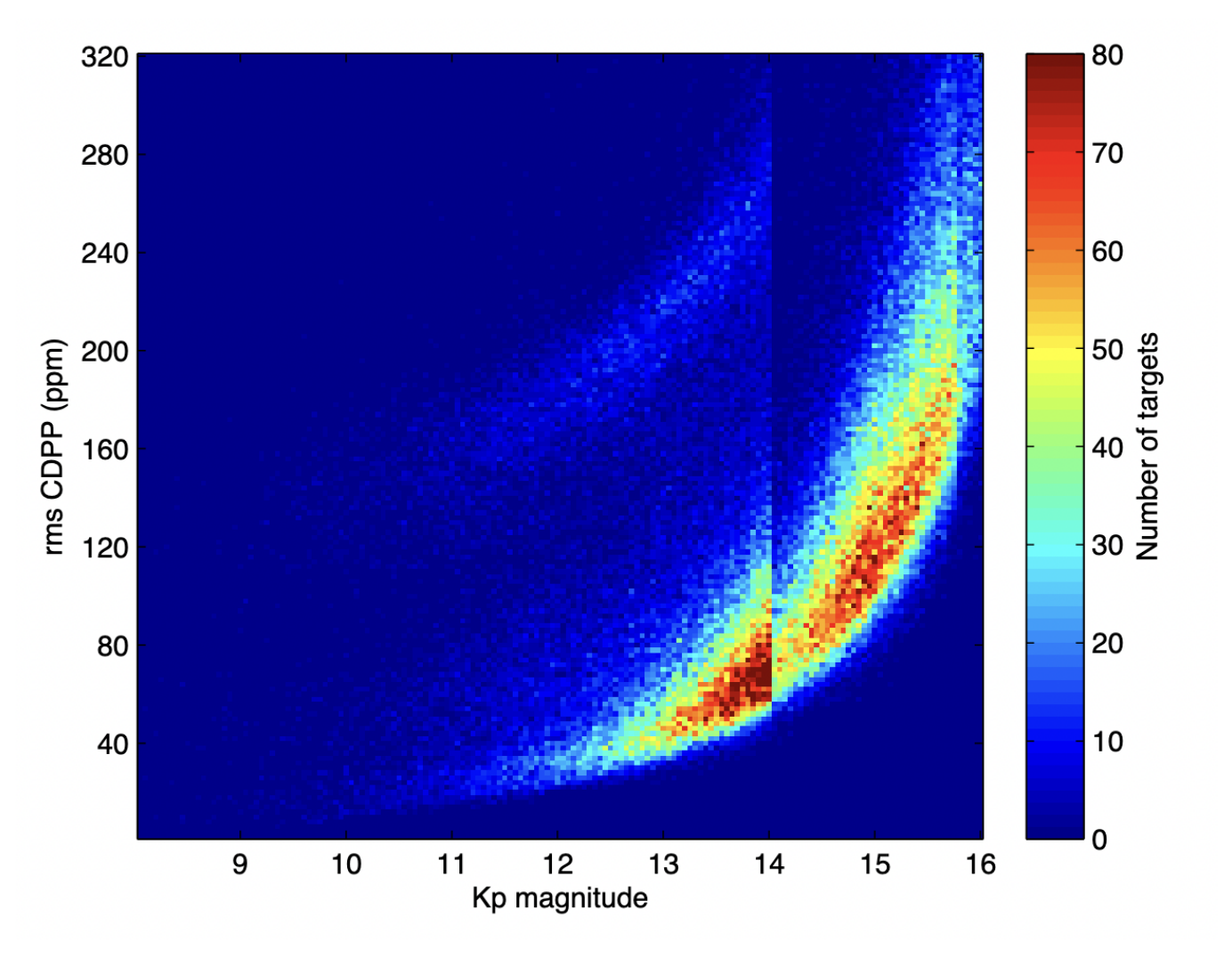
Consider a target with Kepler magnitude that’s among the best targets for its magnitude with respect to noise in Figure 6. Also consider three independent exoplanet scenarios for exoplanets with radii:
- I. 0.5
- II. 1
- III. 10
Using a detection threshold (and assuming 6-hour transit durations), which planet(s) transits would we likely fail to observe due to noise?
(a) I
(b) III
(c) I and II
(d) II and III
(e) I, II, and III
Отговори
- A
Решение
If the target has a , it’s 6 hour CDPP is according to Figure 6. This means we’ll only be able to detect transits deeper than (assuming we’re using a 1 sigma threshold, which is a fairly low threshold).
The planets have expected depths of:
- ppm
- ppm
- ppm
21 is less than 40, so we likely wouldn’t be able to detect planet I due to the noise in the light curve.
Note that there are many reasons we could fail to detect an exoplanet: e.g we didn’t catch enough transits, the exoplanet isn’t perfectly edge on so the depth and duration are particularly low, the field is particularly crowded, etc. In other words, we can’t guarantee that we’ll detect planets II and III, but we do know that planet I will fall below our noise floor.
Answer: A
Оригинал в Архива: usaaao_first_exam_2022_problems.pdf · официални решения: usaaao_first_exam_2022_solutions-1.pdf