USAAAO 2022, II кръг — Задача 9. The Sundial I
2022 National Astronomy Competition · 45 т.
Instructions (Please Read Carefully)
The top 5 eligible scorers on the NAC will be invited to represent USA at the next IOAA. In order to qualify for the national team, you must be a high school student with US citizenship or permanent residency.
This exam consists of 3 parts: Short Questions, Medium Questions and Long Questions.
The maximum number of points is 200.
The test must be completed within 2.5 hours (150 minutes).
Please solve each problem on a blank piece of paper and mark the number of the problem at the top of the page. The contestant’s full name in capital letters should appear at the top of each solution page. If the contestant uses scratch papers, those should be labeled with the contestant’s name as well and marked as “scratch paper” at the top of the page. Scratch paper will not be graded. Partial credit will be available given that correct and legible work was displayed in the solution.
This is a written exam. Contestants can only use a scientific or graphing calculator for this exam. A table of physical constants will be provided. Discussing the problems with other people is strictly prohibited in any way until the end of the examination period on March 26th. Receiving any external help during the exam is strictly prohibited. This means that the only allowed items are: a calculator, the provided table of constants, a pencil (or pen), an eraser, blank sheets of papers, and the exam. No books or notes are allowed during the exam. Exam is proctored and recorded. You are expected to have your video on at all times.
Условие
While on a walk in Princeton University, Leo stumbled upon the following sundial, mounted on the southern wall of a building:
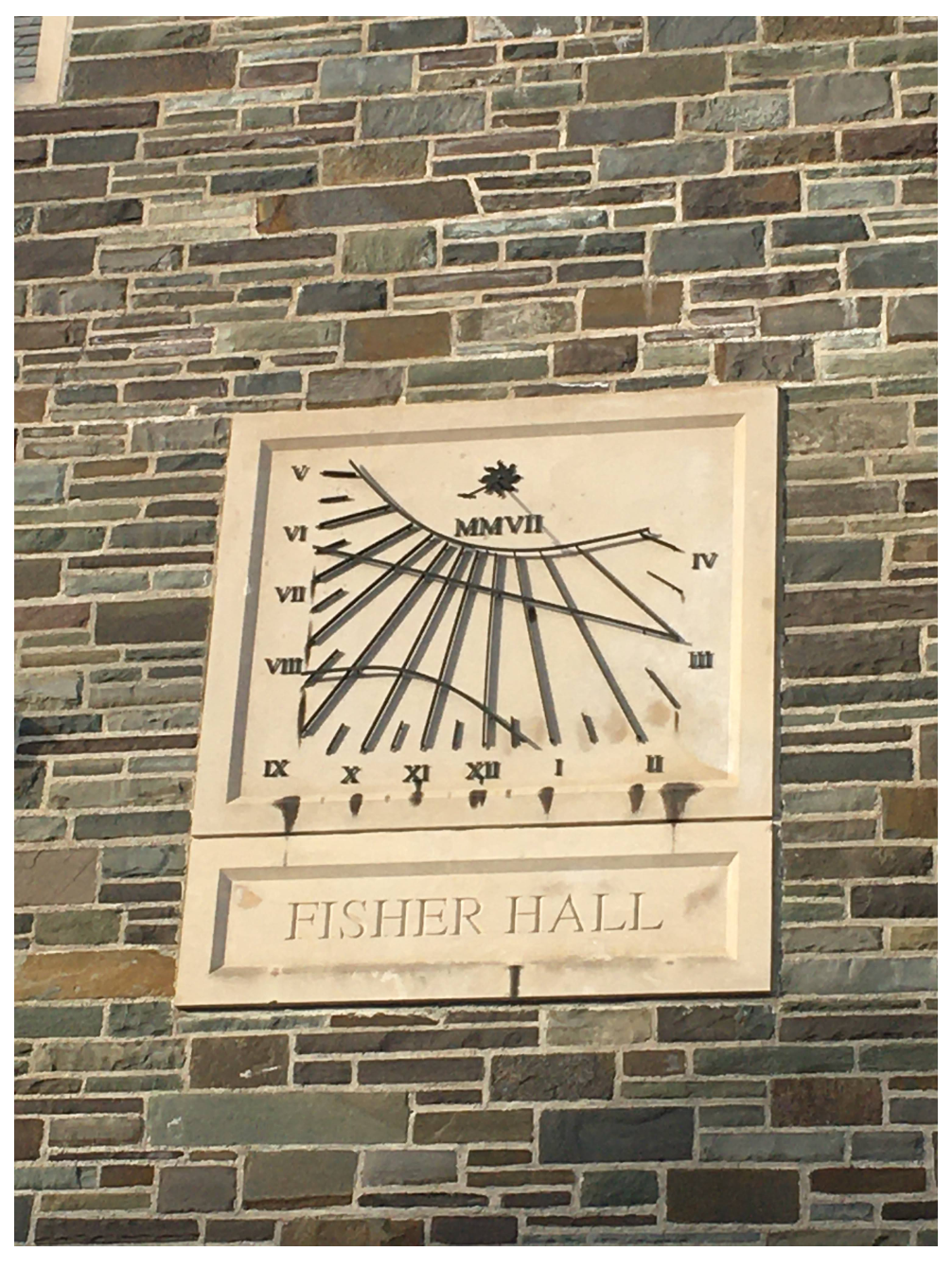
He was familiar with the lines pointing outwards from the center, marking off time of day. However, he also noticed the three curves crossing the other lines. After a bit of thought, he realized these curves marked off the path of the shadow on the equinoxes and solstices.
(a) For each of the two equinoxes and solstices, match the day to the curve (top, middle, bottom) denoting the path of the shadow on that day. (No explanation needed) [3 т.]
(b) For the days corresponding to the middle curve, what is the declination of the Sun on those days? Assume the length of the day is small compared to the length of the year. (No explanation needed) [1 т.]
He then noticed that the middle curve seemed to be a straight line, and started thinking about if this is the case. He first considered a simpler system: a stick mounted vertically on a flat surface, casting a shadow on flat ground.
(c) Consider the shadow of the tip of the stick, which might possibly trace a straight line over the course of the day. Explain why, if this happens, it can only happen on a day when the Sun’s declination is that determined above.
This part can be solved independently, or as part of your solution for the next part. If your solution for the next part also proves this, note that down on your solution sheets, and proceed directly to the next part. [9 т.]
(d) Prove that, for the Sun’s declination determined above, the shadow of the tip of the stick traces a straight line over the course of the day.
Any method is acceptable, as long as it is presented clearly and rigorously. For example, one possible method might involve the following steps:
i) Determining the orientation of the line and explaining why it must be in this orientation;
ii) Determining the length of the shadow for a given position of the Sun in alt-az coordinates;
iii) Deriving a relation between altitude and azimuth given that the tip of the shadow is on the line;
iv) Determining a constant quantity and showing that it is constant over all positions of the Sun that day.
If you skipped the previous part, make sure your proof also shows the inverse: that for a different declination of the Sun, the tip’s shadow does not trace a straight line.
You do not necessarily need to follow these steps. Simpler and/or faster methods may be possible, including those that do not need any equations. Any fully-formed, valid explanation gives full credit. [24 т.]
After figuring out the simpler case, Leo realized that he could easily generalize it to the sundial mounted on the wall. He then started thinking about other ways the model and the sundial on the wall differed, and thought about the orientation of the center line, noticing that it was not perfectly horizontal, but instead slanted.
(e) Based on the picture and the orientation of the center line, does the wall run perfectly East-West, or does it run Northeast-Southwest or Southeast-Northwest? Explanation needed for credit.
Assume the wall is perfectly vertical. This part can be solved independently of the previous two parts. [8 т.]
Отговори
- (a) Top curve: winter solstice; middle curve: equinoxes; bottom curve: summer solstice.
- (b)
- (e) The wall is angled Southwest to Northeast.
Решение
(a) The Sun is highest on the summer solstice, and lowest on the winter solstice. Therefore shadows for sundials on the ground are shorter in summer than in winter. However, this sundial is on a vertical wall, so this trend is actually reversed: the top curve (shortest shadows) corresponds to the winter solstice and the bottom curve (longest shadows) corresponds to the summer solstice.
Also notice the visible shadow close to the top curve; as the picture was taken in December 2020, this shadow corresponds to the winter solstice and again the top curve.
The equinoxes therefore correspond to the curve in the middle.
(b) On the equinoxes, the declination of the Sun is .
(c) There are many possible solutions to this part; here we present one.
First note that, as the Sun’s path is symmetric across the meridian, by symmetry, the line must run perfectly East to West.
Consider the Sun’s position at solar noon on any day; if the Sun does not rise, no line is possible. But if the Sun does rise, the altitude of the Sun as it crosses the meridian is nonzero. For a finite stick height, the shadow length is finite. Therefore, the line must be a finite distance from the stick.
Now consider the azimuth of the Sun at sunset. If , then there is some component of the shadow that runs North-South. But as the Sun’s altitude goes to 0, the shadow length goes to . As the line runs East-West, the line must therefore be an infinite distance from the stick, which is a contradiction.
Therefore, this is only possible for at sunset, implying .
(d) We present a variety of solutions. First we present the method described in the problem statement:
i) From the previous part, we know the line must run perfectly East to West, at a finite distance from the stick.
ii) If the Sun has altitude , then if the stick has length , then the length of the shadow is given by .
iii) Let , such that the Sun rises at and sets at . Let the line be a distance from the stick; then we need .
iv) Therefore, , which we need to hold for all positions of the Sun over the entire day. We have therefore derived the constant quantity .
To finish off the proof, we need to show this is a constant quantity:
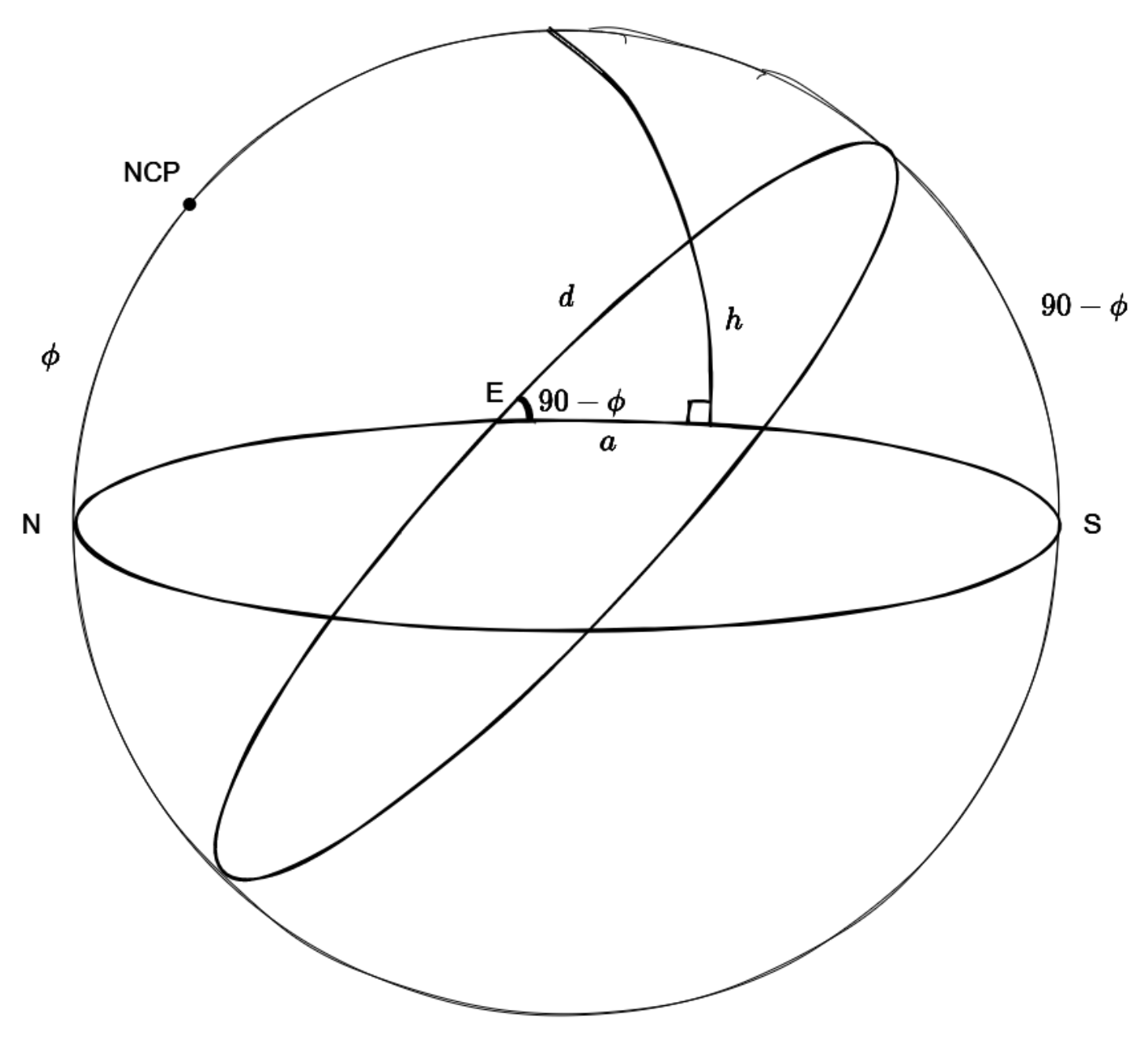
Using the spherical law of cosines:
Using the spherical right triangle equality :
Noticing the first term has the same form as the original:
Using and cancelling terms:
Using the spherical law of sines :
Therefore, this is a constant quantity, which means the tip of the shadow is always on this straight line.
If the previous part was skipped, it is also necessary to prove the line is perfectly East to West, and that it is a finite distance from the stick, as those assumptions were used in the derivation above.
The inverse would also need to be correctly justified. For example, one way to do this would be to simplify without the assumption.
Using the spherical law of cosines to derive the coordinate transformation:
Applying this transformation:
The latitude is a constant, and the declination is approximately unchanged over the course of a day. However, varies over the course of a day as the Sun rises and sets. Therefore, for this to be a conserved quantity, we need , implying .
However, this problem can be solved much faster geometrically. A simple solution using nothing but properties of great circles and planes goes as follows:
Place the tip of the stick at the center of the celestial sphere. On the equinoxes, the declination of the Sun is 0, so the path of the Sun is a great circle; therefore the path of the Sun through the day and the tip of the stick lie in the same plane. Therefore, the shadow of the tip of the stick must be in the same plane. Intersecting this plane with the plane of the ground gives a straight line for the shadow’s path.
Notice that this solution quickly generalizes to any other intersecting plane, be it a vertical wall or any other orientation the sundial is mounted in.
(e) Consider two positions of the Sun on the equinox, equidistant from noon. By symmetry, the altitudes are the same, and the azimuths are equally offset from due South.
Consider the shadow cast by the Sun at each of these times, which is the intersection of the line connecting the Sun’s position and the tip of the sundial with the wall. As the Sun is up in the South, these lines slope down as they head North.
Looking at the line in the picture, the line traveling West drops less compared to the line traveling East. This implies the wall juts out towards the observers perspective on the left, meaning the wall is angled Southwest to Northeast.
Looking at the actual building, Fisher Hall, on Google Maps, it indeed is oriented that way!
Problem adapted and extended from Roberto Bozcko and Lucas Carrit Delgado Pinheiro.
Оригинал в Архива: usaaao_second_exam_2022_problems.pdf · официални решения: usaaao_second_exam_2022_solutions.pdf