USAAAO 2023, I кръг — Задача 1
USAAAO 2023 - First Round
Условие
1. According to the astronomical Julian day count, JD 2459946.0 corresponds to January 1, 2023 at 12:00 UT. What would be the date and time at Chorzow, Poland corresponding to JD 2460000.0?
Poland uses the Central European Time (GMT + 1:00).
(a) 31 January 2023, 24:00
(b) 24 February 2023, 13:00
(c) 21 March 2023, 14:00
(d) 21 June 2023, 18:00
(e) 31 December 2023, 24:00
2. A cluster has a radius of 2 parsecs. A Sun-like star in the cluster has an apparent magnitude of 10. When we look at the cluster with a telescope that has an en eyepiece with a field of view of 30 degrees, the cluster just fits within the eyepiece. If this telescope has an eyepiece of focal length 20 mm, what is the focal length of its objective lens?
(a) 570 mm
(b) 283 mm
(c) 144 mm
(d) 425 mm
(e) 301 mm
3. The radius of the Moon is about 4 times smaller than the radius of the Earth. The mean albedos of the Moon and the Earth are 0.12 and 0.36, respectively. The Mars Reconnaissance Orbiter took a picture of the Earth-Moon system. How many times brighter than the Moon did the Earth appear in the image?
(a) 4/9
(b) 4/3
(c) 16/3
(d) 12
(e) 48
4. The Sun has a surface temperature of about and its blackbody emission peaks in the visible spectrum. Around 1940s, astronomers found out that the Sun is a strong X-ray emitter. Today, it is understood that this emission comes from the solar corona where temperatures can reach on the order of . Assuming the corona is a blackbody emitter, what wavelength would that emission peak at?
(a)
(b)
(c)
(d)
(e)
5. Friedrich Bessel was the first person to quantitatively measure the annual change in stellar positions due to the motion of the Earth around the Sun. This change is known as stellar parallax. Bessel determined the stellar parallax for 61 Cygni to be about 1/3 arc-seconds. What is the distance to 61 Cygni from Earth?
(a) 1/3 light years
(b) 3 light years
(c) 1/3 parsec
(d) 3 parsecs
(e) 3 kiloparsecs
6. Compute the black body luminosity of a neutron star with its surface temperature at K and radius m.
(a) 0.1
(b) 0.2
(c) 0.3
(d) 0.4
(e) 0.5
7. Fill in the blanks.
The Balmer lines are a series of emission spectrum of hydrogen. In the low temperature interstellar medium, despite hydrogen being the most commonly occurring element in such environment, the Balmer series is not observed as absorption lines. That happens because the transitions that require such spectrum to appear as absorption lines correspond to transitions from the _____(1)_____ hydrogen level to higher states. In low temperature environments, the _____(1)_____ level is _____(2)_____.
(a) (1) , (2) always occupied
(b) (1) , (2) never occupied
(c) (1) , (2) always occupied
(d) (1) , (2) never occupied
(e) (1) , (2) never occupied
8. A comet passes near the Sun on a parabolic orbit. While it's passing near the Sun with orbital velocity , the Sun's heat causes the comet to melt, and it shatters into many small fragments. The fragments move away uniformly in all directions (in the comet's reference frame) with velocity . What fraction of the fragments will escape the solar system? Ignore any forces other than the Sun's gravity.
(a) 0%
(b) 50%
(c) 100%
(d)
(e)
9. Consider Galaxies A and B, both of which have radius . At a distance from its center, Galaxy A's rotational velocity is equal to . Meanwhile, Galaxy B's radial velocity dispersion is also equal to . However, galaxy A is spiral while galaxy B is spherical elliptical and composed of uniform, evenly-spaced stars. Calculate the masses of both galaxies. (Answer choices are listed as ; ).
(a) ;
(b) ;
(c) ;
(d) ;
(e) ;
10. Consider a satellite that has a circular orbit with a radius of m around Venus. Due to a failure in its ignition system, the satellite's orbital velocity was suddenly decreased to zero during a maneuver. How long does the satellite take to hit the surface of the planet? Consider that the mass of Venus is kg and neglect any gravitational effects on the satellite other than that from Venus.
(a) 15 hours.
(b) 3 days.
(c) 11 days.
(d) 25 days.
(e) 37 days.
11. Consider a main-sequence star with mass kg, which is sustained through the proton-proton chain reaction, which operates with efficiency. The hydrogen and helium fractions of this star are and at the beginning of its lifetime. Assume this star has solar luminosity and that all hydrogen can be used for fusion. Calculate the lifetime of this star.
(a) s
(b) s
(c) s
(d) s
(e) s
12. A planet is in an elliptical orbit around a star. Let be the minimum distance between the planet and star, and let be the maximum distance between the planet and star. Suppose that . During what percentage of the time period of each orbit is the planet at least away from the star?
(a) 23%
(b) 50%
(c) 57%
(d) 69%
(e) 77%
13. The apparent magnitude of a star of radius as observed from Earth appears to fluctuate by 0.037. That is, the difference between the maximum and minimum apparent magnitudes is 0.037. This fluctuation is caused by an exoplanet that orbits the star. Determine the radius of the exoplanet.
(a)
(b)
(c)
(d)
(e)
14. An empirically determined approximate formula for the lifetime of a star is given by:
where is the stellar lifetime and is the mass of the star.
If the very first stars in the universe formed approximately 400 million years after the Big Bang, what is the most massive such star that could still exist today?
(a)
(b)
(c)
(d)
(e)
15. With the technology currently available, it would take hundreds of millennia to send a human-made object to other stars. A possible solution to this problem is to use relativistic light sails, which consist of very small probes propelled by radiation pressure. It is estimated that on the reference frame of an Earth observer, these sails would take 20.0 years to reach Alpha Centauri, which is 4.37 light-years away from the Solar System. The velocity of a light sail can be assumed to be constant throughout the entire trip. How long would this trip be on the reference frame of the light sail?
(a) 18.5 years
(b) 19.0 years
(c) 19.5 years
(d) 20.0 years
(e) 20.5 years
16. Which of the following constellations is not on the sky map below?

(a) Virgo
(b) Crux
(c) Lupus
(d) Libra
(e) Corona Borealis
17. The fictional towns of Baia and Caia are located at and , respectively. It is known that the spherical triangle with vertices at Baia, Caia, and the North Pole covers 6.75% of Earth's surface. Compute .
(a) N
(b) N
(c) N
(d) S
(e) S
18. Now suppose that Lucas is standing still in Baia (from the previous question), and Justin is standing still on the equator. Let and be the paths of Lucas's and Justin's shadows on the summer solstice, respectively. Let and be the paths of Lucas's and Justin's shadows on the vernal equinox, respectively. Assume that the heights of Lucas and Justin are small compared to the radius of the Earth, there is no atmospheric refraction, and that the Sun is a point. Given Earth's obliquity , which of the following is the most specific accurate description of the shapes of each path?
(a) : Parabola, : Hyperbola, : Line, : Line
(b) : Parabola, : Hyperbola, : Hyperbola, : Line
(c) : Parabola, : Parabola, : Line, : Line
(d) : Hyperbola, : Parabola, : Hyperbola, : Line
(e) : Hyperbola, : Parabola, : Line, : Line
19. In 1995, researchers at the University of Geneva discovered an exoplanet in the main-sequence star 51 Pegasi. This was the first-ever discovery of an exoplanet orbiting a Sun-like star! When they observed the star, a periodic Doppler shifting of its stellar spectrum indicated that its radial velocity was varying sinusoidally; this wobbling could be explained if the star was being pulled in a circle by the gravity of an exoplanet. The radial velocity sinusoid of 51 Pegasi was measured to have a semi-amplitude of 56 m/s with a period of 4.2 days, and the mass of the star is known to be . Assuming that the researchers at Geneva viewed the planet's orbit edge-on and that the orbit was circular, what is the mass of the exoplanet in Jupiter masses?
(a)
(b)
(c)
(d)
(e)
20. Suppose that an astronomer detects an electromagnetic wave of frequency . Some time later, another wave with the same amplitude is received, but now with a frequency . In order to calibrate the apparatus and do the necessary calculations, the astronomer decided to calculate the intensity of the second signal relative to the first. Considering that they both came from the same place, what value did the astronomer obtain?
(a) 1/4
(b) 1/2
(c) 1
(d) 2
(e) 4
21. Consider the binary system Kepler-16, which has the primary star Kepler-16A and the secondary star Kepler-16B. It has an orbital period days and the measured parallax is mas. Calculate the total mass of the stars, using the fact that their maximum angular separation measured from Earth is mas and they are on an edge-on orbit.
(a) 0.756
(b) 0.803
(c) 0.891
(d) 0.987
(e) 1.326
22. The habitable zone of a star is defined as the one where water in the liquid state can exist in the surface of a planet. Therefore, considering that the planets are ideal black bodies with fast rotation, determine the maximum eccentricity that the orbit of a planet can have so that it can be home to life. Ignore any thermodynamic effects that might happen in the atmosphere or the sidereal space. Consider that the melting point of water is 273 K and the boiling point is 373 K.
(a) 0.274
(b) 0.302
(c) 0.316
(d) 0.328
(e) 0.540
23. Billions of years from now, as the Moon moves farther away from the Earth, the Earth's axial tilt may become unstable. Imagine the Earth's tilt is such that the angle between the celestial equator and the ecliptic is , rather than the current - so the Arctic Circle is now as far south as North. For an observer at North, how many days out of the year would the Sun never set (also known as the “polar day”)? (Ignore atmospheric refraction, and assume the Earth's orbit is circular and nothing else has changed from today.)
(a) 28
(b) 56
(c) 61
(d) 67
(e) 113
24. Erez is designing a Newtonian telescope! The equation of the primary mirror is , and the telescope tube intersects the mirror at . What is the f-number (focal ratio) of the telescope?
(a) f/0.75
(b) f/1.00
(c) f/1.25
(d) f/1.33
(e) f/1.75
25. Consider a hypothetical planet orbiting the Sun with an obliquity angle (angle between the axis of rotation and the normal to the orbital plane). Assume that a year is much longer than a day for this planet.
Define a tropical region in the planet as one where the Sun reaches the zenith at some time in its revolution period. Define a frigid region in the planet as one where there is a day when the Sun never rises.
What is the minimum value of for which there is a location on the planet which is both tropical and frigid?
(a)
(b)
(c)
(d)
(e)
26. A comet is approaching our solar system from the depths of space with a velocity of 10000 m/s, and if it continues moving in a straight line on its current trajectory, it will just barely graze the surface of the Sun! What is the eccentricity of the comet's orbit?
(a) 1.00014
(b) 1.000014
(c) 1.0000014
(d) 1.00000014
(e) 1.000000014
27. How far from the Solar System would a galaxy with a redshift of 0.035 be?
(a) 150 Mpc
(b) 200 Mpc
(c) 250 Mpc
(d) 300 Mpc
(e) 350 Mpc
28. Two planets A and B orbit a star with coplanar orbital paths that don't intersect. The major axes of the orbits are perfectly aligned, but the major axis of A is larger than that of B. A and B are observed to have eccentricities 0.5 and 0.75, respectively. What is the minimal possible ratio of semi-major axes of A to B?
(a) 1
(b)
(c)
(d)
(e) 6
29. Here is a map of MIT and the surrounding area, where North points directly upwards, as taken from https://whereis.mit.edu:
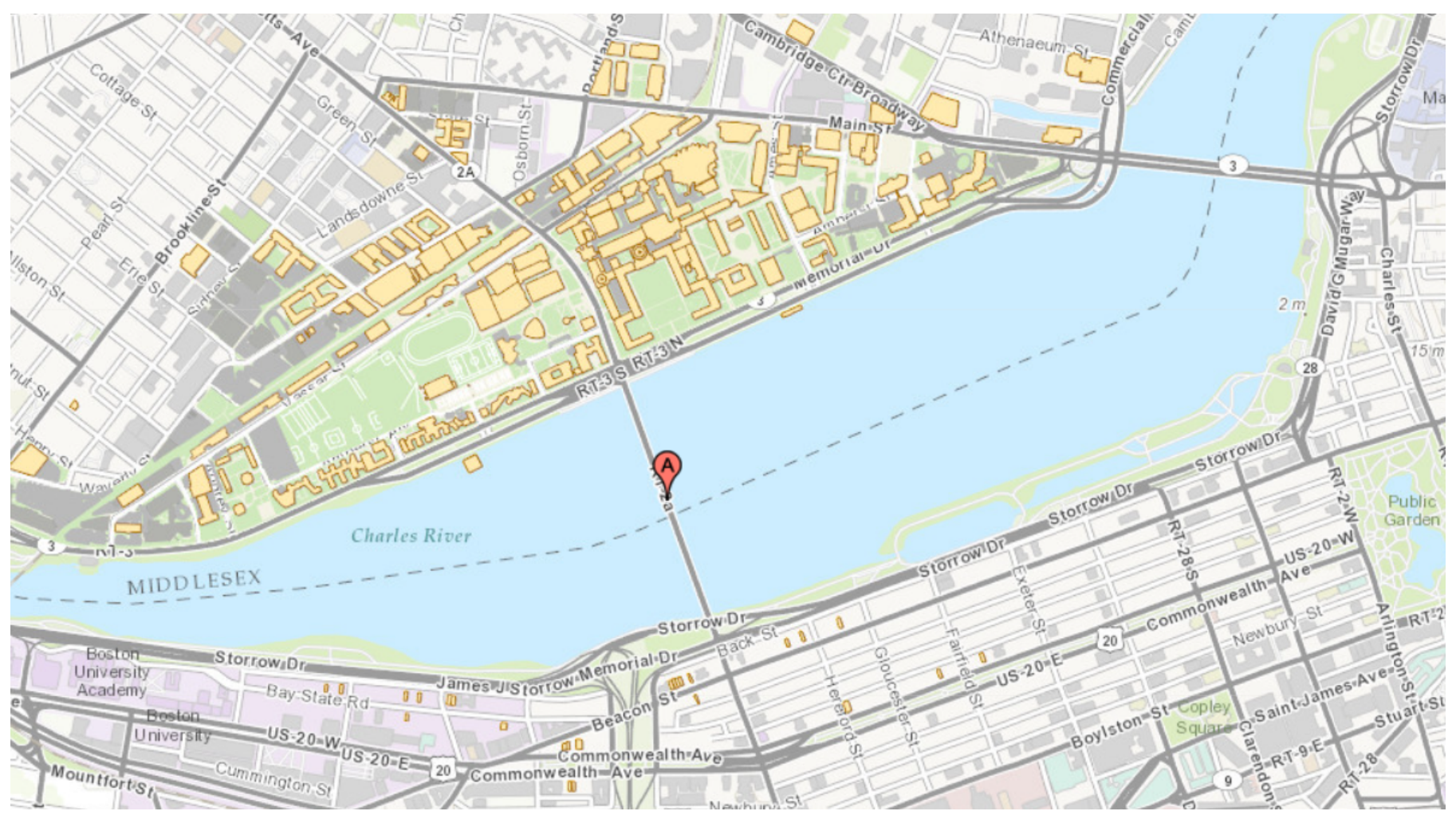
Leo is biking along the Harvard Bridge (marked as “A”) when he stops and looks out at the river. Looking out downriver (to the right on this map) and parallel to the banks, he sees the Sun straight in front of him, peeking out from above the buildings, and has to avert his eyes to not be blinded. What part of the academic year is it?
(a) Early fall semester (late September-early October)
(b) Late fall semester (late November-early December)
(c) Independent Activities Period (January)
(d) Early spring semester (late February-early March)
(e) Late spring semester (late April-early May)
30. After a day spent showing a visiting friend around Boston, Leo is walking back along the bridge (see diagram in previous problem) to return to Next House. The time is such that the Sun now aligns with perfectly upriver, so it is in the opposite direction compared to the morning. How high in the sky is the Sun relative to the morning?
(a) Above the horizon, and higher than in the morning
(b) Above the horizon, at the same altitude as in the morning
(c) Above the horizon, but lower than in the morning
(d) On the horizon
(e) Below the horizon
Отговори
- 1. B
- 2. B
- 3. E
- 4. A
- 5. D
- 6. B
- 7. D
- 8. B
- 9. D
- 10. C
- 11. B
- 12. D
- 13. A
- 14. D
- 15. C
- 16. E
- 17. E
- 18. A
- 19. D
- 20. C
- 21. C
- 22. B
- 23. B
- 24. A
- 25. C
- 26. D
- 27. A
- 28. B
- 29. E
- 30. A
Решение
1. Solution: The difference is exactly 54 days, so JD 2460000.0 corresponds to 24 February at 12:00 UT. Poland follows Central European Time, so we must add 1 hour to the Universal Time.
Answer: B
2. Solution: The Sun-like star has absolute magnitude 4.83 (from the table of constants). Then, using
we get parsecs.
Then we notice this means the true FOV of the cluster is degrees.
So
This gives magnification=14.2 so = 283 mm
Answer: B
3. Solution: The brightness of each object is proportional to its surface area and its albedo. The required ratio is therefore .
Answer: E
4. Solution: Wien's law
Answer: A
5. Solution: The parsec is defined as where is the stellar parallax in arc-seconds.
Answer: D
6. Solution: The black body luminosity is . After unit conversion, .
Answer: B
7. Solution: At state of hydrogen, the excitation energy of approximately 10 eV, which rarely occurs in low-temperature gas.
Answer: D
8. Solution: Since the comet is in a parabolic orbit, its total orbital energy is 0 and it's exactly at the threshold to be gravitationally bound to the sun. This means that any fragments moving faster than the original comet will escape, and any fragments moving slower than the original comet will be gravitationally bound to the Sun. If a fragment is launched at an angle relative to the comet's direction of motion around the Sun, then its final velocity is .
Assuming , we can expand this in to first order in , giving , which is larger than only for . This means that the fragments will escape for but not for , so 50% of the fragments escape.
Answer: B
9. Solution: Note that spiral galaxies are uniformly rotating, so we can simply write
However, the velocity distribution in an elliptical galaxy is uniform and random. Then, we can use the Virial theorem () to calculate the velocity at the edge of the galaxy.
Where is the total magnitude of the velocity (in tangential and nontangential directions). However, we also note that (from the assumption that velocities are randomly distributed). Then, .
Answer: D
10. Solution: It is important to note that the orbital radius of the satellite is much larger than the radius of a rocky planet, so it is possible to consider that the time to reach the surface of Venus is approximately the same as the time to reach the center of Venus.
An easy method to calculate the time that the satellite takes to reach Venus is to assume that as it falls to the ground, it is in an elliptical orbit with a semi-minor axis tending to zero and a semi-major axis equal to half of the orbital radius of the satellite. Venus is one of the foci of the ellipse. In that case, the satellite would take half of the orbital period to reach Venus. Therefore, it is possible to use Kepler's Third Law to determine the time that the satellite would take to reach Venus:
Answer: C
11. Solution: There is a total hydrogen mass of for fusion (proton-proton chain reaction uses hydrogen, not helium). Then, the total energy released over the lifetime of the star is . The lifetime of the star is then s.
Answer: B
12. Solution: We recall that if is the eccentricity and is the semi-major axis for the orbit, then and . Thus,
Now, we have , so . The points where the semiminor axis intersects the ellipse are both a distance from the foci. Thus, the semi-minor axis precisely cuts off the portion of the elliptical orbit where the distance is more than .
To calculate the percentage of the orbit spent on this part of the orbit, we use Kepler's second law. The area swept during this time is half of the ellipse plus a triangle with base and height . Thus, the proportion of area swept is
Answer: D
13. Solution: The change in flux occurs when the exoplanet is transiting. The flux during transit is given by
where is the maximum flux of the star. Thus, the change in apparent magnitude is
Solving for yields .
Answer: A
14. Solution: 400 million years after the Big Bang was roughly 13.3 billion years ago. If we set equal to years and solve for , we get
Answer: D
Since the lifetime of the Sun is 10 billion years which is somewhat less than the age of the first stars, it makes sense that the answer is a bit less than the mass of the Sun.
15. Solution: The first step is to calculate the velocity of the light sail:
The Lorentz factor associated with this velocity is the following:
Considering that the time for the Earth reference frame is dilated with respect to the time for the light sail reference frame:
Therefore, this trip would take 19.5 years in the reference frame of the light sail.
Answer: C
16. Solution:
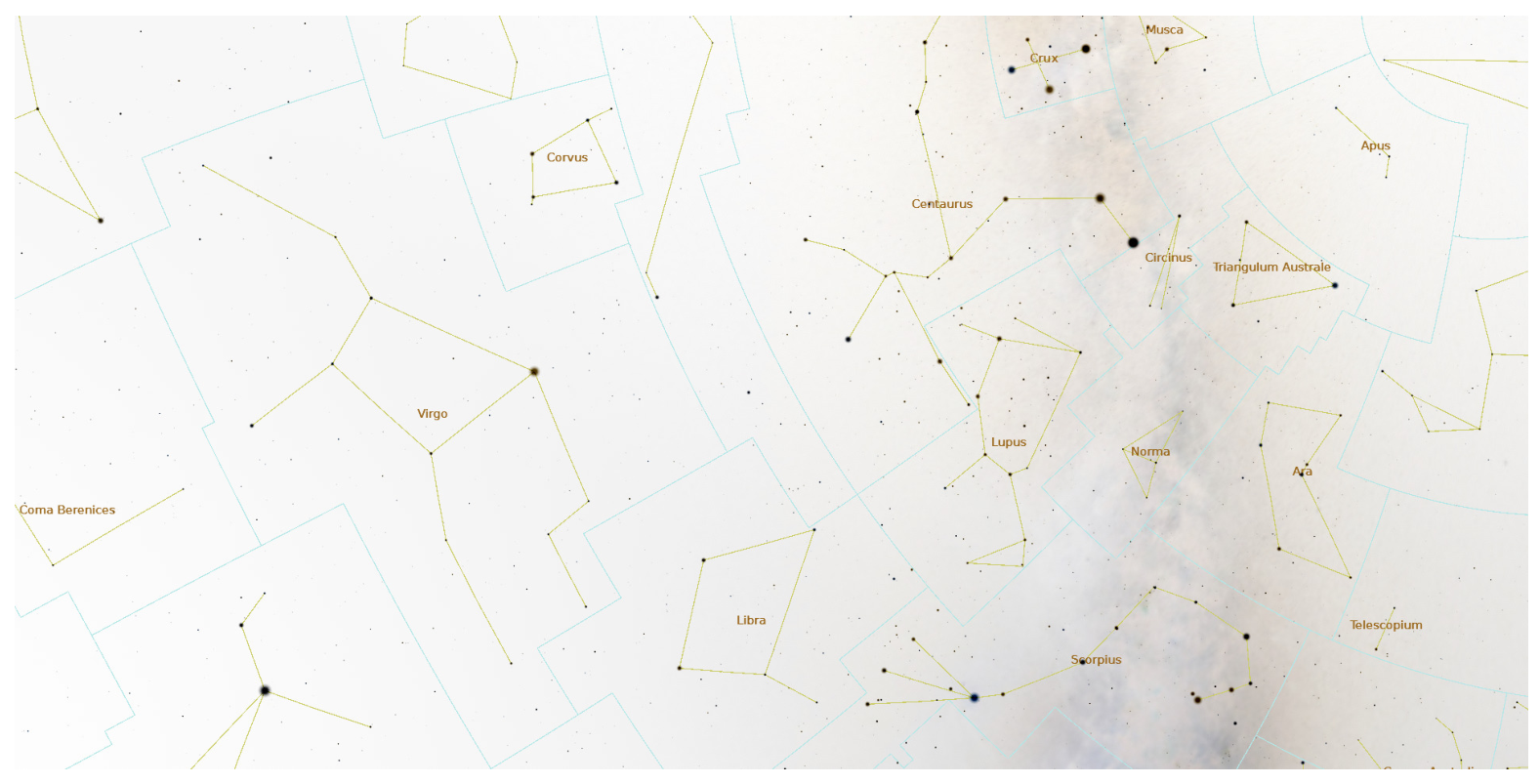
Corona Borealis is the only constellation from the given options that is not on the image.
Answer: E
17. Solution: Let denote the north pole, denote Baia, and denote Caia. It is well known that the area of is equal to its spherical excess multiplied by the squared radius of earth. If , then this implies that
Substituting and gives , so . Applying the spherical law of sines in , this gives us . Since and are supplementary, we thus have , so Caia is in the southern hemisphere and S.
Alternatively, you can also have used the answer choices to help deduce the answer. Given S, the area of our desired triangle is exactly half of the area of the wedge of earth from to . Since this wedge covers of the Earth's surface, covers 6.75%, so is our answer.
Answer: E
18. Solution: To determine the shape of each path, consider the cone whose base is the declination circle of the Sun and whose vertex is located at the head of either Lucas or Justin. Each path is then equal to the intersection of the great circle determined by the ground and the cone.
First we consider the summer solstice from each point. From the previous problem, the latitude of Baia is , so the declination circle of the sun touches the ground at one point. This implies that ground is parallel to a generator of our cone, so the path of Lucas's shadow at this time is a parabola. At the equator, the declination circle intersects the ground in two points, so the path of Justin's shadow is a non-parallel cross section of our cone, i.e., a hyperbola.
Now, consider what happens at the vernal equinox. In both locations, the head of Lucas and Justin coincides with the declination circle, so the “cone” has height zero. But then the intersection of the ground with our flat cone is just a line, so both shadows are lines at the vernal equinox.
Answer: A
19. Solution: If an object is viewed with its orbit edge-on, its radial velocity semi-amplitude is just its speed along its circular orbit. This problem can be solved by combining Kepler's Third with the knowledge that for two orbiting bodies, but we'll use conservation of momentum instead. Because the two orbiting bodies will always have velocity vectors pointing in opposite directions, in the center of mass frame, . In addition, because the each body orbits in a circle, we know that . Using these, we can rewrite Kepler's Third:
Now, applying conservation of momentum, .
Answer: D
20. Solution: Since the intensity of an electromagnetic wave just depends on its amplitude, both waves have the same intensity. This result can be seen by the Poynting Vector, which represents the energy flux of the wave:
Answer: C
21. Solution: From the definition of parallax, the distance of the system from us, in parsecs, is given by:
Hence, the distance between the stars projected on the sky in the moment of maximum separation is
Since they are on an edge-on orbit, the projected distance is equal to the physical distance of the stars. Therefore, via Kepler's Third Law, we have that
Comparing to the Earth-Sun system,
Answer: C
22. Solution: Since we are dealing with an ideal black body, its albedo is equal to zero and its emissivity is 1. So, we can calculate the planet's equilibrium temperature setting the absorbed power to be equal to the emitted power.
Here, refers to Power, to Flux, and to area. Using Stefan-Boltzmann's Law, the power emitted by a perfect black body is given by:
Besides that, we have that the effective area is equal to . So,
Therefore, since the temperature is inversely proportional to the distance squared, we have the lowest possible temperature on the perihelion and the highest possible on the aphelion. For the planet to be on the habitable zone, K and K So, we can write that:
In the extreme condition, we have the maximum possible aphelion and the minimum possible perihelion. So, since and ,
Hence,
Answer: B
23. Solution: The Sun's declination varies over the course of the year due to the Earth's axial tilt. At latitude , the Sun will be observed to never set if it has a declination greater than . Thus, we can calculate the beginning and end of the polar day by calculating when the Sun reaches this declination.
We draw a spherical triangle with the vernal equinox forming one corner, two sides formed by the celestial equator and the ecliptic, and a third side perpendicular to the celestial equator which represents the declination of the Sun. The lengths of these sides are (the ecliptic longitude of the sun), and (the right ascension and declination of the sun) respectively.
Using the spherical law of sines on this triangle,
Thus,
For an observer at North, the Sun never sets if , so this period begins and ends when exactly. Solving for , we get or . The Sun never sets when it's between these two points on the ecliptic, which are apart. Since the Sun traverses a full 360 degrees around the ecliptic in 365 days, this means that the polar day is 56 days long.
Answer: B
24. Solution: First, we solve to find that the mirror ends at , thus the diameter of the telescope is 12m. The equation for an axial parabola in terms of its focal length is where is the focal length, so the focal length is ; this focal length can also be derived using the geometric definition of the parabola. The focal ratio (f-number) is defined as , and thus the ratio is . We write the f-number as f/0.75.
Answer: A
25. Solution: The Sun travels up and down (its declination changes) by degrees from the equator over the course of a year. Since the zenith and horizon (the point with the highest altitude on a path that just doesn't rise about the horizon is on the horizon) are 90 degrees off, needs to be 45 degrees at least for the sun to be able to reach both.
Answer: C
26. Solution: One particularly short solution uses the relation where is the specific angular momentum, is the standard gravitational parameter, and is the semi-latus rectum. With m/s, combining with from vis-viva ( so ) yields:
A more elementary solution to this question uses only relations about conics and the vis-viva equation: it can be shown by congruent triangles that the perpendicular distance from an asymptote to a focus is equal to the semi-minor axis of the hyperbola, so we find that . This can be combined with from vis-viva.
Answer: D
27. Solution: Since this is a low redshift, it is possible to use the following expression to estimate the velocity of the galaxy:
Using Hubble's Law, it is possible to calculate the distance:
Answer: A
28. Solution: It is important to notice that this ratio will be minimal when the orbits are at limit of touching each other. If the orbits weren't about to touch each other, it would be possible to shrink the larger orbit to obtain a smaller ratio between the semi-major axes.
Considering that the major axes of the orbits are aligned, there are two possible scenarios in which the orbits are the limit of touching each other. The first one is when the apoapsis of the smaller orbit is about to touch the periapsis of the larger one. In this scenario, the ratio between the major axes would be the following:
The second scenario is when the apoapsis of the smaller orbit is at the limit of touching the apoapsis of the larger one. In that case, the ratio would be the following:
The smallest of the two ratios is , which is therefore the minimal possible ratio between the semi-major axes of the orbits.
Answer:B
29. Solution: There are two pieces of information that matter here:
MIT is in the Northern Hemisphere, and
The Sun is above the horizon north of due East.
These two pieces of information imply the declination of the Sun must be greater than 0. Therefore, we must be after the spring equinox and before the fall equinox, so the only possible answer is late April-early May.
Answer: E
30. Solution:
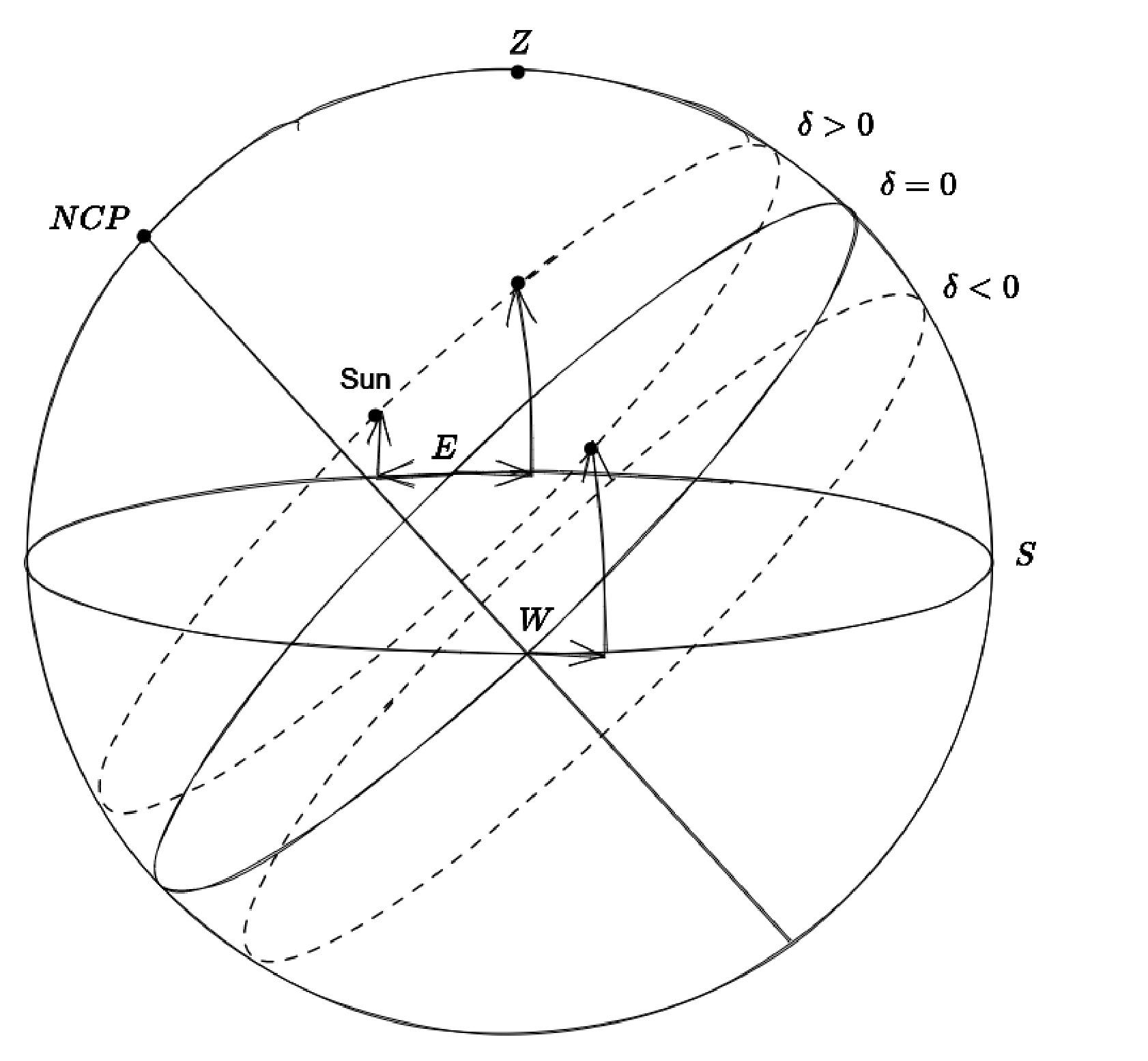
As the Sun was north of East in the morning, it is now south of West. By symmetry across the meridian, the altitude of the Sun now is the same as the altitude of the Sun when it was south of East by the same angle. But as the Sun rises in altitude in the morning before it passes the meridian, it therefore must've been higher than it was in the morning.
Answer: A
Оригинал в Архива: usaaao_first_exam_2023.pdf · официални решения: usaaao_first_exam_2023_solutions.pdf