USAAAO 2023, II кръг — Задача 5. Medium 2
2023 National Astronomy Competition · 20 т.
Внимание: Бележка към темата
The separately attributed physical-constants.pdf is an undated common USAAAO archive reference; its identity as the table supplied for this exam is unproven. Printed question/key inconsistencies are preserved, including Medium 3 P5 radius and graph slope, Long 1 cosine denominator, and Long 2 exit-coordinate term and proper-motion magnitude.
Instructions (Please Read Carefully)
2023 National Astronomy Competition
1 Instructions (Please Read Carefully)
The top 5 eligible scorers on the NAC will be invited to represent USA at the next IOAA. In order to qualify for the national team, you must be a high school student with US citizenship or permanent residency.
This exam consists of 3 parts: Short Questions, Medium Questions and Long Questions.
The maximum number of points is 240 points.
The test must be completed within 2.5 hours (150 minutes).
Please solve each problem on a blank piece of paper and mark the number of the problem at the top of the page. The contestant’s full name in capital letters should appear at the top of each solution page. If the contestant uses scratch papers, those should be labeled with the contestant’s name as well and marked as “scratch paper” at the top of the page. Scratch paper will not be graded. Partial credit will be available given that correct and legible work was displayed in the solution.
This is a written exam. Contestants can only use a scientific or graphing calculator for this exam. A table of physical constants will be provided. Discussing the problems with other people is strictly prohibited in any way until the end of the examination period on April 1st. Receiving any external help during the exam is strictly prohibited. This means that the only allowed items are: a calculator, the provided table of constants, a pencil (or pen), an eraser, blank sheets of papers, and the exam. No books or notes are allowed during the exam. Exam is proctored and recorded. You are expected to have your video on at all times.
We acknowledge the following people for their contributions to this year’s exam:
Wesley Antônio Machado Andrade de Aguiar, Erez Abrams, Lucas Pinheiro, Sahil Pontula, Joe McCarty, Hagan Hensley, Leo Yao, and Andrew Liu.
Undated common archive reference · Table of Physical Constants
Table of Physical Constants
| Quantity | Symbol | Value |
|---|---|---|
| Electron rest mass | ||
| Proton rest mass | ||
| Electronic charge | ||
| Speed of light in free space | ||
| Permeability of free space | ||
| Permittivity of free space | ||
| Planck’s constant | ||
| Reduced Planck’s constant | ||
| Boltzmann’s constant | ||
| Gas constant | ||
| Molar gas constant | ||
| Avogadro’s number | ||
| Standard molar volume | ||
| Unified atomic mass unit ( scale) | ||
| Mass of hydrogen atom | ||
| Bohr magneton | or | |
| Nuclear magneton | or | |
| Proton magnetic moment | ||
| Neutron magnetic moment | ||
| Bohr radius | ||
| Fine structure constant | ||
| Compton wavelength of electron | ||
| Rydberg’s constant | ||
| Stefan-Boltzmann constant | ||
| Radiation density constant | ||
| Gravitational constant |
Rest masses of some leptons and hadrons in :
0.5110, 105.66, 1777, 134.98, 139.57, 493.7, 497.7, 547, 1865, 1869, p 938.3, n 939.6, 1115.7, 1189, 1193, 1197, 1315, 1321, 1672, , .
| Quark | Charge | Mass () | |||||
|---|---|---|---|---|---|---|---|
| u | 0 | 0 | 0 | 0 | |||
| d | 0 | 0 | 0 | 0 | |||
| c | 0 | 0 | +1 | 0 | 0 | ||
| s | 0 | -1 | 0 | 0 | 0 | ||
| t | 0 | 0 | 0 | 0 | +1 | 174.3 | |
| b | 0 | 0 | 0 | -1 | 0 | 4.2 |
Undated common archive reference · Astrophysical Data and Conversion Factors
Astrophysical Data
| Quantity | Symbol | Value |
|---|---|---|
| 1 astronomical unit | AU | |
| 1 parsec | pc | |
| Luminosity of Sun | ||
| Mass of Sun | ||
| Radius of Sun | ||
| Mass of Earth | ||
| Radius of Earth |
Other data and conversion factors
| Quantity | Symbol | Value |
|---|---|---|
| 1 ångstrom | Å | |
| 1 fermi | fm | |
| 1 barn | b | |
| 1 pascal | Pa | |
| 1 standard atmosphere | ||
| Standard acceleration due to gravity | ||
| 1 electron volt | eV | |
| Wavelength of 1 eV photon |
Trigonometrical identities
In a triangle ABC,
and
Prefixes
| T = tera = | c = centi = |
| G = giga = | m = milli = |
| M = mega = | = micro = |
| k = kilo = | n = nano = |
| p = pico = | |
| f = femto = |
Условие
(20 points) Astrophysics studies both the smallest and largest scales of physics. The latter is one of the main focuses of cosmology. Here, we look into the former - the role of quantum mechanics in the astrophysics of stars. For this problem, assume that the Sun’s core has a proton number density of and temperature million K.
(a) (2 points) Suppose that two hydrogen nuclei (protons) are flying towards each other in equal and opposite directions, with an impact parameter (distance of closest approach) of fm. If all of this initial kinetic energy came from the average thermal energy of an ideal gas, what would be the requisite temperature for “fusion” to occur?
In quantum mechanics, particles are described by wavefunctions , whose squared norms govern the probability of finding the particle in a particular state (e.g. having a certain position, momentum, or energy). Particles are said to behave as waves with a wavelength given by the de Broglie wavelength , where is the particle’s momentum and is Planck’s constant. It’s also convenient to define , where is the wavevector and .
(b) (2 points) Evaluate the de Broglie wavelength in fm for a proton with the average thermal energy of an ideal gas at the temperature of the Sun’s core, .
In Figure 1, we see that it’s classically impossible for a nucleus to make it through the potential barrier with (potential energy larger than the total energy). However, quantum mechanics gives a nonzero probability to “tunnel” through the barrier. To solve for in the regions before, inside, and after the barrier, we can use an ansatz , where is a normalization constant and .
(c) (2 points) In which regions of Figure 1 is purely real? Purely imaginary?
(d) (2 points) Modeling the Sun’s main fusion reaction as a single process where two protons and two neutrons combine to form a He-4 nucleus, calculate how much energy is released in a single fusion reaction.
(e) (6 points) Not every proton-proton collision results in fusion. Calculate the probability of fusion per proton necessary to sustain the Sun’s current luminosity. You may assume 1% of the Sun’s mass is comprised of protons available for fusion. For this part, treat the fusion reaction as a collision between two protons (i.e. ignore the neutrons). Assume the cross section for collision is given by , where is the de Broglie wavelength corresponding to being in thermal equilibrium at temperature .
(f) (6 points) Consider one proton (moving) in the potential of the other (at rest) in the simplified 1D model of Figure 1. Suppose that is given by the Coulomb repulsion energy of the two protons at a distance fm and that is the approximate width of the barrier. Here, is the impact parameter for a proton repelled by the Coulomb force with initial kinetic energy (outside the barrier) equal to the average thermal energy . Assuming the potential energy outside the barrier, find the temperature such that the probability that protons can tunnel through the barrier and fuse is .
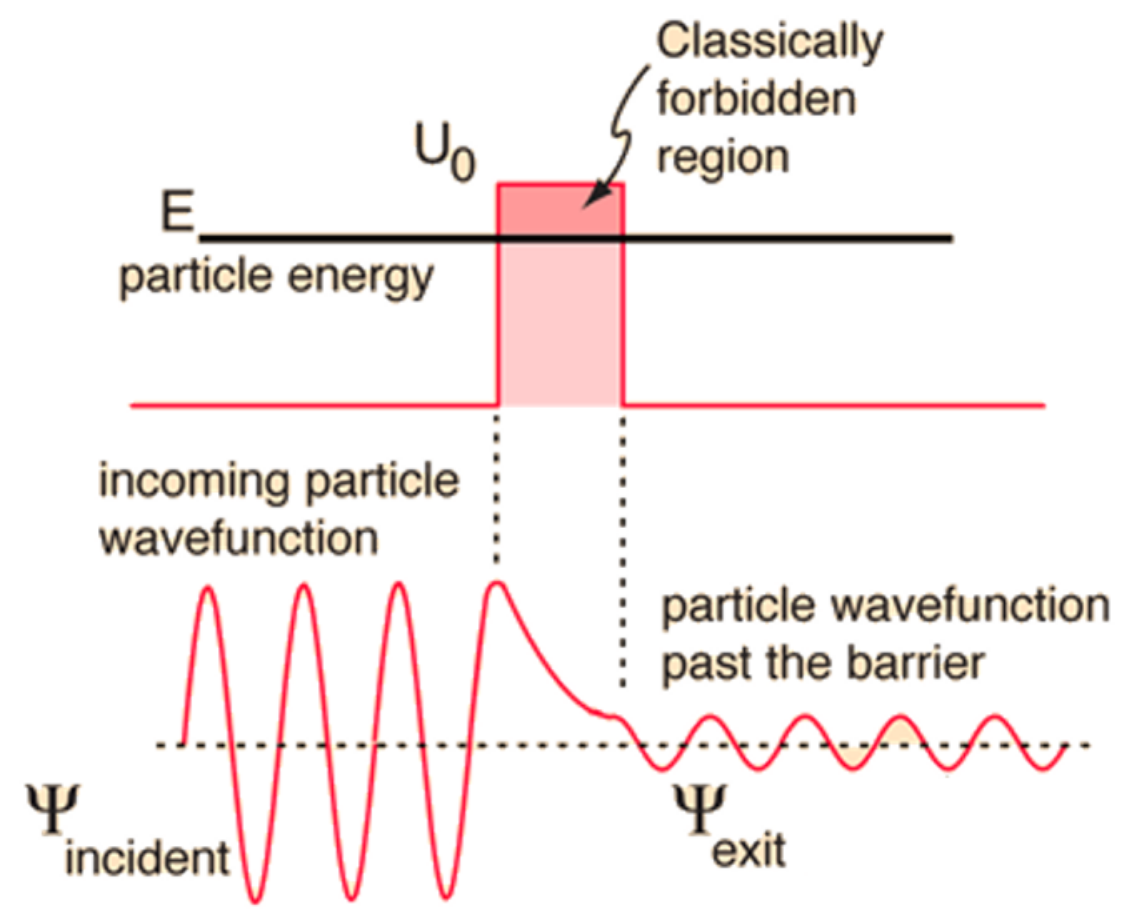
Figure 1: Quantum tunneling.
Решение
Solution
(a) We have , from which .
(b) We have , from which .
(c) Before and after the barrier is purely real, inside the barrier it is imaginary.
(d) The mass defect for the simplified proton-proton fusion reaction is , so are released per fusion reaction.
(e) The collision rate is given by , where . Thus is the number of fusion reactions per second (where is the Sun’s luminosity). Finally, this rate per proton is . Thus .
(f) Transmission through the barrier goes as , where is the imaginary wavevector, is given by the Coulomb repulsion energy at , is given by the average thermal kinetic energy, and is the width of the well. Let denote the probability for fusion. Then,
Here, we have made the assumption that , whose validity we can check after solving. With and , million K. Note that , so our assumption is valid.
Note: A more rigorous solution to this problem would involve modeling the potential more realistically than a square well. For example, approaches include modeling long-range potentials as power laws or even just effective square wells (though much more rigorously than we have done here). Furthermore, the physics is more interesting (and realistic) in 3D, where considerations of angular momentum and effective potentials become important. Common methods in quantum mechanics such as the WKB method are used in problems like this and, in general, one would need to carefully integrate over the barrier to derive the transmission coefficient.
Оригинал в Архива: second_exam_2023-1.pdf · официални решения: second_exam_2023_sols-1.pdf · допълнителни данни: physical-constants.pdf