USAAAO 2024, I кръг — Задача 6
USAAAO 2024 - First Round · 10 февруари 2024 г.
Problem writers
Wesley Andrade, Abhay Bestrapalli, Austin Chen, Justin Chen, Ved Gund, Hagan Hensley, Sandesh Kalantre, Evan Kim, David Lee, Joe McCarty, Arjun Patel, Sahil Pontula, Tara Rezaei, Raul Teixeira, Leo Yao, David Zhang
Условие
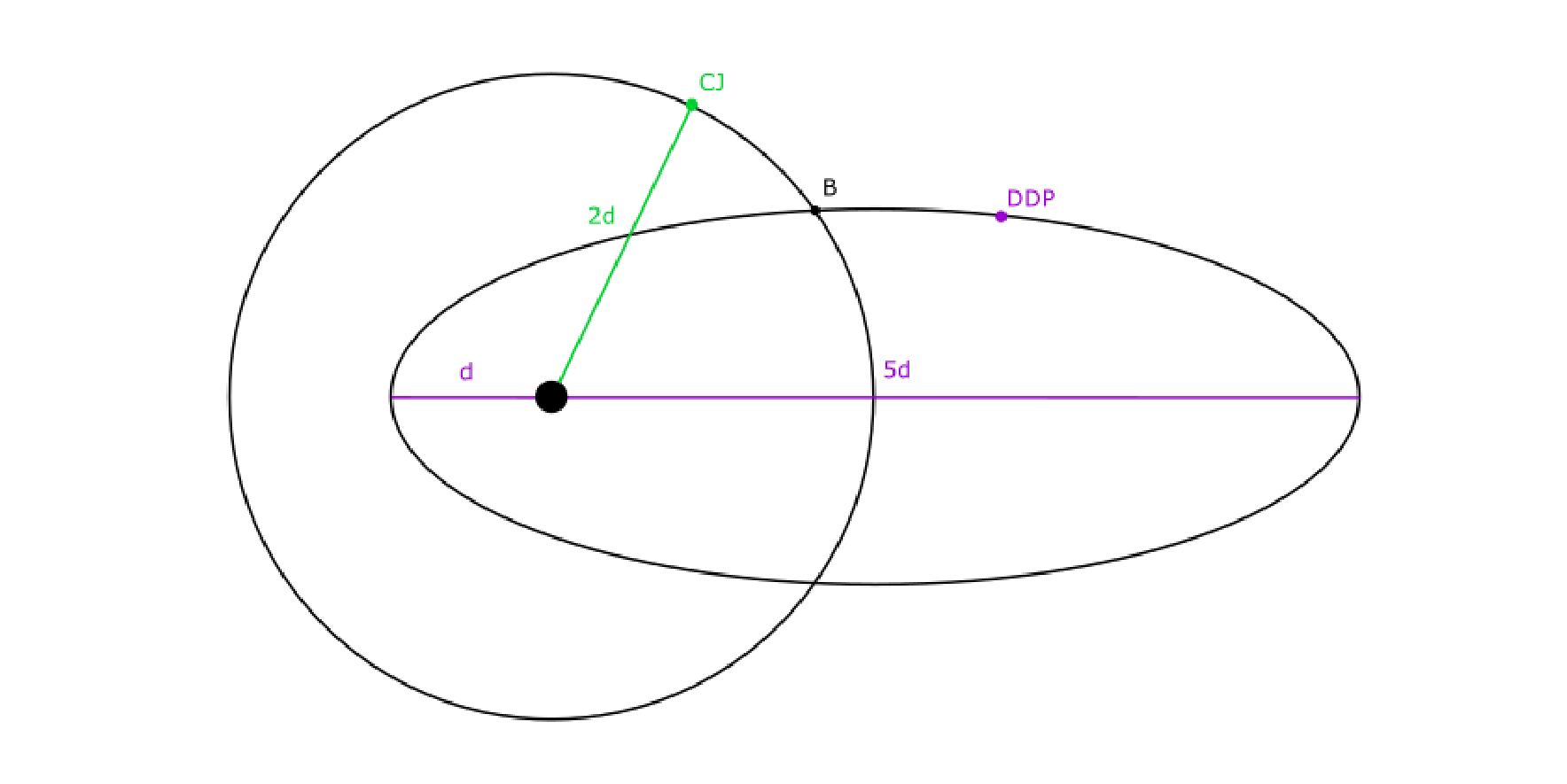
Newly discovered planets DDP and CJ are found to orbit a nearby star, as shown in the figure above. Planet CJ has a circular orbit with a radius of , while planet DDP moves in an elliptical orbit with an aphelion of and a perihelion of . Their orbits intersect at location B in the figure. Additionally, through external analysis, planet DDP is found to be three times more massive than planet CJ. From the perspective of the star, what is the ratio of the angular momentum of planet DDP when it passes through point B to the angular momentum of planet CJ when it passes through point B? You may assume that the masses of both planets are significantly smaller than the mass of the star they orbit.
(a)
(b)
(c)
(d)
(e)
Отговори
- B
Решение
Solution:
Answer: B
Оригинал в Архива: usaaao_first_exam_2024-3.pdf · официални решения: usaaao_first_exam_2024_solutions-1.pdf