USAAAO 2025, I кръг — Задача 16
USAAAO 2025 - First Round · 8 февруари 2025 г.
Внимание: Бележка към темата
All 30 separately numbered original first-round multiple-choice questions and their matching official explanations/answer letters are retained. The printed explanations for Questions 2 and 3 stop before a promised formula; Question 26 refers to a following triangle absent from its native solution page. No missing expression or diagram is reconstructed. Native scientific discrepancies and ambiguous formula notation remain literal and are explicitly attributed in local source notes. A separate two-page common USAAAO archive constants/reference table is included with its own source identity; it is undated in the catalogue, and its use as the exact 2025 attachment is not established. No separate dated instructions, answer sheet or constants companion is present in the 2025 archive folder. No point total or time limit is printed in these two exam booklets.
Original first-round date and writers
USAAAO 2025 - First Round
February 8th, 2025
Writers: Abhay Bestrapalli, Sidhant Chaliha, Ferdinand, Ved Gund, Hagan Hensley, Yehong Jiang, Alexander Li, Joe McCarty, Lucas Carrit Delgado Pinheiro, Sahil Pontula.
Common archive reference — Table of Physical Constants
This separate common USAAAO archive reference is undated in the catalogue. Its use as the exact 2025 exam attachment is not established.
| Quantity | Symbol | Value |
|---|---|---|
| Electron rest mass | ||
| Proton rest mass | ||
| Electronic charge | ||
| Speed of light in free space | ||
| Permeability of free space | ||
| Permittivity of free space | ||
| Planck’s constant | ||
| Reduced Planck’s constant | ||
| Boltzmann’s constant | ||
| Gas constant | ||
| Molar gas constant | ||
| Avogadro’s number | ||
| Standard molar volume | ||
| Unified atomic mass unit ( scale) | ||
| Mass of hydrogen atom | ||
| Bohr magneton | or | |
| Nuclear magneton | or | |
| Proton magnetic moment | ||
| Neutron magnetic moment | ||
| Bohr radius | ||
| Fine structure constant | ||
| Compton wavelength of electron | ||
| Rydberg’s constant | ||
| Stefan-Boltzmann constant | ||
| Radiation density constant | ||
| Gravitational constant |
Rest masses of some leptons and hadrons in :
0.5110, 105.66, 1777, 134.98, 139.57, 493.7, 497.7, 547, 1865, 1869, p 938.3, n 939.6, 1115.7, 1189, 1193, 1197, 1315, 1321, 1672, , .
| Quark | Charge | Mass () | |||||
|---|---|---|---|---|---|---|---|
| u | 0 | 0 | 0 | 0 | |||
| d | 0 | 0 | 0 | 0 | |||
| c | 0 | 0 | +1 | 0 | 0 | ||
| s | 0 | -1 | 0 | 0 | 0 | ||
| t | 0 | 0 | 0 | 0 | +1 | 174.3 | |
| b | 0 | 0 | 0 | -1 | 0 | 4.2 |
Common archive reference — Astrophysical Data and identities
Astrophysical Data
| Quantity | Symbol | Value |
|---|---|---|
| 1 astronomical unit | AU | |
| 1 parsec | pc | |
| Luminosity of Sun | ||
| Mass of Sun | ||
| Radius of Sun | ||
| Mass of Earth | ||
| Radius of Earth |
Other data and conversion factors
| Quantity | Symbol | Value |
|---|---|---|
| 1 ångstrom | Å | |
| 1 fermi | fm | |
| 1 barn | b | |
| 1 pascal | Pa | |
| 1 standard atmosphere | ||
| Standard acceleration due to gravity | ||
| 1 electron volt | eV | |
| Wavelength of 1 eV photon |
Trigonometrical identities
In a triangle ABC,
and
Prefixes
| Prefix | Name | Factor |
|---|---|---|
| T | tera | |
| G | giga | |
| M | mega | |
| k | kilo | |
| c | centi | |
| m | milli | |
| micro | ||
| n | nano | |
| p | pico | |
| f | femto |
Source note: The common table prints and . The 2025 question14/key15 use 9.81 and key7 uses 6371 km; those original exam values are preserved separately.
Условие
Shared original context (Question 14, question PDF page 5): A cylindrical space station rotating about its primary axis could create artificial “spin gravity,” allowing people to live on the inner surface of the cylinder.
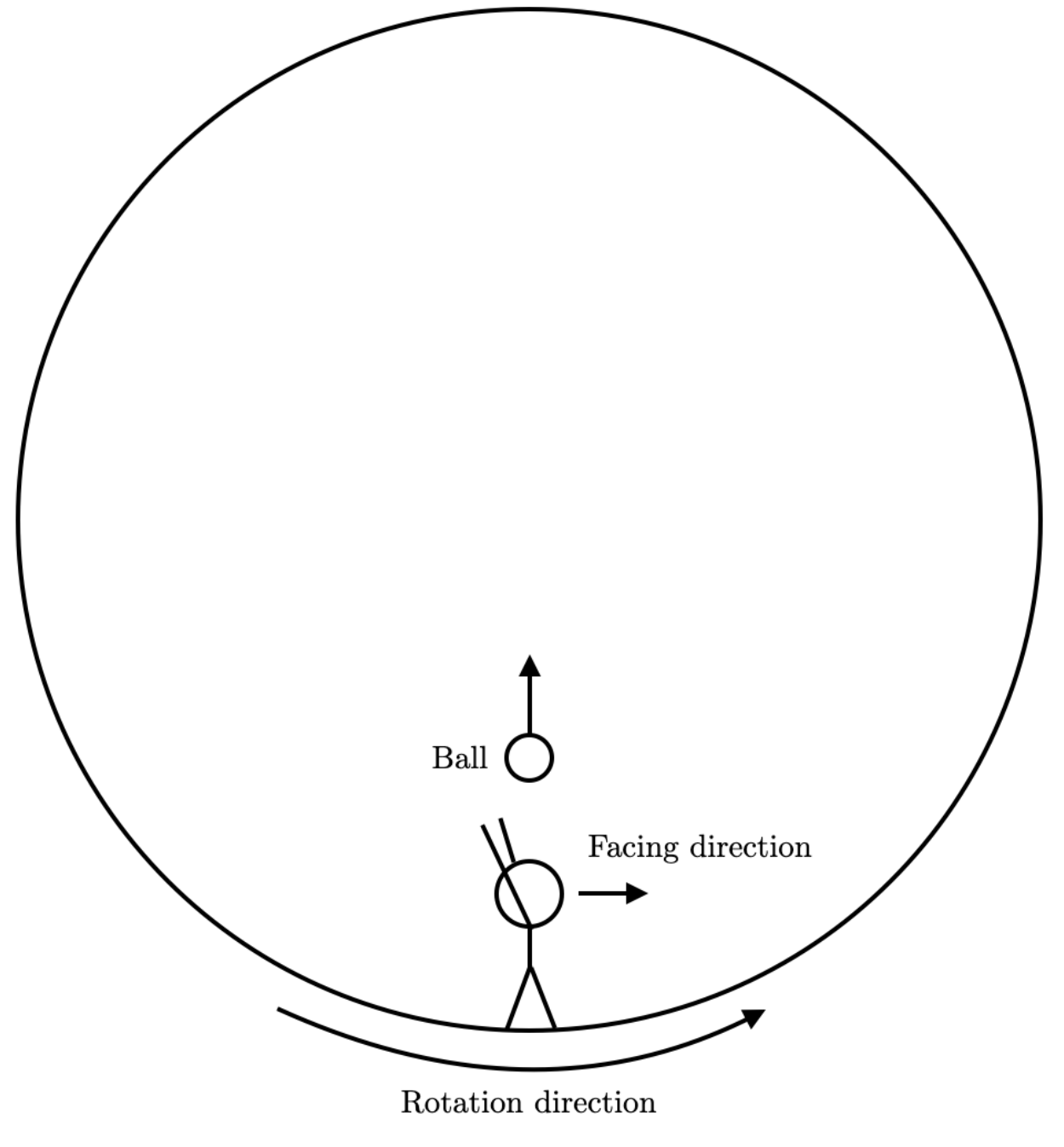
You are standing inside the space station, facing in the direction of the cylinder’s rotation (see image). You throw a ball directly upward. Where does it land?
(a) Right back in your hand
(b) In front of you
(c) Behind you
(d) To your right
(e) To your left
Отговори
- B
Решение
This is just an exercise in carefully using the right-hand rule. It’s helpful to draw a picture.
If you are facing in the direction of the spin, the angular velocity vector points towards your right. For clarity, let’s define a local right-handed coordinate system: the angular velocity vector is in the direction, you are facing in the direction, and the direction is up (towards the center of the cylinder.) Note that we can immediately rule out (d) and (e) due to symmetry considerations: the motion must be confined to the plane.
When the ball is moving upwards (), the Coriolis force is in the direction . Similarly, when the ball is moving back downwards (), this force is in the direction.
The net effect is that the ball gains some velocity component in the direction on the way up, and loses it on the way down. This means its landing position is deflected in the direction, or in front of you.
This problem can also be considered in an inertial reference frame, where you and the station are rotating. The ball’s path from the throwing point to the eventual landing point must follow a chord of the circle (a straight line). However, your own path to the landing point is a circular arc, which is longer. Since you threw the ball in a direction perpendicular to your own velocity vector, its speed must also be greater than yours. Since the ball moves from the throwing point to the landing point along a shorter path and at a higher speed, it certainly gets there before you do. This means it lands in front of you.
Answer: B
Теми и трудност
Оценена трудност: 2/5.
Механика · Неинерциални отправни системи · Момент на импулса
Предпоставки: Гимназиална подготовка, Разширена олимпиадна подготовка
Оригинал в Архива: exam_2025.pdf · официални решения: sol_2025.pdf · допълнителни данни: physical-constants.pdf