USAAAO 2025, I кръг — Задача 6
USAAAO 2025 - First Round · 8 февруари 2025 г.
Внимание: Бележка към темата
All 30 separately numbered original first-round multiple-choice questions and their matching official explanations/answer letters are retained. The printed explanations for Questions 2 and 3 stop before a promised formula; Question 26 refers to a following triangle absent from its native solution page. No missing expression or diagram is reconstructed. Native scientific discrepancies and ambiguous formula notation remain literal and are explicitly attributed in local source notes. A separate two-page common USAAAO archive constants/reference table is included with its own source identity; it is undated in the catalogue, and its use as the exact 2025 attachment is not established. No separate dated instructions, answer sheet or constants companion is present in the 2025 archive folder. No point total or time limit is printed in these two exam booklets.
Original first-round date and writers
USAAAO 2025 - First Round
February 8th, 2025
Writers: Abhay Bestrapalli, Sidhant Chaliha, Ferdinand, Ved Gund, Hagan Hensley, Yehong Jiang, Alexander Li, Joe McCarty, Lucas Carrit Delgado Pinheiro, Sahil Pontula.
Common archive reference — Table of Physical Constants
This separate common USAAAO archive reference is undated in the catalogue. Its use as the exact 2025 exam attachment is not established.
| Quantity | Symbol | Value |
|---|---|---|
| Electron rest mass | ||
| Proton rest mass | ||
| Electronic charge | ||
| Speed of light in free space | ||
| Permeability of free space | ||
| Permittivity of free space | ||
| Planck’s constant | ||
| Reduced Planck’s constant | ||
| Boltzmann’s constant | ||
| Gas constant | ||
| Molar gas constant | ||
| Avogadro’s number | ||
| Standard molar volume | ||
| Unified atomic mass unit ( scale) | ||
| Mass of hydrogen atom | ||
| Bohr magneton | or | |
| Nuclear magneton | or | |
| Proton magnetic moment | ||
| Neutron magnetic moment | ||
| Bohr radius | ||
| Fine structure constant | ||
| Compton wavelength of electron | ||
| Rydberg’s constant | ||
| Stefan-Boltzmann constant | ||
| Radiation density constant | ||
| Gravitational constant |
Rest masses of some leptons and hadrons in :
0.5110, 105.66, 1777, 134.98, 139.57, 493.7, 497.7, 547, 1865, 1869, p 938.3, n 939.6, 1115.7, 1189, 1193, 1197, 1315, 1321, 1672, , .
| Quark | Charge | Mass () | |||||
|---|---|---|---|---|---|---|---|
| u | 0 | 0 | 0 | 0 | |||
| d | 0 | 0 | 0 | 0 | |||
| c | 0 | 0 | +1 | 0 | 0 | ||
| s | 0 | -1 | 0 | 0 | 0 | ||
| t | 0 | 0 | 0 | 0 | +1 | 174.3 | |
| b | 0 | 0 | 0 | -1 | 0 | 4.2 |
Common archive reference — Astrophysical Data and identities
Astrophysical Data
| Quantity | Symbol | Value |
|---|---|---|
| 1 astronomical unit | AU | |
| 1 parsec | pc | |
| Luminosity of Sun | ||
| Mass of Sun | ||
| Radius of Sun | ||
| Mass of Earth | ||
| Radius of Earth |
Other data and conversion factors
| Quantity | Symbol | Value |
|---|---|---|
| 1 ångstrom | Å | |
| 1 fermi | fm | |
| 1 barn | b | |
| 1 pascal | Pa | |
| 1 standard atmosphere | ||
| Standard acceleration due to gravity | ||
| 1 electron volt | eV | |
| Wavelength of 1 eV photon |
Trigonometrical identities
In a triangle ABC,
and
Prefixes
| Prefix | Name | Factor |
|---|---|---|
| T | tera | |
| G | giga | |
| M | mega | |
| k | kilo | |
| c | centi | |
| m | milli | |
| micro | ||
| n | nano | |
| p | pico | |
| f | femto |
Source note: The common table prints and . The 2025 question14/key15 use 9.81 and key7 uses 6371 km; those original exam values are preserved separately.
Условие
Galileo the Tyrant has conquered the Earth. In his madness, he launched many bright satellites into space because he thought that the celestial equator should be visible from Earth, and not just be an imaginary line. These satellites all orbit around Earth from the surface, where is the radius of earth.
However, there was a major mistake made in the plan – the satellites now orbit in a circle on Earth’s orbital plane instead of directly above the equator. Nevertheless, Galileo still forces all astronomers to use these satellites as the new Celestial Equator. They must calculate the declination for any star by finding the angle to the satellite at the same Right Ascension. What is the maximum absolute difference between the new declination and the old declination of bodies throughout the sky experienced by astronomers around the Earth? (Choose the closest value.)
(a)
(b)
(c)
(d)
(e)
Отговори
- A
Решение
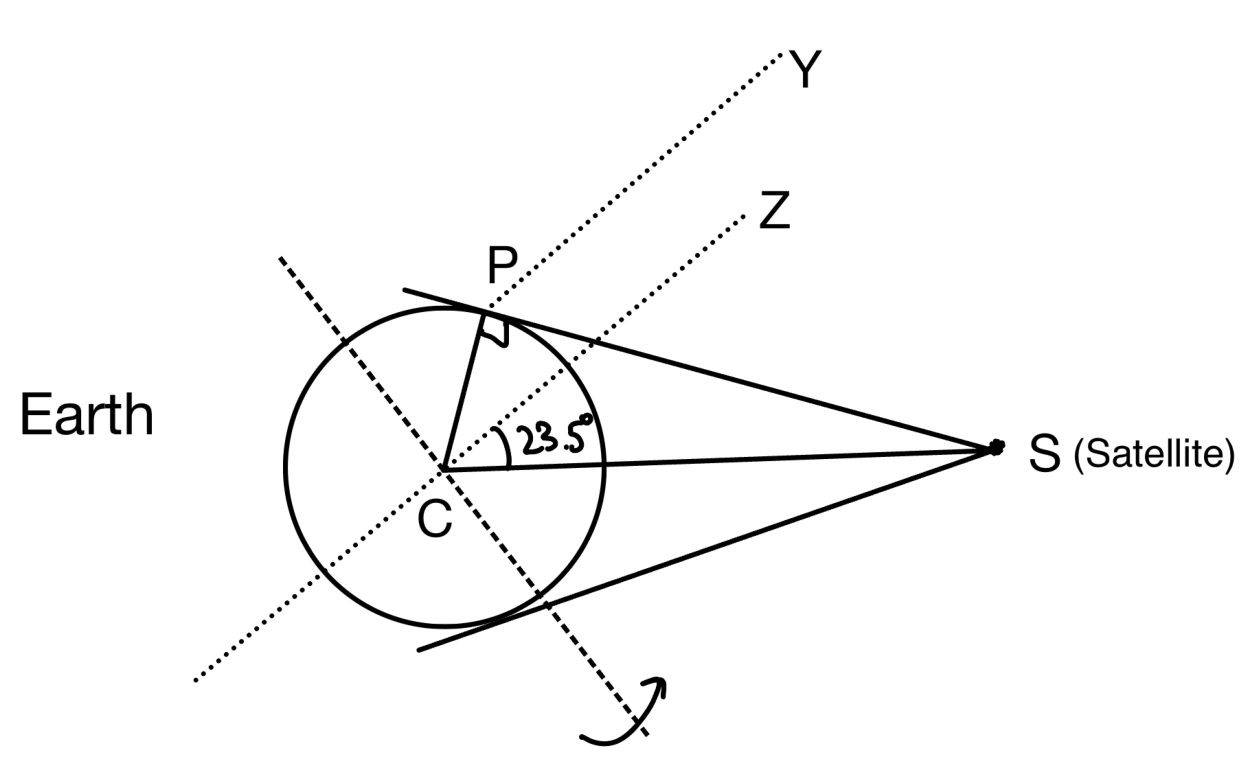
The difference in new and old declination for any body is the same as the angle between the old (or actual) celestial equator and the band of satellites for any location on Earth. However, the location of the satellites in the celestial sphere will change depending on the location on Earth because they are only a finite distance away, i.e. parallax.
Any location on the Celestial Equator is seen to be parallel to line CZ in the figure (since the projection of the night sky is considered to be at ’infinity’ not a mere away) from anywhere on Earth. That is, if an astronomer at any place on Earth is looking at the Celestial Equator, their sight will be parallel to CZ, e.g. PY.
However, the direction of the satellites in the sky that different parts of the Earth perceive will be different. Some examples of these lines of sight are PS and CS in the figure. The minimum and maximum values can be found using tangents to the Earth as shown. Notably the orbital plane, which the satellites are on, is 23.5 degrees off from the celestial equator (the angle between CS and CZ is ).
The maximum angle that we want is .
Here, is the maximum angle for the satellites with reference to the orbital plane and is . Note CS is measured from the center of Earth, and is equal to . So, this value is around 14.5 degrees. Thus the max difference is degrees.
Answer: A
Теми и трудност
Оценена трудност: 3/5.
Небесна сфера и сферична астрономия · Небесни координати · Небесна сфера
Предпоставки: Гимназиална подготовка, Разширена олимпиадна подготовка
Оригинал в Архива: exam_2025.pdf · официални решения: sol_2025.pdf · допълнителни данни: physical-constants.pdf