USAAAO 2026, I кръг — Задача 4
USAAAO 2026 - First Round · 9 февруари 2026 г.
Problem writers
Problem writers: Srihari (Hari) Balaji, Vincent Bian, Ferdinand, Hagan Hensley, Elizabeth Lee, Joe McCarty, Lucas Pinheiro, Feodor Yevtushenko
Условие
The following figure is used for questions 4, 5, and 6.
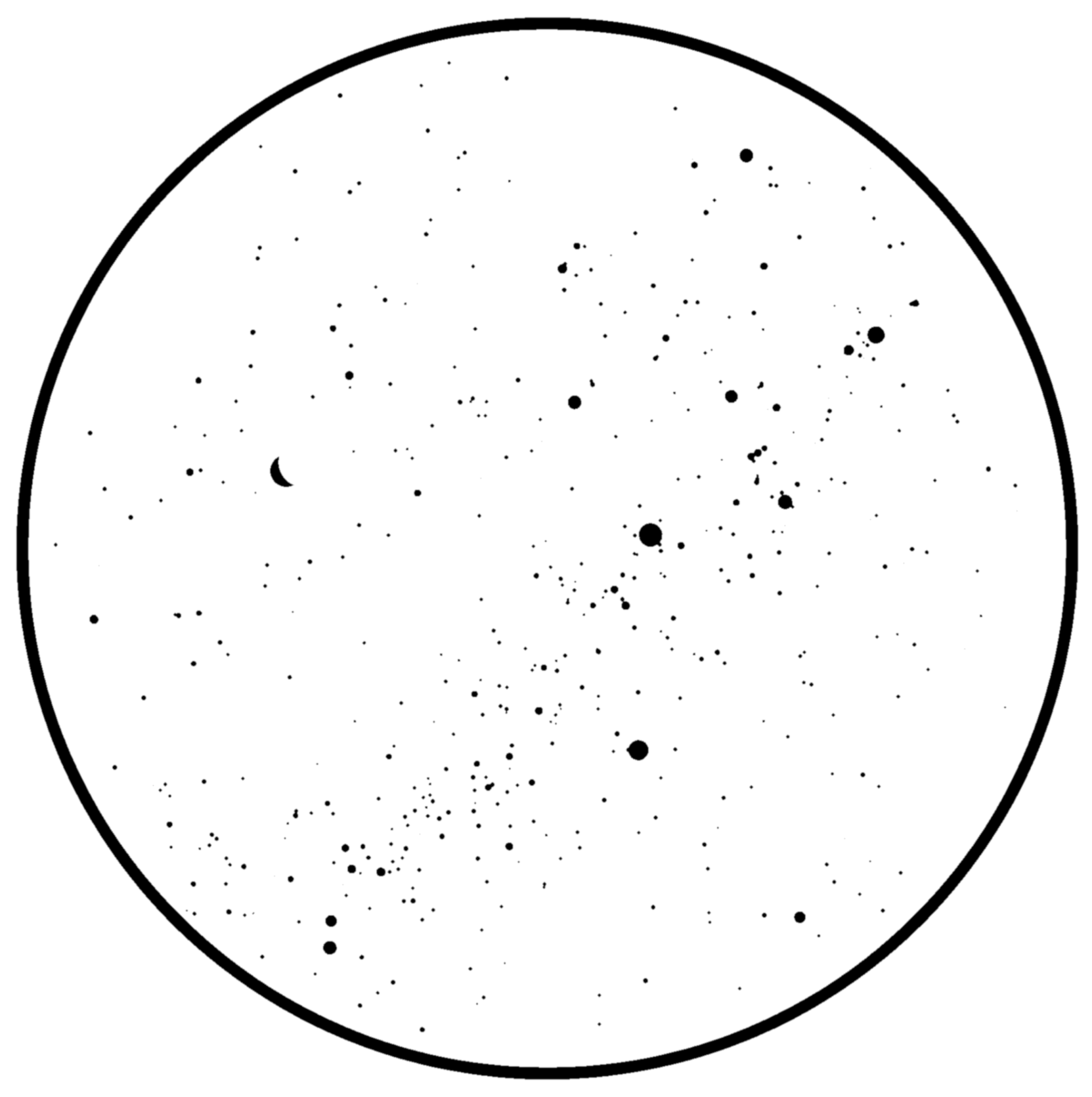
You are stranded on a remote island somewhere on Earth, at an unknown date and time (in the century). You look up and see the night sky.
(For avoidance of doubt, the illuminated side of the Moon is on the left.)
Which of the following is the best estimate of your latitude?
(a) N
(b) N
(c)
(d) S
(e) S
Отговори
- D
Решение
Solution: There are many ways to solve this, depending on your familiarity with various parts of the night sky.
From the orientation of familiar constellations such as Orion and Canis Major, we can see that north is oriented up on the image. Since Polaris is not visible and Orion (which lies on the celestial equator) is in the northern half of the sky, we can conclude that we are in the southern hemisphere.
Since the Southern Cross points towards the south celestial pole, the south celestial pole must lie at the intersection between the meridian and the line made by the Southern Cross. This is very close to the horizon, so S is a better estimate than S. (You can measure this with a ruler if you want to be careful.) You could also have used the fact that Canis Major is nearly directly overhead.
Answer: D
Оригинал в Архива: usaaao_first_exam_2026.pdf · официални решения: usaaao_first_exam_solutions_2026.pdf