USAAAO 2026, II кръг — Задача 3. Sky Map Attack!
2026 National Astronomy Competition · 15 т.
Внимание: Бележка към темата
Questions 3 and 9 refer to designated answer sheets, and question 6 to provided grid paper; these sheets were not obtained in the two native 2026-II PDFs or their two-row same-folder archive catalogue. The separately attributed physical-constants.pdf is an undated common USAAAO archive reference; its identity as the table supplied for this exam is unproven.
Instructions (Please Read Carefully)
2026 National Astronomy Competition
1 Instructions (Please Read Carefully)
The top 15 eligible scorers on the NAC will be invited to the training camp. A third round will be conducted during the camp to select the national team for the IOAA 2026. In order to qualify for camp, you must be a high school student with US citizenship or permanent residency.
The test must be completed within 2.5 hours (150 minutes) and the maximum number of points is 300 points. The point breakdown per problem is as follows.
| Problem | P1 | P2 | P3 | P4 | P5 | P6 | P7 | P8 | P9 | Total |
|---|---|---|---|---|---|---|---|---|---|---|
| Points | 10 | 15 | 15 | 20 | 20 | 40 | 40 | 55 | 85 | 300 |
Please solve each problem on a blank piece of paper and mark the number of the problem at the top of the page. Some problems may require a designated answer sheet; these will be provided. The contestant’s full name in capital letters should appear at the top of each solution page. If the contestant uses scratch papers, those should be labeled with the contestant’s name as well and marked as “scratch paper” at the top of the page. Scratch paper will not be graded. Partial credit will be available given that correct and legible work was displayed in the solution.
This is a written exam. Contestants can only use a scientific calculator (non-programmable and non-graphing) for this exam. A table of physical constants will be provided. Discussing the problems with other people is strictly prohibited in any way until the end of the examination period on April 20, 2026. Receiving any external help during the exam is strictly prohibited. This means that the only allowed items are: a calculator, the provided table of constants, a pencil (or pen), an eraser, blank sheets of papers, and the exam. No books or notes are allowed during the exam. Students must be proctored during the entire duration of the exam.
This exam sheet and your answer sheets (including scratch papers) should be returned to your proctors once the exam ended. Your proctors should upload your answer sheets to the Google Form provided to them.
We acknowledge the following people for their contributions to this year’s exam:
Srihari (Hari) Balaji, Feodor Yevtushenko, Ferdinand, Hagan Hensley, Joe McCarty, Lucas Pinheiro, Vincent Bian, Elizabeth Lee
After reading the instructions, please make sure to sign, affirming that:
- All work on this exam has been completed by me.
- I took this exam under the supervision of a proctor.
- I did not receive any external help beyond the materials provided.
- I will not discuss the contents of this exam with anyone until April 20, 2026.
- Failure to follow these rules will result in disqualification from the exam.
Student Signature: ____________________ Date: ____________________
Undated common archive reference · Table of Physical Constants
Table of Physical Constants
| Quantity | Symbol | Value |
|---|---|---|
| Electron rest mass | ||
| Proton rest mass | ||
| Electronic charge | ||
| Speed of light in free space | ||
| Permeability of free space | ||
| Permittivity of free space | ||
| Planck’s constant | ||
| Reduced Planck’s constant | ||
| Boltzmann’s constant | ||
| Gas constant | ||
| Molar gas constant | ||
| Avogadro’s number | ||
| Standard molar volume | ||
| Unified atomic mass unit ( scale) | ||
| Mass of hydrogen atom | ||
| Bohr magneton | or | |
| Nuclear magneton | or | |
| Proton magnetic moment | ||
| Neutron magnetic moment | ||
| Bohr radius | ||
| Fine structure constant | ||
| Compton wavelength of electron | ||
| Rydberg’s constant | ||
| Stefan-Boltzmann constant | ||
| Radiation density constant | ||
| Gravitational constant |
Rest masses of some leptons and hadrons in :
0.5110, 105.66, 1777, 134.98, 139.57, 493.7, 497.7, 547, 1865, 1869, p 938.3, n 939.6, 1115.7, 1189, 1193, 1197, 1315, 1321, 1672, , .
| Quark | Charge | Mass () | |||||
|---|---|---|---|---|---|---|---|
| u | 0 | 0 | 0 | 0 | |||
| d | 0 | 0 | 0 | 0 | |||
| c | 0 | 0 | +1 | 0 | 0 | ||
| s | 0 | -1 | 0 | 0 | 0 | ||
| t | 0 | 0 | 0 | 0 | +1 | 174.3 | |
| b | 0 | 0 | 0 | -1 | 0 | 4.2 |
Undated common archive reference · Astrophysical Data and Conversion Factors
Astrophysical Data
| Quantity | Symbol | Value |
|---|---|---|
| 1 astronomical unit | AU | |
| 1 parsec | pc | |
| Luminosity of Sun | ||
| Mass of Sun | ||
| Radius of Sun | ||
| Mass of Earth | ||
| Radius of Earth |
Other data and conversion factors
| Quantity | Symbol | Value |
|---|---|---|
| 1 ångstrom | Å | |
| 1 fermi | fm | |
| 1 barn | b | |
| 1 pascal | Pa | |
| 1 standard atmosphere | ||
| Standard acceleration due to gravity | ||
| 1 electron volt | eV | |
| Wavelength of 1 eV photon |
Trigonometrical identities
In a triangle ABC,
and
Prefixes
| T = tera = | c = centi = |
| G = giga = | m = milli = |
| M = mega = | = micro = |
| k = kilo = | n = nano = |
| p = pico = | |
| f = femto = |
Условие
Please answer this question in the provided Question 3 Answer Sheet
Before IOAA 2026, you and your friends decided to go on vacation to a deserted island. One night, you looked up at the sky and it looked like the image below:
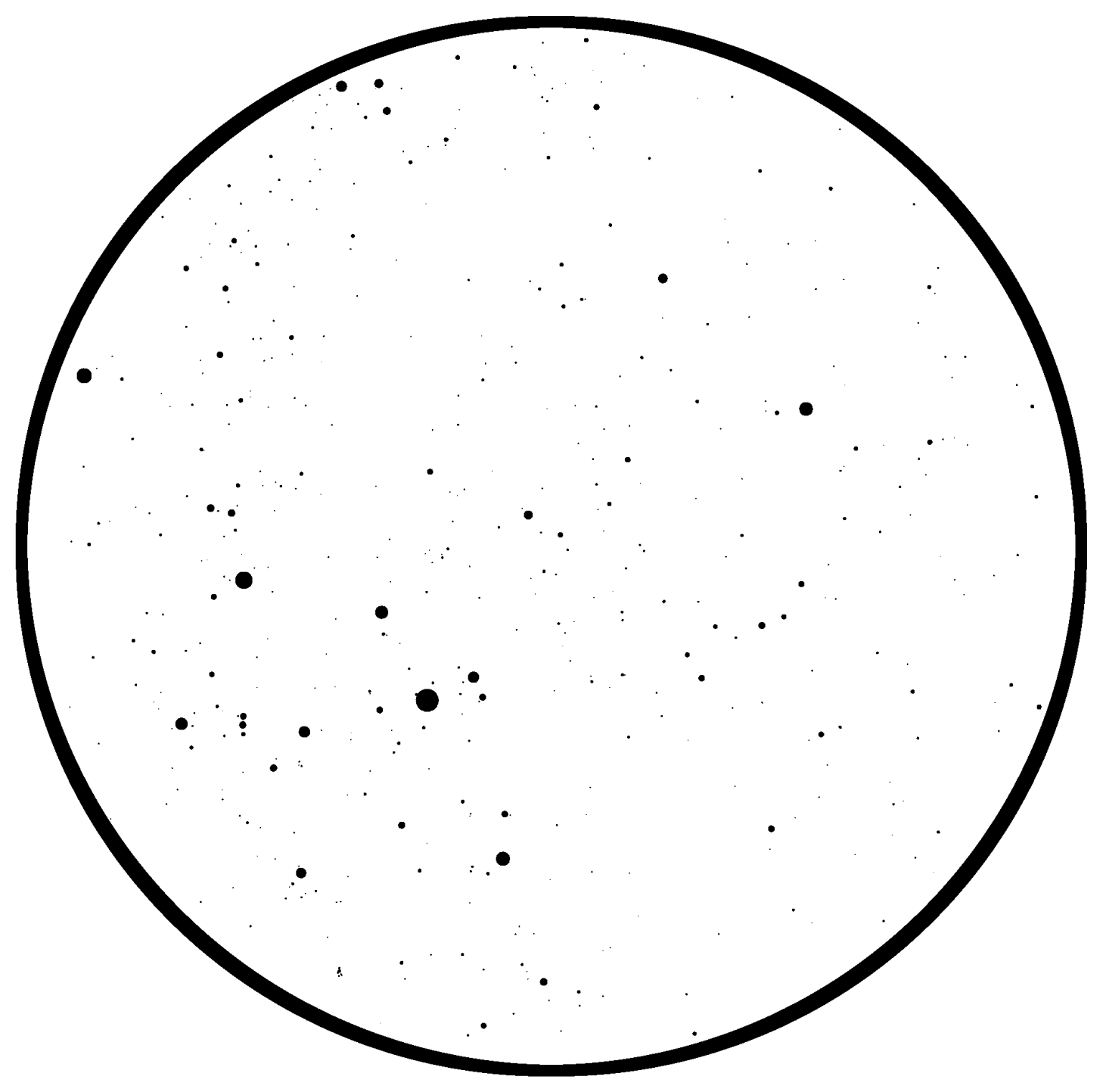
As the sky was bright, you and your friends gave each other quizzes about the sky.
(a) (3 points) What is the estimated latitude of the island?
Hint: The all sky map above is a stereographic projection, which means the zenith distance would follow: , where is the distance of an object to the center of the map and is the radius of the all sky map.
(b) (2 points) Mark and label the cardinal directions: North, East, South, and West.
(c) (2 points) Draw and label the celestial equator.
(d) (2 points) Draw and label the ecliptic.
(e) (3 points) Mark and label (North/South) the available Celestial, Ecliptic, and Galactic Poles.
(f) (1.5 points) Are there any planets seen in the sky? If yes, mark and label the planets.
(g) (1.5 points) Circle and label the Pleiades (M45).
Решение
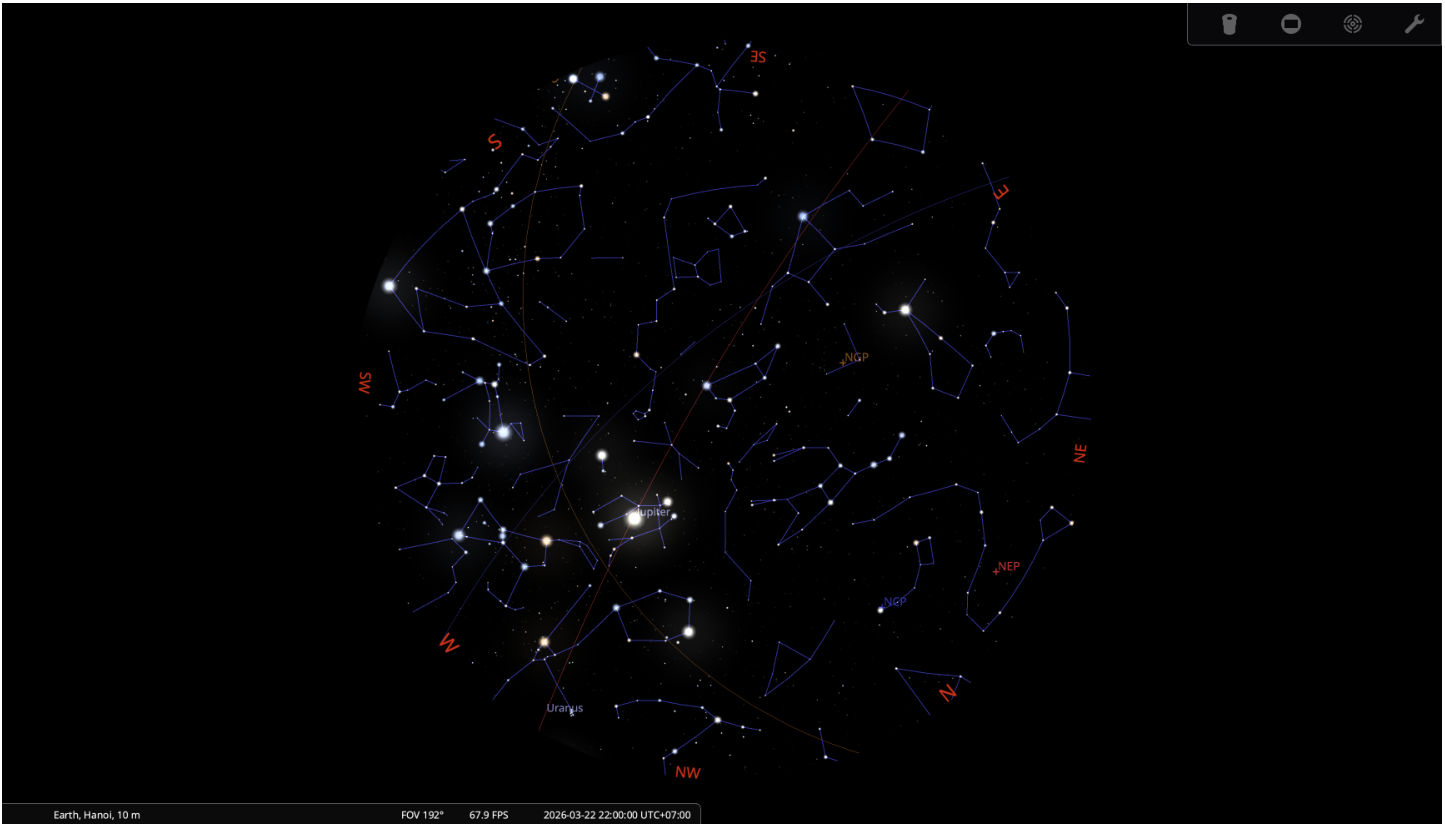
Solution: Please refer to these two images below for the sky map. The first image is the inverted image, while the second image is the screenshot from Stellarium.
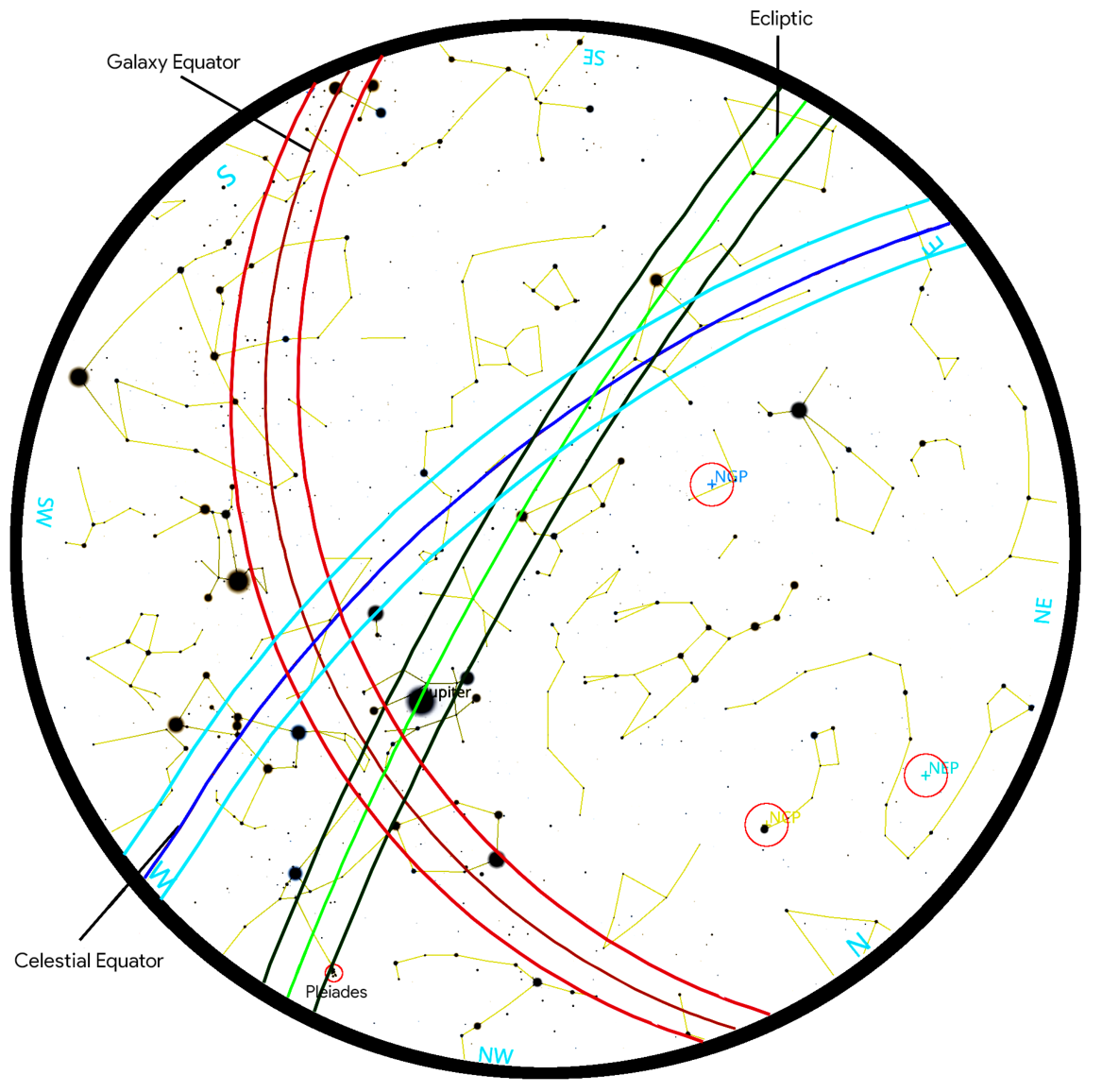
(a) In the sky image, we can see that there is the big dipper and polaris, which means it is in the northern hemisphere. The Polaris altitude is around and the distance to the center of the sky is around . So, using the zenith distance formula from the hint, we get the latitude . In this subpart, a gets the full 3 points; a or gets 1.5 points; and outside that range gets no points. If you didn’t write your thoughts, you’d only get 1 point if it’s within .
Note: As you can see in the Stellarium image, the sky map was actually taken in Hanoi, Vietnam. Hence, the true latitude is around .
(b) Marked and labeled in the sky map images. Each cardinal point is 0.5 point.
(c) Drawn and labeled in the sky map images. As long as it’s within the range drawn out in the map, get full 2 points.
(d) Drawn and labeled in the sky map images. As long as it’s within the range drawn out in the map, get full 2 points.
(e) Marked and labeled in the sky map images. As long as the positions are within the red circles, get full points; each pole is one point.
(f) There is only one planet: Jupiter. It’s also marked and labeled in the sky map images. 1 points for marked correctly, 0.5 points for label Jupiter correctly. 0 points if marked/labeled more than 1 planet.t
(g) Circled and labeled in the inverted sky map. Either full 1.5 points if marked correctly or zero.
Оригинал в Архива: usaaao2026.pdf · официални решения: usaaao2026_sol.pdf · допълнителни данни: physical-constants.pdf