USAAAO 2026, III кръг — Задача 2. Travelers in Outer Space
2026 USAAAO Third Exam (Data Analysis + Observation) · 75 т.
Instructions (Please Read Carefully)
The test must be completed within 2 hours (120 minutes) and the maximum number of points is 230 points. The point breakdown per problem is as follows.
| Problem | P1 | P2 | P3 | P4 | Total |
|---|---|---|---|---|---|
| Points | 55 | 75 | 46 | 54 | 230 |
Please solve each problem on a blank piece of paper and mark the number of the problem at the top of the page. Some problems may require a designated answer sheet; these will be provided. The contestant's full name in capital letters should appear at the top of each solution page. If the contestant uses scratch papers, those should be labeled with the contestant's name as well and marked as “scratch paper” at the top of the page. Scratch paper will not be graded. Partial credit will be available given that correct and legible work was displayed in the solution.
This is a written exam. Contestants can only use a scientific calculator (non-programmable and non-graphing) for this exam. A table of physical constants will be provided. Discussing the problems with other people is strictly prohibited in any way until the end of the examination period on June 25, 2026. Receiving any external help during the exam is strictly prohibited. This means that the only allowed items are: a calculator, the provided table of constants, a pencil (or pen), an eraser, blank sheets of papers, and the exam. No books or notes are allowed during the exam. Students must be proctored during the entire duration of the exam.
This exam sheet and your answer sheets (including scratch papers) should be returned to your proctors once the exam ended. Your proctors should upload your answer sheets to the Google Form provided to them.
We acknowledge the following people for their contributions to this year's practical exam:
Ferdinand, Vincent Bian
After reading the instructions, please make sure to sign, affirming that:
- All work on this exam has been completed by me.
- I took this exam under the supervision of a proctor.
- I did not receive any external help beyond the materials provided.
- I will not discuss the contents of this exam with anyone until June 24, 2026.
- Failure to follow these rules will result in disqualification from the exam.
Student Signature: ____________ Date: ____________
Условие
Esker, Chert, and Gabbro are traveling in a spaceship in the Solar System when their spaceship explodes! Fortunately, everyone makes it to an escape pod in time and escapes safely, but they end up all scattered in different locations.
Note: For all questions asking you to compute a numerical answer from the data provided, include the uncertainty in your answer.
(a)(i) (25 points total) Esker's escape pod ends up in orbit around some planet in the Solar System. They gaze longingly at Earth through a telescope, and every day they measure the apparent angular diameter of the Earth. Unfortunately, they don't have any precise instruments, so they can only measure the relative angular size of the Earth. You may assume that the absolute angular size of Earth is small. The following is a table of the relative size over time. The uncertainty in each measurement is 0.05.
Table 2: Apparent relative angular diameter of Earth as seen from Esker's pod (arbitrary units)
| Day | Rel. size | Day | Rel. size | Day | Rel. size |
|---|---|---|---|---|---|
| 0 | 0.87 | 440 | 3.99 | 930 | 1.46 |
| 63 | 0.78 | 462 | 3.26 | 989 | 2.68 |
| 112 | 0.59 | 478 | 2.57 | 1004 | 3.34 |
| 169 | 0.77 | 543 | 1.28 | 1030 | 4.02 |
| 219 | 0.72 | 592 | 0.96 | 1045 | 3.54 |
| 284 | 0.87 | 653 | 0.96 | 1062 | 2.74 |
| 325 | 1.04 | 700 | 0.64 | 1079 | 2.12 |
| 392 | 2.35 | 756 | 0.62 | 1144 | 1.02 |
| 402 | 2.58 | 824 | 0.69 | 1190 | 0.87 |
| 418 | 3.33 | 869 | 0.98 | 1249 | 0.73 |
Let be the closest distance between Earth and Esker, and let be the farthest distance. What is the ratio ? [5 т.]
(a)(ii) What is the period of Esker's motion relative to the Earth? [10 т.]
(a)(iii) What is the radius of Esker's orbit around the sun? Where is Esker? [10 т.]
(b)(i) (25 points total) Chert's escape pod lands on a rocky body in the Solar System, and they can't find Earth! Fortunately, they have a very accurate telescope, a star-chart computer, and a gyroscope that locks their coordinate frame to Earth's equatorial axes.
Chert measures the RA and declination of many bright stars and compares each measurement to the catalog value from Earth at the same date. The resulting angular offsets measured in milli-arcseconds, caused by the parallax of Chert's location relative to Earth, are listed below in Table 3 along with each star's distance. The uncertainty in each measurement is 0.001 mas (it is a very precise telescope).
Table 3: Chert's stellar parallax measurements
| Star | Day | (mas) | (ly) | Star | Day | (mas) | (ly) |
|---|---|---|---|---|---|---|---|
| Aldebaran | 0 | 0.123 | 65 | Dschubba | 15 | 0.020 | 402 |
| Tianguan | 2 | 0.020 | 417 | Tania | 15 | 0.024 | 249 |
| Furud | 2 | 0.025 | 336 | Chertan | 16 | 0.020 | 178 |
| Mirach | 3 | 0.019 | 199 | Shaula | 17 | 0.009 | 703 |
| Ankaa | 4 | 0.096 | 77 | Ascella | 17 | 0.098 | 89 |
| Fawaris | 4 | 0.046 | 171 | Seginus | 18 | 0.081 | 85 |
| Scheat | 4 | 0.030 | 199 | Hadar | 22 | 0.013 | 525 |
| Fulu | 5 | 0.011 | 597 | Porrima | 22 | 0.205 | 39 |
| Menkalinan | 5 | 0.066 | 82 | Izar | 22 | 0.038 | 210 |
| Alkaphrah | 7 | 0.015 | 423 | Unukalhai | 22 | 0.074 | 73 |
| Zosma | 8 | 0.139 | 58 | Matar | 23 | 0.037 | 215 |
| Meissa | 9 | 0.005 | 1056 | Sargas | 23 | 0.010 | 272 |
| Aludra | 9 | 0.003 | 3198 | Kitalpha | 24 | 0.030 | 186 |
| Gomeisa | 11 | 0.022 | 170 | Dalim | 25 | 0.172 | 46 |
| Cor | 12 | 0.059 | 110 | Azha | 26 | 0.058 | 133 |
Ignore aberration caused by orbital motion.
Suppose Chert is a distance from Earth, and measuring the apparent location of a star which is a distance from Earth (you may assume ). What are the possible values Chert might get for the angular distance between the apparent positions for that star on Earth vs at Chert's location? [5 т.]
(b)(ii) Plot vs . Using this plot, determine how far Chert is from the Earth. [12 т.]
(b)(iii) Why do more of the data points lie closer to the maximum possible angular displacement than the minimum possible angular displacement? [3 т.]
(b)(iv) Where is Chert, and why might Earth not be visible from their location? [5 т.]
(c) Gabbro's escape pod somehow ends up in orbit around another star! Just like Chert, they have a telescope, a star-chart computer, and a gyroscope that locks their coordinate frame to Earth's equatorial axes.
They measure the right ascension and declination of a few known stars and compare it to the equatorial coordinates of those stars when observed from Earth.
Table 4: Apparent positions of stars as seen from Earth and from Gabbro's pod
| Star | RA (Earth) | Dec (Earth) | RA (Gabbro) | Dec (Gabbro) | Dist (ly) |
|---|---|---|---|---|---|
| Nekkar | 219 | ||||
| Dubhe | 124 | ||||
| Tania Australis | 134 | ||||
| Ruchbah | 99 | ||||
| Capella | 43 | ||||
| Muscida | 184 | ||||
| Polaris | 431 | ||||
| Tania Borealis | 249 | ||||
| Algol | 93 | ||||
| Menkalinan | 82 | ||||
| Mirach | 199 | ||||
| Grumium | 111 | ||||
| Schedar | 229 |
Where is Gabbro?
You are provided with an answer sheet with a gnomonic projection of the celestial sphere.
Hint: lines in a gnomonic projection correspond to great circles on the sphere [25 т.]
Отговори
(a)(i) 6.8
Official answer 6.8 ± 0.6; any uncertainty in the printed range is accepted.
(a)(ii) 590 days
Official answer 590 ± 30 days (any uncertainty from 10 to 50 days is reasonable).
(a)(iii) About 0.73 AU — the orbit of Venus.
The official solution calls the traveller Chert in this part although the problem refers to Esker.
(b)(i)
(b)(ii) m
Official answer (4.0 ± 0.1) × 10⁸ m, from a slope r = 8.7 ± 0.3 mas·ly.
(b)(iv) On the far side of the Moon (about 4 × 10⁸ m from Earth; the Moon is tidally locked to the Earth).
(c) Near Capella (all great-circle displacement lines intersect at Capella).
Решение
Solution:
(a) (i) (5 points) To get a sense of the motion, we need to make a plot such as the one in Figure 1, and draw a trend line. Note that the line in Figure 1 shows the true value, based on real astronomical data.
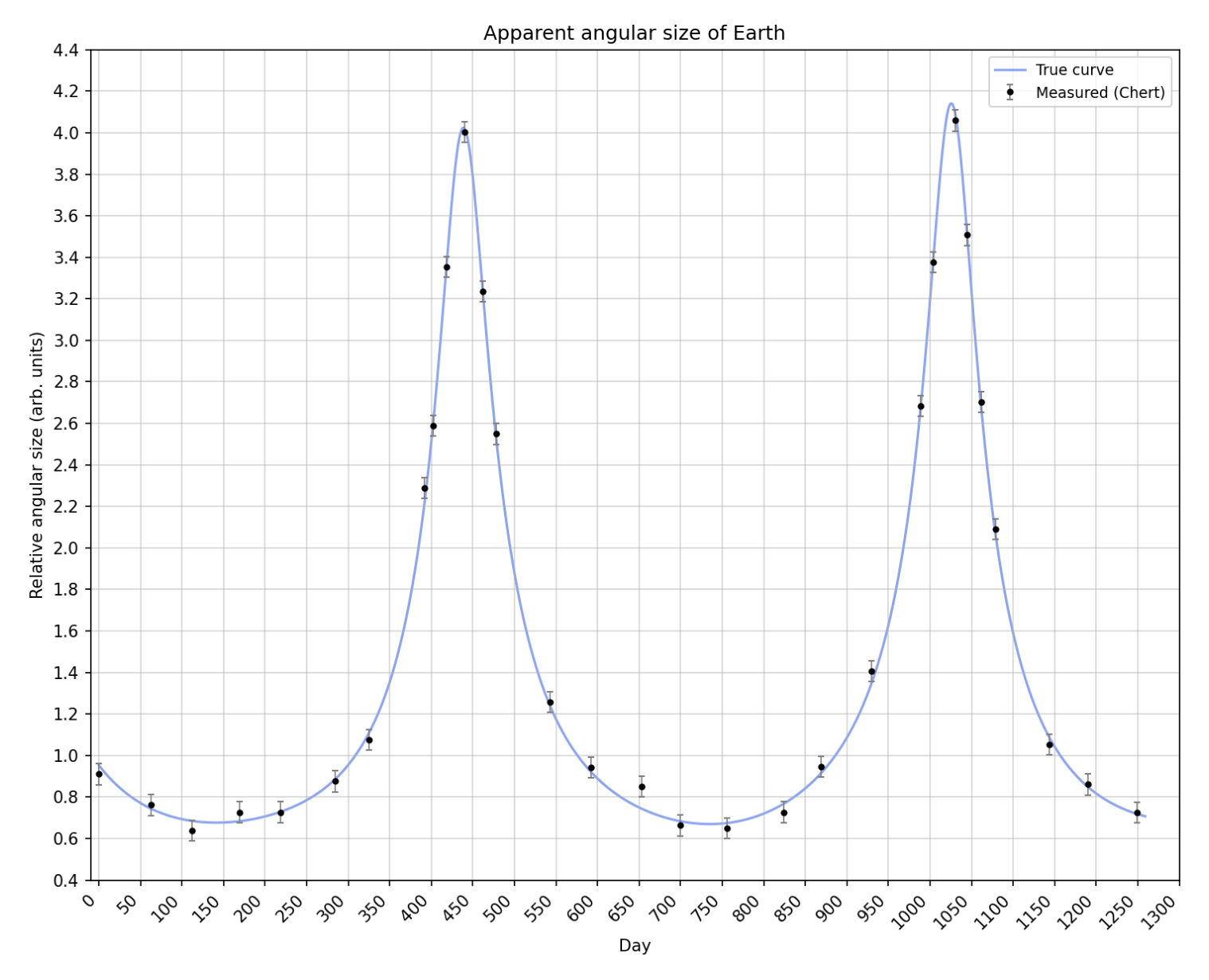
From drawing a best fit line, the peak seems to be around and the lowest looks to be around .
This gives a ratio of . The relative uncertainty in the quotient is , meaning that the ratio with uncertainty would be . This is also the answer one arrives at by reading off the largest and smallest values from the table, which is also acceptable for this part.
Any uncertainty in the range 0.4 to 0.12 would be acceptable, as determining the uncertainty from the graph would be subjective.
(ii) (10 points)
From the plot, we see that the peaks on days 440 and 1030 are close to the true peaks. We can estimate the period to be days (any uncertainty from 10 to 50 days is reasonable).
(iii) (10 points) We first consider the result of part (a)(i). Suppose Chert is orbiting at a distance of AU from the sun. The farthest distance from the Earth is , and the nearest distance from the Earth is either or , depending on whether .
If we assume , the equation becomes , (using the upper bound of the range of uncertainty) which gives . If , the equation is , which gives . The uncertainties in this part of the solution were computed by solving the equation using the upper and lower bounds of .
From (a)(ii), the synodic period of Chert's orbit with Earth is days (using the upper range of acceptable uncertainties). If the sidereal period of Chert's orbit is days, then either , or , depending on whether .
Solving these equations for , we get that is either days or days. By Kepler's 3rd law, these correspond to orbits of radius AU and AU.
The only orbital radius consistent with both parts would be about 0.73 AU, which corresponds to the orbit of .
(b) (i) (5 points) Let the location of the Earth be , the location of the star be , and the location of Esker be .
The angular displacement observed by Esker is equal to the measure of . Using the law of sines, .
We then use the following:
- (from the problem statement)
- (using a small angle approximation)
- (because )
Then, we get .
Because ranges from 0 to 1, we get that .
(ii) (12 points) If we plot the angular displacement vs , we have from part (b)(i) that all the points should lie below a line of slope . If we make this plot and draw a line as in Figure 2, the points seem to lie below a line of slope mas/ly.
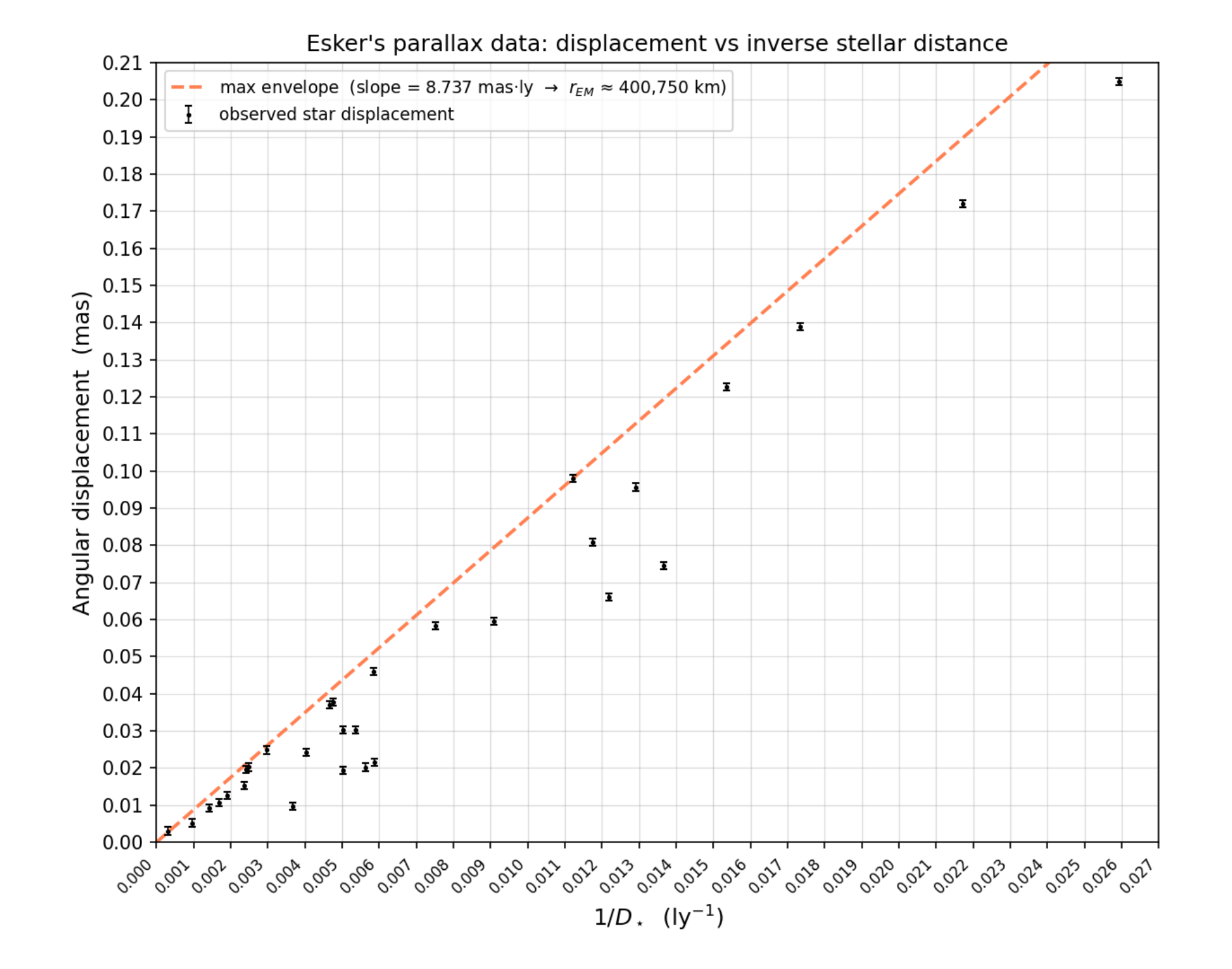
Some uncertainty comes from the chance that there aren't any stars with the exact maximum parallax, so any estimate of the uncertainty from 0.1 to 0.5 is reasonable.
Converting mas into radians, we get that
(iii) (3 points) As in part (b)(i), let the location of the Earth be , the location of the star be , and the location of Esker be . Suppose that is a random direction on the celestial sphere. is smaller when is closer to the poles. Since more of the area of a sphere lies away from the poles, larger values of , and thus larger values of relative to the maximum value, are more likely. Figure 3 shows a visualization of this effect.
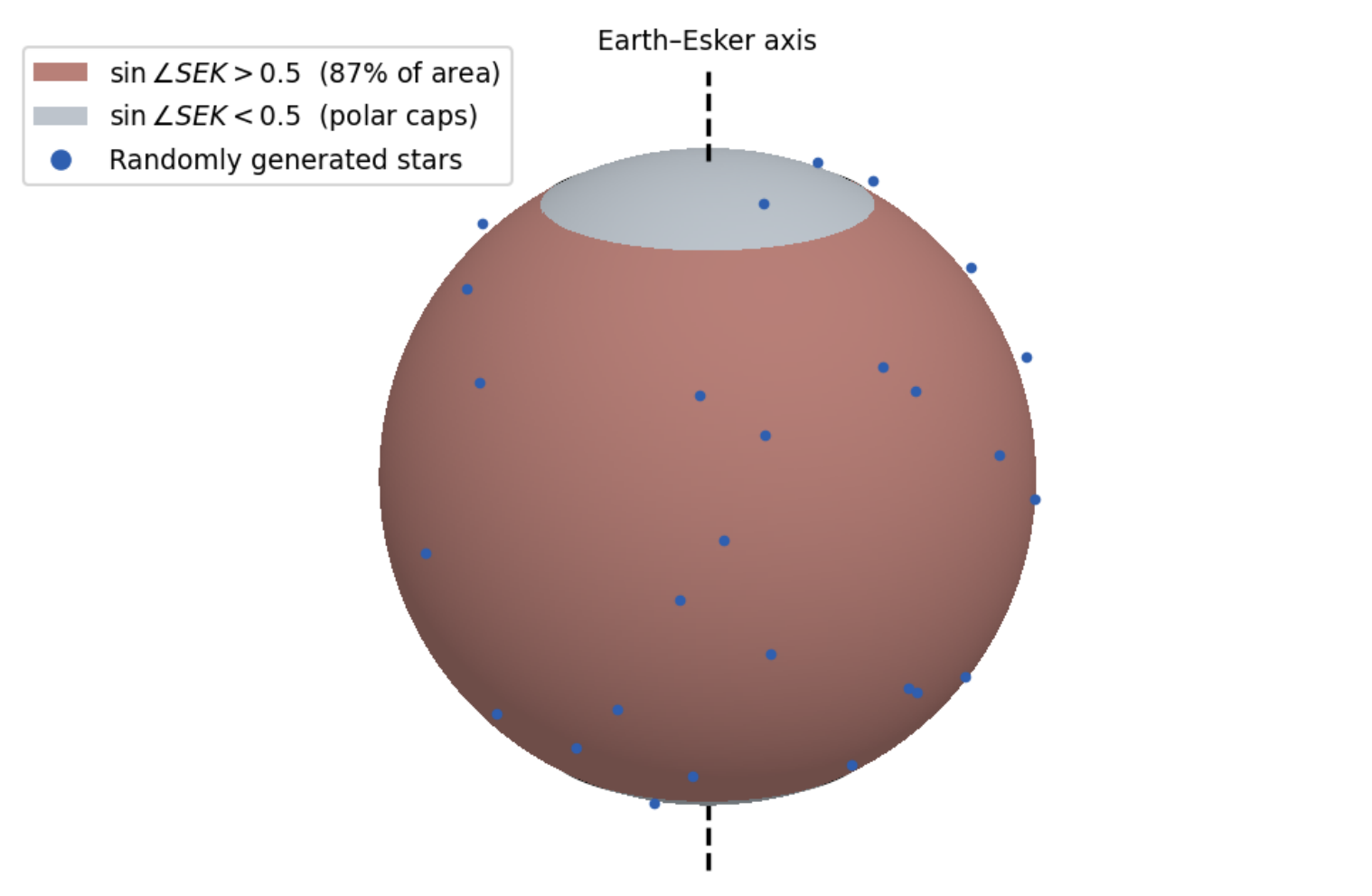
Any explanation mentioning either the fact that is likely to be close to , or that the distribution of for is biased towards larger values, should get full credit.
(iv) (5 points) From part (b)(ii), Esker is around m from the Earth, which should be recognizable as being around the Earth-Moon distance.
Since the Moon is tidally locked to the Earth, the reason Esker never sees Earth could be that they are on .
(c) (25 points) Let be the (unknown) apparent location of Gabbro on the celestial sphere as viewed from Earth. For a given star, let be the apparent location of that star from Earth, and be the apparent location of that star from Gabbro's location. The key insight is that , , and all lie on a great circle.
One way to prove this assertion is to consider the locations of Earth, Gabbro, and the star in 3D space. Let be the position of the Earth in 3D space, let be Gabbros' position, and let be the star's location.
Then, the direction of on the celestial sphere is the direction of the vector . Similarly, corresponds to the direction of , and corresponds to . Note that all three of these vectors lie within the plane passing through , , and . This means that the direction of those vectors lie on the plane passing through the origin, parallel to this plane. Since the intersection of a sphere and a plane passing through its center is a great circle, this concludes the proof.
Thus, we can plot the position of a few stars from Earth's perspective and from Gabbro's perspective on a gnomonic projection, draw the line connecting them, and see where they all intersect. This is shown in Figure 4.
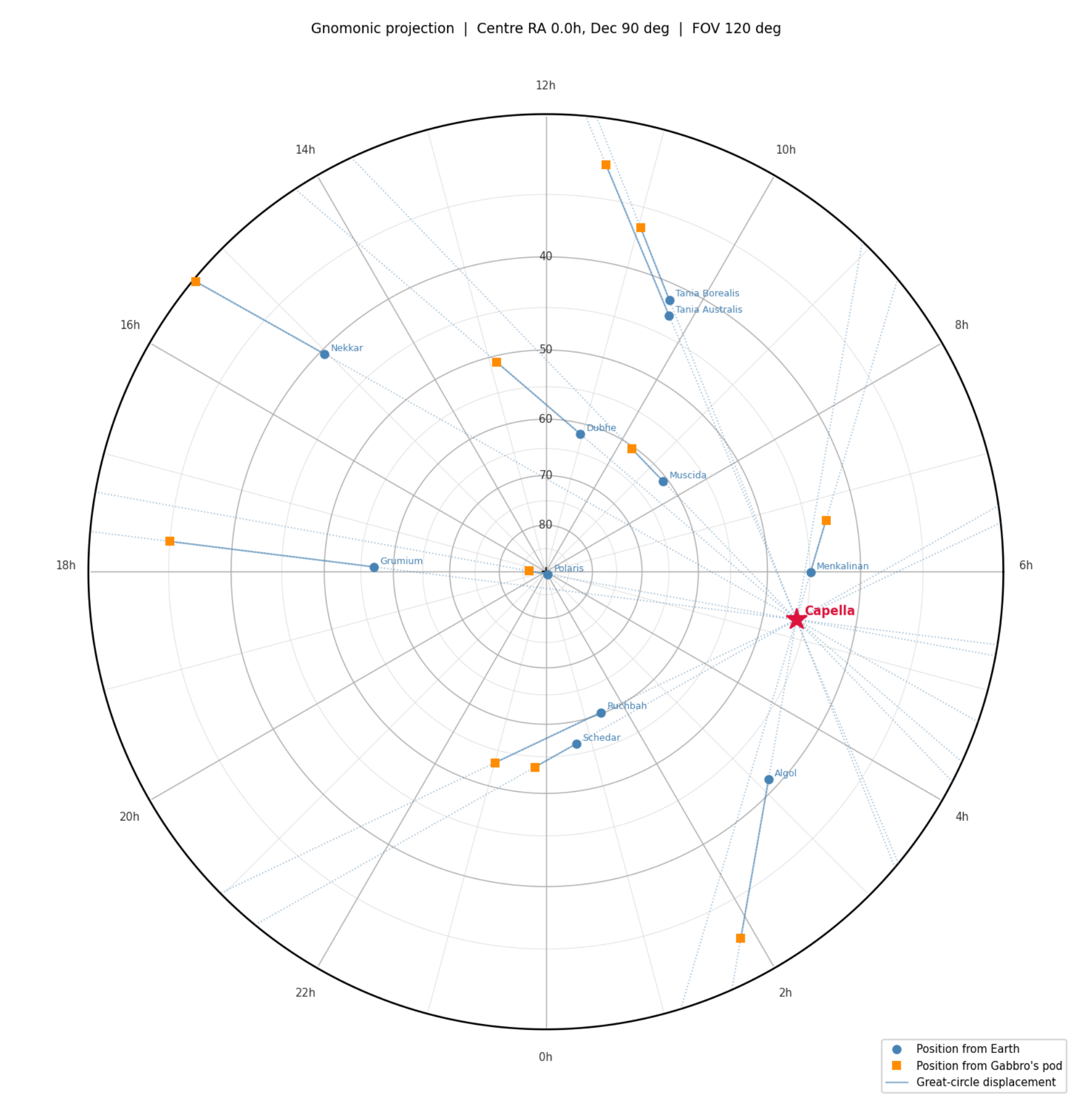
From the figure, we see that all the lines intersect around , whose location is also listed in the table.
Оригинал в Архива: practical.pdf · официални решения: practical_solutions.pdf