USAPhO 1997, Четвъртфинал — Задача 3
United States Physics Team — 1997 Creative Response Portion of Exam 1 · 20 т.
Указания
4 Questions, 60 Minutes
Show all work, as partial credit may be earned.
Communicate! The grader will not attempt to read your mind.
A hand-held calculator may be used. Its memory must be cleared of data and programs. Calculators may not be shared.
Possibly useful approximations:
Условие
A basketball of mass , radius , and moment of inertia about its center of mass (CM) is set spinning with angular velocity about a horizontal axis through its CM. The CM is originally at rest and located at the height above the floor. The basketball is dropped while spinning, and subsequently collides with the floor. Neglect air resistance.
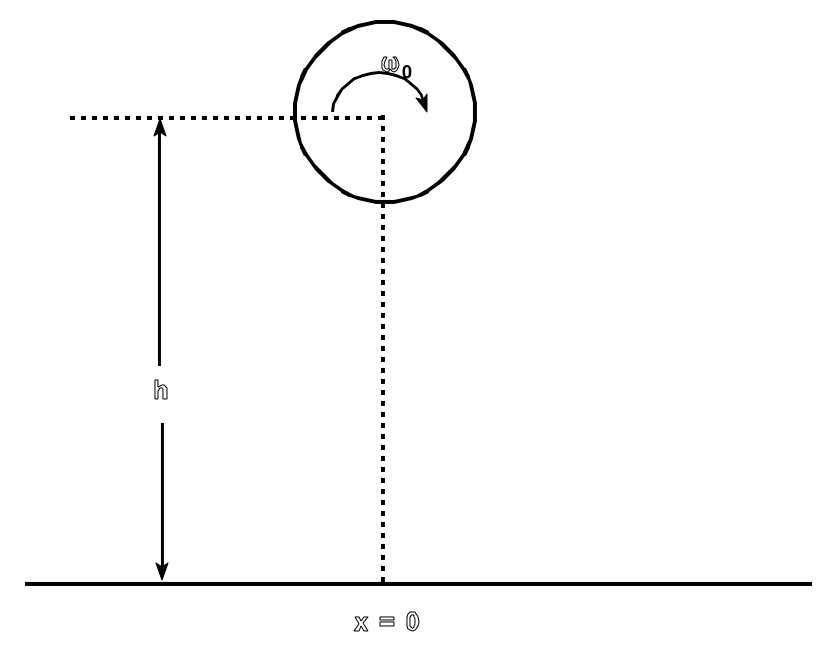
(a) Let be the basketball’s kinetic energy just before it collides with the floor. Write in terms of the given parameters and any needed constants. [3 т.]
(b) Immediately after the first bounce, the basketball is no longer spinning, and its kinetic energy is , where is a known factor. What are the horizontal and vertical components of the basketball's velocity immediately after the first bounce? [17 т.]
Отговори
- (a)
- (b)
Решение
(a, 3)
By conservation of energy,
so that
(3)
(b, 17)
Let = velocity of the ball immediately after the collision is over.
Given:
(2)
Since and are known, if either of or is known then so is the other. Let us find .
(Note that linear momentum is not conserved.)
In the collision, the angular frequency goes from to .
Let be the average force of friction that acts horizontally on the ball during the collision. Then from torque = ,
where is the collision time. (5)
Now apply in the -direction.
The -component of velocity changes from to during time , and the horizontal force is :
. (5)
From the torque equation we have , so combining the torque and force equations, (2)
and solving for ,
(2)
Now is known. Thus, so is .
(1)
Оригинал в Архива: Quarterfinal 1997.pdf · официални решения: Quarterfinal 1997 Solutions.pdf