Please show all work, and do not hesitate to use explanatory words in addition to equations. Partial credit will be awarded.
Begin each problem on a fresh sheet of paper. In the upper right-hand corner of each page, write your name, problem number, and the page number/total number of pages for this problem (e.g., "A2, 3/4" for "Problem A2, page 3 of four").
You may use a non-programmable calculator, but may not use any tables, books, notes, or collections of formulas.
Work Part A first. You have ninety minutes to complete all four problems.
After you have completed Part A, you may take a break.
Then work Part B. You have 90 minutes to complete both problems.
Possibly useful information:
Gravitational field on Earth’s surface: g=9.8N/kg
Gravitational constant: G=6.67×10⁻¹¹N-m2/kg2
Coulomb constant: k=1/4πϵo=8.99×109N-m2/C2
Speed of light in vacuum: c=3.00×10⁸m/s
Permeability of empty space: μo, where μoϵo=1/c2
Ideal gas constant R=8.31J/mol-K
Boltzmann’s constant: kB=1.38×10⁻²³J/K
Avagadro’s number: NA=6.02×10²³
1 electron volt = 1eV=1.60×10⁻¹⁹J
Planck’s constant: h=6.63×10⁻³⁴J-s=4.14×10⁻¹⁵eV-s
(1−x)−1=1+x+x2+x3+… for ∣x∣<1cosθ≈1−θ2/2 for θ≪1
(1+x)n=1+nx+(1/2!)n(n−1)x2+… for ∣x∣<1sinθ≈θ for θ≪1
Условие
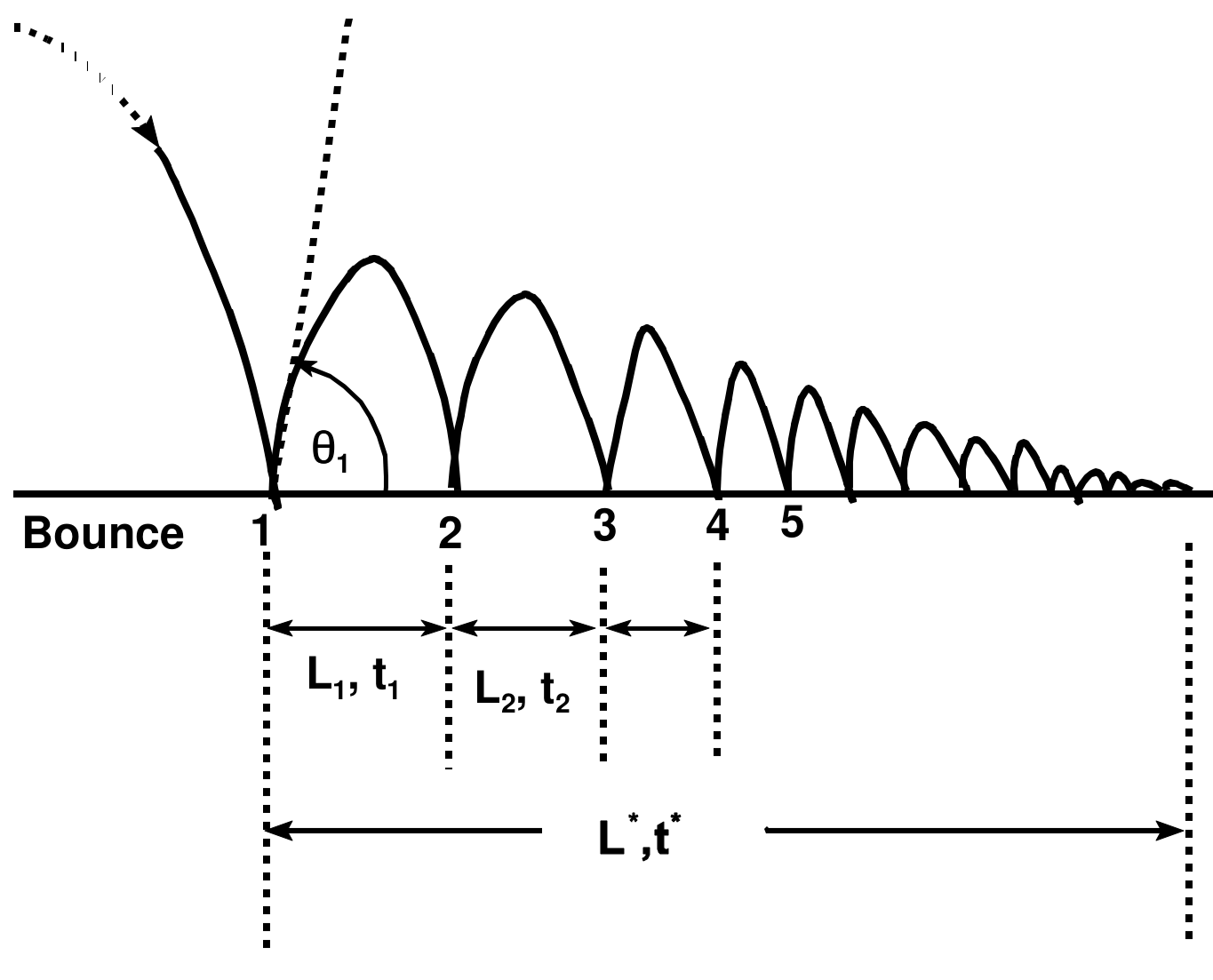
A ball is tossed onto the floor, where it makes a succession of bounces as illustrated in the figure below. Assume that because of internal elasticity and friction with the floor, at each bounce the magnitude of the vertical velocity component is reduced by a factor ϵy and the horizontal component is reduced by a factor ϵx. That is, if voy,n+1 denotes the y-component of the velocity as the ball emerges from the (n+1)st bounce, then voy,n+1=ϵyvoy,n, and similarly for the x-component. Note that ϵy and ϵx are <1. Thus after each bounce, the ball moves slower and hops a shorter distance than it did after the preceding bounce.
Let the ball's succession of bounces traverse a total horizontal distance L∗ which takes the time t∗. (As a practical matter, we measure L∗ and t∗ as the length and time where the bounces become imperceptible; mathematically, the number of bounces goes to infinity.) Find θ1, the angle the ball's velocity makes with the horizontal immediately after the first bounce, written in terms of L∗, t∗, ϵy, ϵx, and needed constants. Neglect air resistance.
Отговори
θ1=tan−1{2L∗(1−ϵyϵx)gt∗2(1−ϵy)2}
Решение
Each hop is a projectile motion, so that
x=voxt,(2)
and
t=2voy/g(from 0=y=voyt−21gt2).(2)
and upon eliminating t, the range L of a hop is
L=2voxvoy/g.(2)
Since voy,n+1=ϵyvoy,n and vox,n+1=ϵxvox,n, it follows that