USAPhO 1999, Полуфинал — Задача 5. B1
1999 Semi-Final Exam
Условие
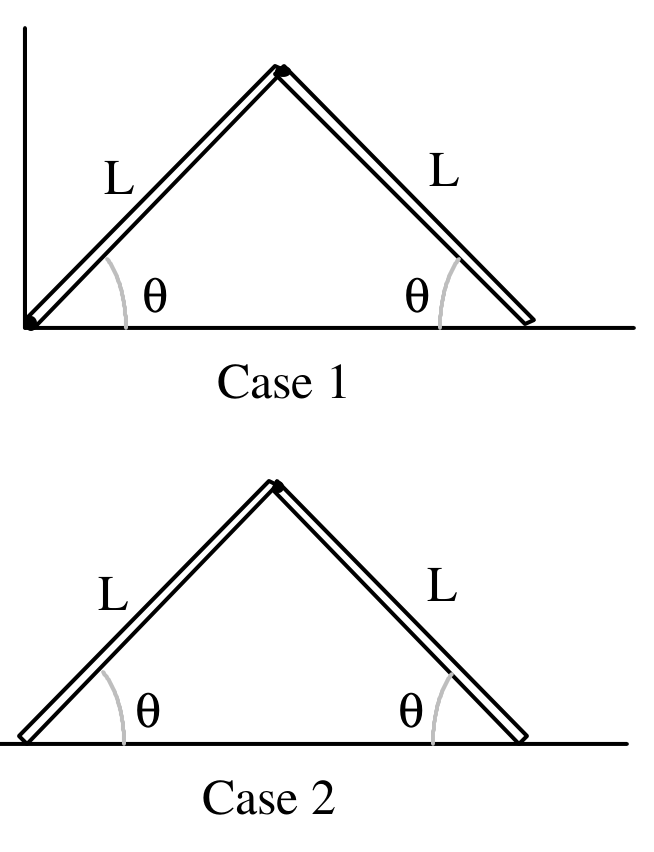
Consider two uniform rods each of mass and length , hinged together to form an upside-down “vee” shape whose angle can vary. The rods are released from rest when their angle θ with the horizontal is 45°. All hinges are frictionless and have negligible mass.
Case 1: The left end is also hinged at a fixed point at the bottom. The right-hand end of the configuration slides on the horizontal surface without friction.
Case 2: Both ends can slide frictionlessly along the surface.
(The sub-parts of this problem may be worked in any order.)
a. Find the upward force that the horizontal surface exerts on the right hand side of the Case 1 rods just after release, when θ = 45°. [10 т.]
b. Repeat Part (a) for Case 2. [10 т.]
c. Find the angular velocity of the Case 1 rods as a function of θ. [10 т.]
d. Repeat Part (c) for the configuration of Case 2. [10 т.]
(contributed by Leaf Turner)
Отговори
- a.
- b.
- c.
- d.
Решение
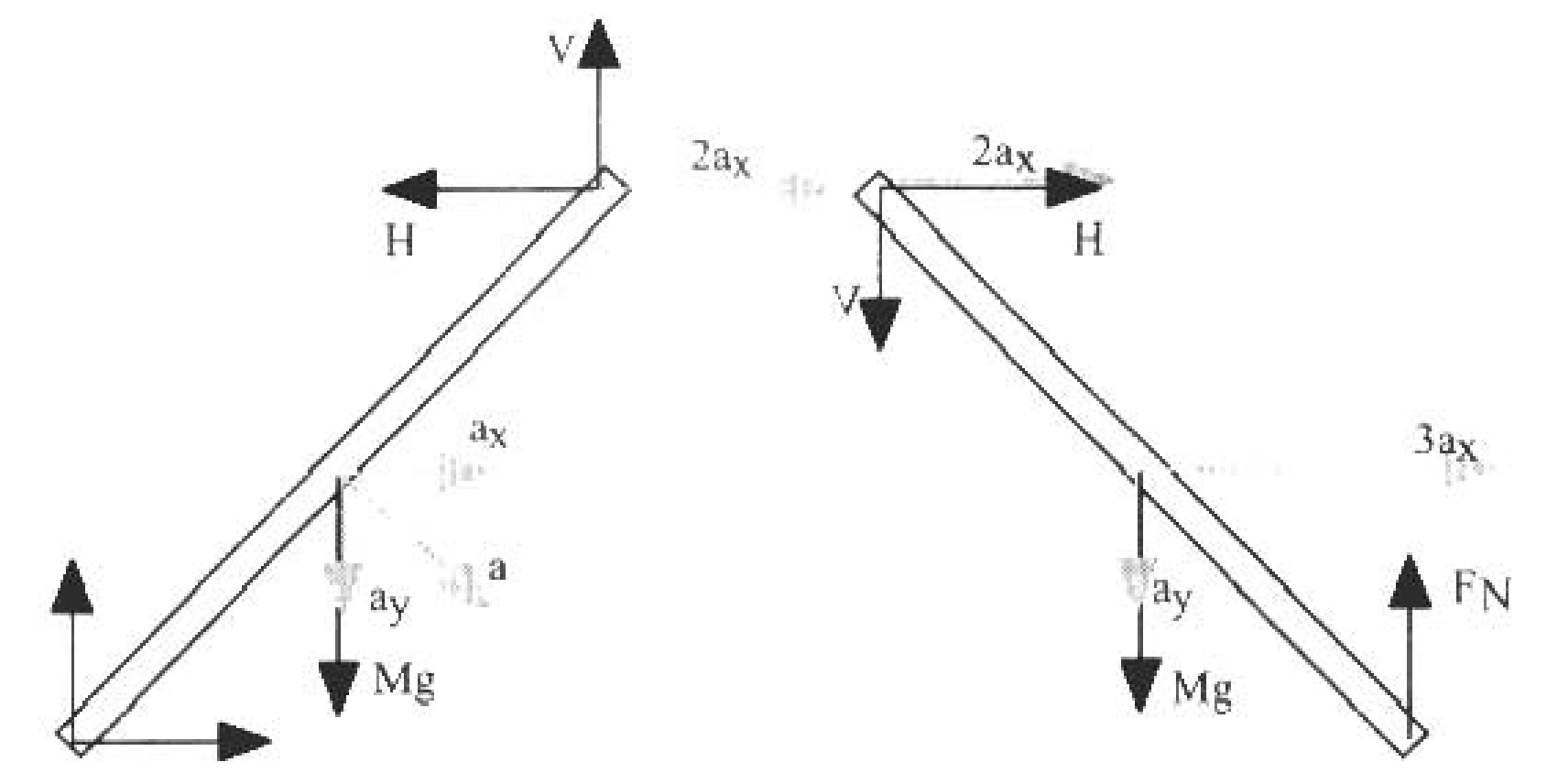
B1a. For θ = 45°, both and . The relation between the magnitude of the angular acceleration α and the magnitude of the linear acceleration a is with . Using Iα = Στ for the rotation about the hinge at the lower end of the left rod
Applying Newton's second law to the right rod
The net torque about the center of mass of the right rod is
Equations (a.1), (a.2), (a.3), and (a.4) form a set of four simultaneous equations in the four unknowns , , , and . Solving them simultaneously for , yields
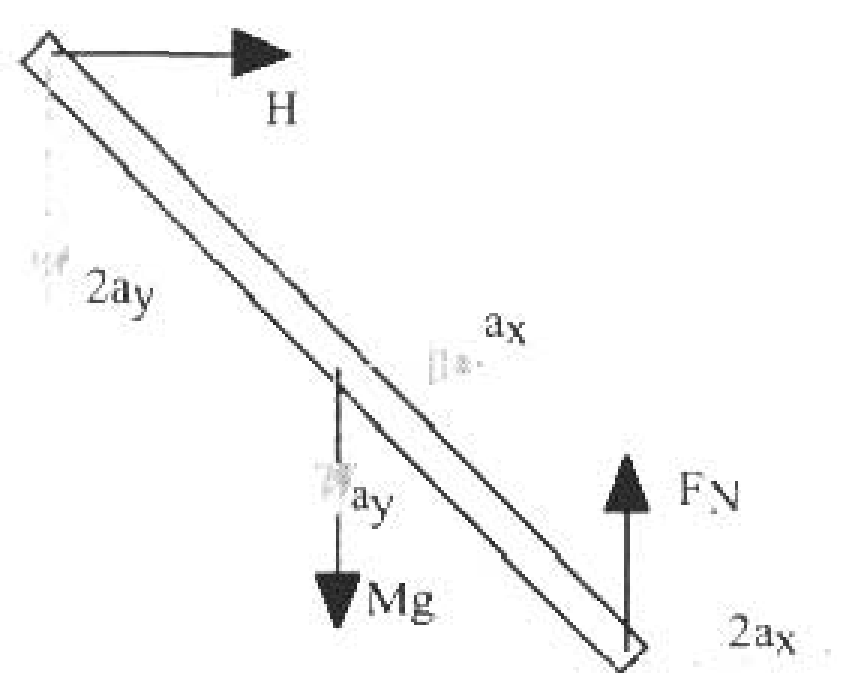
b. By symmetry V = 0. Applying Newton's second law to the right rod
The net torque about the center of mass
Solving these three equations in unknowns , and . Solving them simultaneously for , yields
c. Considering both rods as the system so we don't need to include the work done by the forces H and V,
Initially the center of mass of each rod is at a height where
Finally,
For each side
For the left rod , so
For the right rod , but , so
Substituting all of the above into (c.1):
Or
d. By symmetry, V = 0. The top of the “vee” doesn't move horizontally so H does no work. for both rods. Applying energy conservation to either rod
with
For either side
With , so
Combining equations (d.1), (d.2), and (d.3), yields
Or
Автори
The 1999 Semi-Final Examination questions were written by the coaches of the United States Physics Team. The coaches are: Academic Director, Dr. Mary Mogge – Professor of Physics at California State Polytechnic University, Pomona, CA; Senior Coach, Dr. Leaf Turner – Physicist in the Theoretical Division of Los Alamos National Laboratory, Los Alamos, NM; Dr. Warren Turner – Physics Teacher at St. Paul's School, Concord, NH. The coaches would also like to thank former academic director, Dr. Larry Kirkpatrick for his many helpful comments.
Оригинал в Архива: Semifinal 1999.pdf · официални решения: Semifinal 1999 Solutions.pdf