USAPhO 2000, Четвъртфинал — Задача 1
2000 Preliminary Exam — Open Response Questions · 25 т.
Указания
DO NOT OPEN THIS TEST UNTIL YOU ARE TOLD TO BEGIN
- Show all your work. Partial credit will be given.
- Start each question on a new sheet of paper. Be sure to put your name in the upper right-hand corner of each page, along with the question number and the page number/total pages for this problem. For example, Doe, Jamie / Q1 – 1/3
- A hand-held calculator may be used. Its memory must be cleared of data and programs. You may use only the basic functions found on a simple scientific calculator. Calculators may not be shared. You may not use any tables, books, or collections of formulas.
- Each of the four questions is worth 25 points. The questions are not necessarily of the same difficulty.
Possibly Useful Information
Gravitational field at the Earth’s surface
Newton’s gravitational constant
Binomial expansion for
Moment of Inertia about Center of Mass – Uniform Object (will not be provided on the second screening exam)
| Object | Moment of Inertia |
|---|---|
| Disk | |
| Sphere | |
| Rod |
Solutions
(Suggested partial-credit points in square brackets at the right margin)
Условие
A 4.00-meter long catapult, hinged at ground level, is used to fire large rocks as shown in the diagram at the right. A rock starts from rest with the catapult arm horizontal and is accelerated uniformly until it is released when the catapult arm makes an angle of () with respect to the horizontal and the rock has a tangential velocity of 10.0 m/s.
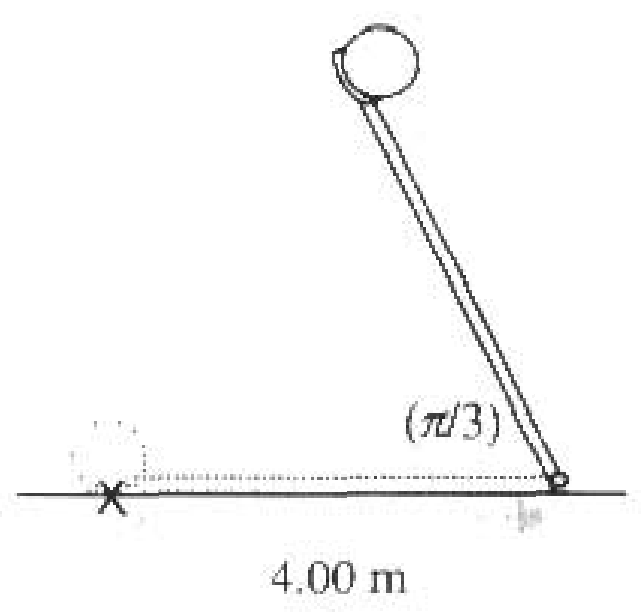
a. How far from the original starting position (marked with an X in the diagram) does the rock land? The ground is level. Assume air resistance is negligible. [17 т.]
b. What was the angular acceleration of the rock before its release? [8 т.]
Отговори
- a. 15 m
- b. 2.98 rad/s²
Решение
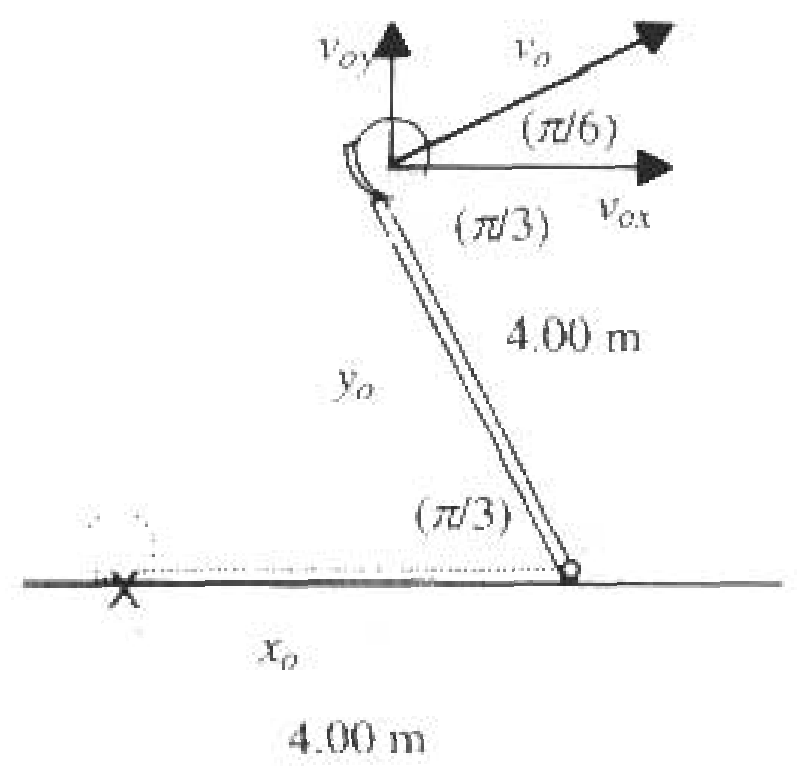
a. The tangential velocity of the rock as it leaves the catapult is the initial velocity of the projectile with [1+1]
First find the x- and y-components of the rock’s position and velocity as it leaves the catapult arm and becomes a projectile. See the accompanying figure. Taking the point marked X as the origin
[1]
[1]
[1]
[1]
The equations for the x and y position of the rock are:
[2]
[2]
with and for the vertical position of the rocks landing point. [1+1]
Substituting into the y-equation,
[1]
solving the quadratic equation for t and retaining only the positive t solution
[2]
[2]
b. The angular velocity of the rock at the point of release is:
[2]
Using [2]
with: , [1+1]
[2]
Теми и трудност
Трудност: неоценена.
Механика · Движение на хвърлено тяло · Въртене на твърдо тяло
Предпоставки: Разширена олимпиадна подготовка
Оригинал в Архива: Quarterfinal 2000.pdf · официални решения: Quarterfinal 2000 Solutions.pdf