USAPhO 2000, Четвъртфинал — Задача 3
2000 Preliminary Exam — Open Response Questions · 25 т.
Указания
DO NOT OPEN THIS TEST UNTIL YOU ARE TOLD TO BEGIN
- Show all your work. Partial credit will be given.
- Start each question on a new sheet of paper. Be sure to put your name in the upper right-hand corner of each page, along with the question number and the page number/total pages for this problem. For example, Doe, Jamie / Q1 – 1/3
- A hand-held calculator may be used. Its memory must be cleared of data and programs. You may use only the basic functions found on a simple scientific calculator. Calculators may not be shared. You may not use any tables, books, or collections of formulas.
- Each of the four questions is worth 25 points. The questions are not necessarily of the same difficulty.
Possibly Useful Information
Gravitational field at the Earth’s surface
Newton’s gravitational constant
Binomial expansion for
Moment of Inertia about Center of Mass – Uniform Object (will not be provided on the second screening exam)
| Object | Moment of Inertia |
|---|---|
| Disk | |
| Sphere | |
| Rod |
Solutions
(Suggested partial-credit points in square brackets at the right margin)
Условие
A uniform thin rod of length and mass is free to swing in a vertical plane about a frictionless horizontal axis through its upper end. Express your answers to Parts (a) and (b) in terms of , and . Assume air resistance is negligible.
a. The rod is released from rest in a horizontal position. Find its angular velocity at the moment it reaches a vertical orientation. [10 т.]
b. Suppose at this moment its bottom end collides totally inelastically with a stationary point mass (the same mass as that of the rod). The point mass sticks to the rod. What is the angular velocity just after the collision? [8 т.]
c. Numerically evaluate the maximum angle (with respect to the vertical) the rod attains after the collision. [7 т.]
Отговори
- a.
- b.
- c. 0.41 rad
Решение
a. The rotational inertia of a uniform thin rod about its end is found using the parallel axis theorem:
[2]
Using energy conservation: [2]
Let the lowest position of the rod’s center of mass ( below the axis) be the zero of gravitational potential energy. Then and [1+1]
For kinetic energy: , [1+1]
Substitution into the energy conservation equation yields
. [1]
Dividing by , and
or [1]
b. The collision is inelastic. Using angular momentum conservation
[2]
Only the rod is moving initially, so and [1+1]
The final rotational inertia is the sum of the rod’s and point mass’s
[2]
Therefore:
[2]
c. Once the collision is over, mechanical energy is again conserved. Equating total mechanical energy immediately after the collision and at the highest point
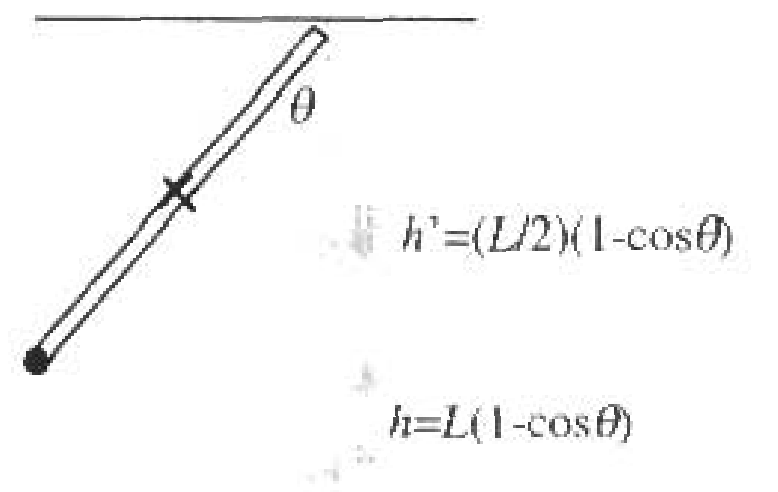
At the highest point [1]
[1]
Choosing the lowest point as the zero of gravitational potential energy, .
In swinging to an angle , the center of mass of the rod (marked by an x in the diagram) has moved up a distance , [1]
While the point mass at the end has moved up . [1]
Therefore the final potential energy is
[1]
Substituting into the energy conservation equation
[1]
[1]
Теми и трудност
Трудност: неоценена.
Механика · Въртене на твърдо тяло · Момент на импулса · Работа и енергия
Предпоставки: Разширена олимпиадна подготовка
Оригинал в Архива: Quarterfinal 2000.pdf · официални решения: Quarterfinal 2000 Solutions.pdf