USAPhO 2001, Четвъртфинал — Задача 4
2001 Preliminary Exam — Open Response Questions · 25 т.
Preliminary Exam
Open Response Questions
4 Questions, 60 minutes
Указания
DO NOT OPEN THIS TEST UNTIL YOU ARE TOLD TO BEGIN
- Show all your work. Partial credit will be given.
- Start each question on a new sheet of paper. Be sure to put your name in the upper right-hand corner of each page, along with the question number and the page number/total pages for this problem. For example, Doe, Jamie / Q1 – 1/3
- A hand-held calculator may be used. Its memory must be cleared of data and programs. You may use only the basic functions found on a simple scientific calculator. Calculators may not be shared. You may not use any tables, books, or collections of formulas.
- Each of the four questions is worth 25 points. The questions are not necessarily of the same difficulty.
Possibly Useful Information
Gravitational field at the Earth’s surface
Newton’s gravitational constant
Binomial expansion for
Moment of Inertia about Center of Mass – Uniform Object (will not be provided on the second screening exam)
| Object | Moment of Inertia |
|---|---|
| Disk | |
| Sphere | |
| Rod |
Solutions to Problems
Any correct solution should be awarded equivalent points. Suggested partial-credit points are presented in square brackets at the right margin. You may further break down the listed points into one point increments. If it is clear they have done an intermediate step, they should get credit for it even if they have not presented it. For example, in 1.a., if a student wrote down , they should get 6 points credit. Students should not be penalized in a subsequent part for using the wrong answer to a previous part. (No double jeopardy.)
Условие
[Two projectiles launched at 30 degrees and 45 degrees from sites separated by S]
A projectile is launched in a vertical plane from a fixed site. It has an initial velocity at an angle of above the horizontal. A second projectile is simultaneously launched at an angle of from a second site a distance directly behind the first one. See diagram above. They collide when the first projectile attains its maximum height. Ignore any effects of air resistance. Express your answers in terms of in terms of and .
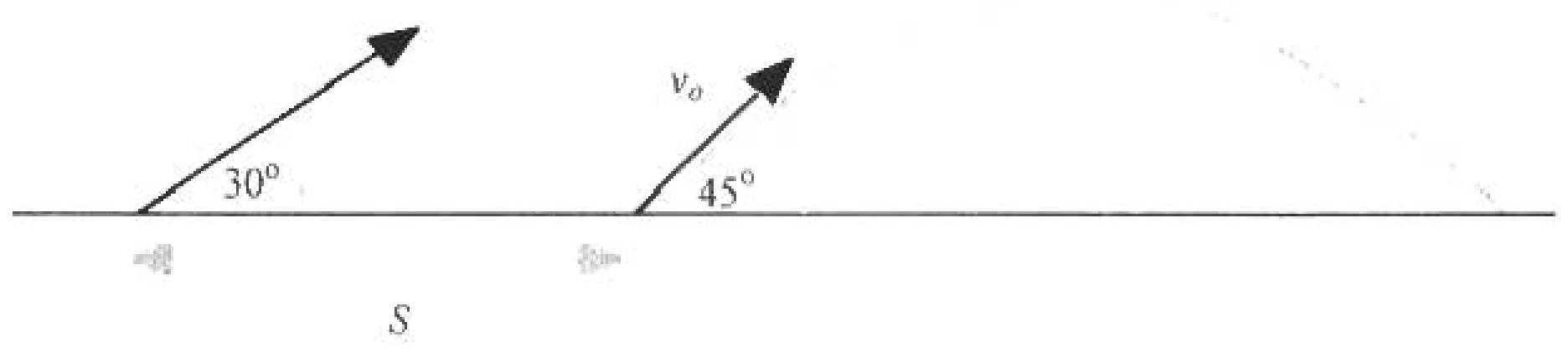
a Find the separation between the two launch sites. Hint: You will first need to find the initial velocity of the second projectile. [15 т.]
b What are the velocities of the two projectiles immediately before they collide? (You may leave your answers to this part and the following part in component form.) [5 т.]
c Assuming that the two projectile are identical small spheres of equal mass that collide elastically, what are the velocities of the two spheres immediately after they collide? [5 т.]
Отговори
- a
- b
- c
Решение
a. The two projectiles are simultaneously launched at from , and , . Let = the initial velocity of the second projectile. The components of the initial velocities are
[1]
[1] Projectile 1 reaches its highest point when . [1]
[1] or
[1] At this time, and . [2] With
[1] and . [1] Equating 's at time ,
[1]
[1] Thus . [1] Equating 's at time ,
[1] Substituting in for and 's,
[1]
[1]
b. The - and -components of the velocity are and . [1] Therefore
[2] and
[1]
[1] Both projectiles are at their highest points.
c. Since immediately before the collision the velocities are totally in the -direction, the collision is one-dimensional. [1] The collision is elastic so total momentum and total kinetic energy are unchanged. [2] Because the masses are equal, this requires the velocities to interchange.
[1]
[1]
Теми и трудност
Трудност: неоценена.
Механика · Движение на хвърлено тяло · Импулс и сблъсъци
Предпоставки: Разширена олимпиадна подготовка
Оригинал в Архива: Quarterfinal 2001.pdf · официални решения: Quarterfinal 2001 Solutions.pdf