USAPhO 2001, Полуфинал — B1
2001 Semi-Final Exam · 50 т.
Указания
DO NOT OPEN THIS TEST UNTIL YOU ARE TOLD TO BEGIN
- Work Part A first. You have 90 minutes to complete all four problems.
- After you have completed Part A, you may take a break.
- Then work Part B. You have 90 minutes to complete both problems.
- Show all your work. Partial credit will be given.
- Start each question on a new sheet of paper. Be sure to put your name in the upper right-hand corner of each page, along with the question number and the page number/total pages for this problem. For example,
Doe, Jamie
A1 – 1/3
- A hand-held calculator may be used. Its memory must be cleared of data and programs. It may not be used in graphing mode. Calculators may not be shared. You may not use any tables, books, or collections of formulas. You may use a ruler or straight edge.
- Questions with the same point value are not necessarily of the same difficulty.
- Good luck!
Possibly Useful Information
| Quantity | Value |
|---|---|
| Gravitational field at the Earth's surface | N/kg |
| Newton's gravitational constant | N·m/kg |
| Coulomb's constant | N·m/C |
| Biot-Savart constant | T·m/A |
| Speed of light in a vacuum | m/s |
| Boltzmann's constant | J/K |
| Avogadro's number | (mol) |
| Ideal gas constant | J/(mol·K) |
| Stefan-Boltzmann constant | J/(s·m·K) |
| Elementary charge | C |
| 1 electron volt | J |
| Planck's constant | |
| Electron mass | |
| Binomial expansion |
Copyright © 2001, American Association of Physics Teachers
Условие
A spherical capacitor consists of two concentric conducting spherical shells separated by air. The inner shell has radius and charge . The outer shell has radius and charge .
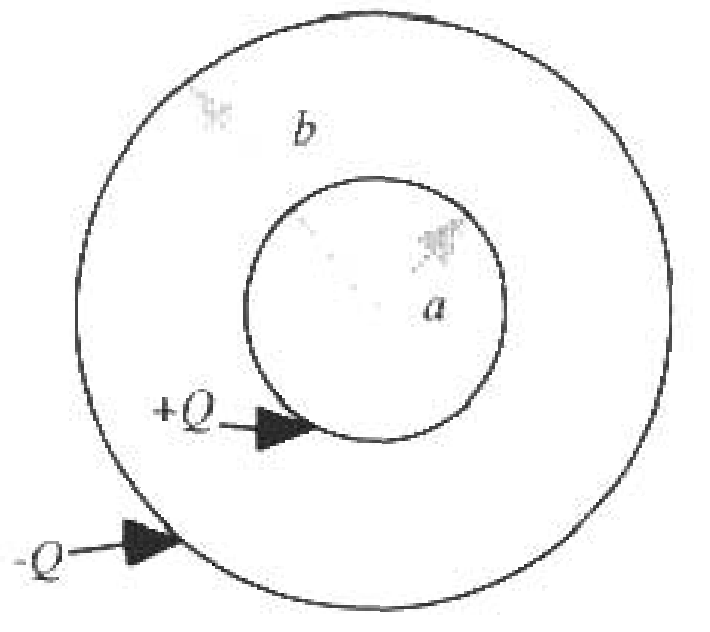
a.–d.
a. What is the field in the region between the shells ()? [5 т.]
b. What is the potential difference between the shells? [5 т.]
c. What is the capacitance of the system? [5 т.]
d. How much energy is stored in the field between the shells? [5 т.]
e.–h.
After the capacitor has acquired a charge , it is disconnected from the battery and a linear, homogeneous, isotropic insulating material with dielectric constant is inserted to completely fill the volume between the shells without discharging them. The effect of such a dielectric is to multiply the vacuum permittivity by .
Wherever possible, express your answers to the following parts in terms of your answers to Parts (a), (b), (c), and (d).
e. Find the field, potential difference, capacitance, and stored energy in this case. [10 т.]
f. What is the total surface charge induced on the inner surface () of the dielectric? [5 т.]
g. Find the field, potential difference, capacitance, stored energy, charge on the capacitor, and total surface charge induced on the inner surface () of the dielectric if the capacitor is left connected to the battery as the dielectric material is inserted. [10 т.]
h. Find the capacitance if, instead of a single dielectric, two different linear, homogeneous, isotropic dielectrics are inserted between the shells. Dielectric 1 fills the top half and has dielectric constant . Dielectric 2 fills the bottom half and has dielectric constant .
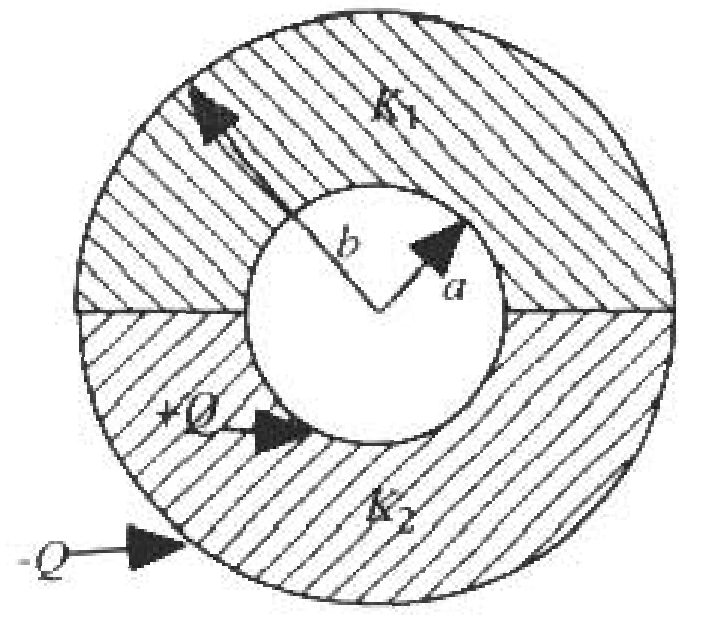
[5 т.]
Решение
a. (5 т.)
Using Gauss's Law the field is where is Coulomb's constant and is the total charge enclosed by a Gaussian sphere of radius . Since , . The field direction is radially outward and
b. (5 т.)
The total potential anywhere in the region is
where the first term is due to the outer sphere and the second term to the inner sphere. finding the difference between at and at ,
c. (5 т.)
The capacitance is defined .
Inserting equation (B1-1)
d. (5 т.)
The work done in charging the capacitor to charge and voltage is . This is equal to the stored energy
e. (10 т.)
Since the capacitor has been disconnected from the battery without discharging the charge on the shells is still . Using the subscript K to denote quantities with the dielectric inserted, .
In , , and
Therefore
For the stored energy
f. (5 т.)
The magnitude of the field at is . Using Gauss's Law, the total charge enclosed by a Gaussian sphere of radius is . This charge includes the charge on the conducting shell and the charge on the inner surface of the dielectric .
Solving for
g. (10 т.)
Since the capacitor is left connected to the battery .
Since is unchanged so is . .
The capacitance is independent of whether or not the battery was connected.
Additional charge flows onto the capacitor
The energy stored is
Applying Gauss's Law to find the total charge enclosed by a Gaussian sphere with radius ,
Solving for
h. (5 т.)
The two halves can be considered capacitors in parallel. Each has half the capacitance it would have if it were whole. Therefore
Оригинал в Архива: Semifinal 2001.pdf · официални решения: Semifinal 2001 Solutions.pdf